
零跑汽车

Search documents
北水动向|北水成交净买入13.41亿 科技股分化明显 小米集团-W获加仓超30亿
Zhi Tong Cai Jing· 2025-12-05 11:12
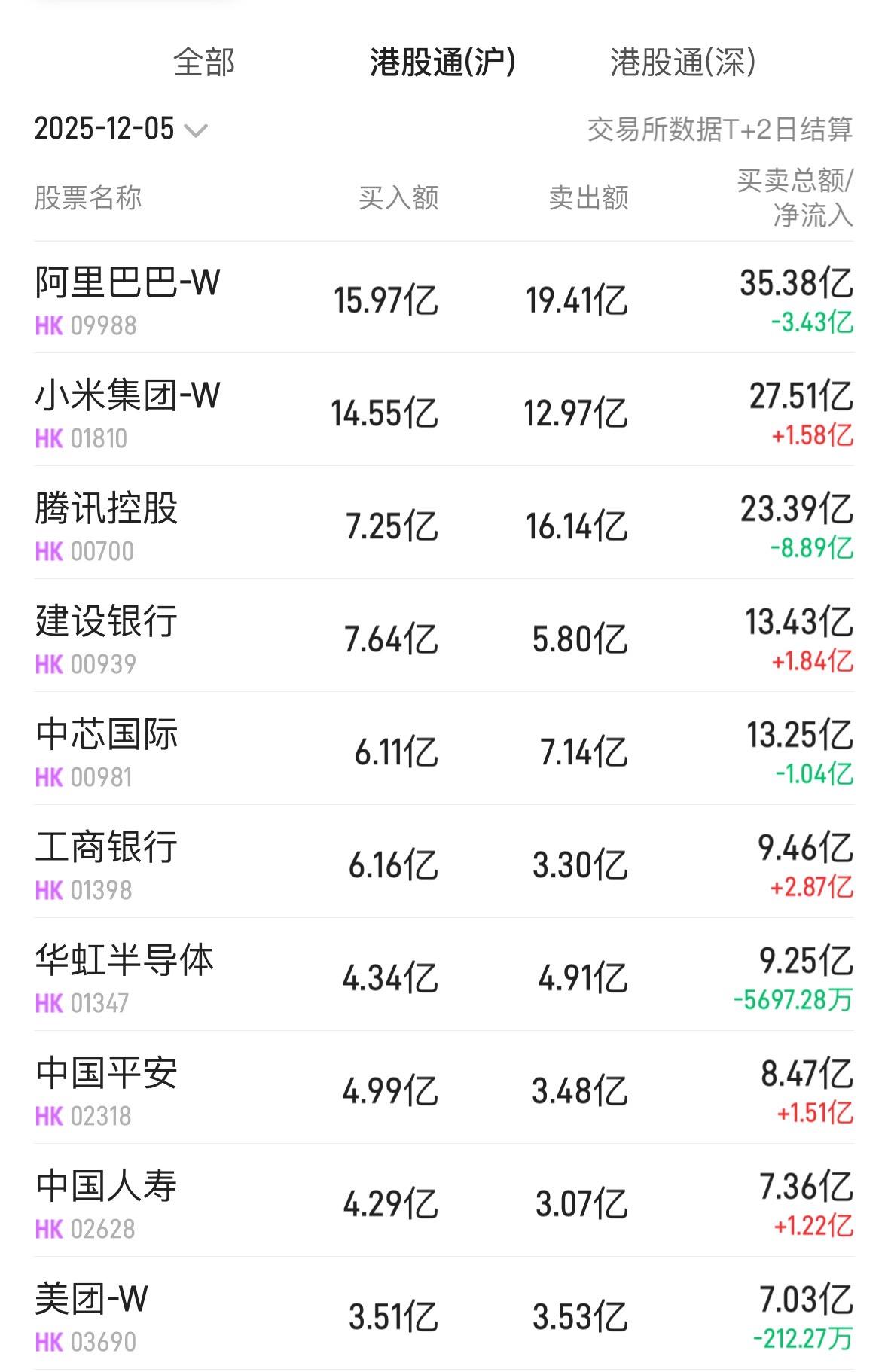
Summary of Key Points Core Viewpoint - The Hong Kong stock market experienced significant net buying from Northbound funds, with a total net inflow of 1.48 billion HKD on December 5, 2025, indicating a positive sentiment towards certain stocks while others faced net selling pressure [1]. Group 1: Northbound Fund Activity - Northbound funds recorded a net buying of 1.48 billion HKD, with the Shanghai Stock Connect showing a net selling of 394 million HKD and the Shenzhen Stock Connect showing a net buying of 1.735 billion HKD [1]. - The stocks with the highest net buying included Xiaomi Group-W (01810), Meituan-W (03690), and Li Auto (09863) [1]. - The stocks with the highest net selling included Alibaba-W (09988), Tencent Holdings (00700), and ASMPT (00522) [1]. Group 2: Individual Stock Performance - Xiaomi Group-W (01810) received a net buying of 3.013 billion HKD, supported by a bullish report from Goldman Sachs predicting future AI developments to enhance its ecosystem [5]. - Li Auto (09863) saw a net buying of 392 million HKD, with a record delivery of 70,327 vehicles in November, achieving its annual sales target ahead of schedule [5]. - BYD Company (01211) had a net buying of 339 million HKD, reporting a record monthly sales figure of 480,186 vehicles in November, with a year-to-date sales increase of 11.3% [5]. Group 3: Insurance and Banking Sector - China Ping An (02318) received a net buying of 151 million HKD, with Morgan Stanley raising its target price by 27% to 89 HKD, citing growth opportunities in wealth management and healthcare [6]. - Industrial and Commercial Bank of China (01398) had a net buying of 287 million HKD, while China Construction Bank (00939) saw a net buying of 184 million HKD, indicating continued interest from institutional investors [7]. - The banking sector is viewed positively due to ongoing reforms and improved profitability, with expectations of continued dividend payouts [7]. Group 4: Technology Sector Trends - Semiconductor stocks faced significant selling pressure, with Huahong Semiconductor (01347) experiencing a net selling of 56.97 million HKD, and SMIC (00981) facing a net selling of 119 million HKD [7]. - Alibaba-W (09988) faced a substantial net selling of 1.776 billion HKD, while Tencent Holdings (00700) saw a net selling of 1.445 billion HKD, reflecting a bearish sentiment towards major tech stocks [7].

智通港股通活跃成交|12月5日





智通财经网· 2025-12-05 11:02
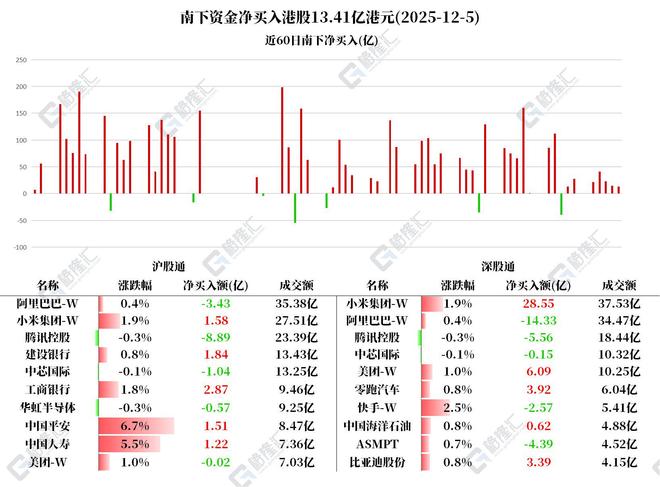
| 公司名称 | 成交金额 | 净买入额 | | --- | --- | --- | | 小米集团-W(01810) | 37.53 亿元 | +28.55 亿元 | | 阿里巴巴-W(09988) | 34.47 亿元 | -14.33 亿元 | | 腾讯控股(00700) | 18.44 亿元 | -5.56 亿元 | | 中芯国际(00981) | 10.32 亿元 | -1549.07 万元 | | 美团-W(03690) | 10.25 亿元 | +6.09 亿元 | | 零跑汽车(09863) | 6.04 亿元 | +3.92 亿元 | | 快手-W(01024) | 5.41 亿元 | -2.57 亿元 | | 中国海洋石油(00883) | 4.88 亿元 | +6206.91 万元 | | ASMPT(00522) | 4.52 亿元 | -4.39 亿元 | | 比亚迪股份(01211) | 4.15 亿元 | +3.39 亿元 | | 公司名称 | 成交金额 | 净买入额 | | --- | --- | --- | | 阿里巴巴-W(09988) | 35.38 亿元 | -3.43 ...
图解丨南下资金大幅加仓小米超30亿港元,减持阿里
Xin Lang Cai Jing· 2025-12-05 09:57
Group 1 - Southbound funds recorded a net purchase of HKD 1.341 billion in Hong Kong stocks today [1] - Notable net purchases included Xiaomi Group-W at HKD 3.013 billion, Tracker Fund at HKD 2.606 billion, and Meituan-W at HKD 607 million [1] - Continuous net buying trends were observed for Meituan over the past 7 days totaling HKD 2.89598 billion and for Xiaomi over the past 6 days totaling HKD 5.0656 billion [1] Group 2 - Significant net selling was noted for Alibaba-W at HKD 1.776 billion and Tencent Holdings at HKD 1.445 billion [1] - Semiconductor company ASMPT experienced a net sell of HKD 439 million, while Kuaishou-W and SMIC also saw net selling [1] - The trend of net selling for SMIC has persisted for 12 consecutive days, amounting to HKD 3.56848 billion [1]
去伪存真,聚焦景气赛道核心资产
HTSC· 2025-12-05 09:05
Group 1: Core Insights - The report emphasizes the importance of focusing on high-end and export opportunities in the automotive sector, particularly for domestic brands like BYD, Geely, Great Wall, and Leap Motor [1][2] - The automotive industry is expected to see a stable growth in 2026, with wholesale and retail sales projected to increase by 3% and decrease by 1% respectively, indicating a flat overall market [2][18] - The report highlights the significant growth potential in the European electric vehicle market, forecasting a 35% year-on-year increase in sales to reach 3.65 million units in 2026, driven by carbon emission regulations and high-quality new vehicle supply [2][18] Group 2: Passenger Vehicles - Domestic brands have increased their market share from 60% to 66% in the first ten months of 2025, with mid-to-low-end segments experiencing the fastest growth [26][28] - The report identifies key models in the five/six-seat SUV market, including Xiaomi's YU9, NIO's ES7, and others, as significant contributors to the high-end market push [2][18] - The report anticipates intensified competition among domestic car manufacturers, particularly in the high-end segment, as they aim to capture a larger share of the market [2][18] Group 3: Auto Parts - The auto parts sector is focusing on globalization and new technological avenues, with an emphasis on opportunities in Europe and advancements in AI and robotics [3][4] - The report suggests that the auto parts industry will benefit from structural opportunities as traditional international giants undergo transformation [3][4] - Key companies recommended for investment in the auto parts sector include Minth Group, Xingyu, and others, which are expected to leverage their technological advantages for growth [3][4] Group 4: Intelligent Driving - The report predicts that by 2026, high-speed NOA (Navigation on Autopilot) will become a standard feature priced between 100,000 to 150,000 yuan, with penetration rates expected to reach 43% for high-speed NOA and 24% for urban NOA [4][5] - The acceleration of L4 commercial deployment is anticipated, with many scenarios expected to complete technical validation by 2025, leading to a rapid commercialization phase in 2026 [4][5] - Recommended companies in the intelligent driving space include Horizon Robotics, Black Sesame, and others, which are positioned to benefit from the growing demand for AI applications in vehicles [4][5] Group 5: Robotics - The robotics sector is expected to experience significant growth in 2026, driven by advancements in technology and production capabilities, particularly with Tesla's V3 technology [5][6] - The report highlights the importance of domestic companies in the robotics field, which are likely to see valuation increases as they innovate and expand their production capabilities [5][6] - Key players in the robotics sector recommended for investment include Xpeng and others, which are expected to benefit from the evolving landscape of robotics technology [5][6]




9家主流车企年度销量目标完成率超八成 零跑、小鹏、小米提前达成KPI
Xin Lang Cai Jing· 2025-12-05 08:40
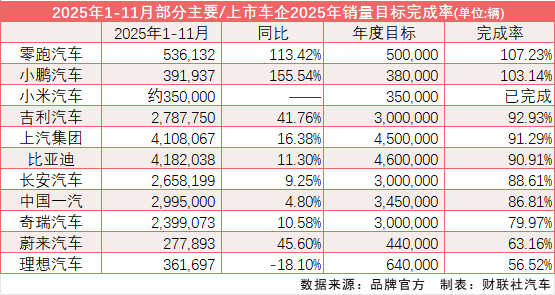
Core Viewpoint - The Chinese automotive market is experiencing a year-end "sprint" driven by the approaching policy window, pressure to meet annual sales targets, and a surge in consumer demand [1] Group 1: Sales Performance - As of November, major domestic car manufacturers have varying completion rates for their 2025 sales targets, with Leap Motor, Xpeng, and Xiaomi having already met their goals, while NIO and Li Auto are below 70% completion [1] - Leap Motor achieved 536,132 vehicle deliveries from January to November, a year-on-year increase of 113.42%, exceeding its annual target of 500,000 vehicles by 7.23% [2] - Xpeng delivered 391,937 vehicles in the same period, marking a 155.54% year-on-year growth and successfully meeting its annual target of 380,000 vehicles [3] - Xiaomi's total sales reached approximately 350,000 vehicles, also achieving its annual target [3] - Geely, SAIC Group, and BYD have completion rates of 92.93%, 91.29%, and 90.91% respectively, with Geely's sales reaching 2.787 million vehicles, a 41.76% increase year-on-year [2][4] - NIO and Li Auto reported significantly lower completion rates, with NIO at 63.16% and Li Auto at 56.52% [2][6] Group 2: Market Trends and Strategies - Leap Motor aims to reach a sales target of 1 million vehicles in 2026, supported by the launch of new models like the A10 and Lafa5 [3] - Xpeng's overseas market performance has been a highlight, with 39,773 vehicles delivered internationally, a 95% increase year-on-year [3] - Geely's growth is driven by its strong performance in the new energy sector, with 153.4 million new energy vehicles sold, a 97% increase [4] - SAIC Group's sales have shown resilience, with a total of 4.108 million vehicles sold, a 16.4% increase year-on-year [5] - BYD's sales reached 4.182 million vehicles, but it has faced a decline in monthly performance since September, attributed to increased competition and market saturation [5] Group 3: Challenges and Outlook - NIO's performance has been inconsistent, with a total of 277,893 vehicles delivered, and it faces a challenging target of 43,000 deliveries in December to meet its quarterly guidance [6] - Li Auto has experienced a decline in deliveries for six consecutive months, with a focus on resolving supply issues for its i6 model [6] - The overall passenger car market in China saw a wholesale increase of 11% year-on-year, but consumer sentiment is cautious due to tightening policies on trade-in and scrappage subsidies [6]




汽车行业双周报(2025、11、21-2025、12、4):今年全年我国汽车销量预计将超3400万辆-20251205
Dongguan Securities· 2025-12-05 08:37
Investment Rating - The report maintains an "Overweight" rating for the automotive industry, expecting the industry index to outperform the market index by over 10% in the next six months [38]. Core Insights - The total automotive sales in China for the year are projected to exceed 34 million units, with new energy vehicle (NEV) sales expected to reach 16 million units and exports anticipated to surpass 6.8 million units [26][33]. - The tightening of purchase tax incentives for NEVs starting in 2026 is expected to create a rush in vehicle purchases by the end of 2025, leading to a potential "micro-growth" phase in the domestic market in 2026 [33]. - Export markets are seen as a new growth driver for major automotive companies, transitioning from merely exporting products to establishing local production capabilities abroad [33]. Industry Performance and Valuation - As of December 4, 2025, the Shenyin Wanguo automotive sector index has increased by 1.43% over the past two weeks, outperforming the CSI 300 index by 1.83 percentage points, ranking 7th among 31 industries [10][12]. - Year-to-date, the automotive sector has risen by 17.68%, also outperforming the CSI 300 index by 2.14 percentage points [10][12]. - The current price-to-earnings (P/E) ratio for the automotive sector is 25.38 times, with sub-sectors showing varying valuations: automotive services at 30.71 times, automotive parts at 27.11 times, and passenger vehicles at 23.69 times [16]. Industry Data Tracking - Raw material prices have shown mixed trends: steel prices increased by 0.20%, aluminum by 1.38%, and copper by 2.21%, while lithium carbonate prices decreased by 0.37% and glass prices fell by 0.26% [18][19]. Industry News - In November 2025, retail sales of passenger vehicles in China decreased by 7% year-on-year, while NEV retail sales grew by 20% [21][22]. - The Shanghai government announced that all new or updated public charging facilities must comply with mandatory certification standards starting August 1, 2026 [22]. - The China Automobile Dealers Association reported a rise in the inventory alert index to 55.6%, indicating a decline in the automotive circulation industry's prosperity [23]. Company News - Li Auto launched its first AI smart glasses, priced from 1,699 yuan after subsidies [27]. - Changan Automobile reported November sales of 283,000 units, a 2.3% year-on-year increase, with NEV sales up 23% [28]. - Xiaomi's automotive division has delivered over 500,000 vehicles since its launch [29]. Investment Recommendations - The report suggests focusing on companies that are actively expanding into overseas markets, such as BYD and Seres, as well as those in the intelligent driving supply chain like Fuyao Glass and Joyson Electronics [33][34].



贾可:中国汽车淘汰赛至少还有十年
汽车商业评论· 2025-12-05 07:31
Core Viewpoint - The Chinese automotive industry has not yet reached a stable state, and it may take another 10 years for the market to stabilize, with approximately 10 major automotive giants expected to remain in the future [3][35]. Group 1: Industry Overview - The WNATCES 2025 event focused on the theme of "long-term vs. short-term," featuring various forums and exhibitions aimed at addressing current industry pain points and promoting sustainable development in the new automotive ecosystem [5][7]. - Historical context shows that the automotive industry has undergone significant changes over the past century, with periods of fragmentation followed by consolidation, particularly in Europe and the U.S. [12][15][17]. Group 2: Market Dynamics - Predictions from industry leaders suggest a competitive landscape where only a few manufacturers will survive in the coming years, with estimates ranging from 3 to 10 major players by 2030 [10][19]. - The transition from traditional fuel vehicles to electric and intelligent vehicles has created new opportunities and challenges, with core components like the "three electrics" (battery, motor, and electronic control) becoming critical for competitiveness [20][22]. Group 3: Competitive Landscape - The current automotive market is categorized into six major camps, including traditional private enterprises, state-owned groups, new car-making forces, and joint ventures, each with distinct strategies and market positions [26][29]. - The rise of new entrants in the automotive sector, particularly those leveraging technology and innovative business models, indicates a dynamic and evolving competitive environment [31][38]. Group 4: Future Outlook - The industry is expected to continue evolving, with a focus on both cost leadership and superior user experience as key competitive strategies [24][30]. - The integration of AI and other advanced technologies into the automotive sector presents significant potential for transformation and growth, suggesting that the industry is still in a phase of exploration and development [33][43].

政策暖风频吹,聚焦港股消费ETF(513230)布局机遇
Sou Hu Cai Jing· 2025-12-05 03:36
Group 1 - The Hong Kong stock consumer sector opened lower and experienced narrow fluctuations, with the Hong Kong consumer ETF (513230) slightly down by nearly 0.5% [1] - Among the holdings, companies like Chuangke Industrial, Li Auto, XPeng Motors-W, and Xiaomi Group-W saw notable gains, while Shenzhou International, Bosideng, Tongcheng Travel, and Galaxy Entertainment faced significant declines [1] - The Ministry of Finance and the Ministry of Commerce announced a list of 50 cities for pilot programs in new consumption formats, with a maximum financial subsidy of 400 million yuan per city to enhance the consumption market [1] Group 2 - Huatai Securities believes that the real estate cycle, particularly changes in real estate prices, will be crucial in determining the pace and strength of consumer recovery in 2026, with expectations of structural stabilization in housing prices [2] - The potential for supply and demand policy stimuli is expected to boost consumer willingness, while essential consumer companies have significant room for structural upgrades and overseas expansion [2] - The Hong Kong consumer ETF (513230) tracks the CSI Hong Kong Stock Connect Consumer Theme Index, encompassing leading companies in various consumer sectors, including Pop Mart, Laopuyin Gold, and Miniso, as well as internet e-commerce giants like Tencent, Kuaishou, Alibaba, and Xiaomi [2]
科技股多重利好!小米大模型应用超预期,蔚小理Q3业绩亮眼
Xin Lang Cai Jing· 2025-12-05 03:23
Group 1 - Xiaomi Group's partner Lu Weibing stated that significant investments have been made in AI, particularly in AI large models and applications, achieving results that exceeded expectations [1][2] - Following Li Auto and Leap Motor, Xiaomi's new energy vehicle (NEV) business has also achieved profitability for the first time, while XPeng Motors and NIO have set their first profitability targets for Q4 2025 [1][2] - According to the Hang Seng Index Company, the quarterly adjustment of the Hang Seng Tech Index will take effect on December 8, covering leading domestic NEV manufacturers such as NIO, Li Auto, XPeng, Leap Motor, Xiaomi, and BYD [1][2] Group 2 - The Hang Seng Tech Index ETF (513180) ranks first in size among ETFs tracking the Hang Seng Tech Index in mainland China, covering not only new energy vehicle manufacturers but also the upstream and downstream of the AI industry chain, focusing on core AI assets in China [1][2]
汽车企业,压力来了!年终行情悬而未决,淘汰赛鸣笛!|人民智行
Zheng Quan Shi Bao Wang· 2025-12-05 03:01
Core Viewpoint - The Chinese automotive market faces significant uncertainty as it transitions into the "post-subsidy era," with many companies expressing concerns about market conditions and competition intensifying [1][2][5]. Group 1: Market Conditions - By the end of 2025, the anticipated "tail effect" in the automotive market remains uncertain, with many companies unprepared for year-end sales targets [2][5]. - The withdrawal of local replacement subsidies and the adjustment of the new energy vehicle purchase tax from full exemption to a 50% reduction are expected to increase purchase costs for consumers [2][5]. - The overall automotive sales in China from January to October reached 27.687 million units, reflecting a year-on-year growth of 12.4% [5]. Group 2: Competitive Landscape - Companies are increasingly adopting "bottom-line" subsidy strategies to boost year-end sales, which may raise sales costs and challenge smaller brands with limited profit margins [3][4]. - The competition is expected to become more transparent and brutal, focusing on product strength, cost control, and user experience as the market moves away from policy-driven growth [5][9]. - The market is predicted to see a significant divide, with leading companies leveraging scale advantages and brand influence, while smaller brands may struggle with cash flow and product iteration [8][10]. Group 3: Future Outlook - The automotive industry is entering a phase where only a few strong brands are likely to survive, with predictions suggesting that in the future, only five dominant brands will remain in the market [10][11]. - The shift away from policy reliance is expected to allow companies to focus on technological innovation and service upgrades, fostering healthier industry development [10][11].