软银集团

Search documents
Bank of America resets Nvidia stock forecast before earnings
Yahoo Finance· 2025-11-16 18:07
Core Viewpoint - Nvidia's stock has experienced slight gains but remains under pressure due to growing skepticism about artificial intelligence and upcoming Q3 earnings release on November 19 [1] Group 1: Market Sentiment and Stock Performance - Nvidia's stock closed at $190.17, up 1.77%, which is approximately 8% lower than its peak of $207.04 on October 29 [1] - Hedge fund manager Michael Burry is shorting Nvidia, contributing to negative sentiment [2] - SoftBank Group sold all its Nvidia shares (32.1 million) worth $5.8 billion to invest in OpenAI, further impacting market perception [2] Group 2: Analyst Insights and Forecasts - Bank of America has raised its long-term sales estimates for Nvidia for fiscal years 2026, 2027, and 2028, indicating confidence in the company's future despite current skepticism [4] - Analysts have increased non-GAAP EPS estimates for Nvidia for fiscal years 2026, 2027, and 2028 by 3%, 12%, and 14% respectively, reflecting a positive outlook ahead of Q3 earnings [6] - The sales estimates for Nvidia have been revised upwards from $204.14 billion to $208.48 billion for 2026, from $271.62 billion to $300.19 billion for 2027, and from $343.59 billion to $383.95 billion for 2028 [6] Group 3: Competitive Position and Market Dynamics - Nvidia is recognized as the only merchant chip supplier with proven full-stack execution in large AI clusters, which is expected to enhance its competitive position [5] - Concerns regarding cloud capital expenditures are noted to be seasonal, with expectations of resolution in the new year as cloud customers provide their capital expenditure outlooks [5]

软银弃英伟达押OpenAI:套现58亿加码算力工程,全球AI布局生变
Sou Hu Cai Jing· 2025-11-16 15:52
Core Viewpoint - SoftBank's decision to sell all its shares in NVIDIA, amounting to $5.8 billion, has raised questions about its investment strategy, especially given the current AI boom and NVIDIA's record-high stock price [1][3][5] Group 1: Investment Decision - SoftBank completely liquidated its 32.1 million shares of NVIDIA in October, cashing out $5.8 billion, which was then redirected towards investments in OpenAI and a super data center project [1][3] - The management clarified that the sale was not due to a lack of confidence in NVIDIA's fundamentals but rather a necessity for capital allocation to support large-scale projects [3][5] Group 2: Market Dynamics - The AI industry is experiencing a dichotomy, with hardware manufacturers like NVIDIA thriving while platforms like OpenAI are rapidly increasing in valuation [5][7] - The hardware market, despite its current profitability, is expected to reach a ceiling, while platforms that control AI models can create a more sustainable ecosystem [7][9] Group 3: Strategic Shift - The sale of NVIDIA shares is viewed as a strategic repositioning from hardware investments to platform investments, reflecting a shift in SoftBank's long-term vision [7][13] - SoftBank's previous experience with NVIDIA, where it sold shares too early, has influenced its current approach, emphasizing the importance of owning core assets in the AI space [9][13] Group 4: Future Outlook - SoftBank aims to become a partner in the general intelligence era rather than just a shareholder in a hardware supplier, recognizing the growing importance of platforms like OpenAI [13][15] - The collaboration on the Stargate data center project is seen as a critical move to establish a comprehensive ecosystem that integrates chips, models, and infrastructure [15][17] Group 5: Competitive Advantage - SoftBank's strategy is to build a robust infrastructure for AI applications, which is perceived as having more long-term potential than merely holding stock in a chip manufacturer [17][19] - The company believes that controlling the AI infrastructure will provide a competitive edge, akin to building an electric grid rather than just selling generators [17][19]



AI烧钱烧到“藏债”?巨头拉华尔街搞暗操作,万亿缺口快兜不住了
Sou Hu Cai Jing· 2025-11-16 13:49
Core Insights - The AI industry is facing significant financial challenges despite its perceived success, with major companies like Meta, OpenAI, and xAI resorting to complex financing strategies to manage their substantial debts [1][20]. Financing Strategies - Meta's financing strategy involved a partnership with Blue Owl, where Meta contributed $13 billion for a 20% stake while Blue Owl invested $30 billion for 80%, leading to a $270 billion bond issuance that Meta does not directly account for on its balance sheet [3][5]. - OpenAI's Stargate data center project, in collaboration with Oracle and SoftBank, relies on a $380 billion bank loan, with ongoing concerns about the remaining $50 billion in loans that have yet to be sold [5][7]. - xAI's financing has escalated to $220 billion, with increased debt interest rates reflecting rising risks associated with their chip purchases [9][10]. Market Risks - The AI-related debt levels are unprecedented, with a significant increase in the scale of debt compared to previous credit cycles, raising concerns about the sustainability of these financial structures [12][18]. - The rapid evolution of AI technology poses a risk that current assets may depreciate quickly, potentially leading to bad debts if the market shifts [14][20]. Funding Gaps - The projected funding requirement for AI data centers has risen from $5 trillion to $5.2 trillion, with the funding gap expanding from $1.4 trillion to $1.6 trillion, indicating a critical financial shortfall [16][18]. - Private credit institutions have become more selective, reducing their lending to AI projects by 30% and demanding higher collateral, reflecting a cautious approach to financing in the sector [16][18]. Conclusion - The AI sector's reliance on complex financing and off-balance-sheet strategies may not be sustainable in the long term, as the industry must focus on genuine technological advancements and sustainable business models rather than temporary financial maneuvers [20].
孙正义重夺日本首富后清仓英伟达,释放了AI泡沫破裂信号?
创业邦· 2025-11-16 10:53
Core Viewpoint - The article discusses Masayoshi Son's strategic decision to liquidate SoftBank's entire stake in NVIDIA, raising approximately $5.8 billion, and the implications of this move on the AI investment landscape, particularly regarding OpenAI [5][10][12]. Group 1: NVIDIA Investment - SoftBank's liquidation of NVIDIA shares resulted in a significant drop in NVIDIA's market value, losing $100 billion overnight [5]. - Son's previous experience with NVIDIA, including a complete exit in 2019, serves as a cautionary tale about missed opportunities in tech investments [10]. - The decision to sell NVIDIA shares is seen as a shift in focus towards OpenAI, which Son believes is undervalued compared to its potential [11][12]. Group 2: OpenAI Focus - SoftBank plans to invest over $30 billion in OpenAI, necessitating the liquidation of existing assets to fund this commitment [13]. - Son's investment strategy emphasizes high-stakes bets on leading companies rather than diversified portfolios, which has led to both successes and failures in the past [7][11]. - OpenAI is currently viewed as being in its early stages, with expectations of significant future growth, but also faces challenges such as high operational costs and potential market corrections [12][18]. Group 3: Market Dynamics and Risks - The article highlights concerns about a potential AI bubble, with significant investments flowing into companies like OpenAI, raising questions about sustainability [15][18]. - There are indications that the market may be underestimating the risks associated with over-commitment to AI investments, as evidenced by SoftBank's financial maneuvers [16][20]. - The reliance on circular financing among tech giants, where funds are recycled between companies, raises concerns about the underlying economic viability of these investments [19][20]. Group 4: Future Outlook - The article suggests that while OpenAI may succeed in going public, it faces substantial challenges related to resource availability, particularly in power supply for data centers [20]. - Historical patterns indicate that technological bubbles can burst without undermining the overall progress of the technology sector, as seen in past tech revolutions [22].

做空英伟达的华尔街大空头,基金清盘了
Tai Mei Ti A P P· 2025-11-16 09:41
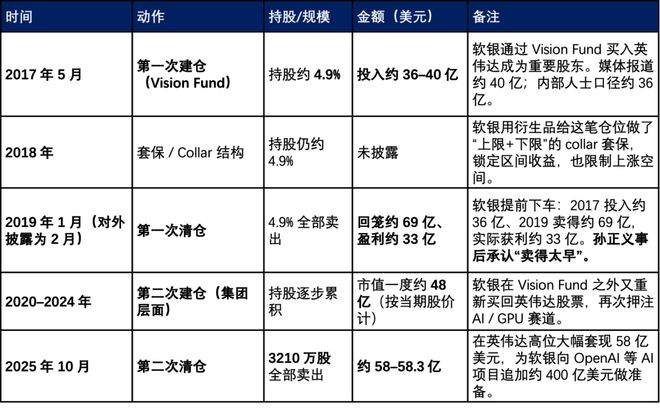
Core Insights - The article discusses Masayoshi Son's regret over selling SoftBank's stake in NVIDIA, which could have been worth over $150 billion today if held [1][2] - The conversation highlights NVIDIA's transformation into a key player in the AI era, emphasizing the importance of timing in high-growth industries [2] - SoftBank's recent strategic moves, including selling NVIDIA shares to invest in OpenAI, reflect a shift in focus towards AI startups [3][4] Group 1: NVIDIA Investment History - SoftBank invested approximately $3.6 billion in NVIDIA in May 2017, acquiring a 4.9% stake, but sold all shares by January 2019 for about $6.9 billion, realizing a profit of around $3.3 billion [1][3] - In October 2025, SoftBank sold 32.1 million shares of NVIDIA for approximately $9.17 billion as part of its asset monetization strategy [3] - The company has a history of buying and selling NVIDIA shares, indicating a pattern of missing out on significant gains during NVIDIA's growth phases [5] Group 2: Strategic Shift Towards AI - SoftBank's decision to divest from NVIDIA was influenced by its investment in OpenAI, where it plans to invest $22.5 billion, increasing its stake from 4% to 11% [3][4] - The Vision Fund's $19 billion profit in the second quarter was bolstered by investments in the AI ecosystem, including chips and large language models [4] - Despite selling NVIDIA shares, SoftBank remains involved in AI projects that rely on NVIDIA technology, such as the $500 billion Stargate data center project [4] Group 3: Market Dynamics and Short Selling - NVIDIA's stock has become a focal point for both bullish and bearish investors, with significant short positions being taken by notable figures like Michael Burry [6][12] - The article outlines the volatility surrounding NVIDIA's stock, driven by large short positions and the potential for significant price swings [14][20] - Concerns about NVIDIA's valuation and the sustainability of its growth are highlighted, with analysts questioning the timing of cash flow realization in relation to capital expenditures [10][17]
光大证券:短期内市场或维持宽幅震荡
Sou Hu Cai Jing· 2025-11-16 07:11
Market Overview - The A-share market experienced fluctuations and adjustments this week, with most broad-based indices declining, particularly the Sci-Tech 50 and ChiNext indices [1] - The current valuation of the Sci-Tech 50 and Wind All A indices is relatively high, with their PE (TTM) percentile exceeding 85% since 2010 as of November 14, 2025 [1] Sector Performance - In terms of market style, large-cap value and small-cap value indices performed well, while large-cap growth and small-cap growth indices saw declines [1] - Among the Shenwan first-level industries, sectors such as comprehensive, textile and apparel, and retail saw gains, while communication, electronics, and computing sectors experienced losses [1] Policy and Economic Developments - The State Council issued measures to promote private investment, outlining 13 specific initiatives to support its development [2] - The central bank's report indicated a solid foundation for achieving annual economic targets, with industrial production and high-tech manufacturing showing positive growth [2] - Fixed asset investment saw a year-on-year decline, while manufacturing investment continued to grow [2] International Relations and Events - Recent developments in US-China relations showed signs of easing, with the US suspending certain investigations and export controls related to China [2] - The US government ended a shutdown following the signing of a temporary funding bill by President Trump [2] - A trade agreement aimed at reducing tariffs between the US and India is expected to be finalized soon [2] Market Outlook - The recent decline in the A-share market is attributed to overseas events, including SoftBank's liquidation of Nvidia shares, which raised concerns about AI market bubbles [3] - The market is expected to remain in a wide fluctuation phase in the short term, despite being in a broader bull market [3] - The current market may lack strong catalysts, and investors may adopt a more cautious approach as the year-end approaches, leading to a focus on consolidation [3]

孙正义重夺日本首富后清仓英伟达,释放了AI泡沫破裂信号?
首席商业评论· 2025-11-16 04:12
Core Viewpoint - The article discusses the recent actions of SoftBank's Masayoshi Son regarding NVIDIA, highlighting concerns about potential market bubbles and the implications of heavy investments in AI, particularly in OpenAI [3][10][12]. Group 1: SoftBank's Actions - SoftBank has completely liquidated its NVIDIA holdings, cashing out approximately $5.83 billion (around 41.5 billion RMB), which led to a significant drop in NVIDIA's market value by $100 billion overnight [3][10]. - This marks the second time Son has sold off NVIDIA shares, with a previous liquidation in 2019 that has since been viewed as a cautionary tale in the investment community [10][11]. - The decision to sell NVIDIA is seen as a strategic move to free up capital for investments in OpenAI, with SoftBank's CFO stating the need for liquidity to fulfill commitments to OpenAI [12][14]. Group 2: Investment Strategy and Risks - Son's investment strategy appears to focus on concentrated bets on leading companies rather than diversified hedging, which has led to significant losses in past investments, such as WeWork and Coupang [7][11]. - The article raises concerns about the sustainability of OpenAI's business model, noting that it may face substantial losses and cash burn in the coming years, with estimates suggesting losses exceeding $5 billion by 2025 [18][21]. - There are indications that the current market environment may be experiencing a bubble, with warnings from prominent figures about the risks associated with inflated asset prices in the tech sector [18][19]. Group 3: Market Dynamics and Future Outlook - The article suggests that the heavy reliance on circular financing among tech companies, including OpenAI, creates an illusion of unlimited demand while facing real supply constraints, particularly in energy and resources [21][24]. - Historical patterns indicate that SoftBank's stock splits have often coincided with significant market downturns, raising questions about the potential implications of its upcoming stock split [15][18]. - The future of OpenAI is uncertain, with challenges related to energy supply and operational sustainability posing significant risks to its growth and profitability [22][24].
做空英伟达的华尔街大空头,基金刚刚被迫清盘了!
Sou Hu Cai Jing· 2025-11-16 02:28
Core Insights - The article discusses the missed investment opportunity by SoftBank's founder Masayoshi Son in NVIDIA, highlighting the regret over selling shares before the company's significant growth driven by AI demand [1][2][4]. Group 1: Investment History - SoftBank invested approximately $3.6 billion in NVIDIA in May 2017, acquiring a 4.9% stake, but sold all shares in January 2019 for about $6.9 billion, realizing a profit of approximately $3.3 billion [1][7]. - If SoftBank had retained its shares, their current value would exceed $150 billion [1][7]. - In October 2025, SoftBank sold 32.1 million shares of NVIDIA for approximately $5.83 billion as part of its asset monetization strategy [5][7]. Group 2: Strategic Shifts - SoftBank's recent stock sales are part of a broader strategy to invest heavily in AI projects, including a $22.5 billion investment in OpenAI, which will increase its stake from 4% to 11% [5][8]. - The company aims to maintain financial stability while providing investment opportunities, as stated by CFO Yoshiaki Goto [5]. Group 3: Market Reactions and Analyst Perspectives - Despite SoftBank's stock sales causing a 2% drop in NVIDIA's share price, the company remains involved in several AI projects reliant on NVIDIA technology, such as the $500 billion Stargate data center project [6]. - Analysts suggest that SoftBank's actions should not be interpreted as a negative stance towards NVIDIA but rather as a necessity for funding its AI investments [6]. Group 4: Short Selling Dynamics - NVIDIA has become a significant target for short sellers, with a nominal short position exceeding $48 billion as of October 2025, making it the largest single short position in the U.S. capital markets [16][21]. - The volatility of NVIDIA's stock is largely influenced by the substantial options positions, leading to exaggerated price movements [23]. - Short sellers express concerns over NVIDIA's pricing power, the AI investment return timeline, and potential accounting adjustments affecting depreciation [17][18][19].

多家航司:涉日航线客票可免费退改;宇树科技IPO辅导完成|南财早新闻
2 1 Shi Ji Jing Ji Bao Dao· 2025-11-15 23:20
Company Movements - Yushu Technology has completed its IPO counseling report and plans to apply for an initial public offering in China, with CITIC Securities providing guidance [4] - Tmall's president, Jia Luo, announced that Tmall achieved its best growth in four years during the "Double 11" shopping festival, with nearly 600 brands surpassing 100 million yuan in sales and over 34,091 brands doubling their sales compared to last year [4] - Leap Motor has surpassed 500,000 units in cumulative sales this year, achieving its sales target for 2025 ahead of schedule [4] - Beijing Automotive Group signed a strategic cooperation agreement with Beijing Rural Commercial Bank, which will provide a credit line of 50 billion yuan to support the group's development [5] - Alibaba's Tongyi App has been renamed to Qianwen App, with a new version launched, aiming to develop a personal AI assistant to compete with ChatGPT [5] Investment News - Berkshire Hathaway, led by Warren Buffett, reduced its stake in Apple by approximately 41.79 million shares in the third quarter, a decrease of over 14.9% from the previous quarter, resulting in a reduction of about 10.6 billion USD in market value [3] - Nvidia is set to release its third-quarter report next week amid increasing discussions about an AI bubble, while SoftBank has liquidated its Nvidia shares for 5.83 billion USD [3] - The Shanghai Composite Index has retreated after reaching a 10-year high, with bank stocks showing strong performance, having increased by 94% over the past three years, significantly outperforming the index's 29% increase [3] - Foreign investors continue to favor Chinese assets, with Citigroup raising Tencent's target price to 751 HKD per share, and other firms also increasing target prices for various Chinese companies [3]

Dietze: All Eyes on NVDA Earnings, Bullish on KHC, SLB, MOH
Youtube· 2025-11-15 21:00
Market Overview - The S&P 500 is currently only 2.5% off its highs, indicating that there is no immediate cause for concern despite recent volatility [1] - Investors are reassessing the AI trade, questioning whether there is a bubble, as evidenced by significant declines in blue-chip stocks like Oracle and Meta [2][3] AI and Tech Stocks - Oracle has lost one-third of its value since August, while Meta is down nearly 20% in the last month, prompting investors to reconsider their positions [2] - Concerns are growing regarding capital expenditures in AI and the timing and magnitude of potential payoffs [4] - Nvidia's upcoming earnings report is critical, as its performance could significantly influence market sentiment [7][9] Investment Strategies - A cautious approach is being adopted, with many investors taking profits and rebalancing portfolios due to the high concentration of market cap in top AI-related stocks [6] - Despite concerns about an AI bubble, there are still opportunities in tech, with analysts like Dan Ives highlighting potential investments [5] Company-Specific Insights - Craft Heinz is viewed as a cheap stock with an 11% free cash flow yield and a 6.4% dividend, despite its struggles [12][13] - SLB (formerly Schlumberger) is favored due to its position in oil field services and its recent performance, rising 11% in the last month while the S&P 500 remained flat [15][16] - Molina Healthcare is down 46% year-to-date, but is expected to rebound as it adjusts premiums in response to rising claims costs [17][19] Economic Indicators - The Federal Reserve is expected to cut rates, with current speculation around the true unemployment and inflation rates affecting market dynamics [22][24] - The 10-year Treasury yield has been fluctuating around 4%, indicating a stable economic outlook despite some concerns about unemployment [26][28] Tariffs and Affordability - The administration's focus on affordability, including potential tariff adjustments and housing affordability measures, is seen as a positive step for the economy [29]