三花智控

Search documents
从A到H浪潮涌起 今年以来港股IPO募资总额位居全球交易所首位
Zhong Guo Zheng Quan Bao· 2025-11-11 22:17
Group 1 - The Hong Kong IPO market has seen 87 new listings this year, raising over 240 billion HKD, making it the leading exchange globally for IPO fundraising [1][2] - A total of 16 A-share companies have successfully listed on the Hong Kong Stock Exchange this year, with over 80 more in the pipeline, indicating a significant trend of A+H listings [1][3] - The successful listings are predominantly from leading companies in their respective industries, with most having a market capitalization exceeding 20 billion HKD [3][4] Group 2 - Notable companies like CATL, Heng Rui Pharmaceutical, and Sai Lisi have raised substantial funds, with CATL alone accounting for over 30% of the total fundraising from A+H listed companies [4][5] - The majority of the A+H listed companies are concentrated in the technology and consumer sectors, reflecting a strategic focus on these core areas [4][9] - The performance of newly listed companies has been strong, with 12 out of 16 stocks rising or remaining stable on their first trading day [4][10] Group 3 - There has been a notable trend of H-shares trading at a premium over A-shares for some leading companies, indicating strong international investor confidence [5][9] - A record 302 companies have submitted IPO applications to the Hong Kong Stock Exchange this year, highlighting a robust interest in the market [6][8] - The influx of A-share companies seeking to list in Hong Kong is expected to enhance the quality and liquidity of the Hong Kong market [9][11]




摩根士丹利将三花智控A股评级下调至平配,目标价42元人民币
Xin Lang Cai Jing· 2025-11-11 21:37
Core Viewpoint - Morgan Stanley has downgraded the rating of Sanhua Intelligent Control to "Equal Weight" with a target price of 42 RMB per share [1] Company Summary - The downgrade reflects a cautious outlook on Sanhua Intelligent Control's performance in the A-share market [1] - The target price set by Morgan Stanley indicates a potential adjustment in investor expectations regarding the company's future growth [1]

摩根士丹利将三花智控A股评级下调至平配,目标价42元人民币。
Xin Lang Cai Jing· 2025-11-11 21:23
Core Viewpoint - Morgan Stanley has downgraded the rating of Sanhua Intelligent Control's A-shares to "Equal-weight" with a target price of 42 RMB [1] Company Summary - The downgrade reflects a cautious outlook on Sanhua Intelligent Control's performance in the market [1] - The target price set by Morgan Stanley indicates a potential adjustment in investor expectations regarding the company's future growth [1]
可选消费W45周度趋势解析:海内外消费子版块均无共振,内部因素催化股价表现-20251111
Haitong Securities International· 2025-11-11 15:11
Investment Rating - The report assigns an "Outperform" rating to multiple companies including Nike, Midea Group, JD Group, Haier Smart Home, Gree Electric, Anta Sports, China Duty Free, and others [1]. Core Insights - The report highlights that domestic and overseas consumer subsectors are not showing synchronized movements, with internal factors driving stock performance [4][10]. - The performance of various sectors is analyzed, indicating that the U.S. hotel sector has outperformed others, while luxury goods and overseas cosmetics have seen significant declines [10][13]. Sector Performance Summary - **U.S. Hotels**: The sector saw a weekly increase of 7.9%, driven by strong performance from Marriott and Hilton, with Marriott's RevPAR growth meeting market expectations [5][13]. - **Pet Sector**: Increased by 1.1%, with leading brands showing significant growth in GMV despite overall sales being weak [5][13]. - **Gambling Sector**: Rose by 0.7%, with Macau's GGR exceeding expectations, indicating strong future performance [5][13]. - **Retail Sector**: Experienced a slight decline of 0.3%, with China Duty Free benefiting from new tax policies [7][13]. - **Snack Sector**: Fell by 1.9%, with competitive pressures affecting performance [7][13]. - **Gold and Jewelry Sector**: Decreased by 2.5% due to tax reforms impacting profitability [7][13]. - **Overseas Sportswear**: Dropped by 2.8%, facing tariff pressures and concerns over U.S. consumer spending [7][13]. - **Luxury Goods**: Declined by 3.0%, with concerns over upcoming earnings reports affecting stock prices [7][13]. - **Domestic Cosmetics**: Fell by 3.4%, with overall performance weaker than international brands [7][13]. - **Overseas Cosmetics**: Experienced a significant drop of 11.6%, primarily due to ELF Beauty's disappointing earnings [7][13]. Valuation Analysis - Most sectors are valued below their average over the past five years, with specific PE ratios indicating potential undervaluation [8][14]. - **Overseas Sportswear**: Expected PE of 28.6, 54% of the past five-year average [14]. - **Domestic Sportswear**: Expected PE of 14.1, 74% of the past five-year average [14]. - **Gold and Jewelry**: Expected PE of 22.1, 42% of the past five-year average [14]. - **Luxury Goods**: Expected PE of 25.6, 46% of the past five-year average [14]. - **Gambling**: Expected PE of 29.1, 47% of the past five-year average [14]. - **Overseas Cosmetics**: Expected PE of 35.5, 53% of the past five-year average [14]. - **Domestic Cosmetics**: Expected PE of 27.9, 52% of the past five-year average [14]. - **Pet Sector**: Expected PE of 40.3, 55% of the past five-year average [14]. - **Snack Sector**: Expected PE of 26.8, 65% of the past five-year average [14]. - **Retail Sector**: Expected PE of 28.6, 53% of the past five-year average [14]. - **U.S. Hotels**: Expected PE of 31.4, 19% of the past five-year average [14]. - **Credit Card Sector**: Expected PE of 28.9, 55% of the past five-year average [14].
科技股领跌,主线换了吗?
Guo Ji Jin Rong Bao· 2025-11-11 14:45
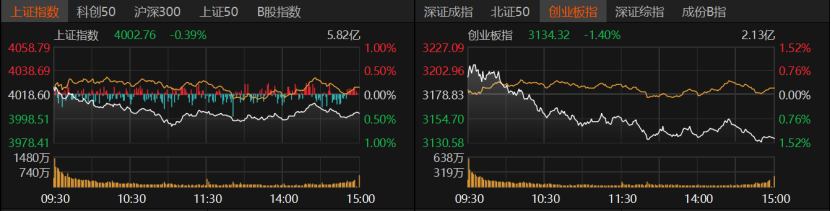
Market Overview - A-shares experienced a downturn with consumer stocks providing support while technology stocks fell sharply, leading to a decline in the ChiNext Index by over 1% [1][2] - The Shanghai Composite Index closed at 4002.76 points, down 0.39%, while the ChiNext Index fell 1.4% to 3134.32 points [2] - A total of 2785 stocks rose, while 2504 stocks fell, indicating a mixed market sentiment [3] Sector Performance - Technology sectors, particularly communication and electronics, led the declines, with significant drops in stocks like Zhongji Xiangchuang and Tianshu Communication, which fell over 4% [4][5] - The consumer sector continued its upward trend, with retail stocks showing resilience, as evidenced by the strong performance of companies like China Duty Free, which rose 4.19% [3][6] - Defensive sectors such as retail and real estate outperformed, with notable gains in the commercial retail sector [7] Investment Sentiment - Market participants are cautious due to a dense sell-off pressure above the 4000-point mark, with technical resistance observed [11] - The ongoing adjustment in technology stocks is attributed to profit-taking by institutions as year-end assessments approach, leading to capital outflows from crowded positions in the TMT sectors [1][12] - Despite the current volatility, the technology sector, particularly AI-related stocks, is expected to remain a focal point for future investment opportunities [13][14] Trading Strategies - Investors are advised to maintain stable positions, dynamically taking profits on high-valued technology stocks while gradually building positions in lower-valued stocks [15] - The focus should be on sectors supported by policy, such as new energy and photovoltaic industries, as well as traditional sectors with strong defensive characteristics [15] - Recommendations include prioritizing investments in low-valuation blue-chip stocks and sectors with strong profit certainty, while avoiding high-valuation hardware equipment [15]





2025Q3板块业绩分化,客车及零部件业绩亮眼:——汽车行业专题研究
Guohai Securities· 2025-11-11 12:33
Investment Rating - The report maintains a "Recommended" rating for the automotive sector [1] Core Views - The automotive industry has shown a mixed performance in Q3 2025, with significant growth in bus and parts sectors, while passenger vehicle profits continue to decline due to intensified competition [1][4] - The overall automotive wholesale sales reached 8.71 million units in Q3 2025, reflecting a year-on-year increase of 15.8% [4][28] - The report highlights the impact of policies such as vehicle trade-in and subsidies, which are expected to support passenger vehicle sales in 2024 and 2025 [4][41] Summary by Sections Recent Trends - The automotive sector outperformed the Shanghai and Shenzhen 300 index with a 23.8% increase from January to October 2025, while the index rose by 17.9% [10] - The parts sector has shown remarkable performance, with significant stock price increases among component companies [22] Revenue and Profit - In Q3 2025, the automotive industry generated revenue of CNY 1,058.55 billion, up 10.1% year-on-year, with a net profit of CNY 40.41 billion, reflecting a 9.1% increase [38][41] - The passenger vehicle segment reported revenue of CNY 544.06 billion, a 7.7% increase, but net profit fell by 18.6% [39][41] - The bus segment saw a revenue increase of 30.1% year-on-year, with net profit soaring by 95.4% [40][41] - The parts sector achieved revenue of CNY 395.66 billion, up 11.0%, with net profit increasing by 26.3% [41] Key Companies and Forecasts - The report identifies key companies benefiting from the current market dynamics, including Li Auto, BYD, and Great Wall Motors, among others [4][5] - It emphasizes the potential for high-end and intelligent vehicle segments to drive future growth, recommending investments in companies positioned for these trends [4][5] Market Dynamics - The report anticipates that the industry will continue to evolve around "new energy expansion and price competition," with further profit differentiation expected [42]
科技股大降温,A股新主线曝光
2 1 Shi Ji Jing Ji Bao Dao· 2025-11-11 12:15
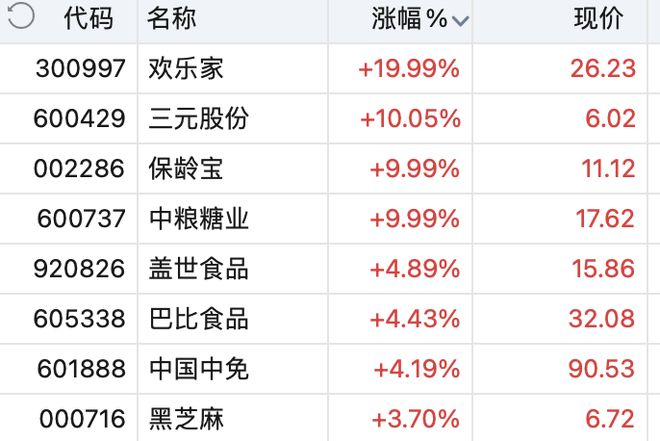
Core Viewpoint - The A-share market shows significant divergence, with consumer stocks experiencing a strong rally while AI computing and robotics sectors face notable pressure [1][3]. Consumer Sector Summary - Major consumer stocks such as Huanlejia (欢乐家) and Sanyuan (三元股份) have seen substantial gains, with Huanlejia rising by 19.99% to 26.23 and Sanyuan increasing by 10.05% to 6.02 [2]. - Other consumer stocks like Baolingbao (保龄宝) and Zhongliang Sugar (中粮糖业) also reached their daily limit up, indicating a robust performance in the consumer sector [1][2]. - The rally in consumer stocks is attributed to supportive policies aimed at boosting consumption and positive macroeconomic data, including a slight increase in CPI and a narrowing decline in PPI [3]. Technology Sector Summary - In contrast, the AI computing and robotics sectors, including companies like New Yisheng (新易盛) and Industrial Fulian (工业富联), experienced significant declines, indicating a temporary setback in these high-growth areas [1][2]. - Despite the current pullback, experts believe that the technology sector, particularly AI computing, remains a key focus of the ongoing bull market, with potential for recovery as demand for AI-related products continues [4]. Market Outlook - Analysts suggest that while the market may be in a broad consolidation phase, there is still considerable upside potential compared to previous bull markets [5]. - The focus for short-term investments should be on defensive and consumer sectors, while mid-term strategies may continue to favor TMT (Technology, Media, and Telecommunications) and advanced manufacturing sectors [5]. - The potential for a style shift in the market is highlighted, with recommendations to monitor new consumer trends and cyclical stocks as PPI improvements gradually influence CPI [5].
高盛:对人形机器人技术的长期趋势仍持积极看法
Zhi Tong Cai Jing· 2025-11-11 11:41
Core Insights - Goldman Sachs recently released a field research report on the supply chain of humanoid robots in China, indicating that most companies plan to gradually scale up after receiving actual orders, suggesting that current plans may not imply an imminent risk of oversupply [1] - The report highlights a positive long-term outlook for humanoid robot technology, but emphasizes the need to monitor the performance of key robotic products and specific end applications to assess whether a technological inflection point is approaching [1] Summary by Sections Company Insights - The report surveyed nine companies in the Chinese robotics industry chain, including Sanhua Intelligent Controls, Top Group, and Shuanghuan Transmission, none of which confirmed receiving significant large orders or provided clear mass production timelines [1] - These companies are actively planning production capacity both domestically and overseas, with annual capacity plans ranging from approximately 100,000 to 1 million units of robots [1] Industry Trends - Goldman Sachs forecasts a global shipment of 1.38 million robots by 2035, contrasting with the optimistic capacity planning of supply chain companies, which raises concerns about potential "oversupply" in the market [1] - An industry analyst cautioned against prematurely concluding "oversupply," noting that the specific application scenarios and technological paths for humanoid robots are still in exploratory development [2] - The current "order vacuum" should be understood as a natural phase in the early development of the industry, where trial and error costs and time are expected [2] - The analyst believes that proactive capacity planning by supply chain companies is a necessary preparation for potential demand surges, and that the future demand volume and technological evolution remain highly variable [2]

科技股大降温,A股新主线曝光
21世纪经济报道· 2025-11-11 11:14
Core Viewpoint - The A-share market is experiencing significant differentiation, with consumer stocks showing strong performance while AI computing and robotics sectors are under pressure [1][2][3]. Group 1: Consumer Stocks Performance - Consumer stocks such as Huanlejia (300997.SZ) and Sanyuan (600429.SH) have seen substantial gains, with Huanlejia rising by 19.99% to a price of 26.23 [2]. - Other notable consumer stocks include Baolingbao (002286.SZ) and Zhongliang Sugar Industry (600737.SH), both achieving a 9.99% increase [2]. - The rise in consumer stocks is attributed to supportive policies and positive macroeconomic data, indicating a potential recovery in consumer spending [3]. Group 2: Policy and Macroeconomic Data - The Ministry of Finance has announced continued efforts to boost consumption, including financial subsidies for personal consumption loans [3]. - October's CPI data shows a 0.2% month-on-month increase and a 0.2% year-on-year increase, with core CPI rising by 1.2%, marking the sixth consecutive month of growth [3]. - PPI has decreased by 2.1% year-on-year but shows signs of improvement, with a 0.1% month-on-month increase, the first rise this year [3]. Group 3: Market Outlook and Sector Analysis - Economic expert Pan Helin suggests that the active consumer sector is a response to policy support and previous underperformance, indicating a potential rebound [3][4]. - Despite the current pullback in AI and technology sectors, they remain the main focus of the ongoing bull market, with high demand for computing power from companies like OpenAI [4]. - Analysts from various securities firms suggest that while the market may experience short-term fluctuations, the overall trend remains bullish, with a focus on defensive and consumer sectors in the near term [4].



A股机器人“订单荒”?相关公司回应
财联社· 2025-11-11 10:47
Core Viewpoint - Goldman Sachs conducted a field research report on the supply chain of humanoid robots in China, revealing that companies are planning significant production capacity expansions despite a lack of confirmed large orders [1][2]. Group 1: Research Findings - The report surveyed nine companies in the Chinese robotics industry, including Sanhua Intelligent Control, Top Group, and Shuanghuan Transmission, indicating a planned annual production capacity ranging from 100,000 to 1,000,000 robot equivalents [1]. - Goldman Sachs predicts a global shipment of 1.38 million units by 2035, highlighting an optimistic outlook for the supply chain's growth potential [1]. - None of the surveyed companies confirmed receiving substantial orders or provided a clear mass production timeline, raising concerns about potential "overcapacity" in the robotics supply chain [1]. Group 2: Industry Insights - Despite the current contrast between the vacuum of orders and the expansion of production capacity, industry insiders caution against prematurely concluding "overcapacity," as proactive planning is often characteristic of emerging industries on the rise [2].