
特宝生物

Search documents
寒武纪拟使用27亿资本公积金弥补亏损,科创100ETF华夏(588800)成交额领先同类、科创半导体ETF(588170)多空胶着
Mei Ri Jing Ji Xin Wen· 2025-12-16 06:05
Group 1 - The Shanghai Stock Exchange Sci-Tech Innovation Board 100 Index decreased by 1.84% as of December 16, 2025, with mixed performance among constituent stocks [1] - Chipmaker Cambricon announced plans to use 2.778 billion yuan from its capital reserve to cover cumulative losses, highlighting the financial challenges faced by companies in the AI chip sector [3] - The Sci-Tech 100 ETF (588800) closely tracks the Sci-Tech 100 Index, focusing on high-growth sectors including semiconductors, pharmaceuticals, and new energy [3] Group 2 - The Sci-Tech Semiconductor ETF (588170) recorded a turnover rate of 16.07% and a transaction volume of 568 million yuan, indicating active market trading [2] - The semiconductor equipment and materials sector is crucial for domestic substitution, characterized by low domestic replacement rates and high ceilings for domestic alternatives, benefiting from the AI revolution [4] - Global economic powers are actively supporting AI industry development, with major internet companies increasing investments and R&D in AI, positioning it as a long-term growth driver [3]

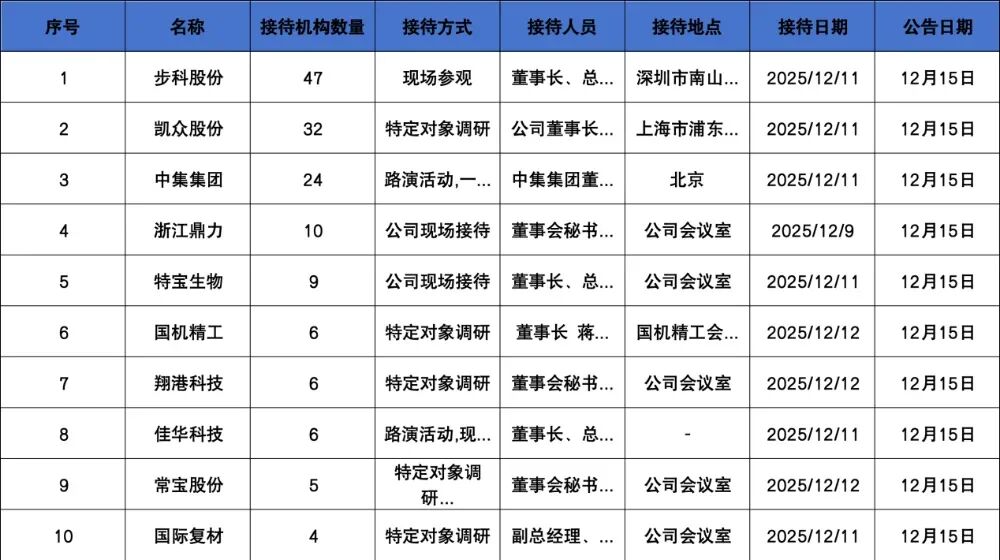
调研汇总:嘉实、天弘基金等24家明星机构调研中集集团!
Xin Lang Cai Jing· 2025-12-15 13:34
Group 1 - The core focus of the company is on robotics and its globalization strategy, leveraging GaN technology for servo drives to enhance performance and efficiency [1][2][37] - The company plans to establish local offices in key markets such as the US and Japan to mitigate geopolitical and trade risks, while building a local partnership network to enhance business resilience [2][37] - The company has developed various core components for humanoid robots, including frameless torque motors and joint modules, and has secured bulk orders from several clients [3][38] Group 2 - The company reported a revenue of 510 million yuan for the first three quarters of 2025, representing a year-over-year increase of 28.4%, with a net profit of 40 million yuan, up 37.5% [7][41] - In Q3 alone, the company achieved a revenue of 200 million yuan, a 41.3% increase year-over-year, and a net profit of 20 million yuan, reflecting a 96.2% growth [7][41] - The gross profit margin for the first three quarters was 35.2%, a decrease of 1.4 percentage points year-over-year, attributed to a higher proportion of lower-margin drive system revenue [12][46] Group 3 - The company has established a systematic risk management framework for domestic receivables, utilizing customer credit assessments and direct sales to manage collection risks [4][38] - The company is optimistic about the growth potential in the robotics sector, with sales in the robotics industry reaching 150 million yuan in the first half of 2025, a 55% increase year-over-year [12][46] - The company has slightly raised its profit forecasts for 2025, 2026, and 2027, expecting net profits of 70 million, 100 million, and 120 million yuan respectively, with corresponding year-over-year growth rates of 43%, 45%, and 20% [12][46]



医保支持创新,持续推荐创新药械产业链
Haitong Securities International· 2025-12-15 05:01
Investment Rating - The report maintains an "Outperform" rating for several companies in the innovative drug and medical device industry, including Jiangsu Heng Rui Medicine, Hansoh Pharmaceutical Group, 3SBio, Sichuan Kelun Pharmaceutical, and Jiangsu Nhwa Pharmaceutical [5][6][25]. Core Insights - The report emphasizes the high prosperity in innovative drugs and continues to recommend companies with innovative pipelines that are entering a volume increase phase, maintaining "Outperform" ratings for various Biopharma/Biotech companies [5][25]. - The National Healthcare Security Administration announced the 2025 insurance drug list, which added 114 drugs, including 50 innovative drugs, further validating insurance support for innovation and indicating promising domestic demand [26][27]. Summary by Sections 1. Continuous Recommendation of Innovative Drugs and Industry Chain - The report highlights the ongoing recommendation of innovative drugs and the industry chain, with a focus on companies expected to see a revaluation due to their innovative pipelines [5][25]. - Specific companies mentioned include WuXi AppTec, WuXi XDC Cayman, Hangzhou Tigermed Consulting, and leading medical equipment companies like Beijing Chunlizhengda Medical Instruments and Lepu Medical, all rated "Outperform" [5][25]. 2. Performance of A-Shares Pharmaceutical Sector - In the second week of December 2025, the A-Shares pharmaceutical sector underperformed the market, with the SW Pharma and Biotech index falling by 1.0% compared to a 0.3% decline in the SHCOMP [8][27]. - The report notes that the premium level of the pharmaceutical sector relative to all A-Shares is at a normal level, with a current relative premium rate of 69.8% [16][27]. 3. Performance of Hong Kong and U.S. Pharmaceutical Sectors - The Hong Kong stock pharmaceutical sector underperformed the market, with the Hang Seng Healthcare index falling by 2.3%, while the U.S. stock pharmaceutical sector outperformed, with the S&P 500 Healthcare Select Sector Index rising by 0.4% [28][27].



国泰海通医药 2025 年 12 月第二周周报:医保支持创新,持续推荐创新药械产业链-20251214
国泰海通· 2025-12-14 12:18
Investment Rating - The report maintains an "Overweight" rating for the innovative pharmaceutical and medical device industry chain [3][5][6]. Core Insights - The report emphasizes the continuous recommendation of innovative drugs and medical devices, highlighting the high growth potential in the innovative pharmaceutical sector. It maintains "Overweight" ratings for companies such as Heng Rui Medicine, Hansoh Pharmaceutical, and others, indicating a potential for value re-evaluation [3][5]. - The report notes that the National Medical Insurance Administration has officially announced the 2025 medical insurance drug catalog, which includes 114 new drugs, 50 of which are first-class innovative drugs. This adjustment is seen as a validation of the support for innovation in the healthcare sector [3][5]. - The A-share pharmaceutical sector underperformed the broader market in the second week of December 2025, with the SW Pharmaceutical Biotechnology index declining by 1.0% compared to a 0.3% drop in the Shanghai Composite Index [7][18]. Summary by Sections Section 1: Continuous Recommendation of Innovative Drugs and Medical Devices - The report highlights the sustained recommendation of innovative drugs and medical devices, with a focus on companies that are expected to see performance growth and value re-evaluation [5][6]. Section 2: A-share Pharmaceutical Sector Performance - In the second week of December 2025, the A-share pharmaceutical sector's performance was weaker than the overall market, ranking 16th among the primary industries [7][18]. Section 3: Hong Kong and US Market Performance - The report indicates that the Hong Kong pharmaceutical sector also underperformed, while the US pharmaceutical sector showed stronger performance compared to the broader market [18].

医药生物行业2026年度投资策略报告:十年创新,踏出海征程-20251214
Orient Securities· 2025-12-14 05:16
Core Insights - The pharmaceutical industry is experiencing a surge in innovative products, with clear domestic demand and significant potential for international expansion [4][14][25] - Investment opportunities are concentrated in innovative drugs and their supply chains, with a notable performance from CRO/CMO and chemical pharmaceuticals [9][15][17] - The report emphasizes the importance of innovation as the primary solution to industry challenges, driven by stable demand and supportive policies [26][32][41] Industry Overview - The pharmaceutical sector has faced revenue declines, with a 0.9% year-on-year decrease in revenue for the first three quarters of 2025, and net profit down by 2.2% [15][16] - The innovative drug sector has outperformed, with CRO/CMO and chemical pharmaceuticals showing net profit growth of 31.0% and 16.6% respectively [17][18] - The overall market is characterized by low fund holdings and historical valuation bottoms, indicating high investment value [20][25] Demand and Payment Dynamics - The demand for healthcare services is steadily increasing, with a projected 5% growth in total medical visits and hospital admissions in 2024 [26][28] - The aging population is expected to drive long-term demand, with 220 million people aged 65 and above by 2050 [28][30] - The medical insurance fund's income growth has outpaced expenditure growth, leading to a significant increase in fund reserves [32][36] Financing and Market Trends - The IPO market for healthcare has rebounded, with 28 IPOs in the first three quarters of 2025, a 100% increase from the previous year [42][43] - License-out transactions have surged, with transaction numbers increasing by 41% and total amounts reaching $92 billion, indicating a robust market for innovative drug licensing [48][50] - The number of IND applications and new clinical trials for innovative drugs has been steadily increasing, with a notable rise in NDA approvals [53][57] Technological Advancements - The report highlights the emergence of new technologies such as ADC and small nucleic acids, with domestic companies leading in these areas [60] - The focus on dual antibodies and GLP-1 drugs is expected to drive significant growth, with multiple development directions emerging [9][60] - The report notes that domestic companies are increasingly recognized for their innovative capabilities, particularly in the ADC space [60]

三季度净利暴跌83%后,“东北药茅”长春高新靠第七次融资续命?
Hua Xia Shi Bao· 2025-12-14 01:27
Core Viewpoint - Changchun High-tech (000661.SZ) faces a complex situation with a weak Q3 report and a favorable policy announcement regarding product inclusion in the national medical insurance directory for 2025, which may signal a shift in its performance despite significant profit declines [2][4]. Financial Performance - For the first three quarters of 2025, the company reported a revenue of 9.81 billion yuan, a decrease of 5.6% year-on-year, and a net profit attributable to shareholders of 1.16 billion yuan, down 58.23% [7][8]. - In Q3 alone, revenue was 3.20 billion yuan, reflecting a 14.55% decline, while net profit plummeted 82.98% to 182 million yuan [7][8]. - The company's net profit margin has dropped from 38.57% in 2020 to 10.81% in the first three quarters of 2025, despite maintaining a gross margin above 85% [7]. Market Dynamics - The inclusion of Changchun High-tech's core product, JinSaiZeng (long-acting growth hormone), in the national medical insurance directory is seen as a double-edged sword, potentially increasing market access but also leading to price reductions that could compress profit margins [3][4]. - The domestic growth hormone market is becoming increasingly competitive, with both multinational and local companies intensifying their efforts, which threatens the market barriers that Changchun High-tech has relied on [4][6]. Product Development and Innovation - JinSaiZeng has been included in the insurance directory for treating children with endogenous growth hormone deficiency, with a significant patient population of approximately 7.6 million in China [5]. - The company is also exploring diversification through new product lines, including an IL-1β monoclonal antibody and desensitization therapy products, although these initiatives are still in early stages and may not provide immediate financial relief [14]. IPO and Financing - Changchun High-tech has submitted an application for an IPO on the Hong Kong Stock Exchange, which would mark its seventh direct financing attempt since its listing in 1996, aiming to raise funds for innovation and operational needs [12][14]. - As of September 2023, the company's cash and cash equivalents have decreased by 50.70% year-on-year, totaling approximately 3.16 billion yuan [12].


西部证券晨会纪要-20251212
Western Securities· 2025-12-12 02:29
Group 1: Pharmaceutical Industry Insights - The 2026 pharmaceutical industry strategy report highlights a reversal in the market, driven by innovative drugs, with significant gains across various secondary sectors, particularly in Hong Kong where innovative drugs saw an increase of over 80% year-to-date [6][8] - Key catalysts for innovative drugs include policy support and successful business development (BD) transactions, with notable deals exceeding $1 billion validating the international competitiveness of Chinese innovative drugs [6][7] - A significant policy reform in October 2025 initiated a dual-track system for medical insurance, addressing the high-value innovative drugs' inclusion challenges, which is expected to guide commercial insurance to cover these gaps [6] Group 2: Company-Specific Updates - Yixin Group (2858.HK) has been included in the Hong Kong Stock Exchange Technology 100 Index, which is expected to enhance liquidity, and has renewed a strategic cooperation agreement for used car services, reflecting confidence in the growing demand for this segment [10][11] - The company reported a robust Q3 performance with a total of 235,000 auto financing transactions, a year-on-year increase of 22.6%, outperforming the market growth rate of approximately 11% [11] - Yixin Group's financial technology business has shown significant growth, with financing facilitated through its platform reaching approximately 114 billion yuan, a year-on-year increase of about 102% [11] Group 3: Electronic Sector Developments - Fuzhicheng Technology (002222.SZ) has exceeded revenue expectations, with a projected revenue growth to 11.15 billion yuan in 2025, and net profit expected to reach 3.02 billion yuan [15] - The company maintains a strong position in the ultra-precision optics sector, with its subsidiary achieving significant advancements and a revenue increase of 73.66% in H1 2025 [14] - Naxin Microelectronics (688052.SH) has successfully completed its H-share IPO, marking a critical step in its internationalization, with projected revenues of 33.01 billion yuan in 2025 [19]


9款创新药首入2025国家医保目录
Jin Rong Shi Bao· 2025-12-12 02:11
Core Insights - The 2025 National Medical Insurance Drug List has successfully added 114 new drugs, including 50 innovative drugs, achieving an overall success rate of 88%, significantly higher than the 76% in 2024 [1] - The first version of the Commercial Health Insurance Innovative Drug List has been released, marking a substantial breakthrough in the multi-tiered medical security system [1] - Nine innovative drugs from the Sci-Tech Innovation Board have been included in the new lists, showcasing the strength of these companies [1] Group 1: National Medical Insurance and Commercial Insurance - The new drug lists aim to establish a multi-tiered medical security system, with the basic insurance list covering essential drugs and the commercial insurance list focusing on high-value drugs not covered by basic insurance [4] - Since 2018, 149 innovative drugs have been included in the medical insurance list, accounting for 17% of the new drugs, supported by various policies to facilitate the entry of innovative drugs [2] - The successful inclusion of innovative drugs in the insurance lists reflects the government's recognition of their clinical value and the importance of supporting local innovation [6] Group 2: Sci-Tech Innovation Board Companies - Nearly 90% of the Sci-Tech Innovation Board's biopharmaceutical companies have received medical insurance support for their approved new drugs [2] - Notable products such as Junshi Biosciences' innovative drug, which is the only domestic PCSK9-targeted drug for statin-intolerant patients, have been included in the insurance list [2] - The successful renewal of contracts for drugs like Baiyue's Bai Ze An and Junshi's Tuoyi further expands the insurance coverage, benefiting a wider patient population [6] Group 3: Research and Development Investment - The R&D investment of Sci-Tech Innovation Board companies reached a new high in the first three quarters of 2025, with a year-on-year increase of over 10% and an R&D intensity of 42%, significantly surpassing the overall level of A-shares [6] - Companies like Baiyue have invested over 10 billion yuan in R&D, demonstrating a strong commitment to innovation [6] - The cycle of R&D investment leading to innovative outcomes, insurance support, market returns, and reinvestment in R&D has been established and is continuously strengthening [7]

科创板这几款创新药,纳入国家目录→
Jin Rong Shi Bao· 2025-12-11 09:48
Core Insights - The release of the 2025 National Medical Insurance Drug List and the first version of the Commercial Health Insurance Innovative Drug List has significantly benefited innovative drug companies on the Sci-Tech Innovation Board [1] - A total of 9 innovative drugs from Sci-Tech Innovation Board companies have been included in the new list, showcasing their strong capabilities [1] - The simultaneous release of the commercial insurance drug list marks a substantial breakthrough in the multi-layered payment system of "medical insurance + commercial insurance" [1] Group 1: Inclusion in Medical Insurance - Nearly 90% of innovative drugs from Sci-Tech Innovation Board companies have received medical insurance support, accelerating their value release and development [2] - Junshi Bioscience's drug, Junsida, is the only domestic PCSK9-targeted drug for statin-intolerant patients included in the new medical insurance list [2] - Haichuang Pharmaceutical's drug, Hainaan, has been approved for treating metastatic castration-resistant prostate cancer and will enhance market promotion and patient accessibility [2] Group 2: New Drug Development - New anti-tumor drugs from companies like Ailis, Yifang Biotech, and Shenzhou Cell provide precise treatment options for major diseases such as lung cancer and head and neck squamous cell carcinoma [3] - Several drugs covering endocrine, hematology, tumor support, and autoimmune treatment areas have been quickly included in the medical insurance list, demonstrating efficient drug review and approval processes [3] Group 3: Commercial Health Insurance Directory - The first version of the Commercial Health Insurance Innovative Drug List enhances the national multi-layered medical security system, with a clear division of roles between basic medical insurance and commercial insurance [4] - Innovative drugs from leading companies like BeiGene have been among the first to be included in this new directory, showcasing their clinical value [4][5] Group 4: Renewal and Market Expansion - Successful renewal negotiations confirm the exceptional value and clinical status of innovative drugs from Sci-Tech Innovation Board companies [6] - Junshi Bioscience's drug, Tuoyi, has expanded its medical insurance coverage with new indications, benefiting a broader patient population [6] Group 5: R&D Investment and Innovation Cycle - R&D investment among Sci-Tech Innovation Board companies reached a new high in the first three quarters of 2025, with a year-on-year increase of over 10% and an R&D intensity of 42% [7] - The formation of a virtuous cycle of "R&D investment - innovation results - medical/commercial insurance support - market returns - reinvestment in R&D" is evident in the industry [7]


2026年医药行业策略报告:黄金赛道:寻找中国的GlobalPharma-20251211
Western Securities· 2025-12-11 05:52
Group 1 - The core viewpoint of the report highlights that the pharmaceutical industry in China is experiencing a reversal in 2025, driven by innovative drugs, with significant benefits observed in the CXO and upstream supply chain sectors, particularly in the Hong Kong stock market where innovative drugs have seen a rise of over 80% year-to-date [1][4] - The report emphasizes that the core catalyst for innovative drugs comes from policy support and the realization of business development (BD) opportunities abroad, with notable transactions exceeding 1 billion USD, validating the international competitiveness of Chinese innovative drugs [1][2] - A significant reform in the payment sector is underway, with the introduction of a dual-track system for medical insurance, allowing for the inclusion of high-value innovative drugs in commercial insurance, addressing the gap in coverage for expensive treatments [1][2] Group 2 - The report indicates a rapid growth trend in the number of license-out transactions by Chinese pharmaceutical companies, with total upfront payments reaching 6.298 billion USD, a 53% year-on-year increase, and total transaction amounts reaching 118.862 billion USD, a 125% increase [2] - Looking ahead to 2026, the report suggests a shift from "BD-driven" to "data-driven" investment in innovative drugs, emphasizing the importance of clinical data validation and commercial capabilities for revenue growth [2] - Recommended stocks for investment include Heng Rui Medicine, Kelun-Biotech, and Teva Biopharmaceuticals, among others, while companies like Kangfang Biotech and Innovent Biologics are suggested for further attention [2][3] Group 3 - The overall profitability of the pharmaceutical sector remains stable, with a gradual improvement in the profitability of the pharmaceutical manufacturing industry, despite a slight decline in revenue growth [11][15] - The report notes a significant divergence within the industry, with the medical services sector performing well, while the profits of the biopharmaceutical sector have seen a substantial decline [28][29] - The report highlights that the medical insurance fund's income and expenditure growth rates are stabilizing, indicating a long-term trend towards cost control in medical insurance, which is essential for the sustainable development of the innovative drug industry [31][36]
