
博时基金

Search documents
市场对央行重启国债买卖操作预期升温,30年国债ETF博时(511130)早盘小幅飘红
Sou Hu Cai Jing· 2025-09-22 04:05
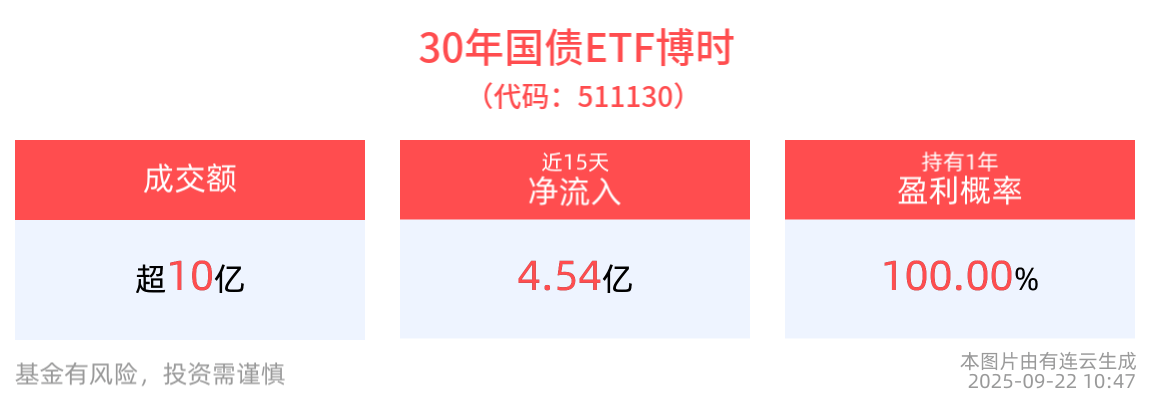
Group 1 - The 30-year government bond ETF from Bosera has seen a price increase of 0.24%, reaching 106.93 yuan as of September 22, 2025 [2] - The trading volume for the 30-year government bond ETF was 10.47 billion yuan, with a turnover rate of 5.38% [2] - The average daily trading volume over the past month was 44.63 billion yuan, indicating strong market activity [2] Group 2 - The 10-year government bond yield has risen above 1.8%, reflecting significant market fluctuations [2] - The People's Bank of China is expected to resume government bond trading operations, following a net purchase of 1 trillion yuan in government bonds from August to December 2024 [2] - Economic indicators such as weak credit data and slowing consumption growth have led to expectations of stable macroeconomic policies in the fourth quarter [2] Group 3 - The latest scale of the 30-year government bond ETF from Bosera is 19.415 billion yuan [3] - There has been a net outflow of 282 million yuan from the ETF recently, although there were net inflows on 8 out of the last 15 trading days, totaling 454 million yuan [3] - The ETF closely tracks the Shanghai Stock Exchange 30-year government bond index, which reflects the overall performance of corresponding maturity government bonds [3]

多只半导体ETF周涨超7%丨ETF基金周报
2 1 Shi Ji Jing Ji Bao Dao· 2025-09-22 03:18
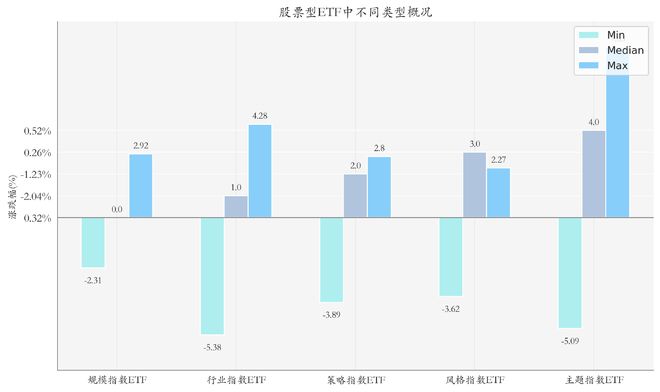
Market Overview - The Shanghai Composite Index fell by 1.3% to 3820.09 points, with a weekly high of 3899.96 points [1] - The Shenzhen Component Index rose by 1.14% to 13070.86 points, reaching a high of 13328.1 points [1] - The ChiNext Index increased by 2.34% to 3091.0 points, with a peak of 3168.68 points [1] - Global markets saw major indices rise, with the Nasdaq Composite up by 2.21%, the Dow Jones Industrial Average up by 1.05%, and the S&P 500 up by 1.22% [1] - In the Asia-Pacific region, the Hang Seng Index rose by 0.59% and the Nikkei 225 Index increased by 0.62% [1] ETF Market Performance - The median weekly return for stock ETFs was 0.08% [2] - The highest weekly return among scale index ETFs was 2.92% for the Jiashi ChiNext 50 ETF [2] - The highest weekly return among industry index ETFs was 4.28% for the China Tai Zhongzheng 800 Automotive and Parts ETF [2] - The highest weekly return among thematic index ETFs was 7.83% for the Huaxia Shanghai Stock Exchange Sci-Tech Innovation Board Semiconductor Materials Equipment Theme ETF [2] ETF Liquidity and Fund Flow - Average daily trading volume for stock ETFs increased by 26.0%, while average daily turnover remained unchanged [6] - The top five stock ETFs with the highest fund inflows included the Southern Zhongzheng 500 ETF with an inflow of 728 million yuan [8] - The top five stock ETFs with the highest fund outflows included the E Fund ChiNext ETF with an outflow of 658 million yuan [9] ETF Financing and Margin Trading - The financing balance for stock ETFs decreased from 45.329 billion yuan to 43.734 billion yuan [10] - The highest financing buy amount was 764 million yuan for the Huaxia Shanghai Stock Exchange ChiNext 50 Component ETF [10] ETF Market Size - The total market size for ETFs reached 5267.037 billion yuan, an increase of 23.954 billion yuan from the previous week [14] - Stock ETFs accounted for 66.9% of the total ETF market size, with a total size of 3526.187 billion yuan [16] New ETF Issuance - No new ETFs were issued last week, but 19 new ETFs were established, including various thematic and bond ETFs [17] Industry Insights - The advanced packaging industry is expected to see significant growth opportunities due to the slowdown of Moore's Law and limitations in advanced process technology [17] - The semiconductor industry is projected to experience a bottom reversal in its economic cycle, with Q2 2025 revenues reaching 1700.23 billion yuan, a year-on-year increase of 15.2% [19]
高澜股份股价涨5.1%,博时基金旗下1只基金重仓,持有17.58万股浮盈赚取28.66万元
Xin Lang Cai Jing· 2025-09-22 02:10
Company Overview - Guangzhou Highlan Technology Co., Ltd. is located in the Science City of Guangzhou, Guangdong Province, and was established on June 29, 2001. The company went public on February 2, 2016. Its main business involves the research, design, production, and sales of pure water cooling equipment and control systems for high-power electronic devices [1]. Business Segmentation - The revenue composition of the company is as follows: 53.54% from high-power electronic thermal management products, 32.78% from high-density device thermal management products, 10.52% from engineering operation and maintenance services, and 3.15% from other sources [1]. Stock Performance - On September 22, the stock price of Highlan increased by 5.1%, reaching 33.61 CNY per share, with a trading volume of 641 million CNY and a turnover rate of 7.20%. The total market capitalization is 10.259 billion CNY [1]. Fund Holdings - According to data, one fund under Bosera Asset Management holds a significant position in Highlan. The Bosera Specialized and New Theme Mixed A Fund (014232) held 175,800 shares in the second quarter, accounting for 0.69% of the fund's net value, ranking as the eighth largest holding. The estimated floating profit today is approximately 286,600 CNY [2]. Fund Performance - The Bosera Specialized and New Theme Mixed A Fund was established on December 6, 2021, with a current scale of 236 million CNY. Year-to-date, it has achieved a return of 48.04%, ranking 1051 out of 8244 in its category. Over the past year, the return is 101.03%, ranking 528 out of 8066, and since inception, the return is 28.48% [2]. Fund Management - The fund managers of Bosera Specialized and New Theme Mixed A are Guo Xiaolin and Liu Yuqiang. Guo has a tenure of 9 years and 67 days, with a total fund asset size of 1.739 billion CNY, achieving a best return of 150.46% and a worst return of -38.97% during his tenure. Liu has a tenure of 2 years and 235 days, managing assets of 2.072 billion CNY, with a best return of 44.7% and a worst return of 6.09% [3].

金价回落后再次冲高,黄金ETF基金(159937)开盘涨超1.3%
Sou Hu Cai Jing· 2025-09-22 01:57
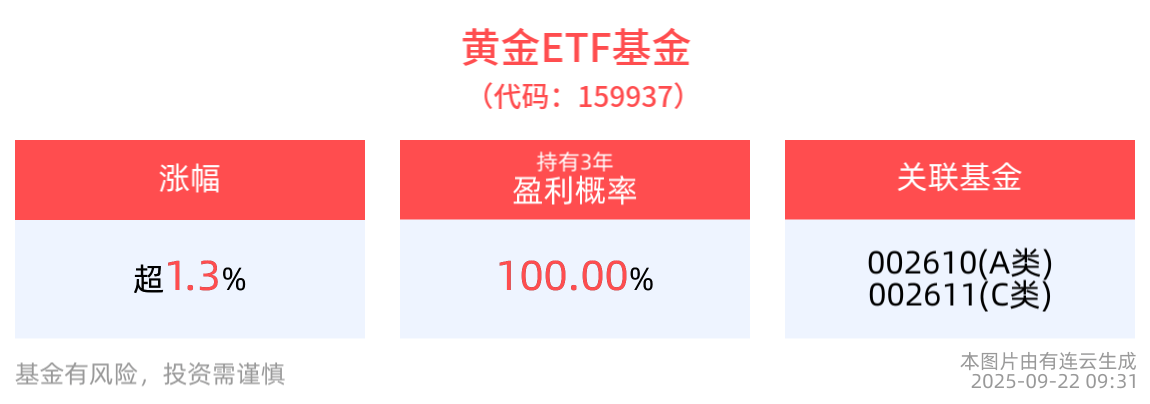
Core Viewpoint - The gold ETF fund (159937) has shown resilience and an upward trend in response to the Federal Reserve's monetary policy adjustments, with a significant probability of further rate cuts anticipated [2][3]. Group 1: Gold ETF Fund Performance - As of September 22, 2025, the gold ETF fund increased by 1.36%, with a latest price of 7.99 yuan [2]. - Over the past two weeks, the gold ETF fund has accumulated a rise of 1.59% [2]. - The fund's liquidity is reflected in a turnover rate of 0.04% and a transaction volume of 10.83 million yuan [2]. Group 2: Federal Reserve's Monetary Policy - The Federal Reserve has entered a monetary easing cycle, with a 91.9% probability of a 25 basis point rate cut in October [2][3]. - The recent decision to lower the target range by 25 basis points to 4.0%–4.25% indicates potential for two more rate cuts within the year [2]. - Fed Chair Powell emphasized a cautious approach, balancing inflation risks and employment downturns, while political pressures will not influence decisions [2]. Group 3: Market Dynamics and Investor Behavior - Investors are advised to focus on fluctuations in the Federal Reserve's monetary policy expectations, as well as economic, employment, and inflation data [3]. - Leverage funds are actively positioning themselves, with a net financing amount of 40.83 million yuan on the previous trading day and a total financing balance of 3.562 billion yuan [3]. - The BoShi Gold ETF (159937) closely tracks domestic gold spot prices, offering convenient trading options and low fees, suitable for both short-term and long-term investment strategies [3].
券商分析师数量已突破6000大关,创历史新高;境内债券ETF总规模突破6000亿元 | 券商基金早参
Mei Ri Jing Ji Xin Wen· 2025-09-22 01:52
Group 1: Brokerage Firms Restructuring - The trend of brokerage firms downsizing continues, with 19 firms closing a total of 43 branches since August, despite rising investor trading sentiment as the Shanghai Composite Index breaks key levels [1] - The shift from expansion to efficiency improvement indicates a transformation in the brokerage industry, moving from a focus on scale to enhancing operational efficiency and cost structure [1] - This optimization is expected to enhance long-term value release and lead to a differentiation in competitive strategies among firms, with larger firms consolidating their market positions while smaller firms seek unique paths [1] Group 2: Analyst Workforce Growth - The number of brokerage analysts has surpassed 6,000, marking a historical high, but the industry faces challenges as the market for commissions shrinks due to public fund fee reforms, leading to a decline of over 30% in commission income [2] - Large brokerages primarily focus on internal training for analysts, while smaller firms rely on external recruitment, highlighting a disparity between workforce expansion and market contraction [2] - The urgent need for research departments to diversify income sources beyond commissions is evident, as some leading firms begin to slow their hiring pace [2] Group 3: Surge in Index Enhanced Funds - The number of newly established index-enhanced funds has surged by 207% year-on-year, with 129 new products launched this year, surpassing the total number and scale of the previous two years combined [3] - The total scale of these new funds reached 72.843 billion, indicating a growing investor preference for low-cost and transparent investment strategies [3] - This trend is expected to stimulate product innovation among fund companies and enhance market liquidity, contributing positively to overall market efficiency and stability [3] Group 4: Growth of Bond ETFs - The total scale of domestic bond ETFs has exceeded 600 billion, reaching 607.448 billion, with 53 bond ETFs now available, reflecting strong demand for fixed-income products [4] - Major institutions like Bosera and Hai Fu Tong lead in product scale, indicating a concentration of funds towards high-quality assets [4] - The influx of over 374 billion into bond ETFs this year suggests accelerated market expansion and may provide liquidity support to the stock market while reflecting a shift in investor risk appetite [4]
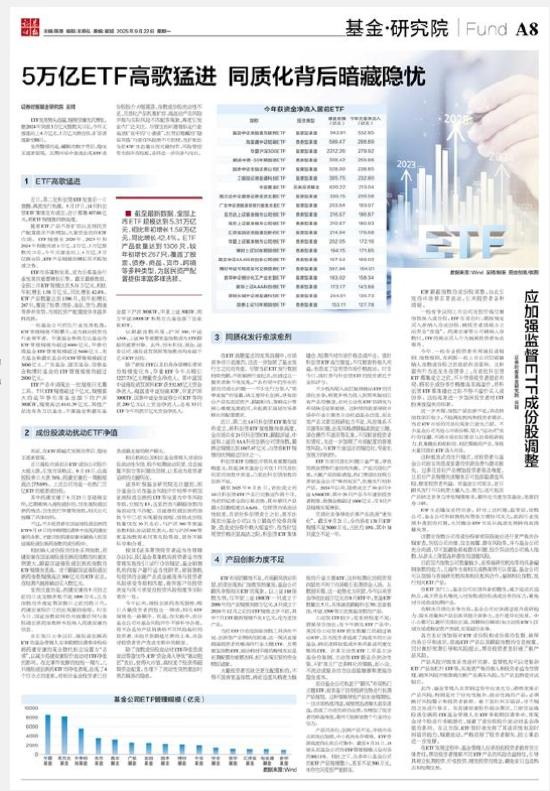
5万亿市场高歌猛进!ETF高速发展背后这些隐忧不可轻忽
Zhong Guo Jing Ji Wang· 2025-09-22 01:29
Core Insights - The rapid growth of ETFs has led to significant milestones, with the total scale surpassing 5 trillion yuan this year, marking a 42.4% year-on-year increase [2][3] - Despite the impressive growth, underlying risks are emerging, including stock price volatility of ETF components, liquidity issues, and mismatched risk ratings [1][5][7] Industry Growth - The ETF market has seen a surge in new products, with the recent launch of 14 science and technology bond ETFs raising a total of 407.86 billion yuan [2] - The total number of listed ETFs has reached 1,306, providing diverse options for asset allocation [2] Major Players - Leading fund companies in the ETF space include Huaxia Fund and E Fund, each managing over 800 billion yuan in ETFs [3] - The largest ETF is the Huatai-PB CSI 300 ETF, with a scale of 4,141.39 billion yuan [3] Fund Inflows - This year, existing ETFs attracted a net inflow of 522.77 billion yuan, with several ETFs receiving over 200 billion yuan in net inflows [4] Market Concerns - Recent volatility in component stocks of ETFs has raised concerns, particularly with stocks like Yaojie Ankang experiencing significant price swings [5][6] - The mismatch between the high volatility of certain indices and their risk ratings has been criticized, as seen with the National Index Hong Kong Stock Connect Innovative Drug ETF [7] Homogeneity Issues - The ETF market is facing challenges of product homogeneity, with many funds lacking differentiation and competing in a crowded space [8][10] - The proliferation of similar products has led to a significant number of ETFs being underperforming or facing liquidation [10][12] Innovation Deficit - There is a noted lack of innovative products in the ETF market, with many fund companies following trends rather than developing unique offerings [11][12] - The concentration of resources among a few leading firms has made it difficult for smaller companies to compete effectively [12]
中信建投:美联储降息背景下黄金ETF资金流向如何?
智通财经网· 2025-09-22 00:16
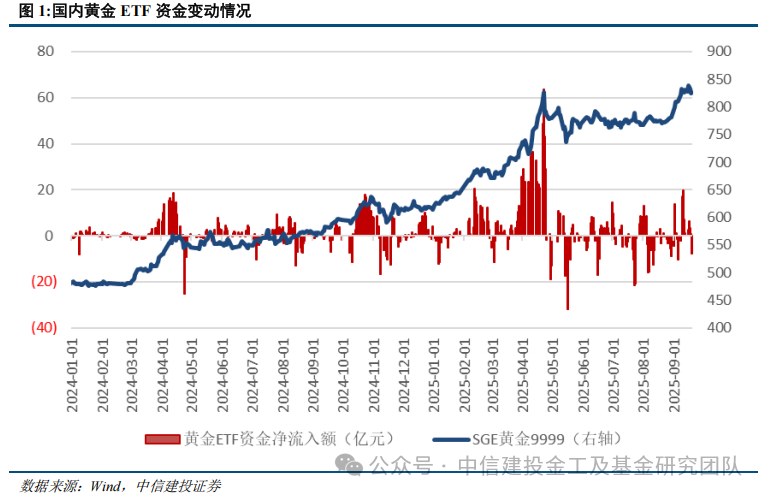
Core Viewpoint - The report highlights a significant increase in gold ETF investments driven by the Federal Reserve's interest rate cuts, geopolitical uncertainties, and central bank gold purchases, emphasizing the long-term value of gold as an investment asset [1][10]. Group 1: Gold Price and ETF Performance - Shanghai gold reached a new high of 838.42 yuan per gram, with domestic gold ETF total assets reaching 155.67 billion yuan, a 120% increase from the end of last year [1][2]. - The performance of gold ETFs is closely linked to gold price movements, with COMEX gold prices rising over 10% in the past month, reaching 3,719.4 USD per ounce [2][3]. - Several gold ETFs, including the Yongying CSI Hong Kong-Shenzhen Gold Industry Stock ETF and Huaxia CSI Hong Kong-Shenzhen Gold Industry Stock ETF, saw net asset value increases exceeding 15% in the last month [2][3]. Group 2: Factors Supporting Gold Prices - Weak U.S. economic data and expectations of interest rate cuts have made gold more attractive, with investors seeking to hedge against currency depreciation [3][4]. - The trend of de-dollarization and increased gold purchases by central banks, particularly in emerging markets, has provided strong support for gold prices [4][7]. - Strong performance in gold mining stocks, driven by rising gold prices and increased production, has attracted more capital into the gold market [4][5]. Group 3: Fund Flows in Gold ETFs - Since September, gold ETFs have seen a reversal from the net outflows experienced in August, with a total inflow of 4.774 billion yuan as of September 19 [5][6]. - The Yongying CSI Hong Kong-Shenzhen Gold Industry Stock ETF had the largest net subscription, totaling 2.548 billion shares, followed by Huaxia and Huazhong ETFs [5][6]. - The overall fund flow in gold ETFs has been complex, influenced by market conditions, economic data, and policy expectations, with significant inflows observed earlier in the year [5][6]. Group 4: Global Gold ETF Holdings - Since 2025, the holdings of six major global gold ETFs have increased by 203.28 tons, with significant contributions from SPDR and iShares [7][10]. - The increase in gold ETF holdings reflects investor confidence in gold as a safe-haven asset amid ongoing geopolitical risks and economic uncertainties [7][10].

5万亿市场高歌猛进!这些隐忧不可轻忽
Zheng Quan Shi Bao· 2025-09-21 23:54
Core Insights - The ETF market is experiencing rapid growth, surpassing 5 trillion yuan in total assets, with significant milestones achieved in 2024 and 2023 [4][8][7] - Despite the impressive growth figures, underlying issues such as stock price volatility, liquidity concerns, and product homogeneity are emerging, raising alarms within the industry [4][7][11] - The rapid expansion of ETFs has highlighted deficiencies in risk management and ecological construction within the ETF ecosystem, necessitating improvements [4][7] Market Growth - The total size of the ETF market reached 5.31 trillion yuan, reflecting a year-to-date increase of 1.58 trillion yuan, which is a 42.4% year-on-year growth [8][9] - The number of listed ETFs has grown to 1,306, with a notable increase of 267 products since the beginning of the year, covering various asset classes [8][9] Fund Management - Leading fund companies such as Huaxia Fund and E Fund have surpassed 800 billion yuan in ETF management scale, while several others have also achieved significant milestones [9] - Seven ETFs have exceeded 100 billion yuan in scale, with the largest being Huatai-PB's CSI 300 ETF at 414.14 billion yuan [9] Investment Trends - A total of 5.227 trillion yuan in net inflows has been recorded for existing ETFs this year, with several funds attracting over 200 billion yuan in net inflows [10] - The influx of funds into ETFs has led to a "passive crowding" effect, concentrating excess capital in large-cap stocks, which poses risks during liquidity withdrawals [13] Homogeneity and Innovation Issues - The ETF market is facing significant homogeneity, with many products lacking differentiation, leading to resource wastage and structural imbalances [14][16] - The emergence of numerous similar products has resulted in a high number of ETFs facing liquidation, with over 30 A500 ETFs launched this year, most of which have seen significant outflows [16] Risk Management Concerns - Recent volatility in ETF component stocks has raised concerns about liquidity and the adequacy of risk ratings, particularly for high-volatility products [11][12] - The mismatch between risk ratings and actual product volatility has been criticized, as some funds are rated similarly to more stable indices despite their higher risk profiles [12][13] Market Dynamics - The competitive landscape among fund issuers is intensifying, with many companies engaging in "copycat" strategies rather than pursuing innovative product development [14][18] - The lack of proactive ETF strategies has led to a concentration of resources among a few leading firms, with 89.11% of ETF management scale held by 15 top companies [18]
机构研究周报:恒生科技利率敏感性高,美联储年内或再降息两次
Wind万得· 2025-09-21 22:36
Core Insights - The article highlights the increasing preference for Hong Kong's technology sector, particularly the Hang Seng Tech Index, due to its high sensitivity to interest rates and the anticipated further rate cuts by the Federal Reserve [1][3]. Group 1: Monetary Policy and Market Impact - The Federal Reserve has lowered the federal funds rate by 25 basis points to a range of 4.00%-4.25%, marking the first rate cut in nine months [3]. - The Fed's dot plot indicates a downward revision in the long-term federal funds rate expectations for 2025-2028, suggesting a more accommodative monetary policy environment [3]. - The anticipated weakening of the US dollar and the release of global liquidity may lead to a reallocation of funds towards Chinese capital markets, benefiting RMB assets [3]. Group 2: Equity Market Trends - Recent market performance shows a divergence between stock market strength and weak economic data, with a few tech stocks driving significant index gains [5]. - The market is expected to transition from extreme differentiation to a more balanced rotation, focusing on sectors with strong industrial trends such as internet, innovative pharmaceuticals, and new energy [6]. - The Hong Kong stock market has seen significant gains due to rate cut expectations and positive sentiment around the AI industry, with the Hang Seng Index reaching its highest level since 2021 [7]. Group 3: Industry Research - The AI sector is rapidly advancing, with domestic capabilities in AI hardware and models narrowing the gap with international standards, creating investment opportunities in related industries [9]. - The Chinese AI chip market is projected to reach nearly $50 billion, with increasing domestic demand for local chips as international supply becomes constrained [10]. - The Hang Seng Tech Index is particularly favored by foreign capital due to its offshore characteristics and relatively low valuations, making it a key area for investment during the current rate cut cycle [11]. Group 4: Macro and Fixed Income - Morgan Asset Management suggests a higher probability of two additional rate cuts by the Federal Reserve this year, which may enhance the appeal of long-duration government bonds [13]. - The ongoing dual expansion of fiscal and monetary policy is expected to continue, with a focus on sectors like digital economy and green transition [14]. - The macroeconomic environment is likely to remain accommodative, with expectations of increased monetary policy easing, which could provide better entry points for domestic bond markets [15].

ETF百亿俱乐部迎新 增量资金有望持续涌入
Zhong Guo Zheng Quan Bao· 2025-09-21 20:17
Group 1 - The equity market is experiencing a strong inflow of funds into popular ETFs, with new members joining the "100 billion club" such as E Fund's National Robot Industry ETF and Yongying's CSI Hong Kong and Shanghai Gold Industry ETF [1] - As of September 19, there are five gold-themed ETFs in the domestic market with assets exceeding 10 billion yuan, including Huaan Gold ETF, which has returned to a scale of 60 billion yuan [1] - The recent rise in gold prices is linked to the inflow of funds from European and American investors, driven by expectations of interest rate cuts by the Federal Reserve [2][3] Group 2 - The E Fund's Robot ETF has seen significant growth, with a net inflow of 8.76 billion yuan this year, reflecting high investor confidence in the humanoid robot industry's development prospects [2][3] - The humanoid robot industry is experiencing technological breakthroughs and increased commercialization, with companies like Tesla and UBTECH receiving substantial orders [3] - Fund managers suggest that the market is likely to continue its upward trend in the second half of the year, encouraging investors to hold onto their positions rather than sell prematurely [3][4]