中科曙光

Search documents
科技当自立,聚焦三大主线
Tianfeng Securities· 2025-10-12 14:12
Investment Rating - Industry rating is maintained at "Outperform the Market" [5] Core Viewpoints - The report emphasizes the acceleration of domestic software localization in response to global technology competition and supply chain security demands, indicating that domestic software has the capability to replace foreign counterparts [1][2] - The ecosystem for basic software is rapidly improving, with significant advancements in operating systems and application software localization rates, particularly in ERP software, which has reached a localization rate of 70% [2] - Quantum technology is highlighted as a critical area for national strategic development, with significant investments and policy support from the government, positioning it as a key future industry [3] Summary by Sections Domestic Software Localization - The report notes that key basic software is becoming increasingly self-sufficient, with domestic software showing strong potential for rapid localization [1] - As of 2022, the number of adaptations for operating systems like Tongxin Software and Kirin Software has reached over 530,000 and 440,000 respectively [2] Application Software Localization - The report identifies that while the localization rate for management software (ERP) is at 70%, there is still room for improvement in other areas such as manufacturing software (50%) and R&D design software (10%) [2] Quantum Technology - The report discusses the implications of quantum computing advancements, particularly in relation to national security and information safety, as major companies like Google and IBM are making significant strides in this field [3] - The Chinese government has initiated over 100 supporting policies to promote the development of quantum technology, indicating its strategic importance [3] Investment Opportunities - The report suggests focusing on companies involved in self-sufficiency in software and hardware, including operating systems, chips, industrial software, and quantum technology [4]
紫光股份(000938):AI业务全面高增助力收入加速增长
Haitong Securities International· 2025-10-12 13:32
Investment Rating - The report maintains an "Outperform" rating for the company, projecting significant revenue and profit growth over the next few years [3][7]. Core Insights - The company is expected to achieve revenues of RMB 95.2 billion, RMB 114.7 billion, and RMB 136.2 billion for the years 2025, 2026, and 2027 respectively, with net profits attributable to shareholders of RMB 2.04 billion, RMB 2.71 billion, and RMB 3.36 billion during the same period [3][7]. - The quarterly revenue has shown acceleration, with a 24.96% year-on-year increase in 2025H1, reaching RMB 47.43 billion [3][7]. - The growth in the internet business is significant, with a 37.75% increase in revenue for New H3C in 2025H1, driven by strong demand in the internet sector [3][7]. Financial Summary - The total revenue for 2023 is projected at RMB 77.31 billion, with a growth rate of 4.4%. By 2027, revenue is expected to reach RMB 136.23 billion, reflecting an 18.8% growth rate [2][4]. - Net profit attributable to shareholders is forecasted to decline to RMB 2.10 billion in 2023, but is expected to recover to RMB 3.36 billion by 2027, with corresponding EPS increasing from RMB 0.74 to RMB 1.17 [2][4]. - The gross profit margin for 2025H1 was reported at 15.24%, a decrease of 3.80 percentage points year-on-year [3][7]. Business Segments - The domestic government and enterprise revenue for New H3C reached RMB 31.04 billion in 2025H1, a 53.55% increase, while international revenue grew by 60.25% to RMB 1.92 billion [3][7]. - The ICT infrastructure and services revenue was RMB 36.04 billion in 2025H1, with a gross profit margin of 18.06%, down 6.32 percentage points year-on-year [3][7]. Inventory and Liabilities - As of the end of 2025H1, inventory stood at RMB 43.84 billion, up 19.0% from the beginning of the year, while contractual liabilities increased by 9.7% to RMB 15.91 billion [3][7].

预计25Q3剪刀差持续:计算机行业2025Q3业绩前瞻
Shenwan Hongyuan Securities· 2025-10-12 12:01
Investment Rating - The report maintains a positive outlook for the computer industry, expecting a continued "scissor difference" in Q3 2025, indicating structural growth despite varying performance among companies [3][4][11]. Core Insights - The report predicts that 22% of the tracked companies will see net profit growth exceeding 50%, with notable performers including 深信服 (1528%), 卡莱特 (998%), and 新国都 (235%) [4][5]. - The report highlights a trend of cost reduction through layoffs and non-essential cost cuts, leading to improved efficiency and profitability across the industry [3][4]. - The report identifies key investment targets in various segments, including AIGC, digital economy leaders, and data innovation [3][4]. Summary by Sections Q3 2025 Performance Forecast - Among 54 tracked companies, 11 are expected to exceed 50% profit growth, while 9 will see growth between 30%-50% [4][5]. - 36% of companies are projected to have growth between 0%-30%, and 22% are expected to experience a decline [5][6]. Key Company Performances - 深信服 is projected to achieve a staggering 1528% profit growth, while 卡莱特 is expected to see 998% growth [4][5]. - Companies like 海康威视 and 金山办公 are expected to maintain stable growth rates of around 9% and 15%, respectively [8][10]. - 联想集团 is forecasted to face a significant decline of 99% in profit, indicating challenges in its operational strategy [6][10]. Investment Targets - The report categorizes investment targets into four segments: AIGC, digital economy leaders, data innovation, and AIGC computing power [3][4]. - Notable companies in the AIGC segment include 金山办公 and 道通科技, while 海光信息 and 软通动力 are highlighted in the data innovation category [3][4].



行业周报:重视信创板块投资机会-20251012
KAIYUAN SECURITIES· 2025-10-12 05:05
Investment Rating - The investment rating for the computer industry is "Positive" (maintained) [1] Core Insights - The report emphasizes the importance of investing in the domestic innovation sector due to increasing external pressures, including the U.S. imposing software export controls and tariffs on China [6][14] - Continuous policy support and funding are expected to accelerate the development of the industry, with significant government initiatives aimed at enhancing domestic production and technology independence [7][15] - Huawei's announcement of its chip development roadmap and the launch of the domestic operating system "Galaxy Kirin V11" indicate ongoing improvements in the domestic innovation ecosystem [8][16] Summary by Sections Market Review - During the week of October 9-10, 2025, the CSI 300 index fell by 0.51%, while the computer index decreased by 1.83% [5][13] Weekly Perspective - The report highlights the need to focus on investment opportunities in the domestic innovation sector, particularly in light of the U.S. export controls on critical software [6][14] Policy Catalysts - The Ministry of Industry and Information Technology and the State Administration for Market Regulation have issued plans to support the electronic information manufacturing industry, emphasizing the promotion of domestic products and technology [7][15] Company Dynamics - The report mentions that Sucen Technology has announced the acquisition of a 55% stake in Kunyu Lancheng Technology, indicating strategic expansion efforts [18] Investment Recommendations - Recommended domestic software companies include Kingsoft Office, Dameng Data, and others, while key domestic computing power companies include Haiguang Information and Inspur Information [9][17]


计算机行业周观点第41期:OpenAI动作不断AI迎密集催化,美国或将对所有关键软件实施出口管制-20251012
Western Securities· 2025-10-12 00:39
Investment Rating - The report assigns an "Overweight" rating to the computer industry, indicating an expected increase in the sector's performance exceeding the market benchmark by over 10% in the next 6-12 months [7]. Core Insights - OpenAI's release of the Sora 2 AI video generation model marks a significant advancement in physical accuracy, consistency, and controllability, potentially leading to a new era in video technology akin to the "GPT-3.5 moment" [1]. - The Sora app, based on Sora 2, has achieved over 1 million downloads within five days of its launch, surpassing the download speed of ChatGPT, indicating its potential as a landmark application in the AI era [1]. - OpenAI's collaboration with AMD to deploy 6GW of AMD GPUs, starting with an initial 1GW, highlights the growing demand for advanced computing power in AI applications [3]. - The U.S. government's announcement of export controls on all critical software emphasizes the urgency for domestic software alternatives, creating opportunities for local software companies [3]. Summary by Sections AI Developments - The Sora 2 model introduces improvements in adherence to physical laws, logical consistency in virtual environments, and audio-visual synchronization [1]. - The Sora app allows users to create and remix AI-generated content, enhancing user engagement and creativity [1]. Strategic Partnerships - OpenAI's partnership with AMD includes a potential acquisition of up to 160 million shares, which could result in OpenAI holding a 10% stake in AMD if fully executed [3]. Market Implications - The U.S. export controls on software are expected to create a "golden window" for domestic software development, accelerating the self-sufficiency of China's software industry [3]. - The report suggests monitoring various companies in the software and AI sectors, including Hikvision, Cambricon, and Kingsoft, among others, for potential investment opportunities [4].
汇视威发布视觉基座大模型“橘洲”V1.5端侧版,完成安卓端全面适配
Chang Sha Wan Bao· 2025-10-11 12:48
Core Insights - The article discusses the launch of the "Juzhou" V1.5 edge version by Hunan Huishiwei, marking a significant advancement in the deployment of domestic AI visual models across platforms and ecosystems [1][3]. Group 1: Product Development - The "Juzhou" V1.5 version has achieved comprehensive adaptation for Android, expanding from its initial iOS platform, thus enabling cross-system and full-terminal deployment [3][4]. - Key technical upgrades in "Juzhou" V1.5 include hardware optimization, intelligent content safety enhancements, and improved generation speed, achieving 1024×1024 image generation in 5 seconds on Snapdragon 8 Gen 5 Elite devices [4][6]. Group 2: Application Scenarios - "Juzhou" V1.5 is being rapidly implemented in various industry applications, including a deep-sea model terminal X1 that supports underwater robotics and autonomous observation [6]. - The "Mojie" application leverages AI to create poetry and art from user inputs, allowing users to generate unique content without requiring advanced skills [6]. Group 3: Partnerships and Support - The rapid iteration of "Juzhou" is supported by partnerships with companies like Zhongke Shuguang, which provides technological backing and support for the model's commercial training platform [9]. - China Telecom's Changsha branch is committed to supporting "Juzhou" through cloud-network integration and ensuring efficient data transmission for its applications in smart parks and factories [9].

芜湖算力“突围”,如何改写安徽AI产业机遇?
AI研究所· 2025-10-11 11:33
Core Viewpoint - Wuhu, a city in the Yangtze River Delta, is emerging as a global technology hub with the establishment of the "China Digital Island," a key part of the national "East Data West Computing" project, which aims to enhance AI computing capabilities [1][2]. Group 1: Industrial Strength Supporting Computing Infrastructure - The "China Digital Island" is backed by Wuhu's long-standing industrial strength, particularly in the low-altitude economy, where it has developed a complete industrial ecosystem over 12 years [4][5]. - By 2025, Wuhu has gathered nearly 200 companies in the low-altitude economy sector, achieving a revenue of 46.38 billion yuan in 2024, reflecting a year-on-year growth of 15.95% [6]. - Wuhu's low-altitude equipment has entered international markets, exemplified by a $1 billion procurement agreement with UAE's Autocraft for 350 eVTOL air taxis, positioning Wuhu as a global production center for low-altitude equipment [9]. - The automotive industry, led by Chery, provides a solid demand foundation for computing development, with smart vehicles driving the need for low-latency data processing [10]. Group 2: Opportunities for AI Industry in Anhui - The large-scale construction of the "China Digital Island" is set to transform Anhui's computing distribution, enabling local demand to be met locally and creating a surplus of computing resources [13]. - Wuhu's centralized scheduling platform for computing resources is the only provincial-level platform, enhancing efficiency and preventing redundant investments in other cities [16]. - The presence of major companies like Huawei and China Telecom in Wuhu is fostering the growth of supporting industries, creating a "leading enterprise + local support" model for AI hardware manufacturing [16]. - The integration of computing infrastructure with local industries is expected to enhance the application of AI technologies in smart manufacturing and urban governance [17]. Group 3: Future Prospects - Wuhu is on a transformative path from an industrial hub to a computing city, positioning itself as a strategic point for the rise of the AI industry in Anhui [20]. - The convergence of low-altitude economy, smart vehicles, and computing capabilities may establish Wuhu as a benchmark for computing economy and AI innovation in the Yangtze River Delta and nationwide [20][21].




再次站定C位,科创板怎么投?ETF全景图拿走不谢!
市值风云· 2025-10-11 10:09
Core Insights - The article emphasizes the significant growth and investment opportunities in the hard technology sector, particularly through the STAR Market, which has seen a cumulative increase of 123.9% since the "9·24" market rally in 2024 [4][5]. Group 1: STAR Market and Hard Technology - The STAR Market has become a crucial platform for hard technology development in China since its inception in July 2019, aiming to support hard tech enterprises and cultivate new productive forces [7]. - The strong performance of companies like Cambrian has highlighted the market's potential, with Cambrian's stock price surpassing 1500 yuan, indicating high market recognition for hard tech firms [7][12]. - The rapid approval of IPOs, such as Moores Threads' 8 billion yuan fundraising, showcases the STAR Market's efficiency and attractiveness for investors [9]. Group 2: ETF Growth and Investment Opportunities - The number and scale of STAR Market ETFs have experienced explosive growth, providing ordinary investors with accessible tools to invest in hard technology [6]. - The restructuring between Haiguang Information and Zhongke Shuguang is seen as a pivotal event, enhancing the quality and attractiveness of STAR Market ETFs [22][23]. - Following the merger announcement, related ETFs saw significant capital inflows, with some funds experiencing a nearly sevenfold increase in scale [26]. Group 3: ETF Product Landscape - As of now, there are 115 STAR Market ETFs listed, with approximately 96 focused on the STAR Market, totaling an asset value of 284.5 billion yuan, which is over ten times the scale of the initial ETFs launched in 2020 [29]. - The STAR Market 50 ETF has become a cornerstone of the market, with a significant portion of its assets concentrated in semiconductor companies, which represent about 65% of its index composition [31][35]. - The STAR Market 50 ETF has seen a price increase of nearly 50% since July, contributing to a substantial rise in its total asset scale [32].




国产阵营加码超节点:华为阿里领跑,AI算力走向系统级效率
Bei Ke Cai Jing· 2025-10-11 07:53
Core Insights - The demand for AI computing power is accelerating from single-point breakthroughs to system-level integration, with "super nodes" emerging as a new product form to overcome traditional computing bottlenecks [1][2] - Major Chinese tech companies are leading the development of super nodes, with Huawei and Alibaba launching advanced AI server products that significantly enhance computing capabilities [1][4] Group 1: Super Node Development - The super node architecture is defined as an AI system composed of AI computing nodes interconnected through high-speed protocols, supporting 32 or more AI chips with bandwidth of at least 400GB/s [2] - Huawei's CloudMatrix384 super node integrates 384 Ascend NPUs and 192 Kunpeng CPUs, achieving a single-card inference throughput of 2300 Tokens/s [1][3] - Alibaba's new generation Panjiu 128 super node AI server features self-developed CIPU 2.0 chips and supports 128 AI computing chips in a single cabinet [1][4] Group 2: Global AI Infrastructure Trends - Global tech giants like NVIDIA, OpenAI, and Meta are accelerating AI infrastructure development, with significant investments planned for the coming years [1][7] - OpenAI has partnered with AMD to deploy 6 gigawatts of AMD GPU computing power, and plans to use NVIDIA systems for its next-generation AI infrastructure [7][8] - NVIDIA executives project that AI infrastructure spending will reach $3 trillion to $4 trillion by 2030, indicating a robust growth trajectory for the sector [9][10] Group 3: Industry Challenges and Opportunities - The AI computing landscape faces challenges such as communication walls, power consumption, and complexity, necessitating the development of super nodes [2] - The core challenge for the domestic computing industry lies in the maturity of the ecosystem, despite opportunities arising from advancements in chip manufacturing and other related fields [5][6]

两市主力资金净流出近930亿元 交通运输等行业实现净流入
Zheng Quan Shi Bao Wang· 2025-10-11 01:25
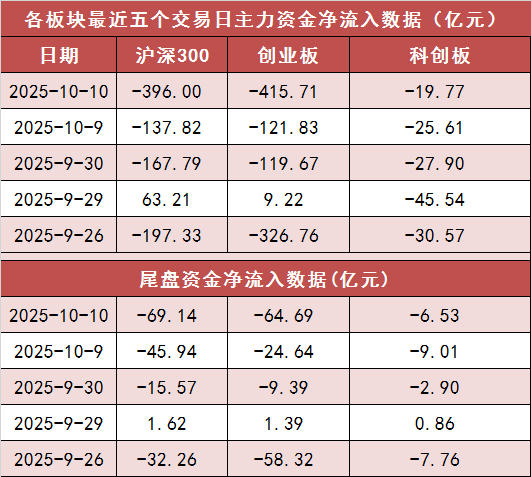
Market Overview - On October 10, the A-share market experienced an overall decline, with the Shanghai Composite Index closing at 3897.03 points, down 0.94%, the Shenzhen Component Index at 13355.42 points, down 2.7%, and the ChiNext Index at 3113.26 points, down 4.55% [1] - The total trading volume for both markets was 25156.14 billion yuan, a decrease of 1375.83 billion yuan compared to the previous trading day [1] Capital Flow - The net outflow of main funds from both markets reached nearly 930 billion yuan, with an opening net outflow of 344.05 billion yuan and a closing net outflow of 150.74 billion yuan [1] - The CSI 300 index saw a net outflow of 396 billion yuan, while the ChiNext experienced a net outflow of 415.71 billion yuan [1] Sector Performance - The transportation sector achieved a net inflow of 17.90 billion yuan, with a growth of 1.12% [3] - Other sectors with net inflows included building materials (13.59 billion yuan, up 1.64%), petroleum and petrochemicals (13.29 billion yuan, up 1.36%), public utilities (12.95 billion yuan, up 1.49%), and coal (11.44 billion yuan, up 1.98%) [3] - Conversely, the electronics sector faced significant outflows of 465.95 billion yuan, down 2.93%, followed by the computer sector with a net outflow of 306.10 billion yuan, down 2.07% [3] Institutional Activity - The top stocks with institutional net buying included Deep Technology (34.14 million yuan, up 3.46%), Dawi Co. (6.07 million yuan, down 0.78%), and Chuling Information (4.24 million yuan, up 12.94%) [5] - Notable stocks with significant institutional net selling included Guo Xuan High-Tech (722.41 million yuan, down 9.96%) and Blue丰 Biochemical (1429.17 million yuan, down 10.04%) [5] Institutional Focus - Recent institutional ratings highlighted stocks such as Kaipu Cloud with a target price of 299.52 yuan, indicating a potential upside of 33.27% from the latest closing price [7] - Other stocks receiving attention included Tonglian Precision and Sairisi, with respective target price increases of 38.96% and 18.69% [7]