石头科技

Search documents
黑猫投诉2025年日用电器领域投诉数据报告:投诉量超3万件 智能清洁机器人投诉量居首
Xin Lang Cai Jing· 2026-02-03 07:52
Group 1 - The core complaint volume in the daily appliance industry exceeded 32,000 cases in 2025, marking a 23.07% increase compared to 2024, driven by enhanced national subsidy policies that expanded appliance consumption [1][11] - The complaint trend showed a clear pattern of "promotion-driven, summer peak," with significant spikes during major promotional events like "618" and "Double 11," and a peak of 192 complaints per day in July due to the arrival of the second batch of subsidy funds and high summer temperatures [1][11] Group 2 - The main complaint issues in the daily appliance industry include after-sales service problems, product quality issues, and difficulties with returns/refunds [2][12] - After-sales service problems accounted for 40.33% of complaints, while product quality issues made up 25.52%, and difficulties with returns/refunds constituted 25.31% [3][13] Group 3 - Smart cleaning robots had the highest complaint rate at 23.33%, primarily due to issues with navigation and obstacle avoidance, while air conditioning complaints accounted for 17.91%, focusing on installation fee disputes and cooling/heating failures [4][15] - Complaints involving amounts between 1,001 and 5,000 yuan represented the highest proportion at 42.17%, with issues centered on high-end smart appliances and major appliances like air conditioners and refrigerators [5][16] Group 4 - The overall complaint handling situation was positive, with a high response rate from most companies, exceeding 98%, including brands like Tineco, Ecovacs, and Midea, which had response rates above 99% [6][17]

国信证券:原材料价格上涨对白电龙头影响有限 白电排产表现有所修复
智通财经网· 2026-02-03 07:32
Core Viewpoint - Recent increases in raw material prices, particularly copper and aluminum, have raised concerns about the profitability of leading white goods companies, but historical data suggests that the negative impact on gross margins may diminish over time [1][2] Group 1: Raw Material Price Impact - Since 2008, the home appliance industry has experienced three significant raw material price increase cycles, with the impact on gross margins decreasing over time: the highest quarterly gross margin decline was 5-7 percentage points during 2009-2011, around 5 percentage points in 2016-2017, and approximately 2 percentage points from 2020-2022 [1] - In January 2026, copper and aluminum prices increased by 36.7% and 20.9% year-on-year, respectively, which is lower than the increases seen from 2020-2022, suggesting that the current raw material cost impact on white goods companies may be less severe [2] Group 2: Production and Demand Trends - In February, the total production of white goods in China reached 23.79 million units, a 22.1% decrease compared to the same period last year, with a projected 5.0% decline for January-February combined [3] - The production performance of white goods has shown signs of recovery, with the impact of the Spring Festival timing affecting February production, but cumulative growth for January-February has slightly improved [3] Group 3: Retail Market Performance - In 2025, the retail scale of China's home appliance market is expected to decline by 4.3% year-on-year to 893.1 billion yuan, with specific categories like air conditioners and refrigerators experiencing declines of 0.4% and 11.5%, respectively [4] - Small home appliances are expected to perform better, with an overall retail growth of 3.8%, indicating a relative resilience compared to larger appliances [4] Group 4: Key Data Tracking - In January, the home appliance sector experienced a relative return of -2.6%, with raw material prices for copper and aluminum increasing by 7.8% and 4.8% month-on-month, respectively [5] Group 5: Investment Recommendations - Recommended stocks in the white goods sector include Midea Group, Haier Smart Home, TCL Smart Home, and Hisense Home Appliances, while TCL Electronics and Hisense Visual are recommended in the black goods sector [6]



【银河家电】行业动态 2026.1丨内销开始提价,热泵、黑电海外表现突出
Xin Lang Cai Jing· 2026-02-03 06:33
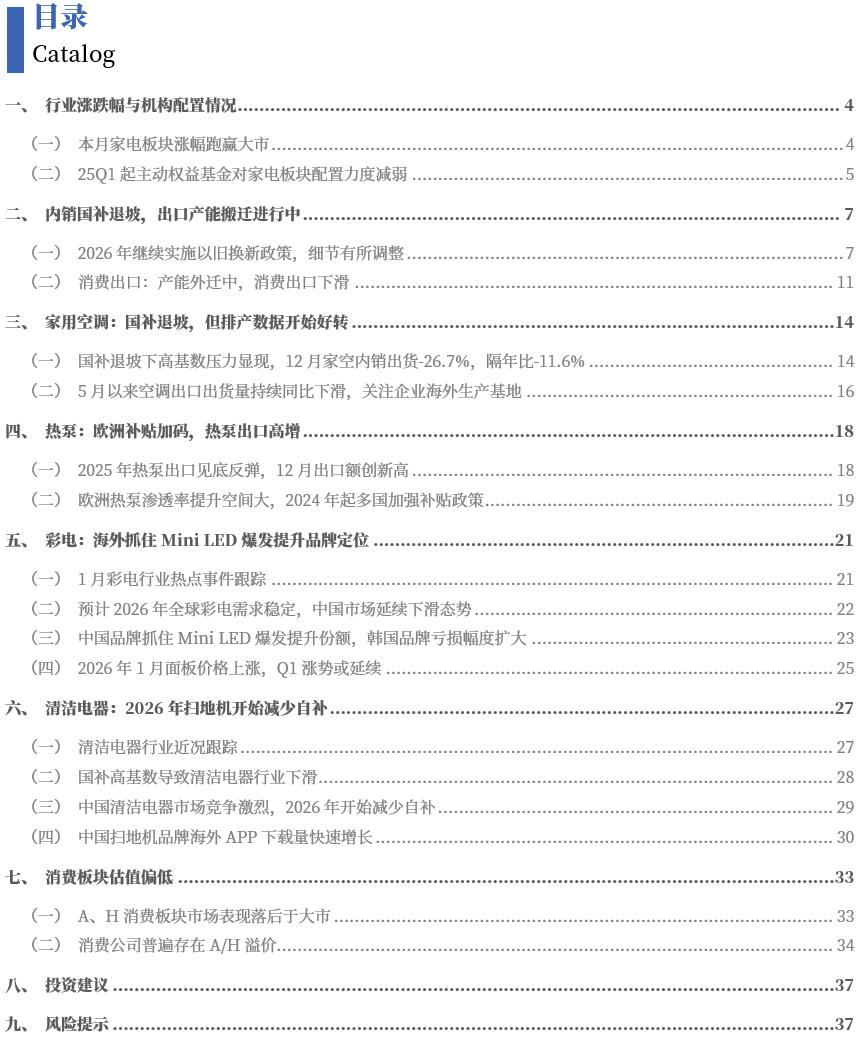
Group 1 - The home appliance sector experienced a decline, with the SW home appliance index dropping by 0.68% as of January 28, 2026, and the current industry P/E ratio (TTM, excluding negative values) standing at 15.60 times [3][22] - Major home appliance companies have begun to raise prices due to increased costs from rising metal raw material prices and memory chips, alongside the reduction of national subsidies [3][22] - Midea implemented a tiered price increase strategy in early January, raising prices by 2% on January 3 and an additional 4% on January 5, with online retail prices for air conditioners increasing by 5.7% compared to December 2025 [3][22] Group 2 - National subsidies for home appliances are set to decline, but large appliances will continue to benefit from subsidies in 2026, including refrigerators, washing machines, televisions, air conditioners, computers, and water heaters [4][23] - The retail sales of home appliances and audio-visual equipment saw significant year-on-year declines in October, November, and December 2025, with decreases of 14.6%, 19.4%, and 18.7% respectively [4][23] - The production of domestic air conditioners in early 2026 is projected to decline by 14.8% in January-February and 5.7% in March compared to the same period last year [4][23] Group 3 - European countries are increasing the promotion of heat pumps, with exports reaching a historical high of 1.62 billion yuan in December 2025, marking a year-on-year increase of 21.7% [5][20] - The heat pump market in Europe is expected to improve, driven by the restoration or enhancement of subsidy policies, with a penetration rate of only 12% in 2024, indicating significant growth potential [5][24] - The promotion of heat pump heating is a key strategy for achieving carbon neutrality by 2050, which is expected to sustain the improvement of exports from China [5][24] Group 4 - TCL is set to acquire Sony's television business, forming a joint venture where TCL will hold 51% and Sony 49%, with the final agreement expected by the end of March 2026 [6][21] - TCL's adjusted net profit for 2025 is projected to be between 2.33 billion and 2.57 billion Hong Kong dollars, reflecting a year-on-year growth of 45-60% [6][21] - The merger is anticipated to increase TCL and Sony's combined market share to 16.7% by 2027, potentially surpassing Samsung's projected market share of 16.2% [6][21]

原材料价格上涨对白电龙头影响有限,白电1-2月排产增速环比改善
Zhong Guo Neng Yuan Wang· 2026-02-03 02:01
国信证券近日发布家电行业2026年2月投资策略:近期铜等原材料价格上涨引发市场对白电龙头盈利的 担忧,通过复盘此前几轮周期发现,原材料成本上涨对毛利率的负面影响逐渐减弱,白电龙头通过结构 调整、费用节省等方式,盈利能力有望穿越周期。2026年1月,以SHFE铜和SHFE铝收盘价月均值计 算,铜价和铝价同比分别上涨36.7%和20.9%。 以下为研究报告摘要: 核心观点 白电1-2月排产降幅收窄,政策拉动下需求有望企稳。据产业在线数据,2月我国白电合计排产量达到 2379万台,较去年同期生产实绩下降22.1%;1-2月合计排产量预计下降5.0%。环比2025Q4排产10%以 上的降幅来看,白电排产表现有所修复。分品类看,2月空调内/外销排产量较去年同期内/外销量分 别-38.1%/-26.5%,合计排产量1149万台,较去年同期产量下降31.6%,1-2月累计下降10.3%;冰箱内/外 销排产量较去年同期内/外销量分别-17.1%/-8.0%,合计排产量600万台,较去年同期产量下降17.0%,1- 2月累计下降6.4%;洗衣机内/外销排产量较去年同期内/外销量分别-5.9%/+1.5%,合计排产量630万台, ...
国信证券晨会纪要-20260203
Guoxin Securities· 2026-02-03 01:11
Macro and Strategy - The "fixed income +" strategy enhances returns by participating in various asset classes while reducing portfolio volatility, improving the Sharpe ratio and minimizing drawdown risks [6][7] - Analysis of financial assets from different time frames shows that A-shares and US stocks lead the equity market, while long-term bonds have shown steady growth [6][7] - The report highlights the negative correlation between Chinese bonds and A-share indices, indicating a "seesaw effect" between stocks and bonds [7] Industry and Company Retail Industry - The report discusses the impact of gold price fluctuations on the jewelry retail market, referencing the "gold rush" of 2013 as a comparative case [10][11] - It notes that gold jewelry retail sales surged by 72.16% during the 2013 gold price drop, suggesting a potential similar consumer response in the current market [11] - Current market dynamics differ from 2013, with a focus on product innovation and brand storytelling driving consumer demand rather than solely price speculation [12][13] Aerospace Industry - SpaceX's application to launch over 1 million satellites aims to create a global AI computing infrastructure, marking a shift towards space-based computing capabilities [14][15] - This initiative is expected to drive growth in sectors like space photovoltaics and laser communication, indicating a new wave of investment opportunities in commercial aerospace [15] Pharmaceutical Industry - The tumor gene testing sector is experiencing rapid growth, with significant stock price increases among leading companies in the field [16][19] - The report emphasizes the potential for tumor gene testing to cover various stages of cancer treatment, indicating a substantial market expansion [16][19] Home Appliance Industry - Rising raw material prices are expected to have a limited impact on the profitability of leading white goods manufacturers, as historical data shows diminishing effects over time [20][21] - Production rates for white goods are showing signs of recovery, with a projected stabilization in demand due to government policies [22][23] Chemical Industry - The report recommends investments in oil and gas, refining, potash, and phosphate sectors, highlighting a recovery in profitability within the chemical industry [24][25] - The report notes that the supply-side issues are being addressed through policies aimed at reducing low-quality competition, which should improve overall industry profitability [25][26] Metal Packaging Industry - The company, Aorikin, is positioned as a leader in metal packaging, with a strong market presence in both three-piece and two-piece can segments [28][29] - The report forecasts a recovery in profitability for two-piece cans due to industry consolidation and improved pricing power following recent acquisitions [29][30] Investment Recommendations - The report suggests focusing on companies with strong product innovation and market positioning in the gold jewelry sector, as well as those in the aerospace and pharmaceutical industries that are poised for growth [13][15][19] - In the home appliance sector, it recommends leading brands that can navigate raw material cost pressures effectively [20][21]
石头科技:关于以集中竞价交易方式回购公司股份的进展公告
Zheng Quan Ri Bao· 2026-02-02 12:40
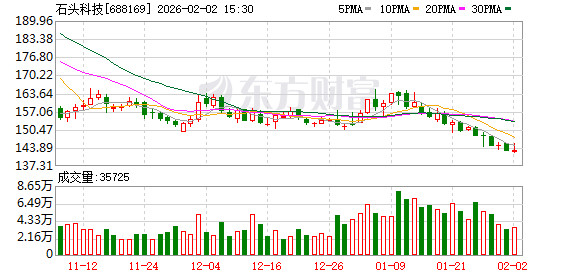
Group 1 - The core point of the article is that Stone Technology announced it did not conduct any share buybacks in January 2026, and as of January 31, 2026, it had repurchased a total of 369,036 shares, which represents 0.1424% of the company's total share capital [2] Group 2 - The share repurchase was executed through the Shanghai Stock Exchange trading system using a centralized bidding method [2] - The announcement highlights the company's ongoing strategy regarding share buybacks and capital management [2]

美的,换帅疑云
3 6 Ke· 2026-02-02 12:11
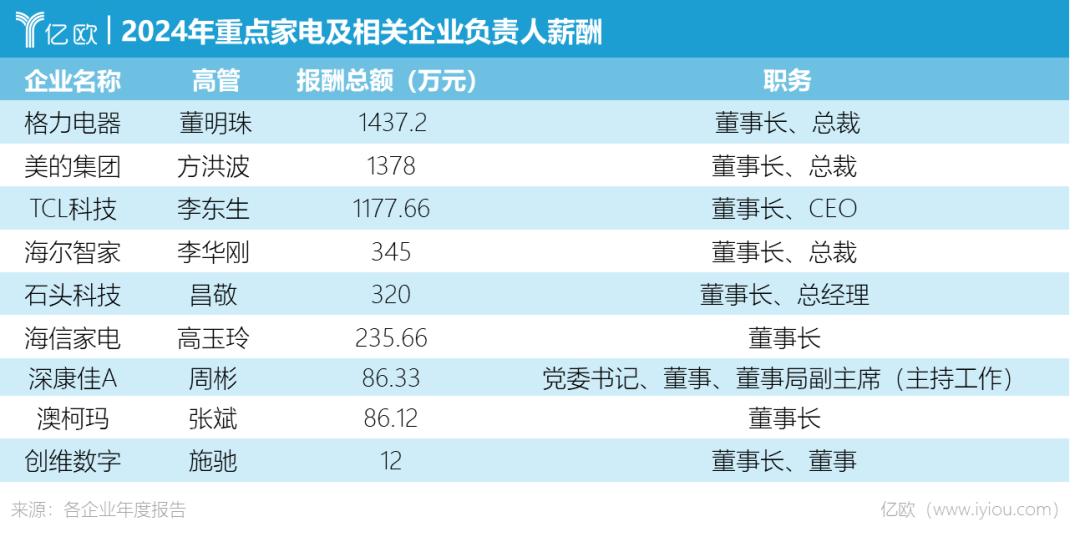
年薪千万元、"最牛打工人"、职业经理人"天花板"......美的集团董事长兼总裁方洪波,在商界拥有耀眼的光环。 以美的视角看,方洪波值得称赞之处在于,既非美的创始元老,也非第一大股东,这突破了民企股权与管理权深度绑定的传统结构。 在这种情况下,方洪波接班12年,推动美的营收增长298%、净利润增长531%、自有资金增长4512%、资产总额增长589%(数据源自美的集团官网,与 2013年年度报告对比存在偏差),市值峰值一度突破7000亿元。方洪波带领美的拳打格力、脚踢海尔,将美的推向了中国"家电一哥"的位置。 更可贵的是,方洪波多次表示"我一定要退下来""我只是美的发展历史中的一个过客"……他对外展示的个人形象非常鲜明——不恋权、不恋名,随时准备 隐入尘烟。 当然,美的集团也没有亏待这位功臣。 天眼查显示,方洪波持有美的集团1.17亿股,占美的集团总股本1.52%。按1月30日开盘价77.60元计算,方洪波身价达到91.84亿元。《2025新财富500创富 榜》显示,方洪波以88.1亿元的持股估值,位列第391位。 在薪酬上,美的也给予了方洪波"天价"回报。2024年美的年度报告显示,方洪波从公司获得的税前报 ...
家电行业2026年2月投资策略:材料价格上涨对白电龙头影响有限,白电1-2月排产增速环改善
Guoxin Securities· 2026-02-02 11:56
Core Views - The report maintains an "Outperform" rating for the home appliance industry, indicating a positive outlook despite recent challenges [5][3] - Rising raw material prices, particularly copper and aluminum, are expected to have a limited impact on the profitability of leading white goods manufacturers, as historical data shows diminishing effects over time [1][17] - The report anticipates that the overall gross margin decline for white goods companies will be less than 2 percentage points due to price adjustments and cost-saving measures [1][17] Production and Demand Trends - In February, the total production of white goods in China reached 23.79 million units, reflecting a year-on-year decline of 22.1%, but the rate of decline is improving compared to previous months [2][24] - The cumulative production decline for January and February is estimated at 5%, showing signs of recovery driven by government subsidy policies [2][24] - The report highlights that the demand for white goods is expected to stabilize and recover as the effects of national subsidy policies continue to manifest [2][24] Retail Market Performance - The retail scale of China's home appliance market is projected to decline by 4.3% in 2025, with small appliances showing relatively better performance [2][31] - Specific categories such as air conditioners and refrigerators are experiencing significant declines in retail sales, while kitchen small appliances are expected to see growth [2][31] Key Investment Recommendations - The report recommends several companies for investment, including Midea Group, Haier Smart Home, TCL Smart Home, and Hisense Home Appliances in the white goods sector, and Stone Technology and Bear Electric in the small appliances sector [3][12] - The report emphasizes the importance of companies with strong overseas growth potential and solid domestic performance, particularly those benefiting from cost reduction and efficiency improvements [12][14] Company Profitability Forecasts - The report provides profitability forecasts for key companies, indicating expected earnings per share (EPS) growth for Midea Group, Haier Smart Home, and TCL Smart Home, among others [4][50] - The projected price-to-earnings (PE) ratios for these companies suggest favorable valuations compared to historical averages, supporting the investment thesis [4][50]

家电行业 2026 年 2 月投资策略:原材料价格上涨对白电龙头影响有限,白电 1-2 月排产增速环比改善
Guoxin Securities· 2026-02-02 11:09
Core Views - The report maintains an "Outperform" rating for the home appliance industry, indicating a positive outlook despite challenges from rising raw material prices and market competition [1][5][11]. Raw Material Price Impact - Recent increases in copper and aluminum prices have raised concerns about the profitability of leading white goods manufacturers. However, historical analysis shows that the negative impact of raw material cost increases on gross margins has diminished over time. For instance, during previous cycles from 2008 to 2022, the maximum quarterly gross margin decline for leading white goods companies was 5-7 percentage points in 2009-2011, around 5 percentage points in 2016-2017, and only about 2 percentage points in 2020-2022. The current price increases are expected to have a lesser impact, with an anticipated gross margin decline of less than 2 percentage points [1][17][18]. Production and Demand Trends - In January and February 2026, the total production of white goods in China was 23.79 million units, reflecting a year-on-year decline of 22.1%. However, the cumulative production decline for the first two months is expected to be around 5%. The production performance has shown signs of recovery compared to a more than 10% decline in Q4 2025. The demand is expected to stabilize due to the effects of national subsidy policies [2][24]. Retail Market Performance - The retail market for home appliances in China is projected to decline by 4.3% in 2025, with a total retail scale of 893.1 billion yuan. Specific categories such as air conditioners and refrigerators are expected to see declines of 0.4% and 11.5%, respectively, while small kitchen appliances are expected to grow by 3.8% [2][31]. Investment Recommendations - The report recommends several companies for investment based on their performance and market position. For white goods, companies like Midea Group, Haier Smart Home, TCL Home, and Hisense Home Appliances are highlighted. In the small appliance sector, Stone Technology, Bear Electric, and New Treasure are recommended. For black goods, TCL Electronics and Hisense Visual are suggested [3][12][50]. Company Earnings Forecasts - The report provides earnings forecasts for key companies, indicating that Midea Group is expected to have an EPS of 5.84 yuan in 2025 and 6.43 yuan in 2026, with a PE ratio of 13 for 2025. Haier Smart Home is projected to have an EPS of 2.27 yuan in 2025 and 2.53 yuan in 2026, with a PE ratio of 11 for 2025 [4][50].

追觅紧迫俞浩癫
虎嗅APP· 2026-02-02 10:49
Core Viewpoint - The article discusses the ambitious plans of the company Zhaimi in the automotive sector, highlighting its founder Yu Hao's bold statements and the challenges the company faces in transitioning from consumer electronics to high-end electric vehicles [5][6][8]. Group 1: Company Overview and Ambitions - Zhaimi's KOSMERA brand debuted two electric concept cars at CES 2026, with plans for mass production in 2027, aiming to disrupt the high-end supercar market [5]. - Founder Yu Hao has made several provocative claims, including aspirations to create the world's first trillion-dollar ecosystem and to surpass established companies like Tesla and Nvidia in revenue [6][8]. - The company has gained significant media attention, reviving interest in the automotive sector [7]. Group 2: Current Status and Strategy - Zhaimi's current automotive strategy involves self-developed high-speed motors and SLAM algorithms, utilizing a light-asset ODM model and overseas manufacturing [11]. - As of January, Zhaimi has secured management rights to three domestic car factories and is negotiating a 5 billion yuan funding partnership with state-owned enterprises [12]. - The company is also establishing a production base near Tesla's Berlin factory, which is planned to be 1.2 times larger [12]. Group 3: Challenges and Risks - Zhaimi's production timeline is tight, with only two years remaining to secure production qualifications, integrate supply chains, and develop a robust automotive R&D system [13]. - The transition from consumer electronics to automotive standards presents significant challenges, particularly in achieving vehicle-grade reliability and safety [14]. - Concerns exist regarding Zhaimi's reliance on external suppliers for core components, which could lead to a "assembly plant" scenario if proprietary technology does not develop adequately [15]. Group 4: Financial Position and Market Potential - Zhaimi is financially robust, with projected revenues of 15 billion yuan in 2024 and potential earnings exceeding 30 billion yuan in 2025 [19]. - The company has a strong cash flow, which is crucial for its automotive ambitions, and is expected to successfully navigate the A-share market for listing [19][21]. - Zhaimi's aggressive expansion into various sectors, including robotics and drones, reflects a strategy to secure market presence and diversify revenue streams [23]. Group 5: Competitive Landscape and Future Outlook - Zhaimi's positioning strategy is seen as unclear, as it simultaneously targets ultra-luxury brands like Bugatti and mid-range SUVs, which may dilute its brand identity [22]. - The company faces a critical need to establish a unique market position and differentiate itself from competitors, similar to how other successful electric vehicle companies have done [52]. - The success of Zhaimi's automotive venture will depend on its ability to navigate the complexities of the automotive industry and establish a sustainable competitive advantage [44][49].