大疆

Search documents
“未来之城”的进阶之路——写在深圳经济特区建立45周年之际
Zheng Quan Shi Bao· 2025-08-25 18:50
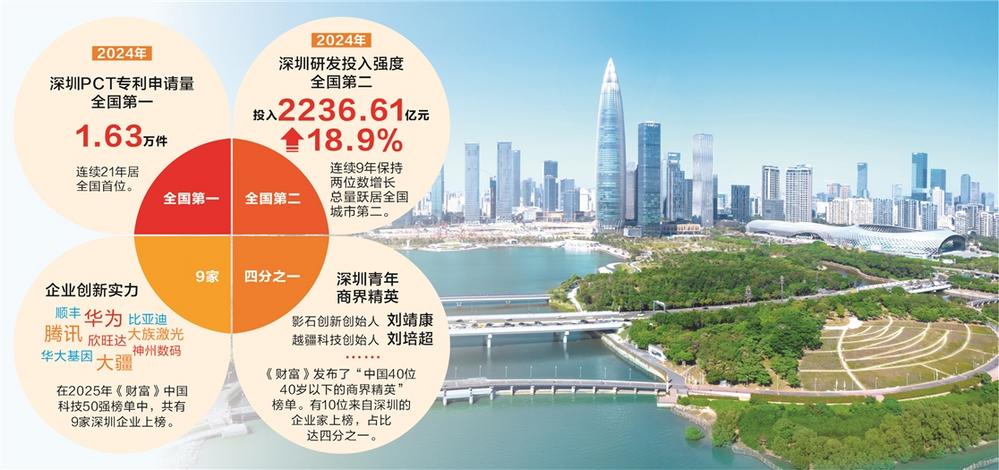
Core Insights - Shenzhen has transformed from a small fishing village into a global innovation hub over 45 years, driven by reform and opening-up policies [2][3] - The city is recognized for its significant economic size, leading foreign trade, and a large number of high-tech enterprises, showcasing the vitality of socialism with Chinese characteristics [2][3] - Shenzhen's success is attributed to a combination of favorable historical conditions, geographical advantages, and a culture of inclusivity [3][6] Economic Development - Shenzhen ranks third in national economic size and first in foreign trade volume, with over 25,000 national high-tech enterprises [2] - The city has implemented 48 reform experiences that have been promoted by the National Development and Reform Commission [4] - The comprehensive reform pilot has led to breakthroughs in market-oriented resource allocation and innovative legislation in emerging industries [4][5] Innovation and Technology - Shenzhen has become a center for technological innovation, with significant investments in R&D, accounting for 6.46% of GDP in 2024, and leading in PCT international patent applications [5][6] - The city has fostered a robust ecosystem for innovation, integrating various chains such as innovation, industry, finance, and talent [5] Future Outlook - Shenzhen is positioned as a model for China's modernization, with new missions to explore higher levels of reform and development [3][6] - The city faces challenges in areas such as international competition, technological self-reliance, and public services, necessitating continued innovation and reform [6][7] - The central government has outlined expectations for Shenzhen to deepen reforms and expand openness, emphasizing the importance of the city's pioneering spirit [6][7]
从世界工厂到科创中心 折射深圳创新“三级跃迁”
Zheng Quan Shi Bao· 2025-08-25 18:21
Group 1 - The "Tiangong" robot, developed by a team associated with the Shenzhen-listed company UBTECH, won the gold medal in the 100-meter sprint at the 2025 World Humanoid Robot Games, marking a significant advancement in robotic capabilities [2] - Shenzhen's innovation journey spans 45 years, evolving from low-end manufacturing to a thriving ecosystem of diverse industries, with an average of approximately 580 patents granted daily [2][11] - The establishment of the Shenzhen Special Economic Zone in 1980 initiated a focus on industrial development, laying the groundwork for future innovation by attracting capital, technology, and labor [3][4] Group 2 - The "Three Comes and One Compensation" model was pivotal in building Shenzhen's industrial base, allowing foreign businesses to provide equipment and materials while local companies handled production [3][4] - By 1994, enterprises operating under the "Three Comes and One Compensation" model accounted for one-third of Guangdong's total, highlighting Shenzhen's role as a burgeoning "world factory" [4] - Companies like China International Marine Containers (CIMC) exemplify the shift from foreign technology reliance to independent innovation, becoming a global leader in container production by 1996 [5] Group 3 - Shenzhen's industrial landscape evolved to include a diverse range of sectors, with significant contributions from state-owned enterprises, enhancing the region's technological capabilities [6][7] - The transition from manufacturing to brand creation marked a second leap in innovation, with local companies like Huawei and DJI establishing themselves as global players [7][8] - Shenzhen's complete industrial chain has attracted high-tech enterprises, fostering an environment conducive to innovation and rapid product development [8][9] Group 4 - The current innovation ecosystem in Shenzhen resembles a "tropical rainforest," where companies collaborate and thrive together, supported by a robust technological infrastructure [10][11] - The government plays a crucial role in nurturing this ecosystem, focusing on creating favorable conditions for innovation through various initiatives, including the development of low-altitude infrastructure [11] - In the first five months of 2025, Shenzhen granted a total of 87,152 patents, reflecting its transformation from a manufacturing hub to a center of technological innovation [11][12]


大疆首款扫地机“盲”了? 旗舰避障系统无法识别落地窗
Feng Huang Wang· 2025-08-25 14:10
凤凰网科技讯(作者/于雷)8月25日,近日,大疆刚刚发布的旗下首款扫地机器人系列DJI ROMO遭遇 用户"差评",有网友在社交平台分享视频,称扫地机器人在清扫时无法识别落地窗等透明障碍物,直 接"撞墙"而行。 据网友分享的视频显示,这款以大疆旗舰级无人机避障系统为卖点的扫地机器人,在行进至落地窗前 时,并未像宣传中那样及时减速或避开,而是径直撞上了窗户,引发了网络热议。 对此,大疆客服人员回应表示,这一现象是由于算法程序存在缺陷,导致机器在识别前方为透明或浅色 物体时,会误判为无障碍物。客服建议,用户可暂时将无法识别的区域设定为清扫禁区,或者在附近放 置醒目的遮挡物以供识别。客服同时透露,该问题已上报至工程部门,预计将在1到2个月内通过算法更 新来解决。 据悉,DJI ROMO系列扫地机器人搭载了双目鱼眼视觉传感器和三颗广视角固态激光雷达,官方宣称标 准模式下可识别直径2毫米以上的电线及15毫米高度以上的障碍物。其最大吸力可达25000Pa,并配备了 双滚刷设计。本次透明障碍物识别问题,对于以避障技术见长的大疆而言,无疑是一次技术上的挑战。 ...
关税大棒砸出抢购潮,美国人疯狂囤积中国货真相揭秘
Sou Hu Cai Jing· 2025-08-25 14:00
Group 1 - The article highlights the absurdity of the U.S. tariff policy, which has led to a surge in demand for Chinese products among American consumers, despite the intended protection of domestic industries [1][3][9] - The U.S. consumers are experiencing significant savings by purchasing Chinese goods, with examples showing price differences of up to 40% compared to domestic brands [3][5] - The article emphasizes the resilience of the Chinese supply chain, which has maintained a high level of integrity during the pandemic, while U.S. attempts to shift orders to Southeast Asia have proven inadequate [3][13] Group 2 - The rise of cross-border e-commerce platforms like Dunhuang.com and Taobao reflects a shift in consumer focus from brand names to product quality and cost-effectiveness [5][10] - The article notes a significant increase in downloads for Dunhuang.com, indicating a growing consumer interest in affordable Chinese products [5][10] - The consumer behavior shift is characterized by a trend towards "consumption democratization," where price transparency and direct access to manufacturers are becoming more prevalent [12][16] Group 3 - The article discusses the impact of tariffs on U.S. inflation, with consumer prices rising significantly, indicating that the tariff policy has backfired on American households [7][15] - It points out that low-income families are disproportionately affected by rising food prices, while high-income households experience a smaller decrease in disposable income [7][12] - The article draws parallels between current tariff policies and historical events, suggesting that the consequences of such policies could lead to a similar economic downturn as seen in the past [9][15] Group 4 - The article concludes that the current consumer behavior in the U.S. demonstrates a deep reliance on Chinese manufacturing, which is essential for maintaining supply chains [9][13] - It highlights the adaptability of Chinese companies in response to tariff challenges, including the establishment of warehouses in Mexico and the development of products that meet U.S. manufacturing standards [13][16] - The article asserts that the ongoing consumer demand for Chinese goods signifies a broader trend of globalization that cannot be easily reversed by political measures [9][16]
45年,深企“生命活力”启示录
2 1 Shi Ji Jing Ji Bao Dao· 2025-08-25 13:10
Core Insights - Shenzhen's economic vitality is driven by its innovative enterprises, which have evolved from traditional manufacturing to high-tech industries over 45 years [1][3][10] - The city has become a hub for unicorn companies and has seen a surge in new sectors such as AI, robotics, and new energy [5][9][10] Group 1: Economic Contributions - The private sector contributes over 50% of Shenzhen's tax revenue, nearly 60% of its added value, and over 90% of employment [1] - As of June 2023, Shenzhen has 425 A-share listed companies with a total market capitalization of 10.39 trillion yuan, ranking third and second among major cities in China, respectively [1] Group 2: Innovation and Industry Evolution - Shenzhen's transformation from a fishing village to a global tech hub began with the establishment of the Special Economic Zone, which encouraged innovation and attracted foreign investment [3][4] - The city has seen the emergence of numerous "first stocks" in various sectors, including new tea drinks and humanoid robots, showcasing its innovative spirit [5][6] Group 3: Unicorn Companies and Investment - Shenzhen is home to 37 private unicorn companies, ranking third in the nation, with a significant number of these companies established in recent years [7] - The city has witnessed a rapid increase in funding for emerging tech companies, with several unicorns completing substantial financing rounds [5][6] Group 4: Strategic Emerging Industries - Shenzhen's strategic emerging industries have seen a 10.5% increase in added value, accounting for 42.3% of the regional GDP, with significant growth in AI, robotics, and new energy vehicles [9] - The city has implemented policies to support the development of strategic emerging industries, including the establishment of new industry clusters [8][9] Group 5: Future Outlook - Shenzhen's commitment to innovation and long-term investment strategies positions it as a potential cradle for the fourth industrial revolution in China [10] - The city aims to cultivate 20 strategic emerging industry clusters and actively develop 8 future industries, aligning with global technological trends [10]




俄罗斯老铁深夜破防:中国制造逆袭美国,我们还在卖石油
Sou Hu Cai Jing· 2025-08-25 13:06
凌晨三点,莫斯科某报社主编伊万猛灌一口伏特加,盯着中国海关总署的出口数据报表,发出了灵魂呐 喊:"同样的社会主义兄弟,凭什么中国人连电动牙刷都能卷出专利,我们TM还在给欧洲送天然 气?!"这画面感简直比西伯利亚寒流还刺骨——俄罗斯媒体最近集体破大防,中国制造业全球占比 31.6%的钛合金数据,直接把俄罗斯1.8%的能源出口占比碾成了渣。但最扎心的还不是数字,而是中俄 这对"难兄难弟"怎么就走出了两条天差地别的全球化路径? 现在中国车企出海都玩起"超本地化"骚操作了!比亚迪在匈牙利建厂,直接复刻了个"迷你比亚迪"—— 研发中心盯欧洲需求,生产线贴欧盟标准,连管理层都雇本地人,彻底把自己打扮成"欧洲企业"。东风 汽车更绝,在意大利卖车非要搞什么豪萨语版维保手册,非洲老哥感动哭了:"这比苏联当年扔给我们 的说明书还详细!"反观俄罗斯,唯一能出口的工业品只剩苏霍伊飞机,还得靠印度老铁友情买单。 最打脸的来了——美国严防死守的技术壁垒,居然被中国小厂撕开口子!常州艾迈斯只有300人,硬是 把美国垄断的大电流连接器干到全球前三,春晚上宇树机器人扭秧歌用的就是他家零件。当初老外傲慢 甩话:"你们造不出来,只能买我们的",结 ...
山西推动农机向高端化智能化迈进 “智慧种地”遍布田间地头
Zhong Guo Chan Ye Jing Ji Xin Xi Wang· 2025-08-25 08:31
Core Viewpoint - The agricultural landscape in Shanxi is being transformed by smart agricultural machinery, driven by policies, technology, and talent development, which collectively enhance agricultural modernization and rural revitalization [1] Policy Initiatives - Shanxi province is implementing targeted policies to upgrade agricultural machinery, including subsidies for scrapping old machines and purchasing new ones, which significantly benefits farmers [2][3] - In 2023, Jin City allocated 600,000 yuan for special subsidies for agricultural machinery, covering various industries and providing up to 30,000 yuan per machine [2] - The province has optimized its policy framework to ensure fair access to subsidies and tailored support for specific agricultural needs [3] Technological Advancements - The introduction of smart agricultural equipment is revolutionizing production efficiency, with drones and intelligent tractors significantly improving operational capabilities [4][5] - For instance, the DJI T70 drone can carry 70 kg of liquid and enhance operational efficiency by 60 times compared to traditional methods [4] - The use of IoT devices for soil data collection has led to a 15% reduction in fertilizer usage while still increasing crop yields [5] Talent Development - Shanxi has established a comprehensive training system for agricultural machinery operators, resulting in over 8,000 trained individuals in the first half of the year [8] - The province has hosted numerous competitions and training sessions, enhancing the skills of participants and increasing their employability in the agricultural sector [6][7] - The training programs have led to significant improvements in operational efficiency, such as a fivefold increase in pesticide application efficiency by trained drone operators [8]
科技创新提速 广东问策岭南现代农业“智”变
2 1 Shi Ji Jing Ji Bao Dao· 2025-08-25 08:11
Core Viewpoint - Guangdong is advancing its agricultural modernization through innovative technologies and strategic initiatives, aiming to transform traditional agriculture into smart agriculture, enhancing productivity and efficiency across the agricultural value chain [1][3][6]. Group 1: Agricultural Modernization Initiatives - The "Yue Qiang Seed Core" and "Yue Qiang Agricultural Equipment" projects are key components of Guangdong's action plan to lead agricultural innovation and upgrade the entire agricultural chain [1][6]. - By 2024, the contribution rate of agricultural technology progress in Guangdong is expected to exceed 73%, with major crop seed coverage reaching 98% and comprehensive mechanization rates for rice exceeding 80% [1][3]. Group 2: Technological Advancements - Guangdong is at the forefront of smart agriculture, with significant advancements in unmanned farms and agricultural machinery, including the largest unmanned rice farm in the province, achieving a yield of 600 kg per mu [3][4]. - The province hosts over 30% of the country's drone companies, fostering leading enterprises in smart agricultural equipment manufacturing [3]. Group 3: Marine and Aquaculture Development - Guangdong is enhancing its marine aquaculture capabilities, with deep-sea cage farming and factory farming production doubling over three years, further solidifying its national leadership in this sector [1][4]. - The province has established a modern marine ranching model, integrating various services and technologies to boost marine resource utilization [4][5]. Group 4: Industry Cluster Development - Guangdong is forming large-scale modern agricultural industry clusters, with total agricultural output value projected to reach 970.12 billion yuan in 2024, reflecting a year-on-year growth of 3.8% [1][6]. - The province aims to cultivate two trillion-level modern marine ranching and deep processing clusters, alongside numerous billion-level and hundred-billion-level industry clusters [8]. Group 5: Seed Industry and Innovation - Guangdong has gathered 63 top breeding teams to drive breakthroughs in seed technology, achieving significant advancements in marine species breeding and rice cultivation [6][7]. - The province's "Yue Qiang Seed Core" initiative coordinates resources and innovation across various cities, enhancing the overall agricultural production and processing capabilities [6][7].
科技创新提速,广东问策岭南现代农业“智”变
2 1 Shi Ji Jing Ji Bao Dao· 2025-08-25 08:07
Core Viewpoint - Guangdong is advancing its agricultural modernization through the integration of AI, smart farming, and innovative breeding techniques, aiming to enhance productivity and efficiency in the agricultural sector [1][2][5]. Group 1: Agricultural Modernization Initiatives - The "Yue Strong Seed Core" and "Yue Strong Agricultural Equipment" projects are key initiatives aimed at upgrading the agricultural supply chain and enhancing the smart agricultural machinery industry [1][2]. - By 2024, the contribution rate of agricultural technology progress in Guangdong is expected to exceed 73%, with a coverage rate of improved varieties for major crops reaching 98% [1][5]. - The total output value of agriculture, forestry, animal husbandry, and fishery in Guangdong is projected to be 970.12 billion yuan in 2024, reflecting a year-on-year growth of 3.8% [1]. Group 2: Technological Advancements - Guangdong has established over 30 unmanned farms across 16 provinces, with a total area exceeding 10,000 acres, utilizing advanced technologies such as IoT and AI for full-process automation in rice farming [3]. - The province hosts over 30% of the country's drone companies, fostering the growth of leading smart agricultural equipment manufacturers [3]. Group 3: Marine Aquaculture Development - Guangdong is focusing on modern marine ranching, with significant advancements in deep-sea cage farming and factory aquaculture, doubling production in three years [1][4]. - The province has built the first standard marine ranch model area, integrating various modern aquaculture practices [4]. Group 4: Breeding and Industry Upgrades - Guangdong has gathered 63 top breeding teams to tackle core technology challenges in marine aquaculture, achieving breakthroughs in the artificial breeding of several fish species [5]. - The "Yue Strong Seed Core" initiative is coordinating breeding resources across the province, enhancing the entire breeding system from laboratory to fishing ground [5][6]. Group 5: Value Chain and Market Expansion - The establishment of modern agricultural industrial parks is enhancing the value chain for products like premium chicken, with a focus on comprehensive industry development [6]. - Guangdong is actively developing the prepared food industry, with 15 provincial-level industrial parks and over 1,500 related enterprises, achieving a total industry output value exceeding 20 billion yuan [6]. Group 6: Future Development Goals - The Guangdong government aims to cultivate two trillion-level modern marine ranches and deep processing clusters for agricultural products, alongside fostering 1,500 agricultural backbone enterprises [7].
中国AI创业只是少数人的游戏
Tai Mei Ti A P P· 2025-08-25 06:01
Core Insights - The AI landscape in China is experiencing a surge of entrepreneurial activity, but underlying challenges persist, particularly regarding monetization and user payment habits [2][3][6] - The disparity in payment habits between China and North America is significant, with Chinese consumers showing much lower willingness to pay for AI services [3][4][6] - Despite a growing number of AI startups, the barriers to entry remain high, with access to quality data and resources being critical for success [9][11][12] - Chinese tech giants are lagging in AI investment compared to their American counterparts, impacting the overall ecosystem and innovation potential [13][14] - The hardware sector in China presents unique advantages, with a strong supply chain and increasing investment, positioning it as a potential growth area for AI innovation [15][16][17] Payment Habits - Payment habits in China are notably poor, with consumer payment rates for AI services ranging from 3% to 13%, compared to 15% to 40% in the U.S. [3][4] - The annual recurring revenue (ARR) for leading AI companies in China is significantly lower than in the U.S., with differences ranging from 5 to 100 times [4][5] - A developer's experience highlights the stark contrast, where a product in China gained thousands of users but had fewer than 10 paying customers, while a similar product overseas achieved substantial revenue quickly [4][6] Investment Landscape - The number of AI startups globally is increasing, with approximately 5,000 new companies expected in the first half of 2025, including 1,380 from China [9][10] - Investment in AI startups has surged, with global funding reaching around $140 billion in the first half of 2025, doubling from the previous year [9][10] - However, the AI entrepreneurial environment in China is not as accessible as during the internet boom, with high hidden barriers to entry [9][11] Challenges for Tech Giants - Chinese tech giants are investing significantly less in AI compared to U.S. companies, with a reported investment of 630 billion RMB against 1.7 trillion RMB from U.S. firms [13] - The focus of Chinese companies appears to be on short-term gains rather than long-term AI infrastructure development, leading to a generational gap in AI model capabilities [13][14] - The reluctance to fully open resources to external developers stifles innovation and growth within the AI ecosystem [13][14] Hardware Opportunities - China has a strong advantage in AI hardware, with leading companies like DJI and Xiaomi contributing to a robust supply chain [15][16] - The number of AI hardware companies in China is growing, with 1,180 operational firms and significant investment activity in the sector [15][16] - The unique development path of AI hardware in China, leveraging its manufacturing base, may provide a competitive edge in the global market [17]