
大疆

Search documents
从“五个一”看华强北的变与不变
Xin Hua Wang· 2025-08-25 02:24
Core Insights - Huaqiangbei is evolving from a traditional electronics market to a new source of productivity, showcasing high-quality development and innovation in the digital economy era [2][3][25] Group 1: Transformation and Innovation - The "one-meter counter" model has transitioned from a simple sales approach to a comprehensive service model, enhancing customer engagement and market competitiveness [7][8] - Huaqiangbei has seen a significant upgrade in its market space, shifting from crowded counters to immersive, experiential digital supermarkets, resulting in an 80% increase in foot traffic [7][9] - The area has implemented a transformation and high-quality development initiative, adding 100,000 square meters of industrial space, with over 80% occupancy in newly renovated electronic markets [9][25] Group 2: Supply Chain and Ecosystem - Huaqiangbei boasts a "one-kilometer full industrial chain innovation ecosystem," allowing rapid response to market changes and fostering collaboration among various stakeholders [20][21] - The logistics network in Huaqiangbei is highly developed, with over 7,000 logistics workers and daily shipments exceeding 150 million packages, contributing to an annual cargo value of over 100 billion yuan [14][16] - The area has established a comprehensive cross-border logistics system, significantly reducing logistics costs for businesses [25][26] Group 3: Global Trade and Market Reach - Huaqiangbei's electronic products are exported to over 190 countries, with an annual transaction volume exceeding 400 billion yuan, reflecting its global market presence [22][23] - The introduction of a second-hand electronic trading center aims to standardize transactions and enhance the credibility of the industry, facilitating international trade [26][28] Group 4: Integrated Service and Support - The area is focusing on building an integrated support system for innovation, combining data, talent, finance, design, and incubation to foster a collaborative entrepreneurial environment [32][34] - Government initiatives are in place to support startups, including financial services and the establishment of multiple incubators to promote technological innovation [31][34]


45年,深圳城市“封面”迭代
2 1 Shi Ji Jing Ji Bao Dao· 2025-08-25 01:44
Core Perspective - The article discusses the evolution of Shenzhen's urban landscape, highlighting its transformation from a manufacturing hub to a center for innovation and technology, with a focus on the development of high-rise buildings and the emergence of a "headquarters economy" [1][7][10]. Group 1: Urban Development and Architectural Significance - Shenzhen's skyline features iconic buildings like the International Trade Center, Diwang Building, and Ping An Finance Center, representing the city's rapid economic growth and urbanization [3][4][13]. - The International Trade Center, completed in 1985, was a symbol of Shenzhen's reform and opening-up, while the Diwang Building, completed in 1995, marked Shenzhen as "Asia's first" in terms of skyscrapers [4][5]. - The Ping An Finance Center, standing at 599 meters, is currently the tallest building in Shenzhen and the fifth tallest globally, serving as a major attraction for both tourists and businesses [13][15]. Group 2: Economic Transformation and Headquarters Economy - The concept of a "headquarters economy" began to take shape in Shenzhen as early as the 1980s, with the establishment of foreign banks and joint ventures in the Luohu district [8][9]. - The establishment of the Futian district in 1990 marked a shift in Shenzhen's economic focus, with major financial institutions like China Merchants Bank relocating their headquarters there [12][15]. - Futian now hosts 295 licensed financial institutions, accounting for nearly 60% of the city's total, and has become a hub for corporate headquarters, attracting various service industries [15][17]. Group 3: Technological Innovation and Future Prospects - Shenzhen's high-tech industry has flourished, with major companies like Tencent and DJI establishing their headquarters in the Nanshan district, contributing to the city's reputation as a technology hub [20][22]. - The density of national high-tech enterprises in Shenzhen is the highest in China, with over 25,000 companies expected by 2024, indicating a robust innovation ecosystem [23]. - Tencent's "Penguin Island" project aims to create a comprehensive headquarters ecosystem, reflecting a trend towards integrated workspaces that foster collaboration and innovation [26][28].

运动相机:“中国智造”的影像时代
2025-08-24 14:47
Summary of the Smart Imaging Device Industry Conference Call Industry Overview - The smart imaging device market in China is valued at approximately 50 billion RMB, with a compound annual growth rate (CAGR) of about 15% from 2017 to 2023, expected to increase to 20.8% due to the growth of short videos [1][3][12] - Annual sales of handheld devices are around 40 million units, with panoramic action cameras accounting for less than 2 million units [1][3] Key Players and Market Dynamics - The industry is concentrated among three major players: GoPro, Yingshi Innovation, and DJI, with a combined annual shipment of about 7 million units [1][5] - GoPro's annual shipment is over 2 million units, Yingshi Innovation slightly below 2 million, and DJI also around 2 million [5][8] - The market has a significant presence of low-end products, with over half of the total shipments priced below 1,000 RMB, while the products from leading companies are priced between 2,500 and 3,000 RMB [5] Market Segmentation - Yingshi Innovation has defined the panoramic action camera category, holding nearly 70% market share, while Ricoh and GoPro hold 12% and 9% respectively [1][6] - The wide-angle action camera market is larger but more fragmented, with GoPro maintaining a leading position [6][10] Competitive Landscape - The panoramic action camera market has a higher concentration due to the definition of the category by Yingshi Innovation and the algorithmic barriers involved [4][10] - Core barriers in the smart imaging device industry include algorithm software capabilities and supply chain advantages, with software tuning being a key competitive factor [4][11] Future Outlook - The smart imaging device industry is expected to continue its rapid growth, driven by advancements in technology and increasing consumer demand for high-quality shooting [7][12] - Emerging brands are anticipated to enter the market, while mid-to-low-end brands will seek to improve technology and reduce costs to capture more market share [7] Additional Insights - DJI does not have a panoramic action camera product before 2025, focusing instead on wide-angle action cameras [8] - Competitors in the wide-angle action camera market include Yuan Innovation, Aijian, SG Can, and other Shenzhen consumer electronics brands, primarily selling online to overseas markets [9]
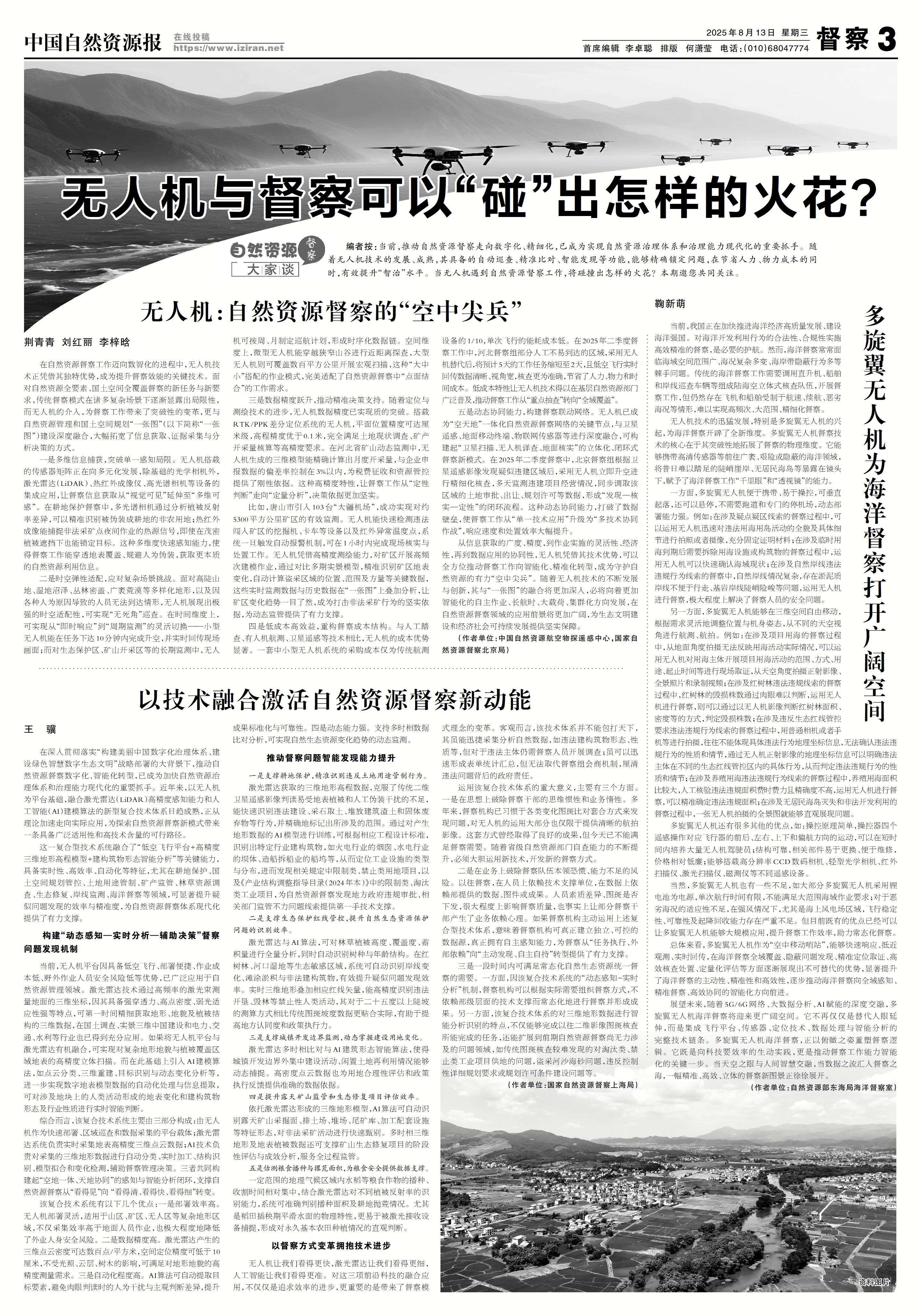
多旋翼无人机为海洋督察打开广阔空间
Zhong Guo Zi Ran Zi Yuan Bao· 2025-08-24 10:31
Core Insights - The article discusses the transformative role of drone technology in enhancing the efficiency of natural resource supervision, addressing the limitations of traditional inspection methods [3][7][11]. Group 1: Drone Technology Advantages - Drones provide multi-dimensional information capture, overcoming the limitations of single-sensor perception by integrating various sensors like LiDAR, thermal imaging, and hyperspectral cameras [3][5]. - The precision of data collected by drones has significantly improved, with high-accuracy positioning systems achieving elevation precision better than 0.1 meters, which is crucial for accurate resource assessment [4][5]. - Drones exhibit strong adaptability to complex terrains, enabling comprehensive inspections in areas that are difficult to access, such as steep mountains and wetlands [5][12]. Group 2: Applications in Natural Resource Management - Drones are effectively utilized in various fields, including farmland protection, land use regulation, and ecological monitoring, significantly enhancing the efficiency and accuracy of problem detection [7][9]. - The integration of AI and LiDAR technology allows for real-time analysis and decision-making, facilitating the identification of illegal activities such as unauthorized construction and resource extraction [8][9]. - Drones can quickly respond to inspection tasks, providing real-time data and visual evidence, which is essential for timely decision-making and enforcement actions [12][14]. Group 3: Future Prospects - The future of drone technology in natural resource supervision looks promising with the integration of 5G/6G networks, big data analytics, and AI, which will further enhance operational efficiency and effectiveness [15]. - Drones are expected to evolve from merely extending human vision to becoming a comprehensive technological solution that integrates flight platforms, sensors, and data processing capabilities [15].
大疆麦克风新品即将发布,无线麦克风市场值得关注
Huaan Securities· 2025-08-24 09:55
大疆麦克风新品即将发布,无线麦克风市场值得关注 [Table_IndNameRptType] 电子 行业点评 [Table_IndRank] 行业评级:增持 报告日期:2025-08-24 [Table_Chart] 行业指数与沪深 300 走势比较 -20% 0% 20% 40% 60% 80% 100% 8/24 11/24 2/25 5/25 电子(申万) 沪深300 [Table_Author] 分析师:陈耀波 执业证书号:S0010523060001 邮箱:chenyaobo@hazq.com 分析师:李元晨 执业证书号:S0010524070001 邮箱:liyc@hazq.com 相关报告 主要观点: ⚫[Table_Summary] 无线麦克风市场迎重磅产品,大疆麦克风新品即将发布 根据 IT 之家 8 月 21 日引述大疆官方消息,将于 8 月 28 日 20:00 发布 一款新品。从预热视频来看,预计是一款麦克风产品。该产品口号为"小 成大器,声势不凡",预热视频显示,该麦克风的一个接收器可同时连 接 4 个发射器,也就是"一拖四"。 同时根据科技媒体 DroneDJ 于 8 月 21 日 ...
又帮到了一位同学拿到了自动驾驶算法岗......
自动驾驶之心· 2025-08-23 14:44
Core Viewpoint - The article emphasizes the importance of continuous learning and adaptation in the field of autonomous driving, particularly in light of industry shifts towards intelligent models and large models, while also highlighting the value of community support for knowledge sharing and job opportunities [1][2]. Group 1: Community and Learning Resources - The "Autonomous Driving Heart Knowledge Planet" is a comprehensive community platform that integrates video, text, learning paths, Q&A, and job exchange, aiming to grow from over 4,000 to nearly 10,000 members in two years [1][2]. - The community provides practical solutions for various topics such as entry points for end-to-end models, learning paths for multimodal large models, and engineering practices for data closed-loop 4D annotation [2][3]. - Members have access to over 40 technical routes, including industry applications, VLA benchmarks, and learning entry routes, significantly reducing search time for relevant information [2][3]. Group 2: Job Opportunities and Networking - The community has established internal referral mechanisms with multiple autonomous driving companies, facilitating job applications and resume submissions directly to desired companies [7]. - Regular job sharing and updates on available positions are provided, creating a complete ecosystem for autonomous driving professionals [15][30]. Group 3: Technical Learning and Development - The community offers a well-structured technical stack and roadmap for beginners, covering essential areas such as mathematics, computer vision, deep learning, and programming [11][32]. - Various learning routes are available for advanced topics, including end-to-end autonomous driving, 3DGS principles, and multimodal large models, catering to both newcomers and experienced professionals [16][34][40]. - The platform also hosts live sessions with industry leaders, providing insights into cutting-edge research and practical applications in autonomous driving [58][66].
9家深企上榜!中国科技50强榜单发布
Sou Hu Cai Jing· 2025-08-23 00:35
Group 1 - The core viewpoint of the article highlights the emergence of artificial intelligence and smart manufacturing as key areas of growth in China's technology sector, with Shenzhen being a significant contributor [6][9]. - Shenzhen is recognized as a leading city with the highest number of companies listed in the Fortune China Tech 50, including Huawei, Tencent, BYD, DJI, and others [9]. - The article emphasizes the shift of Chinese technology companies from consumer internet to new fields such as artificial intelligence and intelligent manufacturing, showcasing their strong execution capabilities [8][10]. Group 2 - The 2023 Fortune China Tech 50 list features both returning companies like Huawei and new entrants such as DeepSeek and Yushutech, indicating a diversification in the technology landscape [6][9]. - Shenzhen's economy is supported by a robust industrial system focused on high-tech manufacturing and equipment manufacturing, with significant contributions from leading companies [9][12]. - The production of high-tech products in Shenzhen, including civilian drones and industrial robots, has seen substantial growth, with increases of 59.0%, 38.0%, and 35.8% respectively, reflecting the city's ongoing industrial upgrades [12].





中国科技50强,9强在深圳!
Sou Hu Cai Jing· 2025-08-22 22:35
Group 1 - The 2025 Fortune China Tech 50 list highlights the rise of artificial intelligence companies, with new entrants like DeepSeek and several robotics firms [1][3] - Shenzhen is recognized for having the most companies on the list, with nine firms including Huawei, Tencent, and BYD, showcasing its industrial strength [1][3] - The list reflects a shift in China's tech focus from consumer internet to artificial intelligence and smart manufacturing, indicating a deeper integration of technology with human needs [1][3] Group 2 - Shenzhen's economy is bolstered by strategic emerging industries, with significant contributions from high-tech manufacturing and digital economy sectors [3] - The city's GDP for the first half of 2025 reached 4980.06 billion yuan, with over 80% coming from the tertiary sector, including digital economy [3] - Production of high-tech products in Shenzhen is rapidly increasing, with notable growth in civilian drones (59.0%), industrial robots (38.0%), and 3D printing equipment (35.8%) [3]

9家深企上榜!战新产业表现亮眼
Shen Zhen Shang Bao· 2025-08-22 12:45
Core Insights - The 2025 Fortune China Tech 50 list highlights the rise of artificial intelligence companies, with a notable inclusion of new entrants in the robotics sector, indicating a shift from consumer internet to AI and smart manufacturing [1][2] Group 1: Company Highlights - Shenzhen is home to nine companies on the list, including Huawei, Tencent, BYD, DJI, and others, making it one of the cities with the most entries [1][2] - Five companies, including Huawei, Tencent, BYD, Shenzhou Information, and XWDA, retained their positions from last year, while four companies, including DJI and Dazhu Laser, made their debut [2] Group 2: Industry Trends - The list reflects a broader trend of Chinese companies focusing on practical applications of technology, particularly in finance and healthcare, rather than speculative concepts [1] - Shenzhen's economy is supported by a robust industrial system centered on high-tech manufacturing and equipment manufacturing, with significant contributions from strategic emerging industries [2] - The production of high-tech products in Shenzhen is rapidly increasing, with notable growth in civilian drones (59.0%), industrial robots (38.0%), and 3D printing equipment (35.8%), aligning with the trends presented in the Fortune list [2]

低空经济行业专题系列三:低空经济乘风而至,产业机遇前景广阔
Guoxin Securities· 2025-08-22 12:36
Investment Rating - The investment rating for the low-altitude economy industry is "Outperform the Market" [1] Core Viewpoints - The low-altitude economy is expected to experience significant growth, with the market size projected to exceed 1 trillion yuan by 2026, reaching 10,644.6 billion yuan, and further expanding to 25 trillion yuan by 2030 and 35 trillion yuan by 2035 [4][64] - The industry is currently in its early stages of development, with a focus on safety and gradual expansion of application scenarios, including low-altitude tourism and emergency services [6][79] Summary by Sections 1. Overview of Low-Altitude Economy - The low-altitude airspace typically refers to airspace below 1,000 meters, which can extend to 3,000 meters based on regional characteristics. Electric Vertical Takeoff and Landing (eVTOL) aircraft generally operate below 300 meters [3][22] 2. Necessity for Developing Low-Altitude Economy - China leads the global drone industry, accounting for approximately 70% of related patent applications and being the largest exporter of civil drones. The market potential for low-altitude economy is vast, with various commercial scenarios anticipated [4][30] 3. Industry Development Constraints - Key constraints include insufficient management precision, low technological maturity, and inadequate infrastructure. The industry is actively exploring solutions to overcome these challenges [5][74] 4. Trends in Large-Scale Commercialization - The development of low-altitude economy will follow a phased approach, prioritizing cargo transport before passenger transport, and focusing on safety and risk control [6][79] 5. Market Space and Growth Projections - The low-altitude economy market size reached 5,059.5 billion yuan in 2023, with a year-on-year growth rate of 33.8%. The growth is driven primarily by the manufacturing of low-altitude vehicles and operational services [64][67] 6. Application Scenarios - The low-altitude economy encompasses various application scenarios, including production operations, transportation, cultural tourism, and security. Each category has distinct characteristics and market demands [55][58]
