
平安银行

Search documents
中海合嘉增强收益债券型证券投资基金分红公告
Sou Hu Cai Jing· 2025-09-25 03:23
| 取替费后日 | 2025年9 25日 | | --- | --- | | 183711 | 2025年9月25日 | | 我会在利罗波日 | 2025年9月26日 | | 分灯对像: | 老师的分析和人都能在线官之歌手群体操作者在古书记者的 1778 12 14 1 | | 基金名称 | | 中海合嘉增强故益储务管证券投资基金 | | | --- | --- | --- | --- | | 新金同样 | | 中海合基礎海改造信息。 | | | 基金主代码 | | 002965 | | | 基金官网生数日 | | 2016 18 1 24 日 | | | 研会管理人名称: | | 中原画设置理有限公司 | | | 未会托管人名称 | | 平安银行股份有限公司 | | | 公告依据 | | | 《正辨投资基金法》《公开震集正券投资基金园作管理办法》、《申游合要增强改革命令受记 | | 病校管理会被查合同) | | | | | 政管分配资和日 | | 2025年9月12日 | | | 书天年度公位次数的5分 | | 14972-282023 E BOS-2002 | | | 中海合黑地强改造使命。 | 新闻官方 ...


连续21日“吸金”,券商ETF(159842)年内份额增长率超214%居同标的第一,机构:行业有较大发展增量空间
2 1 Shi Ji Jing Ji Bao Dao· 2025-09-25 02:07
Group 1 - The securities sector has shown increased activity, with the broker ETF (159842) experiencing a slight rise of 0.09% and a trading volume exceeding 27 million yuan as of September 25 [1] - The broker ETF (159842) has seen a continuous net inflow of funds for 21 trading days, accumulating nearly 2.5 billion yuan [1] - The circulating shares of the broker ETF (159842) reached 5.634 billion, with a year-to-date growth rate of 214.19%, the highest among similar products [1] Group 2 - The recent improvement in market sentiment has led to high trading activity in the securities sector, benefiting from a market recovery [2] - The broker industry is expected to have significant growth potential as a new round of capital market reforms begins [2] - Financial regulatory policies are being continuously improved, with the revision of the "Trust Company Management Measures" clarifying business scope and regulatory requirements, enhancing risk control and promoting industry standardization [2]
贷款利息已创新低!我们借的钱为什么不能再便宜了?背后真相令人意外
Sou Hu Cai Jing· 2025-09-24 23:02
Group 1 - The LPR has remained unchanged for four consecutive months, with the 1-year rate at 3.0% and the 5-year rate at 3.5% [1][3] - Commercial banks' net interest margin has dropped to a historical low of 1.42% as of Q2 2025, down 10 basis points from the previous quarter [3][9] - The traditional banking model of earning interest from loans and deposits is under unprecedented pressure due to declining loan interest rates and limited room for deposit rate cuts [5][9] Group 2 - The current deposit rates for large commercial banks have reached historical lows, with demand deposit rates at 0.05% and 1-year fixed deposit rates at 0.95% [5][9] - The LPR pricing mechanism is influenced by the 7-day reverse repurchase rate, which has remained stable at 1.40%, limiting the potential for LPR decreases [5][7] - The net interest margin has fallen below the non-performing loan rate, indicating a significant imbalance between bank earnings and risks [9][14] Group 3 - Non-interest income from intermediary business has shown signs of recovery, with a 6.97% year-on-year growth in the first half of 2025, indicating banks are seeking new profit growth points [9] - The collaboration between banks and insurance companies has become a key focus, with significant growth in insurance sales through bank channels [9][11] - The global monetary policy landscape is diverging, with some countries maintaining their interest rates while others follow the U.S. Federal Reserve's lead [11][13]
汽车金融公司面临双重压力
Jing Ji Ri Bao· 2025-09-24 22:40
Core Insights - The automotive finance sector is facing significant challenges, with a contraction in asset scale and retail loan volume for automotive finance companies in China, while commercial banks are rapidly expanding their automotive finance business [1][2] Group 1: Market Trends - In 2024, 24 automotive finance companies issued retail financing for 5.299 million vehicles, a year-on-year decrease of 17.31%, with a retail financing balance of 690.024 billion yuan, down 8.95% year-on-year [1] - In contrast, commercial banks have seen substantial growth in their automotive finance operations, with the Bank of Communications reporting a 240.10% increase in automotive installment balance, adding 67.416 billion yuan [1] - The rapid rise of the new energy vehicle market has left many automotive finance companies struggling to adapt, as they remain heavily reliant on traditional fuel vehicle business [2] Group 2: Competitive Dynamics - Automotive finance companies primarily depend on bank loans for funding, resulting in higher funding costs compared to commercial banks, which have adopted aggressive market strategies [2] - Recent government policies aimed at supporting automotive consumption have created favorable conditions for banks to increase automotive consumer credit, further enhancing the market appeal of related credit products [2][3] - The introduction of the fiscal subsidy policy for personal consumption loans has excluded automotive finance companies from benefiting, potentially diverting customers to commercial banks [2] Group 3: Opportunities and Strategies - Automotive finance companies can leverage their relationships with parent manufacturers to implement internal funding cycles through subsidies and promotions, while also collaborating with commercial banks for joint lending models [2] - The revised management regulations for automotive finance companies have opened up financing leasing business through sale-leaseback models, allowing for better risk control [3] - The growth in loans for new energy vehicles, used cars, and commercial vehicles presents new opportunities, with the balance of new energy vehicle loans reaching 204.096 billion yuan, an increase of 23.44% year-on-year [3]
揽储掮客凉了
Bei Jing Shang Bao· 2025-09-24 16:37
Core Viewpoint - The long-standing practice of "deposit rush" in the banking industry is experiencing a decline due to stricter regulations and a growing consensus against excessive competition, leading to a shift in operational strategies among banks [1][3][6]. Group 1: Market Dynamics - The activity of brokers, who previously thrived during peak deposit periods, has significantly decreased, with reports indicating a drop in the number of active brokers and the volume of deposit requests [3][4]. - The once-popular "day-cut arbitrage" strategy is becoming increasingly difficult to execute due to enhanced regulatory scrutiny and improved tracking capabilities of banks [4][5]. - Despite a decrease in market demand, the pricing for deposit rushes has not drastically dropped, remaining in the range of 0.01% to 0.02% for large deposits [5]. Group 2: Regulatory Environment - Financial regulatory bodies have intensified efforts to curb practices that artificially inflate liquidity metrics, leading to a more rational and regulated banking environment [6][8]. - The "anti-involution" concept is gaining traction within the banking sector, prompting banks to focus on sustainable growth rather than short-term metrics [6][10]. Group 3: Internal Banking Challenges - The pressure on bank employees to meet performance targets continues to drive some to seek deposits through informal channels, despite the risks associated with such practices [7][8]. - The disconnect between central bank strategies and branch-level execution has led to a reliance on short-term deposit strategies, undermining long-term profitability [8][10]. Group 4: Future Strategies - Banks are encouraged to shift from a focus on deposit accumulation to enhancing customer service and product offerings, thereby retaining customer funds through better management and service fees [11]. - A comprehensive strategy involving strategic focus, service innovation, and regulatory collaboration is essential for banks to transition from a scale-driven approach to one centered on value creation [11].

银行股在“9·24行情”这一年:涨幅最低8%最高59%,总市值涨了3万多亿
Di Yi Cai Jing· 2025-09-24 13:24
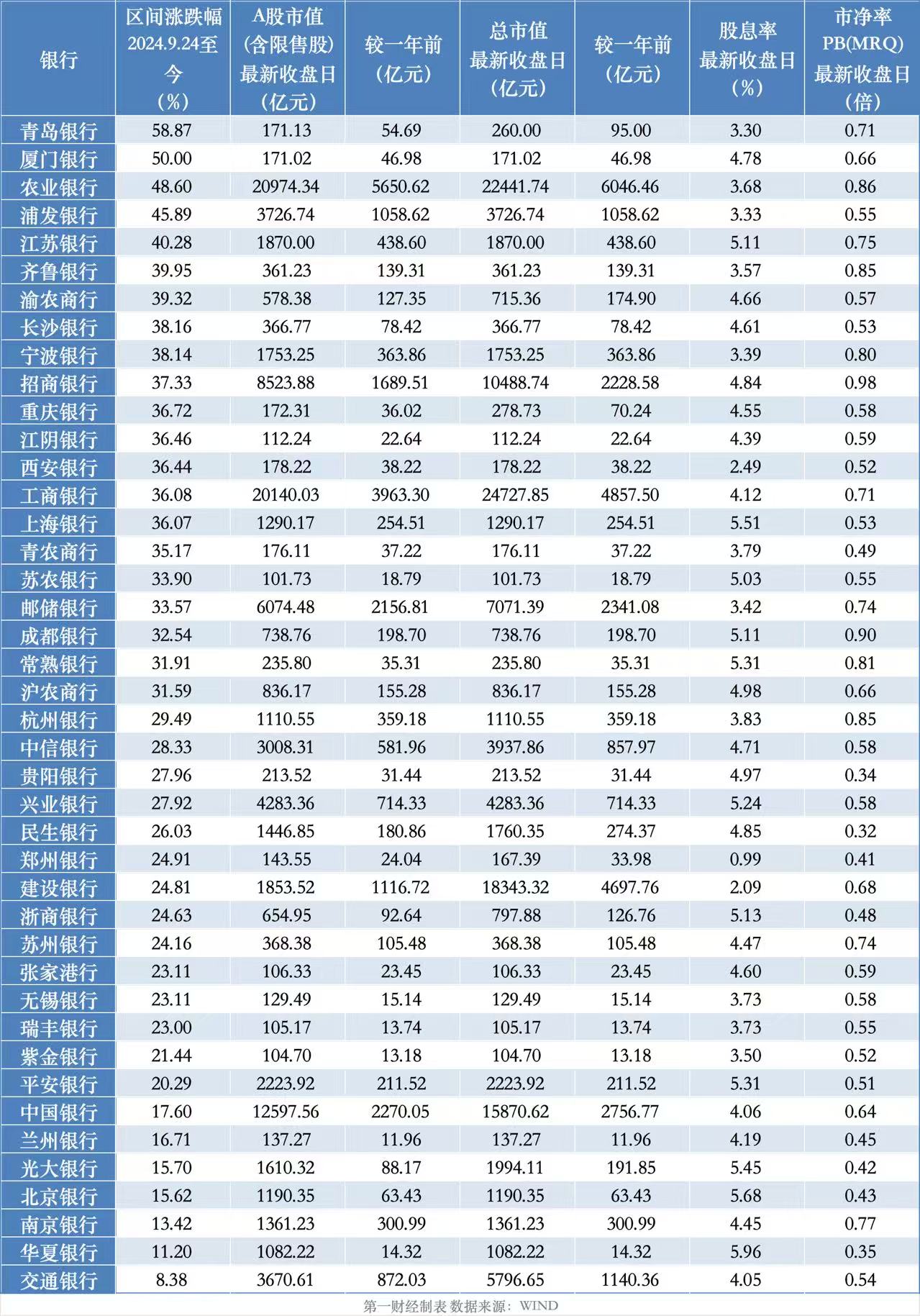
Core Insights - Since the launch of the "9·24" market rally in 2024, bank stocks have been one of the best-performing sectors in the A-share market, with the China Securities Bank Index showing a cumulative increase of approximately 24% over the past year [1] - The market capitalization of the banking sector has surpassed 10 trillion yuan for the first time, with Agricultural Bank of China briefly overtaking Industrial and Commercial Bank of China in market value before the latter regained its position [1][3] - Since July, bank stocks have entered a phase of volatility and correction, with the index declining nearly 13% from its peak, while the Shanghai Composite Index rose over 10% during the same period [1] Market Performance - All 42 A-share listed banks have seen positive stock price movements over the past year, with the highest increase nearing 59% and the lowest around 8% [2] - Specifically, 36 banks have increased by over 20%, 23 by over 30%, and 5 by over 40% [2] - The top three performers include Qingdao Bank (58.87%), Xiamen Bank (50%), and Agricultural Bank of China (48.6%) [2] Market Capitalization - As of September 24, the total A-share market capitalization of the 42 listed banks is approximately 10.6 trillion yuan, an increase of 2.37 trillion yuan from 8.23 trillion yuan a year ago [3] - The total market capitalization, including H-shares, is about 13.9 trillion yuan, up by over 3 trillion yuan from 10.83 trillion yuan a year ago [3] - The top five banks by A-share market capitalization are Agricultural Bank of China (2.1 trillion yuan), Industrial and Commercial Bank of China (2.01 trillion yuan), and China Bank (1.26 trillion yuan) [3] Value Growth - The largest increases in A-share market capitalization have been seen in Agricultural Bank of China and Industrial and Commercial Bank of China, with increases of approximately 565.1 billion yuan and 396.3 billion yuan, respectively [3][4] - Eight banks have seen their A-share market capitalization increase by over 100 billion yuan since last September, with the top four being state-owned banks [3] Recent Trends - Since July, bank stocks have experienced a correction, with over half of the banks seeing declines of more than 10% [5] - Notably, only two banks, Agricultural Bank of China and Postal Savings Bank of China, have remained in the green during this period [5] - The median dividend yield for bank stocks is currently around 4.5%, which has decreased by over 1 percentage point from a year ago but still offers a significant advantage over other asset yields [5]



“冷下去”的揽储掮客群
Bei Jing Shang Bao· 2025-09-24 10:53
Core Viewpoint - The long-standing practice of "deposit rush" in the banking industry is experiencing a decline due to stricter regulations and a growing consensus against excessive competition, leading to a shift in operational strategies among banks [1][3][6]. Group 1: Deposit Rush Dynamics - The "deposit rush" has traditionally been a critical task for banks at the end of financial periods, with brokers acting as intermediaries between banks and private funds [3][6]. - Recent investigations reveal a significant decrease in the number of active brokers and the volume of deposit rush communications, indicating a cooling market [3][4]. - Brokers have reported fewer opportunities to connect with banks, and the once-popular "day-cut arbitrage" strategy is becoming increasingly difficult to execute due to enhanced regulatory scrutiny [4][6]. Group 2: Regulatory Impact and Market Changes - Regulatory authorities have intensified efforts to curb practices like "false deposits" and "interbank assistance," which have historically inflated liquidity metrics [6][8]. - The shift in market dynamics has led to the elimination of many small-scale brokers, as banks transition from a focus on rapid growth to more refined management of funding costs [4][6]. - Despite a decrease in demand, the pricing for deposit rush activities remains stable, with returns for large deposits still within the range of 0.01% to 0.02% [4][6]. Group 3: Internal Banking Challenges - The ongoing pressure for banks to meet performance metrics has resulted in a reliance on short-term deposit strategies, which can distort market pricing and increase overall funding costs [7][9]. - Many banks continue to face internal conflicts between long-term strategic goals and short-term performance pressures, leading to a persistence of "deposit rush" behaviors in informal channels [8][10]. - The current focus on deposit volume over quality has been criticized for undermining sustainable growth and profitability within the banking sector [9][10]. Group 4: Future Strategies for Sustainable Growth - To achieve sustainable development without relying on aggressive deposit acquisition, banks are encouraged to shift their focus from "scale obsession" to "value cultivation" [11][12]. - Strategies include enhancing customer service and product offerings, transitioning from deposit-based income to management fees and service charges [11][12]. - A comprehensive approach involving strategic clarity, service innovation, and regulatory collaboration is essential for banks to realign their operations with the needs of the real economy [11][12].

金条降价,黄金跌价,25年9月23日,各大银行黄金金条最新价格
Sou Hu Cai Jing· 2025-09-24 08:40
Group 1 - On September 23, 2025, gold prices varied slightly among major brands, with all brands' gold jewelry purity reaching 99.9% [1] - Chow Tai Fook and Luk Fook Jewelry priced their gold products at 1085 yuan per gram, while Chow Sang Sang set a slightly higher price at 1090 yuan per gram [1][4] - Other brands like King Fook and Xie Rui Lin also priced their gold at 1085 yuan per gram, maintaining consistency with Chow Tai Fook and Luk Fook Jewelry [1] Group 2 - Various gold shops displayed a wide range of gold prices on the same day, indicating a competitive market [2] - The lowest gold price was offered by Zhou Liufu at 1044 yuan per gram, while Cai Bai priced their gold at 1045 yuan per gram [7][8] - The highest gold price among the listed brands was set by Chow Sang Sang at 1090 yuan per gram [4] Group 3 - Financial institutions offered more stable gold bar prices compared to the fluctuating gold jewelry market, providing an alternative asset allocation for investors [16] - The price of gold bars from major banks ranged from 831 yuan per gram at the Shanghai Gold Exchange to 869 yuan per gram at China Gold [22][23] - Agricultural Bank's "Chuan Shi Zhi Bao Gold Bar" was priced at 864.27 yuan per gram, which was slightly higher than other state-owned banks [19] Group 4 - In the T D (deferred delivery trading) market, gold and silver showed more active price movements, with gold prices experiencing significant fluctuations [28] - The latest transaction price for Au T D gold was 834.57 yuan per gram, with a daily increase of 9.37 yuan, reflecting a 1.14% rise [28] - Silver prices surged dramatically, with Ag T D silver reaching 101731 yuan per kilogram, marking a substantial daily increase of 2712.74 yuan [28] Group 5 - Recent international gold prices have been notably strong, reaching a historical high of 3707.40 USD per ounce following a 25 basis point rate cut by the Federal Reserve [31] - Despite a slight pullback, gold prices remained robust, closing at 3684.93 USD per ounce, marking a cumulative increase of 1.15% over five consecutive weeks [31] - The current bull market in gold is characterized by a nearly 40% increase in price since the beginning of the year, a remarkable performance compared to historical trends [33]

从2700到3800,“924”行情周年之际,还有哪些赛道有补涨需求?
Xin Lang Cai Jing· 2025-09-24 07:47
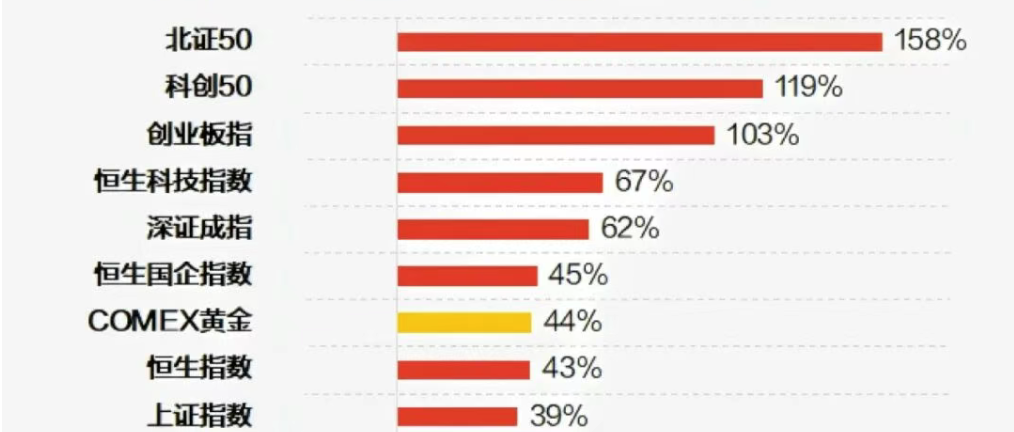
Core Insights - The A-share market has seen a significant recovery over the past year, with the Shanghai Composite Index rising from 2700 points to over 3800 points, and the total market capitalization surpassing 100 trillion yuan, with over 1500 stocks doubling in price [1] - The growth sectors, particularly in innovative pharmaceuticals and semiconductor domestic substitution, have outperformed, with indices like the North Star 50 and ChiNext Index achieving substantial returns [1][3] - Despite the overall market improvement, there remains a structural divergence, with technology and digital economy sectors showing exceptional growth, while traditional cyclical sectors lag behind [3] Market Performance - The CSI 300 index increased by 40% over the past year, with valuation contributing 88% and earnings per share (EPS) contributing 12% to this growth [1] - The average increase in the artificial intelligence industry exceeded 120%, while semiconductor equipment and materials saw gains over 90% [3] - In contrast, traditional cyclical sectors like coal, steel, and real estate only saw increases between 10% and 20% [3] Sector Analysis - The banking sector is highlighted for its low valuation and high dividend yield, making it a safe investment choice amid economic uncertainties, with an average price-to-book (PB) ratio of approximately 0.6 [6] - The food and beverage sector, particularly the liquor segment, has faced challenges but presents opportunities for rebound due to its core consumption scenarios tied to business and social activities, with a current price-to-earnings (PE) ratio of 21.13 [8][10] - The coal sector has underperformed with less than 10% growth, but recent supply constraints and seasonal demand increases may lead to a price rebound, supported by government policies aimed at stabilizing coal prices [13][16] Investment Products - The Huabao CSI Bank ETF has surpassed 10 billion yuan in scale, indicating strong liquidity and investor interest [7] - The Huaxia CSI Food and Beverage ETF focuses on various segments within the industry, including liquor and dairy products, and has a scale exceeding 5 billion yuan [12] - The Guotai CSI Coal ETF has seen significant inflows, reflecting a growing interest in the coal sector despite its recent underperformance [16]
解构非银存款超常增长的三重逻辑
NORTHEAST SECURITIES· 2025-09-24 06:44
1. Report Industry Investment Rating No relevant content provided. 2. Core Viewpoints of the Report - The surge in non - bank deposits is not simply due to "deposits entering the market." It is influenced by government fiscal funds, enterprise "manual interest compensation" policy changes, and the transfer of residents' excess net savings [17][18]. - The current equity market rally may have some sustainability. If the A - share market rises steadily, about 3.3 trillion yuan of residents' "excess net savings" may continue to transfer, with 0.49 - 0.82 trillion yuan potentially entering the equity market [5][18]. 3. Summary According to the Directory 3.1 Non - bank Deposits Surge is Not Simply "Deposits Entering the Market" - In August 2025, the newly - added household deposits were only 110 billion yuan, the lowest in the same period in the past decade. In contrast, the newly - added non - bank financial institution deposits were 1180 billion yuan, significantly exceeding the seasonal level for two consecutive months [19]. - The view of "deposits entering the market" has methodological flaws, as the "household deposits/A - share total market value" ratio is affected by stock price changes and ignores data seasonality [19][21]. - The seasonal fluctuations of household deposits are mainly due to seasonal consumption demand and bank deposit assessment at the end of the half - year. The seasonal fluctuations of non - bank deposits are related to bank MPA assessments and the scale increase of bank wealth management products [21][25]. 3.2 Support Factor from the Government: Lubrication Effect of Active Fiscal Fund Allocation - As of August 2025, the balance of fiscal deposits was 7.8 trillion yuan. Fiscal deposits are mainly affected by broad fiscal revenues and expenditures and government bond net financing [30]. - In 2025, fiscal front - loading provided sufficient funds for government deposits. However, fiscal revenue showed a situation of "high financing, low precipitation," which may be related to the improvement of fiscal expenditure efficiency and the conversion of fiscal funds into entity - sector deposits [31][38]. 3.3 Support Factor from Enterprises: Persistent Scar Effect of Canceling the "Manual Interest Compensation" Policy 3.3.1 Calculation of the Proportion of "Ultra - compliant" Deposits Based on the Annual Reports of Listed Banks - Since the end of 2022, the central bank and regulatory authorities have introduced policies to guide large banks to increase credit investment in specific areas, resulting in more enterprise deposits being concentrated in large - bank systems [45]. - Banks have taken multiple measures to reduce deposit costs, but the effect is not obvious. The main reasons are the regular - ization of household deposits and the high cost of enterprise deposits affected by "manual interest compensation" [47][50]. - After the "manual interest compensation" was stopped in April 2024, about 40% of the current deposits of large state - owned and joint - stock banks were estimated to be "ultra - compliant" deposits. However, not all of these deposits will flow out immediately [56][61]. 3.3.2 Calculation of the Proportion of "Ultra - compliant" Deposits Based on the Trend of Enterprise Current Deposits in the Credit Caliber - After the cancellation of "manual interest compensation," the year - on - year decline of enterprise current deposits significantly expanded. From April to August 2024, the cumulative year - on - year over - reduction scale was 4502.42 billion yuan, accounting for about 18.3% of the total balance at the end of March 2024 [65][69]. 3.3.3 Two Factors for the Improvement of Enterprises' Short - term Capital Position - The issuance of government bonds and the allocation of fiscal funds have accelerated, injecting liquidity into the enterprise sector. The increase in settlement demand has led to an increase in RMB funds, which has also promoted the recovery of enterprise current deposits [70][71]. 3.4 Support Factor from Residents: Maturity Transfer of Excess Net Savings 3.4.1 Historical Review of Two Rounds of Residents' "Deposit Outflows" - From 2009 - 2011, residents' savings first flowed into the stock and real - estate markets and then into wealth management and trust products. This was due to the economic stimulus policies after the financial crisis and the subsequent tightening of monetary policy to control inflation [78][82]. - From 2014 - 2016, the bull markets in stocks and bonds, the rise of Internet finance, and the relaxation of real - estate policies led to the diversion of residents' deposits [89][102]. 3.4.2 Calculation of the Precipitated "Savings" with Migration Potential in the Resident Sector - Since 2020, residents' savings have significantly deviated from the linear trend, mainly in the form of regular deposits. As of August 2025, the excess regular savings were about 47.75 trillion yuan, while the excess current savings were only 0.33 trillion yuan [111][115]. - The concept of "excess net savings" is introduced to measure the real "excess" savings accumulation by considering both the asset and liability sides of the resident sector [118]. 3.5 The Bull Market Continues, and 3.3 Trillion Yuan of Deposits May Continue to Transfer This Year, with 0.49 - 0.82 Trillion Yuan Potentially Entering the Market - From June to August 2025, the "deposit transfer" of residents may be in the initial stage, mainly due to the transfer of matured "excess net savings" rather than a fundamental change in residents' risk preference [5][18]. - The equity market rally may have some sustainability. Leveraged funds, medium - and long - term funds entering the market, and foreign capital may support the market. If the A - share market rises steadily, about 3.3 trillion yuan of funds may continue to transfer, with 15% - 25% (about 0.49 - 0.82 trillion yuan) potentially entering the equity market [5].