国信证券

Search documents
多股两融折算率“归零”?券商:静态市盈率异常的常规操作
Xin Lang Cai Jing· 2025-10-10 01:16
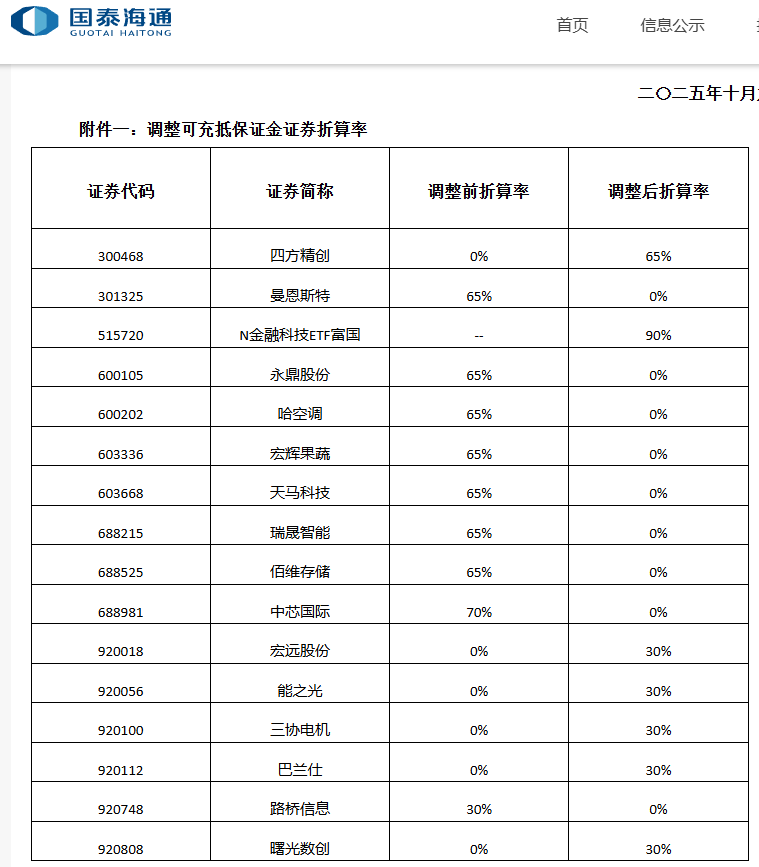
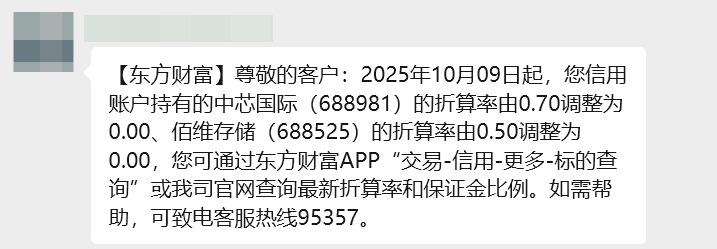
Core Viewpoint - The adjustment of margin financing and securities lending collateral ratios for stocks such as SMIC and BAWI Storage to zero is a routine operation based on exchange regulations due to abnormal static price-earnings ratios [2][5][7]. Group 1: Margin Financing and Securities Lending Adjustments - SMIC's collateral ratio was adjusted from 70% to 0%, while BAWI Storage's was adjusted from 50% to 0% [1][3]. - A total of nine stocks had their collateral ratios adjusted to zero on October 9, including SMIC and BAWI Storage, due to static price-earnings ratios exceeding 300 or being negative [2][5]. - The adjustment is a standard procedure and is expected to revert once the static price-earnings ratios normalize [7]. Group 2: Static Price-Earnings Ratio Regulations - The exchange stipulates that stocks with static price-earnings ratios above 300 or negative will have a collateral ratio of 0% [9][11]. - As of October 9, SMIC's static price-earnings ratio was reported at 300.44%, down from 303.08% on September 30 [7]. - The collateral ratio classifications include various levels, with the highest being 95% for cash management products and the lowest being 0% for stocks with high static price-earnings ratios [9][11].



国信证券晨会纪要-20251010
Guoxin Securities· 2025-10-10 01:12
Group 1: Film Industry Insights - The National Day box office reached 1.808 billion yuan, showing a slight decline of 14.1% compared to 2024 [9] - The number of viewers and average ticket price were 49.335 million and 36.6 yuan, reflecting a year-on-year decrease of 5.3% and 9.4% respectively [9] - The box office trend during the holiday showed a pattern of initial decline followed by recovery, with a notable increase of 20.8% on October 7 [9] - Key films such as "The Volunteer Army" and "731" performed well, contributing significantly to the overall box office [9] - Policy support for content supply recovery and the application of AIGC technology are expected to enhance efficiency in the industry [9] Group 2: Banking Sector Analysis - The investment focus in the banking sector is heavily influenced by macroeconomic conditions, with quality bank stocks showing good long-term investment value [10] - U.S. and Indian bank indices have maintained high PB valuations, reflecting strong economic growth, although they have not achieved excess returns since 2020 [11] - Japanese and European bank indices have shown recovery since 2021, benefiting from policy stimuli that ended the zero/negative interest rate era [11] - In contrast, the Korean banking index remains low at around 0.65x PB, while China's banking index is at approximately 0.53x, indicating market pessimism [11] - A total of 102 out of 154 banks in the analyzed markets outperformed the market index, highlighting the importance of selective stock picking [12] Group 3: Insurance Sector Risk Assessment - Tianan Insurance's bond default marks a significant risk exposure in the insurance sector, reflecting a trend towards breaking rigid payment structures in China's financial market [13] - The default is expected to accelerate the clearing of risks among smaller insurance companies, leading to a more optimized industry landscape [13] Group 4: AI and E-commerce Service Providers - E-commerce service providers are facing operational bottlenecks due to the fading online growth, prompting a shift towards self-owned brands and AI technology integration [14][15] - Companies like Ruoyuchen and Qingmu Technology are successfully developing their own brands and enhancing operational capabilities through AI [15] - The focus on self-owned brands and AI integration is seen as a critical competitive advantage for future growth in the sector [15][16] Group 5: ZTE Corporation Overview - ZTE is actively participating in the construction of intelligent computing infrastructure, aiming to become a leader in domestic computing and connectivity [18] - The company reported a revenue of 71.55 billion yuan in the first half of 2025, marking a 15% year-on-year increase, although net profit decreased by 11.5% [18] - ZTE's second revenue stream, represented by computing and terminal products, has seen nearly 100% growth, contributing over 35% to total revenue [18] - The company is positioned to benefit from the growing demand for AI infrastructure, with significant investments expected from major cloud service providers [17]
多家券商出手调整!一波股票两融折算率降为0 是何原因?
智通财经网· 2025-10-09 22:39
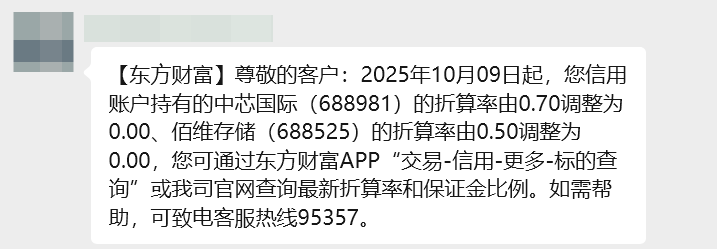
两融折算率一下子调整为0,今天一些个股的变化很是吸引了市场关注。 10月9日,有投资者反馈,接东方财富证券短信告知,自当日起,信用账户持有的中芯国际(688981.SH)的两融折算率由0.7调整为0.00,佰维存储(688525.SH) 的两融折算率由0.5调整为0.00。 智通财经记者就此致电东方财富证券客服,对方确认了上述调整信息,并解释称,依据两交易所规定,当个股静态市盈率超过300倍或为负数时,其融资融 券折算率需调为0,而中芯国际、佰维存储当前静态市盈率均超过300倍,这正是依规进行的正常调整。该规定自2016年起实施,并沿用至今。2025年7月虽 有部分股票调整,但核心规则未变,旨在加强风险控制,确保融资融券业务的平稳运行。 股票折算率调为0的情况并非单家券商行为,而是行业统一动作。同时,这一调整是券商依据交易所规则开展的常态化操作,当前市场中折算率为0的股票数 量已超千只。此外,中芯国际等半导体板块午后集体调整,是多方面因素共同作用的结果。从板块整体表现来看,半导体板块年内已累计大涨57.19%,区 间振幅达72.04%。 国信、国泰海通等多家券商同步调整 东方财富证券并非首家对上述两只股票进行 ...
“凭空多出一大笔开销”与“没想到成了投资收益最好的部分” 金价狂飙下的市场众生相
Zhong Guo Zheng Quan Bao· 2025-10-09 21:48
Core Insights - The rising gold prices have created a divide among consumers, with some feeling pressured by the increased costs of gold jewelry while others have benefited from their investments in gold [1][2][3] Consumer Behavior - Many consumers, like Mr. Wang, are postponing their purchases of gold jewelry due to high prices, which have exceeded 900 RMB per gram earlier this year and are now around 1160 RMB per gram [2][3] - Consumers are increasingly considering alternatives, such as purchasing gold bars from banks, which are cheaper than retail jewelry prices, leading to significant savings [3][4] Investment Trends - Investors who bought gold earlier, like Ms. Jia, have seen substantial returns, with some reporting profits exceeding 13,000 RMB from their investments in gold accumulation products [1][3] - The demand for gold-related financial products, such as gold accumulation and structured deposits, has surged as consumers seek to capitalize on rising gold prices [5][6] Market Dynamics - The gold market is characterized by two main participant types: financial investors who drive price movements and non-financial investors who provide market support [6][7] - Analysts suggest that while gold prices may experience short-term fluctuations, the long-term outlook remains positive due to ongoing geopolitical risks and sustained investment demand [6][7]
金价狂飙下的市场众生相
Zhong Guo Zheng Quan Bao· 2025-10-09 20:53
Group 1 - The article highlights the contrasting sentiments among consumers regarding rising gold prices, with some feeling pressured by increased costs while others celebrate their investment gains [1][2][3] - The current price of gold jewelry in China has surpassed 1160 RMB per gram, with specific brands like Liufu and Chow Sang Sang pricing their gold jewelry at 1168 RMB and 1170 RMB per gram respectively [1][2] - Consumers planning weddings are particularly affected, as the cost of gold jewelry has significantly increased, leading to budgetary concerns for those who view gold as a traditional necessity rather than an investment [2][3] Group 2 - Investors who purchased gold earlier are experiencing substantial returns, with individuals like Ms. Jia reporting gains exceeding 13,000 RMB from her investments in accumulated gold [1][3] - Banks are seeing a rise in inquiries about gold-related products, with customer managers recommending accumulated gold as a way to average investment costs and mitigate risks associated with high prices [3][4] - The demand for gold-related financial products, such as structured deposits and ETFs, has surged as gold prices continue to rise, indicating a growing interest in gold as an investment asset [5] Group 3 - The article notes that the gold market is influenced by two main participant categories: financial investors who drive price movements and non-financial investors who provide market support [5] - Analysts suggest that while gold has long-term investment value, short-term volatility remains a concern, with various factors such as monetary policy and geopolitical risks affecting market dynamics [5]

人工智能行业专题(13):OpenAI的软硬件生态布局与进展-国信证券
Sou Hu Cai Jing· 2025-10-09 18:05
Group 1: Hardware and Computing Ecosystem - OpenAI is advancing its infrastructure through the "Stargate" project, planning to invest $500 billion over four years to build 10GW of AI infrastructure, with the first phase of $100 billion already initiated [1] - Key partnerships include NVIDIA investing $100 billion for future chip supply, AMD exchanging 160 million stock warrants for a 6GW GPU deployment, and a $10 billion order with Broadcom for 3nm ASICs expected to be produced by 2026 [1] - The demand for computing power is surging, with training large models increasing by tenfold each generation; GPT-5 is projected to require 350,000 H100 cards, with training costs exceeding $500 million [1][19] Group 2: Software Ecosystem and User Engagement - ChatGPT is transitioning from a "tool-based application" to an "Agent platform," with three major features set to launch in September 2025: Pulse (personal assistant), Instant Checkout (shopping integration), and Sora App (AI-native social media platform) [2] - This transformation leverages billions of user interaction data to enhance technology, user experience, and monetization strategies, moving from a subscription model to a "subscription + transaction commission" model [2][33] Group 3: User and Commercial Performance - ChatGPT's user base is leading in the AI application space, with over 700 million weekly active users (WAU) and nearly 1 billion monthly active users (MAU) projected by July 2025, alongside an 80%+ retention rate for the paid version [3] - The average user spends nearly 20 minutes daily on the platform, with non-work scenarios accounting for 73% of usage, primarily for decision support and task execution [3][22] - The projected annual recurring revenue (ARR) for 2025 is expected to reach $12 billion, with a valuation of $500 billion by September 2025 [3][22] Group 4: Model Performance - The GPT series maintains a technological edge of 6-12 months, with GPT-5 and Codex scoring highest in intelligence ratings; GPT-5 has a response delay of 0.78 seconds and offers high cost-performance [3][21] - Despite narrowing gaps with competing models, OpenAI's rapid iteration and increasing user engagement correlate positively with model performance, as evidenced by rising user interaction times [3][21] Group 5: Financial Outlook - OpenAI's revenue is projected to reach $13 billion by 2025, up from $3.7 billion in 2024, with a long-term goal of $200 billion by 2030; however, cumulative cash consumption before 2029 may reach $115 billion [1][22] - The company is expected to rely on equity partnerships to mitigate costs, with significant investments from firms like SoftBank and Thrive Capital reflecting high valuations for AI technology [22][24]


券商今年以来发债融资热情高涨
Zheng Quan Ri Bao· 2025-10-09 15:54
Group 1 - The capital market has shown a significant positive trend this year, prompting securities firms to actively supplement capital to seize development opportunities [1][3] - Securities firms are increasingly engaging in private placements, with multiple firms making progress in their fundraising efforts, including Nanjing Securities, which plans to issue up to 1.106 billion shares to raise no more than 5 billion yuan [2][3] - As of October 9, 2023, the total amount raised through bond issuance by securities firms reached 1.27 trillion yuan, marking an 80.22% year-on-year increase [1][3][4] Group 2 - The issuance of bonds has become a crucial method for securities firms to supplement capital, with 71 firms issuing a total of 672 bonds this year [3][4] - Notably, 33 firms have issued bonds exceeding 10 billion yuan, with China Galaxy leading at 107.9 billion yuan, followed by Huatai Securities at 98.1 billion yuan [4] - The current low interest rate environment has made bond financing a primary channel for securities firms to expand their balance sheets, with funds primarily used for debt replacement and operational capital [4]

国联民生获批交易权牌照,点燃中型券商“落子”香港热情
2 1 Shi Ji Jing Ji Bao Dao· 2025-10-09 13:04
Core Insights - The article highlights the accelerated international business expansion of small and medium-sized securities firms in China, particularly in Hong Kong, with several firms obtaining licenses and establishing subsidiaries [1][10][11]. Group 1: Company Developments - Guolian Minsheng Securities has received a trading license from the Hong Kong Securities and Futures Commission, marking a significant milestone in its international strategy [4][5]. - Other firms, such as Northeast Securities, Western Securities, and First Capital, have also announced plans to establish Hong Kong subsidiaries, indicating a trend among smaller firms to enter the market [12][13]. - Guolian Minsheng Securities' Hong Kong subsidiary will focus on investment banking underwriting, stock trading, and stock custody services [4][5]. Group 2: Market Trends - The Hong Kong market is experiencing increased trading activity and a surge in technology IPOs, providing a differentiated development space for smaller securities firms [2][22]. - The total assets of overseas subsidiaries of Chinese securities firms reached HKD 1.64 trillion, a year-on-year increase of 20.45%, indicating robust growth in international operations [18]. - The Hong Kong stock market has seen a revival, with net profits in the securities industry increasing by 14% to HKD 28.9 billion in the first half of the year [14][19]. Group 3: Challenges and Strategic Shifts - Despite the growth, some firms have faced challenges, with reports of losses and delistings among certain subsidiaries, prompting some firms to reconsider their international strategies [2][20]. - The role of Hong Kong is evolving from a mere "outbound bridge" to a "strategic high ground" for international business, attracting more firms to increase their investments in the region [18][22]. - Regulatory scrutiny has increased, with firms needing to balance international expansion with compliance and risk management [21][22].


多家券商出手调整,一波股票两融折算率降为0,是何原因?
Feng Huang Wang· 2025-10-09 11:46
Core Viewpoint - The adjustment of margin financing rates to zero for certain stocks, including SMIC and Bawen Storage, has attracted significant market attention, reflecting regulatory compliance and risk control measures in the financing and securities industry [1][2][10]. Group 1: Margin Financing Rate Adjustments - On October 9, 2023, the margin financing rates for SMIC (688981) and Bawen Storage (688525) were adjusted from 0.7 and 0.5 to 0.00, respectively [1][2]. - This adjustment is in accordance with exchange regulations that mandate a zero financing rate for stocks with a static P/E ratio exceeding 300 or negative [2][10]. - The adjustment is a common practice across the industry, with over 1,000 stocks currently having a financing rate of zero due to similar conditions [2][15]. Group 2: Market Reactions and Stock Performance - Following the adjustment, the semiconductor sector experienced significant volatility, with SMIC showing a daily fluctuation of over 11% [7]. - On the adjustment day, SMIC's stock price fluctuated between a high of 153 CNY and a low of 138.91 CNY, with a closing drop of 0.87% [7][15]. - The ChiNext 50 Index was also affected, initially rising by 6.19% before closing with a smaller gain of 2.93% [9]. Group 3: Regulatory Framework - The rules governing the adjustment of margin financing rates have been in place since December 2016, aimed at enhancing risk control in the financing and securities market [10][15]. - The core logic of these regulations is to limit leverage on stocks with high valuations while allowing it for those with lower valuations, thereby managing business risks effectively [15].
大股东减持套现,新易盛跌4%退守20日线,高“光”159363尾盘翻绿,风险还是机会?
Xin Lang Ji Jin· 2025-10-09 11:44
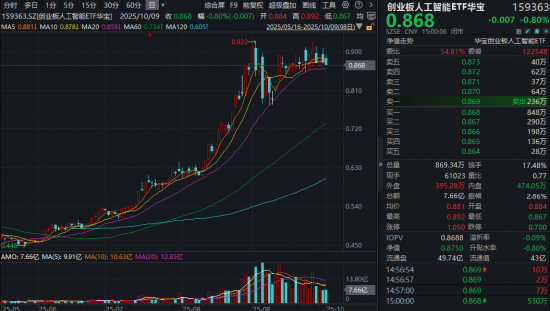
Core Viewpoint - The A-share market experienced a positive opening on October 9, but the artificial intelligence (AI) industry chain saw a significant pullback after an initial surge, particularly in the computing power sector, with notable declines in stocks like New Yisheng and Tianfu Communication [1][3]. Market Performance - The largest and most liquid AI ETF on the ChiNext, ETF 159363, initially rose nearly 2% but ended the day down 0.8%, with a total trading volume of 766 million yuan [1][5]. Stock Movements - The decline in the computing power sector, particularly in optical modules, is attributed to major shareholders' sell-offs, with New Yisheng's chairman planning to sell approximately 11.43 million shares for about 4.18 billion yuan [3][4]. - Despite the sell-offs, analysts believe that the core reasons for these actions are related to personal financial arrangements rather than the companies' operational performance, suggesting that the high growth and strong fundamentals in the optical module industry provide a solid support for stock prices [3][4]. Industry Trends - The computing power sector is expected to see sustained capital expenditures, with both domestic and international investments increasing. Analysts recommend focusing on new technologies and products in this area [3][4]. - OpenAI's recent announcements, including the launch of the Sora 2 model and significant agreements with major tech companies like NVIDIA and AMD, highlight the ongoing high demand and growth potential in the AI sector [4][5]. Investment Strategy - The investment strategy for October emphasizes the continued high demand for AI infrastructure, with North American cloud service providers projected to increase capital expenditures by 40% year-on-year, exceeding 370 billion USD by 2025 [5]. - Investors are encouraged to focus on optical devices and modules, particularly the first AI ETF on the ChiNext, which has a significant allocation towards computing power and AI applications [5].