商汤科技

Search documents
三位一体战略落地,商汤筑牢AI优势未来可期
Sou Hu Cai Jing· 2025-10-08 22:24
Core Insights - The article highlights the strong performance and strategic positioning of SenseTime in the competitive AI industry, emphasizing its focus on technological innovation and business iteration as key drivers of growth [1][14]. Financial Performance - SenseTime reported a total revenue of 2.4 billion yuan for the first half of 2025, representing a year-on-year growth of 36% [1]. - The revenue from generative AI grew by 73% for the third consecutive year, indicating a robust growth trajectory [1]. - The adjusted net loss decreased by 50% to 1.162 billion yuan, showcasing improved financial health [1]. - The gross profit reached 908 million yuan, with a gross margin of 38.5% [1]. - As of mid-2025, the company had a total cash reserve of 13.2 billion yuan, higher than previous reporting periods [1]. Strategic Positioning - SenseTime's "big device - big model - application" strategy aims to create a sustainable growth model in the AI sector [1]. - The company has established a competitive moat through a comprehensive technology layout, which includes infrastructure, model development, and industry application [2]. - SenseTime's "Riri New" model has achieved a leading position in the domestic market, with its GenAI technology stack ranked first in China according to a 2024 report by Frost & Sullivan [2]. Business Evolution - The generative AI segment has become the largest business for SenseTime, with revenue exceeding 2.4 billion yuan in 2024, marking a year-on-year increase of 103.1% [4]. - The share of generative AI in total revenue rose from 34.8% in 2023 to 63.7% in 2024, reflecting significant expansion [7]. - Traditional visual AI revenue decreased by 39.5% to 1.112 billion yuan in 2024, but the company focused on high-margin, high-cash-flow scenarios for structural optimization [7]. Market and Competitive Landscape - SenseTime's full-stack technology layout strengthens its competitive barriers, maintaining a leading market share in computer vision for eight consecutive years [5]. - The company has established over 10 R&D centers globally, with nearly 6,000 professionals and over 14,000 patent applications, enhancing its global collaboration and service capabilities [5]. - The global machine vision market is projected to grow at a compound annual growth rate of around 20% from 2024 to 2029, with SenseTime positioned to benefit from this trend [13]. Future Outlook - The company is expected to leverage its strong cash reserves, which reached 12.75 billion yuan by the end of 2024, to support ongoing R&D and operational investments [13]. - SenseTime's strategic focus on generative AI, smart vehicles, and traditional visual AI aligns with the growth demands of sectors like smart security and intelligent transportation [13]. - The ability to convert technology into revenue and the ongoing industry benefits position SenseTime favorably for future growth [14].

博泰车联与商汤科技联合打造汽车AI“超级大脑”
Zheng Quan Shi Bao Wang· 2025-10-08 04:59
Core Insights - The strategic partnership between Botai Vehicle Networking Technology and SenseTime marks a significant step towards the integration of AI in smart cockpit technology, indicating a new phase in China's intelligent connected vehicle industry [1][2] Group 1: Strategic Collaboration - Botai and SenseTime will focus on the deep integration of AI large models in smart cockpits, while also investing in humanoid robots and integrated cockpit-driving solutions [1] - The collaboration aims to create a platform-level AI agent that offers a comprehensive solution from software to cloud services, enhancing the user experience in smart cockpits [1][2] Group 2: Technological Advancements - The partnership will leverage AIDC infrastructure and self-developed AI inference and training chips to reconstruct the smart cockpit experience across multiple dimensions, including personalized interaction and safety [2] - A high-efficiency collaborative mechanism for "end-side large models" will be established, forming an integrated smart connected vehicle platform [2] Group 3: Humanoid Robotics Development - The collaboration will combine SenseTime's advanced visual perception algorithms with Botai's expertise in hardware design and mass production to develop a new generation of flexible and intelligent humanoid robots [2] - These robots are expected to excel in scenarios such as smart cockpit services and vehicle maintenance, potentially transforming the robotics industry [2] Group 4: Ecosystem Development - The companies will work together to create a full-stack solution focusing on integrated cockpit-driving, vehicle-road collaboration, and international expansion [3] - The integration of driving decisions with cockpit experiences will be enhanced through AI-generated personalized features, promoting unified interaction among people, vehicles, and the environment [3]
Sora登顶苹果App Store;阿里云升级全栈AI体系;英伟达拟投1000亿助OpenAI建数据中心|一周AI要闻回顾
36氪· 2025-10-04 13:22
Core Insights - OpenAI launched the AI video generation app Sora, which quickly became the top free app on the Apple App Store, surpassing competitors like Google’s Gemini and ChatGPT [2] - Alibaba Cloud announced a significant investment of 380 billion yuan over the next three years to enhance its cloud and AI infrastructure, showcasing its commitment to AI development [5][10] - Nvidia plans to invest up to $100 billion to assist OpenAI in building data centers, which could lead to substantial revenue growth for Nvidia [9] Group 1: OpenAI and AI Applications - OpenAI's Sora app allows users to create and share AI-generated videos, raising discussions about the safety and legality of content generation [2] - The Sora2 model behind the app generates highly realistic scenes and sounds, indicating advancements in AI technology [2] - OpenAI's investment in robotics company 1X Technologies aims for a valuation of $10 billion, reflecting the growing interest in AI-driven robotics [14] Group 2: Alibaba and AI Infrastructure - Alibaba Cloud's CTO introduced seven new models at the Yunqi Conference, covering various AI fields, including language and visual processing [3] - The flagship model Qwen3-Max has over one trillion parameters and outperforms competitors in programming and tool usage tests [3] - Alibaba's stock rose over 7% following the announcement of its AI investment plans, indicating positive market reception [5] Group 3: Other AI Developments - Kuaishou launched the Keling 2.5 Turbo video generation model, which reduces costs by 30% while improving output quality [7] - JD.com introduced the "He She It" digital assistant capable of answering questions and facilitating various tasks, showcasing advancements in AI personal assistants [8] - SenseTime's AI video agent Seko attracted over 100,000 creators within a month, highlighting the demand for user-friendly AI content creation tools [8] Group 4: Market Trends and Investments - BlueFocus invested in PureblueAI, marking its first strategic investment in AI following its "All in AI" strategy [13] - Fivetran is in talks to acquire DBT Labs, indicating a trend of consolidation in the data technology sector [15] - The rapid rise of the Neon-Money Talks app, which allows users to earn money through voice calls, raises concerns about data privacy in the AI era [9]

刘庆峰说马斯克不懂AI,但资本市场似乎也不懂科大讯飞
Sou Hu Cai Jing· 2025-09-24 12:16
Core Viewpoint - The article discusses the recent surge in AI stocks, highlighting the contrasting performance of iFlytek, which has not benefited from the AI boom despite its strong technological capabilities. The focus is on the reasons behind this disparity and the challenges iFlytek faces in commercializing its AI products effectively [2][4]. Group 1: AI Market Trends - The year 2025 is anticipated to be a pivotal year for AI applications, with significant capital expenditures expected from major companies like Microsoft, META, Google, and Amazon, projected to exceed $317.2 billion, a 49.6% increase from 2024 [2]. - Domestic giants such as Baidu, Alibaba, and Tencent have seen substantial stock price increases, with Baidu reaching a new high since October 2023, and Tencent's market value returning to 6 trillion HKD after three years [2]. - Other AI companies, like SenseTime, have also experienced stock price surges, with their market capitalization surpassing 100 billion HKD [2]. Group 2: iFlytek's Performance - iFlytek's stock price has remained stable, failing to join the recent AI stock rally, attributed to its reported net loss of 239 million yuan in the first half of 2025 [4][5]. - The company's gross margin for its open platform business has declined to 16.58%, and revenue from smart hardware has decreased by 3.27% year-on-year [4]. - Despite its strong technological capabilities, such as the iFlytek Starfire V4.0 Turbo outperforming GPT-4 Turbo in several tests, the company has struggled with profitability and market perception [4][10]. Group 3: Comparison with Competitors - SenseTime, despite also reporting losses, has benefited from the AI chip boom and is perceived as undervalued, with its stock price hovering around 1 HKD since 2024 [4]. - iFlytek has historically been favored by capital markets, but its reliance on government subsidies remains a concern, with non-recurring gains from government support amounting to 86.3 million yuan in the first half of 2025 [5][10]. - Competitors like Baidu and Alibaba have successfully commercialized their AI technologies, with Baidu's AI cloud revenue exceeding 10 billion yuan, growing 34% year-on-year, and Alibaba's AI-related products achieving triple-digit growth for eight consecutive quarters [6][8]. Group 4: iFlytek's Market Challenges - iFlytek's core revenue from smart education reached 3.531 billion yuan in the first half of 2025, a 23.47% increase, but it still lags behind competitors in market share [12][18]. - The company holds a 12.1% market share in the AI learning machine sector, significantly lower than competitors like Zuoyebang and Xueersi, which hold 33.4% and 19.8% respectively [17][18]. - Factors contributing to iFlytek's market challenges include a focus on high-end technology rather than practical learning aids, strong brand loyalty towards established educational institutions, and past controversies affecting consumer trust [20][26].

东方材料收到行政监管措施决定书 被责令整改
Zheng Quan Shi Bao Wang· 2025-09-24 10:57
Core Viewpoint - Dongfang Materials (603110) has been ordered by the Anhui Regulatory Bureau of the China Securities Regulatory Commission to rectify issues related to accounting practices and internal controls within 30 days, although the company asserts that this will not impact its daily operations [1][2]. Group 1: Regulatory Issues - The Anhui Regulatory Bureau identified two main violations: non-compliance in accounting practices, including missing original vouchers for salary accruals and lack of segregation of duties, and inadequate internal controls in procurement, expense management, and approval processes [1][2]. - Dongfang Materials is required to submit a written rectification report within 30 days of receiving the administrative measure decision [2]. Group 2: Company Overview - Established in late 1994 and listed on the Shanghai Stock Exchange in 2017, Dongfang Materials is based in Hefei, Anhui Province, and primarily operates in the flexible packaging industry [2]. - The company's main business segments include packaging inks (62.27%), adhesives (27.13%), computing system integration and technical services (6.26%), and electronic inks (4.09%) [2]. Group 3: Financial Performance - In the first half of 2025, Dongfang Materials reported revenue of 174 million yuan, a year-on-year decrease of 5.06%, and a net profit attributable to shareholders of 654,400 yuan, down 88.48% year-on-year, attributed to declining revenue and increased expenses [2]. - The company has recently expanded into the computing power sector, generating 27.32 million yuan in revenue from this new business, with a gross margin of 30.98% [3].

不做郑氏第三代接班人?郑裕彤长孙郑志刚要“自我发展”
Di Yi Cai Jing· 2025-09-24 02:40
Core Viewpoint - Zheng Zhigang, a member of the Zheng family, is establishing a new investment company named "Hong Kong Shanghe Development," focusing on digital sectors and emerging markets, while continuing to operate and develop the K11 brand [1][5]. Group 1: Business Developments - Zheng Zhigang's new investment company will cover various industries, including culture, entertainment, sports, traditional Chinese medicine globalization, and finance [1]. - The concept for this new business has been in development for two years, with plans to announce more projects soon [3]. - Zheng Zhigang has prior experience in investment, having co-founded a private investment platform in 2017 and invested in companies like SenseTime, SHEIN, Xiaopeng Motors, and NIO [3]. Group 2: K11 Brand Management - Zheng Zhigang has retained control over the K11 brand, having signed an agreement for the sale of shares related to K11 operations for HKD 209 million, while also establishing a 30-year trademark licensing agreement [5]. - K11 by AC Group, under Hong Kong Shanghe Development, will manage retail assets and cultural art districts, serving multiple stakeholders [5]. Group 3: Corporate Restructuring - Zheng Zhigang has stepped down from various positions within the Zheng family’s companies, including New World Development and Chow Tai Fook, marking a significant shift in his career focus [4][6]. - Following his resignation as CEO of New World Development in September 2024, he has gradually distanced himself from family business roles, culminating in his departure from all positions within the family enterprises [6].

大厂疯抢AI人才!字节跳动、小红书、阿里巴巴岗位最多
Mei Ri Jing Ji Xin Wen· 2025-09-17 13:29
Core Insights - The competition for AI talent has intensified, evolving into a strategic arms race for major companies, crucial for future survival and development [1][7] - The demand for AI talent surged significantly, with new job postings in the AI sector increasing over tenfold year-on-year, and resume submissions rising by 11 times [1][3] Talent Demand and Supply - The report indicates a severe shortage of algorithm-related talent, particularly in "search algorithms," where the talent supply-demand ratio is 0.39, meaning 5 positions compete for 2 candidates [5] - Non-technical roles in AI have also seen a substantial increase, with new non-technical job postings growing 7.74 times compared to the previous year [6] Salary Trends - The average monthly salary for new AI positions reached 61,475 yuan in the first seven months of 2025, marking a 4.33% increase from 58,921 yuan in the same period of 2024 [3] - Microsoft leads in average monthly salary for new AI positions at 90,345 yuan, followed by Alibaba's subsidiary Pingtouge at 89,760 yuan [3] Company Rankings - ByteDance topped the recruitment index for new AI positions at 29.83, followed by Xiaohongshu at 18.32 and Alibaba at 12.25 [1][3] - The top three companies in the "most desirable AI employers" ranking are ByteDance, Tencent, and JD.com, indicating a strong employer brand among major tech firms [6] Industry Trends - The AI penetration rate in new job postings exceeded 10% in the new economy sector, reflecting a significant increase in AI integration across various industries [4] - The shift from "tool replacement" to "intelligent reconstruction" in digital transformation highlights the growing importance of AI talent as a core resource for future competitiveness [7]

火爆!平均月薪超6万元,这类人才火了!岗位量同比增长超10倍,大厂疯抢
Mei Ri Jing Ji Xin Wen· 2025-09-16 13:08
Core Insights - The competition for AI talent has intensified, evolving into a strategic arms race for major companies, crucial for future survival and development [1][11] - The demand for AI talent surged significantly, with new job postings in the AI sector increasing over tenfold year-on-year from January to July 2025 [2][10] - The average monthly salary for new AI positions reached 61,475 yuan, marking a 4.33% increase compared to the same period in 2024 [2][5] Talent Demand and Supply - The report indicates a strong demand for algorithm-related talent, particularly in "search algorithms," where the talent supply-demand ratio is 0.39, meaning five positions compete for two candidates [9][10] - The AI job market is characterized by a shift from broad talent acquisition to precise matching, reflecting strategic investments in future technological barriers and commercial value [1][11] Salary Trends - Microsoft leads in average monthly salary for new AI positions at 90,345 yuan, followed by Alibaba's subsidiary Pingtouge at 89,760 yuan [5][8] - The top 20 companies hiring for AI roles show a mix of internet giants and emerging vertical players, with significant salary offerings across the board [2][5] Non-Technical Roles - Non-technical positions in the AI sector have also seen a substantial increase, with new postings growing 7.74 times compared to the previous year, focusing on product, operations, and design roles [10][11] - The average tenure for AI-related positions is notably lower than other sectors, with 62.99% of AI talent planning to switch jobs within a year [10][11] Employer Reputation - The top three companies in the "desirable AI employers" ranking are ByteDance, Tencent, and JD.com, indicating a strong employer brand among major tech firms [10][11] - The overall employer reputation remains a significant factor in attracting AI talent, with many leading companies maintaining a competitive edge in the job market [11]





Claude背弃中国,何尝不是给国内大模型又一次蓬勃发展的机会?
3 6 Ke· 2025-09-16 12:25
Core Viewpoint - Anthropic's announcement to prohibit "Chinese-controlled companies" from using its AI services, including Claude, marks a significant escalation in the U.S.-China tech rivalry, reflecting concerns over national security and competitive advantage in AI development [1][4][5]. Group 1: Impact of the Ban - The ban is based on equity structure rather than geographical location, affecting companies registered in China, Singapore, or Silicon Valley if they have over 50% Chinese ownership [1][4]. - Anthropic's decision is expected to impact its global revenue by hundreds of millions of dollars, indicating a willingness to incur economic losses to restrict Chinese AI development [4][5]. - The ban extends beyond China to other nations deemed hostile by the U.S., such as Russia, Iran, and North Korea, highlighting a broader strategy of technological containment [5]. Group 2: Response from Chinese AI Industry - In response to the ban, Chinese AI companies quickly initiated a "migration plan" to provide alternatives, with companies like Zhiyun offering seamless transitions to their GLM models [6][10]. - Major players like Kimi and DeepSeek also launched new models, while Volcano Engine introduced solutions to facilitate migration from Claude Code [10][13]. - The rapid response from the Chinese AI sector demonstrates its growing maturity and confidence in technology, showcasing a robust ecosystem capable of adapting to external pressures [10][14]. Group 3: Future Pathways for Chinese AI - The Chinese AI industry is expected to focus on self-innovation and ecosystem development, as highlighted by government initiatives aiming for widespread AI application by 2030 [17][21]. - Companies are encouraged to enhance their software ecosystems and developer support to build trust in domestic products, as reliance on foreign technology remains a concern [17][21]. - The market for AI models in China is projected to exceed 29 billion yuan in 2024, with significant growth anticipated in the coming years, indicating a strong trajectory for domestic AI development [20][21].

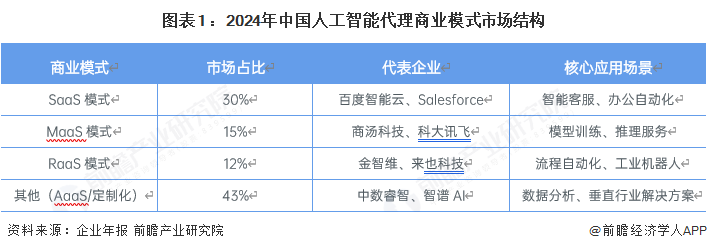
2025年中国人工智能代理行业商业模式分析 从“SaaS铁三角”到园区竞速的万亿赛道博弈【组图】
Qian Zhan Wang· 2025-09-16 04:13
Core Viewpoint - The Chinese AI agent industry has established a "SaaS-MaaS-RaaS" tripartite business model, driven by technology, policy, and ecosystem factors, accelerating the commercialization of a trillion-level market through regional differentiated competition [1]. Business Model Summary - The AI agent industry in China can be categorized into three main models based on service form, deployment method, and application scenario: - **SaaS Model**: Dominates the market with a 30% share, driven by the demand for standardized intelligent tools. It operates on a subscription basis, focusing on efficiency improvement through basic subscription fees and value-added services [3][12]. - **MaaS Model**: Fastest growth at 15%, reflecting the acceleration of model-as-a-service commercialization. It relies on computational power and model innovation for customer acquisition, with significant cost advantages, such as SenseTime's model inference cost being 60% lower than the industry average [3][8]. - **RaaS Model**: Accounts for 12% of the market, focusing on human-machine collaborative automation in sectors like manufacturing and finance, with notable improvements in operational efficiency [3][8]. Market Dynamics - The AI agent industry is experiencing a competitive race among innovation parks, with Shanghai's Xuhui District housing over 1,000 companies and offering substantial computational subsidies. SenseTime's generative AI revenue reached 2.4 billion yuan in 2024, constituting 63.7% of its total revenue [4]. - The industry is supported by policy initiatives, such as the Ministry of Industry and Information Technology promoting "AI + manufacturing" actions and various cities providing computational vouchers and project subsidies to foster ecosystem development [7][8]. Financial Metrics - **SaaS Model**: Average gross margin of 60%-80%, customer retention rate of 75%-90%, and annual customer spending between 50,000 to 500,000 yuan [11][12]. - **MaaS Model**: Average gross margin of 40%-60%, customer retention rate of 60%-75%, and annual customer spending between 100,000 to 2 million yuan [11][12]. - **RaaS Model**: Average gross margin of 30%-50%, customer retention rate of 50%-65%, and annual customer spending between 200,000 to 1 million yuan [11][12].