
零跑汽车

Search documents
三大指数强势上扬 科技医药双引擎领涨市场
Xin Lang Cai Jing· 2025-11-24 08:51
Market Overview - The Hong Kong stock market experienced a strong rebound, with the Hang Seng Index rising by 1.97% to 25,716.50 points, and the Hang Seng Tech Index increasing by 2.78% to 5,545.56 points [2][4] - The rebound was primarily driven by the performance of technology stocks, which had previously been under pressure due to liquidity issues and valuation adjustments [4] Technology Sector - Major tech stocks saw significant gains, with Kuaishou-W rising by 7.11%, Bilibili-W by 5.67%, and Alibaba-W by 4.67% [5][6] - Kuaishou's rise was supported by a Goldman Sachs report predicting that its AI-related revenue could reach $154 million by FY2025, maintaining a "Buy" rating with a target price of HKD 83 [6] - Alibaba's new AI app, Qianwen, achieved over 10 million downloads in its first week, surpassing other international AI applications [7] Pharmaceutical Sector - Innovative pharmaceutical companies showed strong performance, with Silver诺医药-B rising by 31.15% and 泰格医药 increasing by 9.25% [8][9] - The recovery in capital market financing activities and the anticipated US interest rate cuts are expected to boost the performance of CXO companies in the second half of the year [9][10] Automotive Sector - The automotive sector also performed well, with GAC Group rising by 12.03% and Li Auto increasing by 5.77% [10][11] - GAC Group announced the completion of its solid-state battery pilot production line, marking a significant breakthrough in China's new energy vehicle technology [11] Notable Stock Movements - Hesai-W saw an increase of 8.14% after being included in the Hang Seng Composite Index, effective December 8, 2025 [12] - WeRide-W rose by 9.73% after receiving Switzerland's first pure driverless taxi license, allowing it to operate in Zurich [13]


乐道总裁沈斐:做大电池增程车不合逻辑,用户不该为“鸡肋”功能买单
Jing Ji Guan Cha Bao· 2025-11-24 07:56
Core Viewpoint - The emergence of large battery range-extended vehicles is becoming a market trend, but NIO's leadership believes this approach is not logically sound given the current state of charging infrastructure [2][3]. Group 1: Market Trends - Large battery range-extended vehicles like the Zhiji LS9, Leap D19, and Xpeng X9 have been launched, boasting pure electric ranges exceeding 400 kilometers [2]. - NIO is currently the only new energy vehicle company focusing solely on "pure electric + battery swapping" [2]. - The number of public charging stations in China has increased by 5 to 10 times compared to five or six years ago, making charging more convenient [2]. Group 2: Product Insights - NIO's senior vice president, Shen Fei, argues that the current trend of large battery range-extended vehicles is based on outdated market assessments from three years ago [2][3]. - The addition of range extenders increases vehicle weight, cost, and reduces interior space, which may not provide a good user experience [3]. - Shen Fei emphasizes that battery swapping allows for better safety checks on batteries, addressing consumer concerns about battery safety [3]. Group 3: Competitive Landscape - Traditional fuel vehicles are also undergoing smart technology upgrades, with companies like SAIC Volkswagen and Chery launching intelligent fuel models [4]. - The market is gradually shifting towards pure electric vehicles, but range extenders may still be necessary in specific scenarios where costs cannot compete with fuel vehicles [4]. Group 4: Company Developments - NIO's subsidiary, Ladao, has two SUV models, L90 and L60, and recently launched a limited edition L90 at a price of 306,800 yuan, with a battery-as-a-service option available for 220,800 yuan [5]. - The launch of Ladao's third model, L80, has been postponed due to higher-than-expected sales of the L90, indicating a strategic approach to product release timing [5].


经历“十四五”取得自信 期待“十五五”更加惊艳
Zhong Guo Qi Che Bao Wang· 2025-11-24 07:03
Group 1 - The core achievement of the "14th Five-Year Plan" for the Chinese automotive industry is the realization of self-confidence and the emergence of core advantages in market size, supply chain, cost efficiency, innovation, and institutional frameworks [5][6][7] - The pandemic acted as a turning point, enhancing the reputation of Chinese brands and highlighting cost advantages due to inflation abroad [5][6] - The transition from "following" to "keeping pace" in the "14th Five-Year Plan" indicates a significant improvement in overall strength, with expectations to shift towards "leading" in the "15th Five-Year Plan" [5][6] Group 2 - The "14th Five-Year Plan" is characterized by a deep integration of smart connectivity and electric vehicles, leading to a comprehensive innovation ecosystem [7] - The Chinese automotive industry has achieved global leadership in smart driving technology, moving from a follower to a definitional role in technology paths [7] - The cost of advanced driving systems has significantly decreased, with over 50% of new vehicles in China equipped with L2-level assistance systems [7] Group 3 - The "15th Five-Year Plan" is expected to focus on a mindset shift towards open and win-win competition, avoiding past low-price competition pitfalls [8][9] - There is an emphasis on high-quality development, with a need to enhance product quality, operational quality, and brand value [8][9] - The expectation for core technology innovation to be controllable and collaborative, with a focus on international expansion and leveraging the Belt and Road Initiative [9][10] Group 4 - Mainstream automotive enterprises are encouraged to lead by example, focusing on high-quality development and adhering to technical standards [10][11] - The importance of industry organization in addressing issues like "involution" and intellectual property rights is highlighted [10][11] - The emergence of several leading enterprises is seen as a natural outcome of industry evolution, with a call for healthy competition to avoid monopolistic tendencies [11][12] Group 5 - The automotive industry cluster is expected to diversify, with the Greater Bay Area playing a significant role due to its innovation and internationalization capabilities [12][13] - The Greater Bay Area is positioned as a bridgehead for the Chinese automotive industry to expand globally, leveraging its geographical and industrial advantages [13][14] - The integration of AI-driven smart automotive development will enhance collaborative innovation advantages within the cluster [14]

零跑汽车获纳入恒生科技指数,股价一度大涨超7%
Xin Lang Cai Jing· 2025-11-24 07:01
Group 1 - The core point of the article is that Leap Motor (09863.HK) has been included in the Hang Seng Tech Index, which is expected to enhance its market visibility and attract a more diverse investor base [1][3] - Leap Motor's stock price rose by 6.27% to HKD 50.2 per share following the announcement of its inclusion in the index [1] - The adjustment to include Leap Motor in the Hang Seng Tech Index will take effect after the market closes on December 5 and officially on December 8 [1] Group 2 - Leap Motor reported a significant revenue increase of 97.3% year-on-year, reaching CNY 19.45 billion in Q3 2025, driven by higher vehicle and parts deliveries [3] - The company achieved a net profit of CNY 150 million in Q3 2025, compared to a net loss of CNY 740 million in the same period of the previous year [3] - Leap Motor's vehicle sales reached 173,852 units in Q3 2025, marking a year-on-year growth of 101.77% and a quarter-on-quarter increase of 29.63% [3] Group 3 - Despite increases in sales costs, R&D expenses, and administrative costs, Leap Motor's overall gross margin improved to 14.5%, up 0.9 percentage points from the previous quarter [4] - The founder and CEO of Leap Motor announced that the company achieved its 2025 sales target of 500,000 vehicles 45 days ahead of schedule, with a goal of reaching 1 million vehicles in 2026 [4]


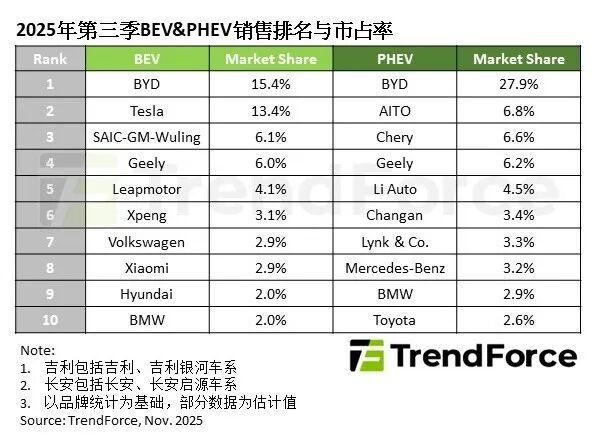
TrendForce集邦咨询:2025年第三季新能源车销量年增31% 全年预计年增长25%
Zhi Tong Cai Jing· 2025-11-24 06:01
Core Insights - Global sales of new energy vehicles (NEVs) are projected to reach 5.39 million units in Q3 2025, representing a 31% year-on-year increase, with battery electric vehicles (BEVs) expected to account for 3.71 million units, a 48% increase, and plug-in hybrid electric vehicles (PHEVs) at 1.67 million units, a 4% increase [1] NEV Market Overview - BYD leads the BEV market with a 15.4% market share, while Tesla follows with 13.4% [2] - In the PHEV segment, BYD also holds the top position with a 27.9% market share, followed by AITO at 6.8% [2] Company Performance - BYD remains the BEV sales champion in Q3, although its sales decreased compared to Q2 [4] - Tesla showed strong performance in Q3 with a 29% quarter-on-quarter increase, driven by U.S. market subsidies and growth in China [4] - Geely and Leapmotor demonstrated significant growth, achieving market shares of 6% and 4.1% respectively, surpassing Xpeng for two consecutive quarters [4] - Volkswagen's ranking fell to seventh due to a decline in the Chinese market, offsetting gains in Europe and the U.S. [4] - Hyundai ranked ninth with a quarterly decline but year-on-year growth [4] - BMW's BEV sales continued to decrease, posing challenges to its annual growth targets [4] PHEV Market Dynamics - BYD faces saturation and intense competition in the Chinese PHEV market, with a quarterly increase but year-on-year decline in sales [5] - AITO, Chery, and Geely have risen to the second to fourth positions, with Chery's market share increasing to 6.6% [5] - Li Auto, despite being the second in sales in Q2, experienced both quarterly and yearly declines due to increasing competition from REEV models [5] - European brands like Mercedes-Benz and BMW saw quarterly declines but performed better than the previous year in the U.S. and parts of Europe [5] Future Projections - TrendForce forecasts global NEV sales to reach 20.43 million units in 2025, a 25% year-on-year increase [5] - For 2026, despite regional subsidy policy adjustments leading to market disparities, global NEV sales are expected to rise to 22.8 million units, a 12% growth [5]


零跑汽车被纳入恒生科技指数成份股,12月8日生效
Feng Huang Wang· 2025-11-24 05:46
Core Points - Leap Motor has been included in the Hang Seng Tech Index, effective December 8, 2025, indicating its alignment with technology-related criteria in the Hong Kong market [1] - The inclusion reflects Leap Motor's achievement in market capitalization, liquidity, and technological attributes, enhancing its "tech label" in the capital market [1] - The company anticipates increased attention in the secondary market and a potential shift in its investor base due to this index inclusion [1] - Historical data suggests that such index adjustments typically lead to increased trading activity and passive fund allocation towards the stock [1] - Leap Motor was previously included in the Hang Seng Composite Index and its sub-indices, marking an upgrade in its market positioning [1]
零跑汽车被恒生科技指数纳入,恒生科技ETF嘉实(159741)备受市场关注
Xin Lang Cai Jing· 2025-11-24 05:25
Group 1 - The Hang Seng Tech Index showed strong performance on November 24, 2025, rising by 1.61%, with notable increases in stocks such as NetEase-S (+5.67%), Kuaishou-W (+5.00%), and NIO-SW (+4.24%) [1] - Li Auto was announced to be included in the Hang Seng Tech Index effective December 8, 2025, as per the announcement from the Hang Seng Index Company on November 21 [1] - The Hang Seng Tech Index is considered a benchmark for core technology stocks in Hong Kong, representing the 30 most growth-oriented companies in the market, focusing on sectors like information technology and smart manufacturing [1] Group 2 - Huatai Securities noted that the main narrative of asset revaluation in China remains unchanged, with a persistent demand for core assets, although there is a need for a more discerning allocation strategy due to the shift from valuation to earnings [2] - The recent adjustment in the Hong Kong stock market occurred earlier and with a deeper decline compared to the A-share market, suggesting that current levels may present value for investment [2] - The Hang Seng Tech ETF closely tracks the Hang Seng Tech Index, which includes the top 30 Hong Kong-listed companies highly related to technology themes, serving as a convenient tool for investing in tech-oriented and growth-oriented companies in the Hong Kong market [2]
消费者信心已跌至冰点
Sou Hu Cai Jing· 2025-11-24 04:42
Group 1 - China's actual foreign investment amount decreased by 10.3% year-on-year to 621.93 billion yuan in the first ten months of this year, marking the smallest contraction since December 2023 [4] - In October, the actual foreign investment was 48.18 billion yuan, with a year-on-year growth rate turning from 11.1% in the previous month to a decline of 8.4% [4] Group 2 - The reduction in mortgage rates has not restored the credit function of China's real estate market, as the growth rate of medium- and long-term loans for residents remains in negative territory [7] - The structural decoupling observed since 2022 indicates that mere price-based monetary stimulus has encountered a liquidity trap in non-core cities, failing to translate into substantial housing credit demand [7] Group 3 - Cement production has entered a long-term downward trend since peaking in 2021, currently 70% lower than the 2019 baseline, confirming that fixed asset investment was previously overestimated [9] Group 4 - In the AI sector, private capital investment in the U.S. has surpassed China's by more than ten times, with U.S. private sector AI investments exceeding $100 billion in 2024 [10] - China's AI industry financing structure has shifted to rely on state-owned capital and government-guided funds, indicating a "state-owned safety net" model [10] Group 5 - The S&P 500 median short position ratio has reached 2.4%, close to the highest level in nearly a decade [34] - Institutional investors have accelerated net selling of individual stocks, amounting to $332.17 billion, while ETFs have seen a net inflow of $148.93 billion, indicating a shift towards passive investment strategies [37] Group 6 - Eli Lilly has surpassed a market capitalization of $1 trillion, becoming the first pharmaceutical giant in U.S. history to reach this milestone, driven by explosive demand for weight loss drugs [40] Group 7 - Bitcoin's price has plummeted, leading to a significant increase in the yield of preferred shares issued by companies that rely on debt to purchase Bitcoin, raising concerns about their business models [44] Group 8 - The Eurozone's third-quarter negotiated wage growth dropped to 1.9% year-on-year, significantly lower than the previous quarter's 4%, supporting the European Central Bank's view that service sector inflation will gradually ease [56] - Moody's upgraded Italy's sovereign credit rating to Baa2, citing improved political and policy continuity, as well as progress in the EU's recovery and resilience plan [56]
港股午评:恒指涨1.42%、科指涨1.65%,科技股回暖,军工、汽车及生物医药股走高,芯片及航空股低迷
Sou Hu Cai Jing· 2025-11-24 04:28
Market Overview - The Hong Kong stock market showed strong performance with the Hang Seng Index rising by 1.42% to 25,578.88 points, the Hang Seng Tech Index increasing by 1.65% to 5,484.46 points, and the National Enterprises Index up by 1.22% to 9,028.24 points [1] - Major technology stocks experienced gains, with Alibaba up 4.13%, Tencent up 2.13%, JD.com up 1.45%, and NetEase up 5.67% [1] - The defense sector saw active trading, with China Shipbuilding Industry Corporation rising nearly 7% and AVIC Industry Company up over 3% [1] - Biopharmaceutical stocks also rose, with Hengrui Medicine up over 6% and 3SBio up over 5% [1] - Automotive stocks surged, led by GAC Group which increased by over 13% [1] - Semiconductor stocks declined, with Hua Hong Semiconductor down over 9% and SMIC down over 5% [1] - The "three barrels of oil" collectively fell, with CNOOC down over 2% and PetroChina down over 1% [1] - Airline stocks were weak due to the cancellation of all flights on 12 Japan-China routes [1] Company News - Huimai Technology reported Q3 revenue of $532 million, a year-on-year increase of 27.6%, with adjusted EBITDA reaching $47.05 million, up 37.3% [2] - Changjiang Garment announced a mid-term revenue of HKD 85.593 million, a 13.67% increase, but reported a loss of HKD 53.314 million, widening by 67.8% year-on-year [2] - Virginie expects a comprehensive profit increase of no less than 100% for the six months ending September 30, 2025 [3] - Maple Leaf Education anticipates a net profit of no less than RMB 300 million for the fiscal year ending August 31, 2025 [4] - Nanshu Holdings reported revenue of approximately HKD 2.8305 billion for the six months ending September 30, 2025, a 1.6% increase, with a net profit of HKD 336 million, up 12.7% [4] - Yongyi International expects a significant reduction in mid-term net loss to no more than HKD 110 million [5] - China Aluminum announced a total cash or asset capital increase of HKD 906 million for Yunnan Aluminum Foil [6] - Hisense Home Appliances subscribed to insurance financial products worth HKD 1.738 billion [7] Stock Buybacks - Tencent repurchased 1.042 million shares for HKD 636 million at prices between HKD 606.5 and HKD 614.5 [9] - Xiaomi repurchased 8 million shares for HKD 303 million at prices between HKD 37.64 and HKD 38.04 [10] - China Feihe repurchased 12.3 million shares for HKD 51.404 million at prices between HKD 4.14 and HKD 4.2 [11] - Techtronic Industries repurchased 500,000 shares for HKD 43.0814 million at prices between HKD 85.2 and HKD 87.25 [12] - COSCO Shipping Holdings repurchased 3 million shares for HKD 40.5895 million at prices between HKD 13.43 and HKD 13.63 [13] - Sinopec repurchased 825,000 shares for HKD 36.7777 million at prices between HKD 4.42 and HKD 4.56 [14]