
协鑫科技

Search documents
工业硅月报:淡季需求走弱,工业硅承压下行-20260109
Tong Guan Jin Yuan Qi Huo· 2026-01-09 07:12
1. Report Industry Investment Rating - No relevant content provided 2. Core Views of the Report - In 2026, at the crucial start of the 15th Five - Year Plan, the central bank will use reserve requirement ratio and interest rate cuts flexibly and efficiently, continue expansionary fiscal policies to boost domestic demand, integrate technological innovation with industrial upgrading, promote green energy transformation and upgrading, and pursue high - quality development. In December 2025, China's manufacturing PMI returned to the expansion range, high - tech manufacturing profit growth accelerated, and CPI increased by 0.8% year - on - year, showing signs of stabilizing and recovering domestic demand [3][50]. - On the supply side, the operating rate in Xinjiang remains at 80%, but some enterprises have routine maintenance and production cuts at the beginning of the year. Production in Sichuan and Yunnan drops significantly during the dry season, and production in Gansu and Inner Mongolia is generally stable. The supply shows a marginal decline, and social inventory is at a high level [3][50]. - On the demand side, anti - monopoly supervision in the polysilicon industry dampens market sentiment. Under the background of silicon wafer price cuts to reduce inventory, both volume and price continue to weaken. Battery manufacturers face increased cost pressure due to rising silver prices and their price - increase attempts are resisted by downstream customers. Component leaders mostly produce based on sales, gradually increasing production cuts to reduce inventory backlogs. Demand for centralized projects shows marginal cooling at the end of the year, with most projects on hold or postponed. Traditional industries such as organic silicon and aluminum alloy face downward consumption pressure. It is expected that in January 2026, the demand side will face downward pressure in the off - season, and the anti - monopoly policy in polysilicon may drag down consumer confidence. Overall, the industrial silicon price in January 2026 is expected to fluctuate weakly within a range, with the price center likely to move down compared to December [3][37][50]. 3. Summary According to the Table of Contents 2025 December Industrial Silicon Market Review Industrial Silicon Futures Price Fluctuated within a Range - In December 2025, industrial silicon showed a trend of first falling and then rising. The main 2512 contract operated in the range of 8120 - 9240 yuan/ton, with the price center lower than the previous month. The manufacturing PMI returned to the expansion range, and industrial enterprise profit growth remained stable. A polysilicon anti - involution platform was launched. On the supply side, the operating rate in Xinjiang remained above 80%, production in the southwest was low during the dry season, and production in Inner Mongolia and Gansu increased. On the demand side, polysilicon manufacturers planned price adjustments, silicon wafer prices were close to the cash cost line, battery manufacturers signaled price increases due to cost pressure, and component manufacturers' price - increase attempts were resisted by downstream customers. The short - term sharp decline in polysilicon futures prices dragged down the industrial silicon price [8]. The Spot Market Remained Stable with a Slight Decline - In December 2025, the number of operating furnaces in the three major industrial silicon producing areas in China was 240, with an overall operating rate of 30.1%. Electricity prices in the southwest increased during the dry season, raising production costs. The operating rate in Xinjiang rose above 80% but decreased slightly at the end of the month due to production cuts by some large factories. Production in Sichuan and Yunnan decreased due to high electricity prices, and production in Gansu and Inner Mongolia was stable. Domestic production in December decreased slightly to 39.7 million tons. By the end of December, social inventory decreased slightly to 55.3 million tons. Mainstream 553 grade spot prices fluctuated moderately. It is expected that in January 2026, the prices of domestic mainstream grades will continue to fluctuate within a range, and the spot market is expected to operate stably [11][12]. Macroeconomic Analysis In December, the Manufacturing PMI Returned to the Expansion Range, and High - Tech Manufacturing Profit Growth Accelerated - In December 2025, China's official manufacturing PMI was 50.1, the first expansion since April. Large - scale enterprise PMI was 50.8, up 1.5% month - on - month, and medium - sized enterprise PMI was 49.8, approaching the boom - bust line. The production index was 51.7, indicating accelerating manufacturing production; the new order index was 50.8, showing improved market demand; the raw material inventory index was 47.8, with a narrowing decline in raw material inventory; the employment index was 48.2, indicating a decline in employment sentiment; and the supplier delivery index was 50.2, indicating faster delivery times. In November 2025, industrial enterprise profits decreased by 13.1% year - on - year, and the cumulative profit from January to November increased by 0.1% year - on - year, maintaining positive cumulative growth for the fourth consecutive month. From January to November, high - tech manufacturing profits increased by 10.0% year - on - year, 2.0 percentage points faster than from January to October, and 9.9 percentage points higher than the average of all large - scale industrial enterprises [16][17]. Fundamental Analysis Northern Production Declined from a High Level, and Production in the Southwest was Low during the Dry Season - In 2025, China's industrial silicon production showed fluctuations. From January to November, the cumulative production was 3.868 million tons, a year - on - year decrease of 14.7%. Xinjiang's production showed a pattern of low at first and high later, with a cumulative production of 1.9248 million tons from January to November, accounting for 52.03%. Production in Sichuan and Yunnan increased from the dry season to the wet season. The new production capacity in Gansu, Inner Mongolia and other places was limited. Overall, in the context of anti - involution policies, China's industrial silicon supply showed a contraction trend [21][22]. In November, Industrial Silicon Exports Increased by 22% Month - on - Month - From January to November 2025, the cumulative export volume of industrial silicon was 661,500 tons, a year - on - year decrease of 1%. In November, the export volume was 54,900 tons, a year - on - year increase of 4%. China's industrial silicon exports are mainly concentrated in Southeast Asia. With the recovery of foreign trade exports and the development of the photovoltaic industry in emerging markets, the export scale of industrial silicon is expected to continue to grow, and the export volume in January 2026 is expected to be between 50,000 and 70,000 tons [25]. In December, Social Inventory was at a High Level, and Warehouse Receipt Inventory Faced Centralized Cancellations - By December 31, 2025, the national industrial silicon social inventory decreased slightly to 5.53 million tons, still at a high level. The warehouse receipt quantity on the Guangzhou Futures Exchange was 10,231 lots, equivalent to 51,000 tons, a month - on - month decrease of 68.9%. After the implementation of the new warehouse receipt delivery standard, mainstream 5 - series products became the main delivery models. It is expected that in January 2026, China's social inventory will continue to rise [28]. The Anti - Involution of the Photovoltaic Industry Entered a Crucial Stage, and the Consumption of Organic Silicon and Aluminum Alloy was Relatively Sluggish - **Polysilicon**: Anti - monopoly supervision was strengthened, and a new platform for capacity clearance was established. From January to November 2024, the cumulative production of polysilicon was 1.206 million tons, a year - on - year decrease of 27.3%. The anti - monopoly policy hit market confidence and led to a sharp decline in futures prices. - **Silicon wafers**: From January to November 2025, the cumulative production was 607,000 tons. Facing over - capacity and high inventory, many enterprises cut production in the fourth quarter, and the overall operating rate dropped to about 45%. - **Battery cells**: The price showed a downward trend throughout the year. In the third quarter, the overseas orders of 183N battery cells decreased, and the domestic demand for 210N battery cells weakened. - **Components**: The demand for distributed projects was weak, while the centralized market improved slightly in the fourth quarter. Most component enterprises produced based on sales and increased production cuts to reduce inventory. - **Organic silicon**: From January to November 2025, the cumulative production of DMC was 2.272 million tons, a year - on - year increase of 4.6%. The industry faced over - capacity and weak terminal consumption in the first half of the year. After the implementation of anti - involution policies in the fourth quarter, enterprises jointly cut production and raised prices, and the price rebounded to 13,600 yuan/ton. It is expected that in January 2026, the organic silicon market will remain stable in terms of volume and price. - **Aluminum alloy**: From January to November 2025, the cumulative production was 17.456 million tons, a year - on - year increase of 15.8%. In December, the processing fee of aluminum rods in the Foshan market showed a short - term increase but then declined. It is expected that in January 2026, the production of aluminum alloy will decline slightly, and the processing fee of aluminum rods will face pressure [30][32][34][35][37]. Market Outlook - Macroeconomically, in 2026, at the start of the 15th Five - Year Plan, the central bank will implement expansionary policies, and domestic demand shows signs of recovery. - On the supply side, production in Xinjiang may decline due to maintenance, production in Sichuan and Yunnan will be low during the dry season, and production in Gansu and Inner Mongolia will be stable. Supply will show a marginal decline, and inventory will remain high. - On the demand side, the demand for the photovoltaic industry and traditional industries such as organic silicon and aluminum alloy will face downward pressure in the off - season. - Overall, the industrial silicon price in January 2026 is expected to fluctuate weakly within a range, with the price center likely to be lower than in December [50][51].
电力设备:反内卷趋势无忧,太空光伏产业提速
Yin He Zheng Quan· 2026-01-09 07:03
Investment Rating - The report maintains a "Recommended" rating for the electric equipment industry [1] Core Insights - The report highlights that the trend of anti-involution is not a concern, and the space photovoltaic industry is accelerating [1] - The recent regulatory actions in the photovoltaic sector aim to prevent monopolistic behaviors while allowing compliance with cost-based sales and technology standards [4] - The prices in the industry continue to rise, indicating a recovery, with silicon material prices increasing by 9.83% week-on-week to 59,200 CNY/ton [4] - The commercial space sector is emerging, with plans for deploying solar energy satellites, which could lead to significant advancements in space photovoltaic technology [4] Summary by Sections Regulatory Environment - The market regulatory authority has halted self-regulatory actions related to silicon material integration in the photovoltaic industry, focusing on preventing monopolistic practices [4] - Compliance measures are being established to ensure fair competition among industry participants [4] Industry Performance - The prices of N-type silicon wafers and cells have seen increases, with N-type cell prices rising to 0.39 CNY/W and TOPCon module prices reaching 0.7 CNY/W [4] - The industry is expected to turn profitable in 2026 as terminal demand recovers [4] Technological Advancements - The report emphasizes the potential of space photovoltaic technology, which can generate energy continuously and is projected to become commercialized in the next 10-15 years [4] - The focus is on companies with technological reserves in space photovoltaics, such as Junda Co., JinkoSolar, Trina Solar, and others [4]
股指期货将偏强震荡,白银、铂、钯、镍期货将宽幅震荡铜、铝、氧化铝、锡、螺纹钢、铁矿石、焦煤将偏弱震荡,多晶硅、玻璃、纯碱期货将震荡偏弱
Guo Tai Jun An Qi Huo· 2026-01-09 05:16
Report Industry Investment Rating There is no information provided regarding the report industry investment rating in the given content. Core Viewpoints of the Report - Through macro - fundamental and technical analysis, the report predicts the trends, resistance levels, and support levels of various futures contracts on January 9, 2026, and for the month of January 2026 [2][5]. - It also provides the performance of these futures contracts on January 8, 2026, including opening prices, closing prices, price changes, and key support and resistance levels [12][32][40] etc. - The report includes macro - economic news, such as statements from government officials, economic data releases, and geopolitical events, which may impact the futures market [6][7][8]. Summary by Related Catalogs Futures Market Outlook - **January 9, 2026 Outlook**: - **Stock Index Futures**: Expected to be strongly volatile. For example, IF2603 has resistance at 4753 and 4786 points, and support at 4708 and 4690 points [2]. - **Precious Metals**: Gold (AU2602) is expected to be strongly volatile; silver (AG2604), platinum (PT2606), and palladium (PD2606) are expected to have wide - range fluctuations [2]. - **Base Metals**: Copper (CU2602), aluminum (AL2602), alumina (AO2605), and tin (SN2602) are expected to be weakly volatile; nickel (NI2602) is expected to have wide - range fluctuations [2]. - **Other Commodities**: Polysilicon (PS2605), glass (FG605), and soda ash (SA605) are expected to be weakly volatile; lithium carbonate (LC2605) is expected to be strongly and widely volatile; rebar (RB2605), hot - rolled coil (HC2605), iron ore (I2605), and coking coal (JM2605) are expected to be weakly volatile [2][4]. - **January 2026 Outlook**: - Stock index futures' main continuous contracts are expected to be strongly volatile [5][17]. - Gold, silver, copper, and aluminum futures' main continuous contracts are expected to be strongly volatile and may reach new highs [5]. - Polysilicon futures' main continuous contract is expected to be weakly volatile [5]. Macro - economic News - **Domestic News**: The Ministry of Commerce will assess Meta's acquisition of Manus; the Ministry of Finance welcomes LSEG's cooperation; Guangzhou plans to develop advanced manufacturing industries [6]. - **International News**: Trump promotes sanctions against Russia; the US may manage Venezuela's oil industry; the US Supreme Court will rule on tariff legality; the US may exit 66 international organizations; the US is expected to cut interest rates; the US economic data shows GDP growth, inflation, and unemployment trends [6][7][8]. Futures Market Performance on January 8, 2026 - **Stock Index Futures**: IF2603, IH2603, and IC2603 had different trends, with some facing downward pressure and others having limited upward space [12][13][14]. - **Precious Metals**: Gold (AU2602) had a slight decline; silver, platinum, and palladium also showed downward trends [32][40][45]. - **Base Metals**: Copper, aluminum, and nickel futures had significant declines [52][58][68]. - **Other Commodities**: Polysilicon futures hit the daily limit down; coking coal futures had a significant increase; glass and soda ash futures had different trends [79][102][106].
多晶硅龙头被反垄断约谈,光伏上游产能整合面临空前危机
Xin Lang Cai Jing· 2026-01-09 04:17
Core Viewpoint - The solar photovoltaic (PV) industry faces significant challenges following an antitrust warning regarding the consolidation of polysilicon production capacity, raising uncertainties about the future of self-regulatory actions in the industry [1][6]. Group 1: Antitrust Warning and Industry Response - On January 6, major polysilicon companies were summoned by the State Administration for Market Regulation (SAMR) due to allegations of price manipulation under the guise of industry self-regulation [1]. - The SAMR issued clear rectification requirements, prohibiting agreements on capacity, utilization rates, production volumes, and sales prices among companies [1][4]. - The meeting highlighted multiple complaints received since July 2025, accusing companies of controlling production and market segmentation based on investment ratios [1][4]. Group 2: Market Impact and Price Fluctuations - Following the news, polysilicon futures contracts hit the daily limit down, with a 9% drop on January 8, while major polysilicon stocks experienced declines, with GCL-Poly Energy falling over 7% [2]. - The average prices for polysilicon, silicon wafers, battery cells, and modules are projected to increase by 38.9%, 2.2%, 0.4%, and 2.3% respectively by November 2025 [2]. - Despite a slowdown in market transactions, many polysilicon companies raised new order prices to over 65,000 yuan per ton, significantly above the market average [2]. Group 3: Industry Consolidation and Future Outlook - The establishment of Beijing Guanghe Qiancheng Technology Co., aimed at consolidating polysilicon resources, has raised concerns about potential monopolistic practices [3][5]. - The platform is designed to operate under a dual-track model, referencing successful experiences from other industries to stabilize prices [3]. - Industry leaders emphasize the need for a balanced profit distribution across the entire solar value chain, as current high profits in polysilicon are unsustainable if downstream sectors continue to incur losses [3][5]. Group 4: Challenges Ahead - The self-regulatory actions in the industry are now facing unprecedented challenges, with the cancellation of monthly meetings aimed at addressing overcapacity and price control until rectification measures are completed [5][6]. - The uncertainty surrounding the path forward for coordinated production control and the exit of outdated capacities is increasing, complicating the industry's efforts to stabilize [6].



港股午评:恒指涨0.02%科指跌0.06%!光伏走弱商业航天强势,MINIMAX首日涨78%,协鑫科技跌8%,山东黄金涨6%
Sou Hu Cai Jing· 2026-01-09 04:13
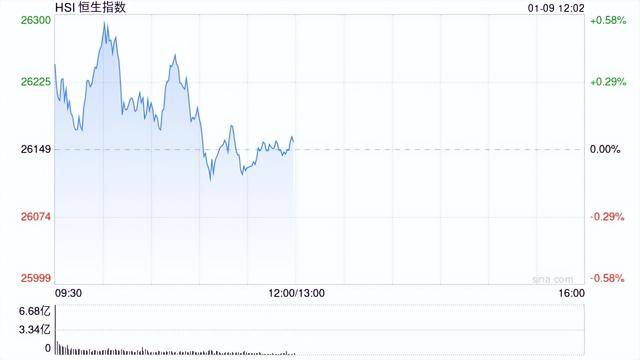
Market Overview - The Hong Kong stock market showed mixed performance with the Hang Seng Index at 26,158.21, up 0.02%, while the Hang Seng Tech Index fell by 0.06% and the National Enterprises Index rose by 0.04% [2] Commercial Aerospace Sector - The commercial aerospace sector is gaining momentum, with Asia Pacific Satellite seeing a surge of over 15% [1] - Domestic companies such as Blue Arrow Aerospace, Tianbing Technology, Xinghe Power, and Interstellar Glory are preparing for IPOs, marking 2026 as a significant year for private rocket enterprises in China [1] Gold Sector - Gold stocks are performing well, with Shandong Gold rising over 6% amid geopolitical risks and expectations of interest rate cuts supporting gold prices [3][4] - Morgan Stanley predicts that gold prices could reach $4,800 per ounce by Q4 2026, driven by declining interest rates and increased buying from central banks and funds [3] Solar Energy Sector - The solar energy sector is facing challenges, with GCL-Poly Energy dropping over 8% following a meeting with the Beijing market regulatory authority addressing monopoly risks and requiring corrective actions from companies [4][5] - Other solar companies also experienced declines, including Kamda Energy and Xinyi Solar, which fell by 4.35% and 3.10% respectively [5] New Listings - Three new stocks were listed today, with Rebo Bio-B rising over 28%, MINIMAX increasing by over 78%, and Jinxun Resources up by 22% [5]


港股午评:恒指微涨0.03%、科指跌0.06%,商业航天及黄金股走高,科技股走势分化,光伏及航空股表现疲软
Jin Rong Jie· 2026-01-09 04:11
Market Overview - The Hong Kong stock market opened higher but experienced a downward trend, with the Hang Seng Index up 0.03% at 26,158.21 points, the Hang Seng Tech Index down 0.06% at 5,674.78 points, and the National Enterprises Index up 0.04% at 9,042.8 points [1] - Major tech stocks showed mixed performance, with Alibaba up 2.81%, Tencent down 0.73%, JD.com up 2.95%, Xiaomi down 0.42%, NetEase down 1.64%, Meituan down 2.38%, Kuaishou up 2.85%, and Bilibili up 3.32% [1] - The commercial aerospace sector was strong, with Asia Pacific Satellite rising over 15%, while gold stocks saw gains, with Shandong Gold up over 6% [1] - Solar energy stocks weakened, with GCL-Poly Energy down over 8%, and real estate and aviation stocks showed collective weakness [1] - MiniMax, a large model enterprise, saw its stock rise over 78% on its first trading day, reaching 294 HKD [1] Company News - Fast Retailing (迅销) reported Q1 earnings for the period ending November 30, 2025, with revenue of 1,027.745 billion JPY, a year-on-year increase of 14.8%, and net profit of 147.445 billion JPY, up 11.7% year-on-year [2] - Bairong Cloud (百融云) repurchased 4.15 million shares for 51.783 million HKD at a price range of 12.41-12.51 HKD [3] - Xianjian Technology (先健科技) received formal registration approval from the National Medical Products Administration for its G-iliacTM Pro iliac artery stent system [4] - Tencent Holdings (腾讯控股) repurchased 1.036 million shares for 636 million HKD at a price range of 610.5-618.5 HKD [4] - Xiaomi Group (小米集团) repurchased 5 million shares for 191 million HKD at a price range of 38.04-38.16 HKD [5] - Giant Bio (巨子生物) repurchased 400,000 shares for 13.7106 million HKD at a price range of 34.12-34.44 HKD [6] - Vanke Enterprises (万科企业) announced the resignation of Yu Liang due to retirement [7] - Baolong Real Estate (宝龙地产) reported a total contract sales amount of approximately 7.272 billion CNY for 2025, a year-on-year decrease of 43.13% [8] - China General Nuclear Power (中广核电力) projected a total on-grid electricity of approximately 2,326.48 billion kWh for 2025, a year-on-year increase of 2.36% [9] - Jieli Trading Treasure (捷利交易宝) reported an increase of 7 institutional clients in December 2025, a year-on-year increase of 1, with registered users at approximately 886,700, up 6.2% year-on-year [9] - CWT International (CWT INT'L) signed a memorandum of cooperation with SF Express Singapore to jointly build a one-stop local and international logistics service [10] - Merui Health International (美瑞健康国际) plans to acquire 100% equity of Jiangsu Yide for 125 million CNY [11] - Dimi Life Holdings (迪米生活控股) entered into a strategic cooperation framework agreement with partners to enter the electronic vaporization industry [12] Institutional Insights - Everbright Securities indicated that domestic policy support combined with a weaker US dollar may lead to continued upward movement in the Hong Kong stock market, highlighting strong overall profitability and the relative scarcity of assets in internet, new consumption, and innovative pharmaceuticals [13] - Galaxy Securities expects active trading in the Hong Kong market to persist due to multiple positive factors, projecting an overall upward trend [13] - Dongwu Securities noted that the Hong Kong market is entering a period of upward fluctuation, emphasizing the importance of dividends as a base and the potential for technology growth in the first half of the year [13]

港股异动丨光伏股走低 据称市场监管总局约谈光伏龙头,禁止约定产能与价格
Ge Long Hui· 2026-01-09 03:02
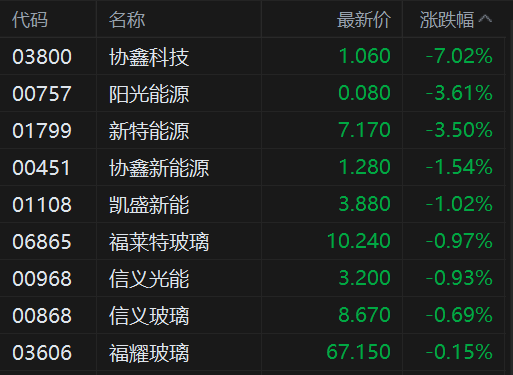
Group 1 - The core viewpoint of the news is that the Hong Kong solar stocks have collectively declined due to regulatory scrutiny from the market supervision authority regarding potential monopoly risks in the solar industry [1] - GCL-Poly Energy has seen a drop of over 7%, while other companies like Sunshine Energy and Xinte Energy have also experienced declines of 3.5% [1][2] - The market supervision authority has held discussions with several key players in the solar industry, including the China Photovoltaic Industry Association and major companies, to address issues related to market manipulation and has mandated corrective actions by January 20 [1] Group 2 - The market supervision authority has prohibited the discussed companies from agreeing on production capacity, utilization rates, sales volumes, and pricing [1] - Companies are also restricted from dividing markets, production volumes, and profits through any form of investment ratio [1] - The authority has required the companies to submit written corrective measures by January 20 [1]

多家多晶硅龙头企业被约谈!业内人士:属实
Bei Jing Shang Bao· 2026-01-09 01:59
Core Viewpoint - The Chinese photovoltaic industry is facing regulatory scrutiny following price increases in polysilicon, with major companies being called for discussions regarding potential monopolistic practices and required corrective actions [1] Group 1: Regulatory Actions - The market regulator has held discussions with leading polysilicon companies including Tongwei, GCL, Daqo Energy, Xinte Energy, Asia Silicon, and Dongfang Hope [1] - The meeting addressed reports of monopolistic risks and outlined corrective measures that companies must implement [1] Group 2: Meeting Outcomes - The corrective measures prohibit companies from agreeing on production capacity, utilization rates, sales volumes, and pricing [1] - Companies are also restricted from engaging in any form of market division, production allocation, or profit sharing through investment ratios [1] - Communication regarding current and future pricing, costs, and production volumes is also restricted [1] Group 3: Industry Developments - In December, the photovoltaic industry established a "polysilicon platform company," Beijing Guanghe Qiancheng Technology Co., Ltd., with shareholders including major polysilicon firms [1] - The recent regulatory discussions may lead to adjustments in future polysilicon storage plans [1]
光伏股全线走低 市场监管总局约谈龙头企业及行业协会 光伏收储遭遇反垄断风暴
Zhi Tong Cai Jing· 2026-01-09 01:56
Core Viewpoint - The photovoltaic stocks have experienced a decline, influenced by regulatory scrutiny regarding potential monopolistic practices within the industry [1] Group 1: Stock Performance - New Special Energy (01799) fell by 3.23%, trading at 7.19 HKD [1] - Xinyi Solar (00968) decreased by 1.55%, trading at 3.18 HKD [1] - Flat Glass (601865) dropped by 1.35%, trading at 10.2 HKD [1] Group 2: Regulatory Actions - The Beijing Market Supervision Administration held discussions with several key players in the photovoltaic sector, including the China Photovoltaic Industry Association and companies like Tongwei Co., Ltd. (600438) and Xiexin Technology [1] - The meeting addressed concerns about monopolistic risks and outlined specific corrective actions that companies must undertake [1] - Companies are prohibited from agreeing on production capacity, utilization rates, sales volumes, and pricing, as well as from engaging in market division or profit allocation through any means [1] - A deadline of January 20 has been set for the submission of written corrective measures to the Market Supervision Administration [1]

港股异动 | 光伏股全线走低 市场监管总局约谈龙头企业及行业协会 光伏收储遭遇反垄断风暴
智通财经网· 2026-01-09 01:50
Core Viewpoint - The solar energy stocks have experienced a decline following a meeting held by the Beijing Market Supervision Administration, which addressed monopoly risks and required corrective actions from several key companies in the industry [1] Group 1: Stock Performance - New Special Energy (01799) fell by 3.23%, trading at 7.19 HKD [1] - Xinyi Solar (00968) decreased by 1.55%, trading at 3.18 HKD [1] - Flat Glass Group (06865) dropped by 1.35%, trading at 10.2 HKD [1] Group 2: Regulatory Actions - The Beijing Market Supervision Administration held discussions with the China Photovoltaic Industry Association and several companies, including Tongwei Co., Xiexin Technology, Daqo New Energy, New Special Energy, Asia Silicon, and Dongfang Hope [1] - The meeting focused on reporting monopoly risks and providing clear rectification opinions, requiring companies to implement corrective measures [1] - Companies are prohibited from agreeing on production capacity, utilization rates, sales volumes, and prices, as well as from engaging in market division or profit distribution through investment ratios [1] - A deadline of January 20 has been set for the submission of written corrective measures to the Market Supervision Administration [1]