
奈雪的茶

Search documents
奈雪的茶2023年净增506家直营店,将逐步关停子品牌台盖7家门店
Ge Long Hui· 2025-12-26 14:09
Core Viewpoint - Naixue Tea has reported a net increase of 506 new direct-operated stores in 2023, falling short of its target of 600 new stores, with franchise store data yet to be disclosed [1][2] Group 1: Store Operations - In Q4 2023, Naixue Tea added 214 new direct-operated stores and closed 14, bringing the total to 1,574 stores by December 31, 2023 [1] - The breakdown of direct-operated stores by city tier includes 398 in first-tier cities, 421 in new first-tier cities, 278 in second-tier cities, and 133 in other cities, totaling 1,230 for the first category, and 144, 131, 50, and 19 for the second category, totaling 344 [1] - The quarterly performance for 2023 shows a steady increase in new store openings: Q1 added 38, Q2 added 88, Q3 added 166, and Q4 added 214 [1] Group 2: Strategic Goals and Future Outlook - Naixue Tea initially aimed for a "store density" strategy with a target of 600 new stores, primarily in first and second-tier cities, but only achieved 506 new direct-operated stores [2] - For 2024, Naixue Tea plans to open approximately 200 new direct-operated stores and will adjust this target based on available locations [2] - The company is also focusing on expanding its franchise business and international market presence [2] Group 3: Brand Management - Naixue Tea is gradually closing its sub-brand, Taigai, with 7 stores operational as of December 31, 2023, due to previous losses amounting to 4.69 million yuan and a negative profit margin of 14.1% [3] - The decision to close Taigai stores is aimed at cost control and strategic focus on the main brand, despite expected closure losses in the hundreds of thousands of yuan [3]
新茶饮集体去美国开店
Di Yi Cai Jing Zi Xun· 2025-12-25 14:56
Group 1: Industry Overview - The new tea beverage industry in China is expected to reach a market size of over 200 billion yuan by 2025, driven by increasing consumer demand and the entry of multiple brands into the capital market [3][4] - The industry is transitioning from incremental competition to stock competition, with a common phenomenon of "ten tea shops on one street" leading brands to seek differentiation [3][4] - New trends include the solidification and dessertification of beverages, with products like "solid mango sago" gaining popularity among consumers [4][5] Group 2: Market Dynamics - The launch of solid products like "solid mango sago" has led to significant sales, with one brand reporting over 8 million cups sold since its introduction [5] - The trend towards solid and dessert-like beverages aligns with younger consumers' preferences for health-conscious options, incorporating nutritious ingredients [5][6] - The competition in the Southeast Asian market has intensified, prompting brands to shift their focus to North America, where there is perceived growth potential [7][8] Group 3: International Expansion - Brands like Mixue Ice City have opened stores in North America, with strategic locations in Los Angeles and New York, marking a shift from previous focus on Southeast Asia [7][8] - The complexity of establishing overseas supply chains poses significant challenges for brands looking to expand internationally [8] - Successful internationalization requires understanding and catering to local consumer preferences, moving beyond just serving Chinese customers [8][9]

新茶饮集体去美国开店
第一财经· 2025-12-25 14:40
Core Viewpoint - The new tea beverage industry in China is experiencing two main paths of breakthrough in 2025: expanding internationally towards stronger consumer markets in Europe and America, and innovating product forms by solidifying and sweetening beverages to broaden consumption scenarios [3][5]. Group 1: Market Expansion and Capital Trends - 2025 is marked as the "capital year" for Chinese tea beverages, with four companies going public, including popular brands like Mixue Ice City and Bawang Tea [5]. - The domestic new tea beverage market is expected to exceed 200 billion yuan in 2025, indicating significant growth in consumer demand [5]. - The market is shifting from incremental competition to stock competition, with a saturation of tea shops in urban areas, leading brands to seek differentiation [6]. Group 2: Product Innovation and Consumer Trends - Brands are increasingly introducing differentiated products such as Thai milk tea and solid desserts, responding to the saturated market and changing consumer preferences [6]. - The popularity of solid desserts like "solid mango sago" has surged, with sales exceeding 8 million cups since its launch, indicating a shift towards more visually appealing and substantial products [7]. - The trend of "light health" among younger consumers is driving the popularity of sugar water products, which are perceived as healthier alternatives compared to traditional milk teas [7]. Group 3: International Expansion Strategies - New tea brands are increasingly targeting North America for expansion, moving away from the highly competitive Southeast Asian market [10][11]. - The establishment of a robust overseas supply chain is identified as a significant challenge for brands looking to expand internationally [11]. - Successful internationalization requires understanding and catering to local consumer preferences, with a focus on creating a genuine global brand presence [12].


年终盘点 | 新茶饮“红海”中求生存:抢滩北美市场、产品从“喝”拓展到“吃”
Di Yi Cai Jing· 2025-12-25 11:37
Group 1: Industry Trends - The new tea beverage industry is experiencing a dual path of expansion and internal competition, with brands seeking global presence while innovating product offerings to differentiate themselves in a saturated market [1][2] - The market size for new tea beverages in China is expected to exceed 200 billion yuan in 2025, indicating significant growth potential despite increasing competition [2] - The trend of "solidifying" and "dessertifying" beverages is emerging, with products like solid mango sago and various dessert teas gaining popularity among consumers [3][4] Group 2: Market Dynamics - The competition in the tea beverage market is shifting from incremental growth to a focus on existing market share, leading to a proliferation of similar stores in close proximity [2] - Brands are increasingly introducing differentiated products, such as salty milk tea and dessert-style offerings, to attract consumers and stand out in a crowded market [2][3] - The popularity of solid dessert drinks is linked to a growing consumer preference for visually appealing and ingredient-rich products, reflecting a shift towards "light health" trends [4] Group 3: International Expansion - The North American market is becoming a preferred destination for Chinese tea brands, moving away from the previously favored Southeast Asian markets due to intense competition [7][8] - Companies like Mixue Ice City and Bawang Chaji are establishing their first stores in the U.S., indicating a strategic shift towards markets with higher consumer spending power [6][7] - Successful internationalization requires a comprehensive approach involving the entire supply chain, rather than just individual brands attempting to enter foreign markets [8]
蜜雪翻车、古茗出圈,奶茶店卖早餐究竟有多难
3 6 Ke· 2025-12-25 00:25
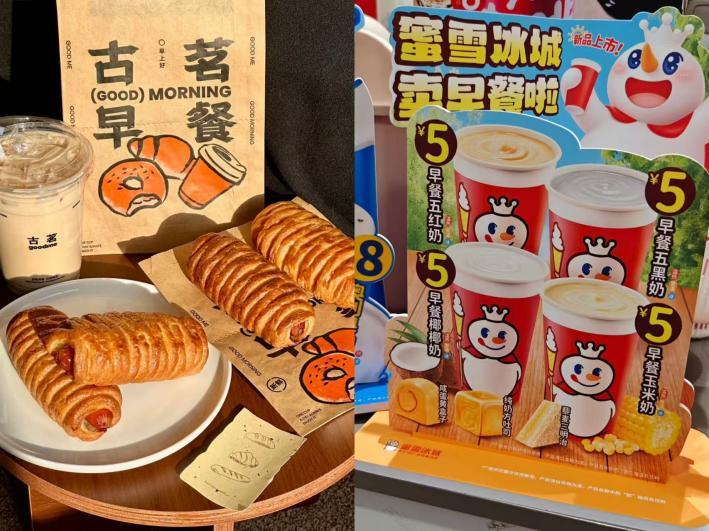
Core Insights - The tea beverage brands are entering the breakfast market to fill the operational gaps during morning hours, aiming to enhance store efficiency and increase average transaction value through breakfast combo offerings [1][8][12] - Despite the potential, the breakfast market presents challenges such as low average transaction prices, high convenience demands, and complex consumer preferences [2][13][15] Group 1: Market Dynamics - The new breakfast offerings from brands like Mixue Ice City and Gu Ming represent a significant shift as tea brands officially enter the breakfast segment, previously dominated by other food service providers [1][6] - The breakfast market is characterized by low average prices (6-10 yuan) and strong regional preferences, making it a challenging segment for tea brands to penetrate effectively [12][13][15] - The saturation of the tea beverage market has led to a slowdown in growth, with a projected market growth rate of only 6.4% in 2024 compared to 52% three years ago [8][9] Group 2: Product Offerings and Consumer Response - Mixue Ice City has introduced a breakfast menu featuring dairy drinks priced at 5 yuan and combo meals at 7.9 yuan, while Gu Ming offers a breakfast combo at 13 yuan, which has received a more favorable consumer response [6][18] - Consumer feedback indicates that while some breakfast offerings are perceived as expensive compared to local alternatives, others, like Gu Ming's coffee and bread combo, are viewed as more attractive [16][18] - The success of breakfast offerings may depend on aligning products with consumer expectations and preferences, particularly in terms of pricing and variety [15][19] Group 3: Strategic Considerations - The operational complexity of introducing breakfast items requires careful consideration of supply chain logistics, staffing, and product differentiation to meet consumer demands [2][13][19] - Brands must cultivate consumer habits around breakfast purchases at tea shops, similar to established practices in coffee shops, which may take time and consistent marketing efforts [19][20] - The experience of McDonald's in the breakfast segment highlights the importance of localizing offerings and maintaining competitive pricing to establish a strong market presence [20][24]
阿嬷手作在西湖边卖起了咖啡,我们去看了看
Ge Long Hui· 2025-12-24 23:14
出品/茶咖观察 作者/王晨瑾 编辑/蒙嘉怡 阿嬷手作开始卖咖啡了。 | 自取 外卖 | | Q ... | O | ■ EV 外卖 | | O ... | 0 | 自取 外卖 | | | | --- | --- | --- | --- | --- | --- | --- | --- | --- | --- | --- | | ★ 杭州西湖天地店 > | | | | | ★ 杭州西湖天地店 > | | | ★ 杭州西湖天地店 > | | | | 2 距您14.6km 前方3杯制作中 | | | | | 2 距您14.6km 前方3杯制作中 | | | | ○ 距您14.6km 前方3杯制作中 | | | 门店详细信息 | | | 点击查看 √ | 门店详细信息 | | 点击查看 ソ | | 门店详细信息 | | | | NEW | 茶与咖 | | | NEW | 时间的冰滴 | | | NEW | 三口奶油(茶与咖) | | | 茶与樹 Teel Co | | | | 茶与咖 100 & Collect | | | | 茶与咖 Ten & Carlos | | | | | | | | | | 冰滴·崖壁茶 | ...

吴世春:没投到字节跳动的天使轮,是我的人生遗憾
创业家· 2025-12-24 10:18
Core Insights - The article discusses the challenges and opportunities in early-stage investment in China, emphasizing the need for patience and a long-term vision in the current economic environment [2][5][6]. Investment Landscape - The investment environment has become more challenging, with longer exit cycles; previously, companies like Li Auto and NIO went public in 3-4 years, but now it takes around 12 years for IPOs [3][4]. - Despite the difficulties, early-stage investment can still be profitable in China if investors have sufficient patience [5]. Investment Logic - Three key investment strategies are outlined: 1. **Investing in "Unicorn Tigers"**: Focus on companies that can dominate their market rather than those that merely resemble successful models [7][9]. 2. **Investing in "Town Youth"**: Targeting young entrepreneurs from smaller towns who are more likely to focus on long-term growth rather than chasing trends [10][11][13]. 3. **Aligning People, Events, Timing, and Valuation**: Successful investments require the right team, the right market conditions, and reasonable valuations [14]. Current Trends - The article notes that many new unicorns are emerging from small-town youth, highlighting figures like Zhang Yiming and Wang Xing as examples [13]. - The focus on AI and new productive forces is emphasized, with a belief that China's innovation landscape will continue to thrive for the next 20 years [14]. Investment Portfolio - The company has invested in over 600 enterprises, with around 70-80 achieving profitability close to A-share listing standards, indicating a high success rate in their investment strategy [14].

“2025年度茶饮咖啡十大杰出董事长”公布!奈雪的茶董事长赵林入选
Sou Hu Cai Jing· 2025-12-24 08:57
Group 1 - The core viewpoint of the article highlights that Zhao Lin, the Chairman and CEO of Nayuki's Tea, has been recognized in the "Top Ten Outstanding Chairmen of Tea and Coffee in 2025" list [1] Group 2 - Nayuki's Tea was co-founded by Zhao Lin and Peng Xin in 2015 and became the first company in the new tea beverage industry to be listed on the Hong Kong Stock Exchange in June 2021 [3] - The company primarily adopts a direct store expansion model, with a total of 1,638 stores as of the first half of this year, including 1,321 direct stores and 317 franchise stores [3] Group 3 - In the first half of this year, Nayuki's Tea achieved a total revenue of 2.178 billion yuan, with direct stores contributing 2.104 billion yuan, increasing the revenue share to 87.8% [4] - Under Zhao Lin's leadership, Nayuki's Tea has been exploring new store formats and actively developing a diversified health product matrix, which has helped in brand image building and performance recovery [4]

2025年度“质量金盾样本”发布暨直播电商行业自律高质量发展大会举行
Xiao Fei Ri Bao Wang· 2025-12-24 06:12
Core Viewpoint - The 2025 China Food and Drug Quality Safety Conference emphasizes the importance of the "Quality Golden Shield" standard in regulating market order and enhancing consumer rights in the rapidly growing live e-commerce sector [3][5]. Group 1: Quality Standards and Industry Development - The "Quality Golden Shield" is described as a rigorous standard and a commitment to leading the industry, crucial for the development of new business models like live e-commerce [3]. - The China Food and Drug Quality Safety Promotion Association aims to collaborate with various stakeholders to continuously improve industry standards and promote self-regulation within the sector [3][5]. Group 2: Recognition of Quality Enterprises - The 2025 "Quality Golden Shield Samples" were officially announced, recognizing over 40 exemplary companies in areas such as quality management, technological innovation, and service quality [8]. - Notable companies recognized include Lee Kum Kee (Xinhui) Food Co., Ltd., Heytea (Shenzhen) Management Co., Ltd., and Perfect (China) Co., Ltd. for their innovative practices [8]. Group 3: Industry Collaboration and Future Goals - The conference serves as a platform for various sectors, including food, pharmaceuticals, health, and services, to collaborate and reinforce the commitment to food safety and industry quality enhancement [10]. - Future efforts will focus on driving industry upgrades through quality innovation and public welfare practices, contributing to the construction of a quality-oriented nation and ensuring public health safety [10].

2025年中国餐饮连锁行业市场研究报告
硕远咨询· 2025-12-23 14:08
Investment Rating - The report does not explicitly provide an investment rating for the Chinese restaurant chain industry Core Insights - The Chinese restaurant chain industry is experiencing rapid growth, with the market expected to exceed 1 trillion RMB by 2024, driven by consumer demand for quality and convenience [20][21] - The industry is characterized by a diverse range of business formats, including fast food, casual dining, coffee shops, and tea houses, each catering to different consumer preferences [9][10] - Digital transformation and innovation in service delivery are key trends, with companies adopting technologies like smart ordering and online-to-offline (O2O) models to enhance customer experience [8][14] Summary by Sections 1. Industry Overview - Restaurant chains are defined as businesses operating multiple outlets under a unified brand, emphasizing standardized management and quality [4] - The industry has evolved from a focus on fast food in the 1980s to a more diversified market with various dining formats [12][14] - Major brands include McDonald's, KFC, Haidilao, and Starbucks, reflecting a mix of local and international influences [10][11] 2. Market Environment Analysis - The macroeconomic environment supports the restaurant chain industry, with rising disposable incomes and urbanization driving demand [26] - The supply chain, including food sourcing and logistics, plays a crucial role in operational efficiency [27][28] - Regulatory frameworks are increasingly focused on food safety and environmental sustainability, impacting operational practices [31] 3. Market Size and Development Trends - The market is projected to grow at a compound annual growth rate (CAGR) of around 10%, with fast food and tea segments leading the growth [20][21] - Online sales channels are rapidly expanding, particularly in delivery services, which are becoming essential for consumer engagement [39] - Future trends indicate a shift towards more personalized and health-conscious dining options, driven by changing consumer preferences [42] 4. Competitive Landscape Analysis - Leading companies like Haidilao and Starbucks dominate the market, leveraging strong brand recognition and supply chain efficiencies [43][44] - Smaller brands are competing through niche offerings and localized strategies, often focusing on innovation and customer engagement [46] - Foreign brands maintain a significant presence but face increasing competition from domestic players [47] 5. Consumer Behavior and Demand Analysis - The consumer base is diverse, with younger demographics showing a preference for quality and unique dining experiences [55] - Health consciousness is rising, leading to increased demand for nutritious and environmentally friendly food options [62][63] - Price sensitivity remains a critical factor, particularly among lower-income consumers, influencing purchasing decisions [65] 6. Technological Innovation and Digital Transformation - Digital technologies are being widely adopted for operational management, enhancing efficiency and customer interaction [67][68] - Emerging technologies like AI and IoT are transforming the industry, promoting automation and improved service delivery [69] - Challenges related to data security and system reliability are significant concerns as companies increase their reliance on technology [70] 7. Future Opportunities and Risks - Opportunities for growth are abundant, driven by rising consumer incomes, technological advancements, and supportive government policies [72] - Key risks include intensified competition, fluctuating raw material prices, and regulatory changes that could impact operational costs [74]