
宁德时代

Search documents
策略跟踪报告:机构配置侧重成长与周期板块
Wanlian Securities· 2026-02-06 12:52
Group 1 - The overall market fund value increased to 36.63 trillion yuan by December 31, 2025, with bond funds accounting for 30.31% of the total, marking a 0.31 percentage point increase from the end of Q3 2025 [5][9] - The performance of public funds varied, with bond funds showing a positive return of 0.5%, while QDII funds experienced a significant decline of -2.98% [20][23] - By the end of 2025, stock and mixed funds accounted for 24.84% of total fund value, with stock investment ratios remaining high, as 33.76% of funds had over 90% in stock investments [41][42] Group 2 - The top 20 heavy stocks were primarily in the electronics, non-bank financial, and power equipment sectors, with Ningde Times, Zhongji Xuchuang, and Xinyi Sheng being the top three by market value [28][29] - The performance of heavy stocks was mixed, with Zhongji Xuchuang leading with a 46.31% increase, while Ningde Times saw a decline of -7.32% [30][32] - The distribution of heavy stocks showed that electronics remained the largest sector, accounting for 8.21% of the total stock investment value [33] Group 3 - The top 20 stocks with increased holdings were concentrated in electronics, non-bank financial, and power equipment sectors, with Zhongji Xuchuang and China Ping An seeing significant increases in their market value [34][37] - The top gainers among the increased holdings included China Satellite with a remarkable 170.90% increase, followed by Maiwei Shares at 104.67% [38][39] - The communication sector had the highest increase in fund allocations, with a 1.74% increase in Q4 2025 [40] Group 4 - The report suggests focusing on technology innovation sectors that are expected to see improvements in industry conditions and performance, particularly in non-bank financial sectors with strong leading brokers [41][42]
热点回应丨钠离子电池能否终结“电动爹”?低温性能与安全优势引关注
Ke Ji Ri Bao· 2026-02-06 12:37
科技日报记者 操秀英 "钠电池的低温性能突破,将激活寒区与高海拔区域新能源乘用车增量市场潜力。"高焕说。数据显示, 目前我国北方部分省份新能源车渗透率不足10%,而钠电池的普及有望推动这一数字向30%甚至更高跃 升。 第三问:长期维护成本如何,充电桩需改造吗? 在安全性和维护成本方面,钠离子电池同样具备显著优势。 随着新能源汽车在北方冬季续航缩水、充电缓慢等问题持续引发用户焦虑,"电动爹"一词一度成为社交 媒体热梗。近日,搭载宁德时代钠新电池的"全球首款钠电量产乘用车"正式亮相,实车预计年中上市。 这一进展让公众对钠离子电池寄予厚望——它真能破解电动车在极寒环境下的使用痛点吗?安全性如 何?是否需要改造现有充电设施?记者就此采访了相关专家。 第一问:钠离子电池有何特别之处? 宁德时代CTO高焕介绍道,相较于主流的锂离子电池,钠离子电池最突出的优势在于优异的低温性能和 本征安全性。 据宁德时代公开数据,其钠离子电池在-40℃环境下容量保持率超过90%,甚至在-50℃极端低温下仍可 稳定放电。相比之下,传统磷酸铁锂电池在-20℃时容量通常衰减至80%以下,且需依赖加热系统维持 工作温度,额外消耗电量。 此外,钠离 ...

「数据看盘」超6亿元资金抢筹恩捷股份,IM期指空头大幅加仓
Sou Hu Cai Jing· 2026-02-06 12:09
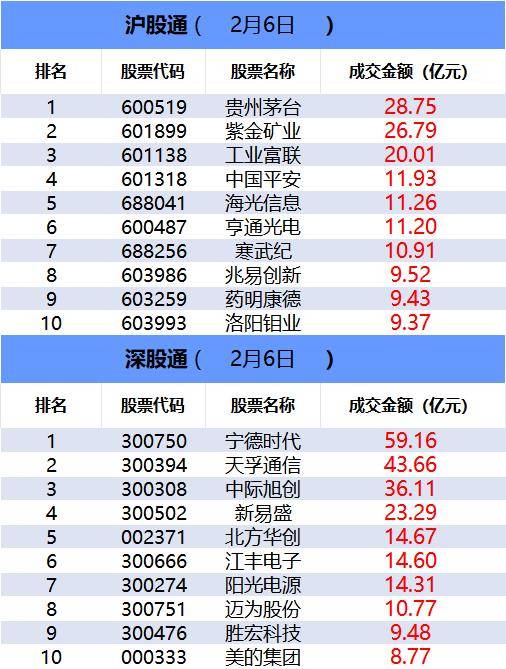
Core Viewpoint - The trading volumes of the Shanghai and Shenzhen Stock Connects indicate significant investor activity, with notable inflows and outflows in various sectors and stocks, reflecting market sentiment and investment trends. Trading Volume Summary - The total trading amount for the Shanghai Stock Connect was 134.14 billion, while the Shenzhen Stock Connect reached 153.30 billion [1]. Top Stocks by Trading Volume Shanghai Stock Connect - The top traded stocks included: - Kweichow Moutai (28.75 billion) - Zijin Mining (26.79 billion) - Industrial Fulian (20.01 billion) [2]. Shenzhen Stock Connect - The leading stocks were: - CATL (59.16 billion) - Tianfu Communication (43.66 billion) - Zhongji Xuchuang (36.11 billion) [3]. Sector Performance - Sectors such as oil and gas, batteries, and chemicals showed strong performance, while consumer sectors experienced declines [4]. Major Fund Inflows and Outflows Fund Inflows - The top sectors with net inflows included: - New Energy (51.65 billion, 1.97%) - Basic Chemicals (37.74 billion, 3.09%) [5]. Fund Outflows - The sectors with the highest net outflows were: - Defense and Military (50.28 billion, -5.27%) - Cultural Media (42.94 billion, -4.62%) [6]. Individual Stock Fund Monitoring Net Inflows - The stocks with the highest net inflows included: - Wuzhou Xinchun (11.85 billion, 30.31%) - Daji Shares (10.68 billion, 35.91%) [7]. Net Outflows - The stocks with the highest net outflows included: - Xinyi Sheng (29.11 billion, -17.14%) - Zhongbiao Xuchuang (15.56 billion, -8.69%) [8]. ETF Trading Summary Top ETFs by Trading Volume - The leading ETFs by trading amount included: - Gold ETF (19.03 billion, -5.10%) - A500 ETF Fund (14.96 billion, -4.58%) [9]. ETFs with Highest Growth in Trading Volume - The ETFs with the highest growth in trading volume included: - Brazil ETF (19.82 billion, 298.93%) - Hang Seng Dividend Low Volatility ETF (4.25 billion, 178.74%) [10]. Futures Positioning - Among the four major futures contracts, both long and short positions were reduced, with the IM futures contract seeing a significant increase in short positions, indicating heightened bearish sentiment [11]. Institutional Activity Buying Activity - Notable institutional buying included: - Enjie Shares (10.00%, 180 million) - Red Treasure (1.94%, 113 million) [12]. Selling Activity - Significant selling activity was observed in: - Jieli Suojun (2.79 billion) [13]. Retail and Quantitative Fund Activity Retail Activity - Retail investors showed reduced activity, with notable purchases in: - Jieli Suojun (1.63 billion) [14]. Quantitative Fund Activity - Quantitative funds were active, with significant purchases in: - Enjie Shares (1.07 billion) [15].



——电新行业2025年年报业绩前瞻:锂电储能周期拐点明显,光伏盈利探底
Shenwan Hongyuan Securities· 2026-02-06 12:01
Investment Rating - The report rates the industry as "Overweight" indicating a positive outlook for investment in the sector [1]. Core Insights - The lithium battery sector is expected to see a significant increase in both volume and price in Q4 2025, with production levels rising across various components, including a 15% increase in ternary cathodes and a 24% increase in lithium batteries [1]. - The photovoltaic industry is experiencing a reduction in losses, but Q4 is anticipated to be under pressure due to rising costs in silver paste and silicon materials, leading to expected losses for major companies [1]. - The wind power sector is witnessing a substantial recovery in profits driven by demand, with a 50.4% year-on-year increase in installed capacity in 2025, although Q4 performance may fall short of expectations due to reduced shipment volumes [1]. - The energy storage market is projected to maintain high growth rates, with independent storage becoming a key growth driver, supported by increasing demand in emerging markets and improved profitability models [1]. Summary by Sections Lithium Batteries - Q4 2025 is expected to see a significant increase in production across various lithium battery components, with production figures reaching 250,000 tons for ternary cathodes and 600 GWh for lithium batteries, reflecting a robust demand [1]. - Price increases in key materials such as lithium hexafluorophosphate and lithium iron phosphate are anticipated, contributing to stable profitability in the battery segment [1]. Photovoltaics - The industry faced substantial losses in the first three quarters of 2025, but there is a marginal improvement. Q4 is expected to be challenging due to rising costs and asset impairment [1]. - The cash flow in the silicon material segment is showing signs of recovery, with financing inflows increasing, although the overall industry remains under pressure [1]. Wind Power - The installed capacity for wind power in China reached 119.33 GW in 2025, marking a 50.4% increase year-on-year, leading to a significant recovery in profits for the sector [1]. - Despite a strong demand outlook, Q4 performance may be impacted by reduced shipment volumes and impairment factors [1]. Energy Storage - The energy storage sector is expected to continue its rapid growth, with independent storage becoming a core growth driver through capacity leasing and market transactions [1]. - The outlook for 2026 is positive, with anticipated demand growth in overseas markets and improved utilization rates in domestic large-scale storage [1]. Investment Recommendations - The report suggests focusing on four main investment lines: 1. Cyclical growth companies such as CATL and EVE Energy 2. Technological innovation firms like Rongbai Technology and Dingsheng Technology 3. Supply-side optimization companies including Tongwei and LONGi Green Energy 4. Companies expanding into AIDC as a secondary business [1].



“问题电芯”索赔案落地!欣旺达与吉利系威睿电动达成和解,预计影响利润超5亿元
Jin Rong Jie· 2026-02-06 11:59
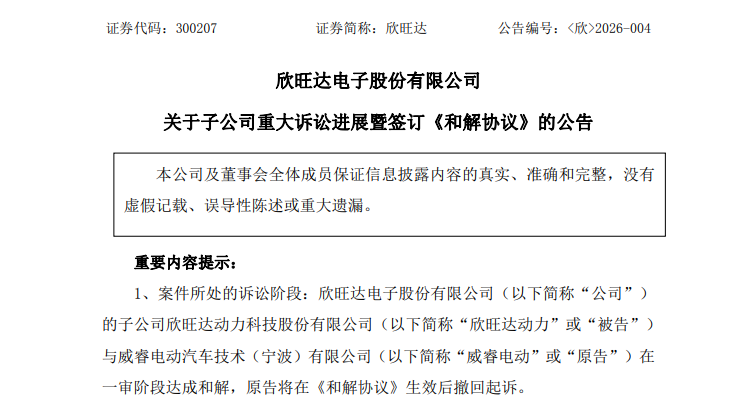
Core Viewpoint - Xiwanda Electronics Co., Ltd. announced that its wholly-owned subsidiary, Xiwanda Power Technology Co., Ltd., reached a settlement agreement with Weir Electric Vehicle Technology (Ningbo) Co., Ltd. regarding a significant sales contract dispute, leading to the withdrawal of the lawsuit by Weir Electric [1][3]. Group 1: Settlement Agreement Details - The agreement stipulates that all costs related to the replacement of power battery packs will be calculated based on actual costs and shared according to an agreed ratio, with all related battery packs belonging to Xiwanda Power after the resolution [3]. - Xiwanda Power is required to pay Weir Electric a remaining amount of 608 million yuan after deducting the costs already borne by Xiwanda Power, with a payment schedule extending over five years [3]. - The payment plan includes specific percentages to be paid in each year from 2026 to 2030, with 60% due in 2026 and the remaining balance to be settled by 2030 [3]. Group 2: Background and Industry Context - The dispute originated from a lawsuit filed by Weir Electric in December 2025, claiming damages of 2.314 billion yuan due to quality issues with battery cells delivered between June 2021 and December 2023 [4]. - Geely Electric, a subsidiary of Geely Holding Group, is a key player in the new energy vehicle sector, focusing on the development and manufacturing of core components such as power batteries and electric drive systems [4]. - Geely has adopted a multi-faceted strategy in the new energy sector, with plans to launch its self-developed all-solid-state battery by 2026 [5]. - In 2025, Geely's total sales reached 4.116 million units, a 26% increase year-on-year, with new energy vehicle sales growing by 58%, achieving a penetration rate of 56% [6].


钠电如何推进新能源汽车后50%渗透?
高工锂电· 2026-02-06 11:53
Core Viewpoint - The article emphasizes the critical role of sodium batteries in the future of electric vehicles, particularly in cold climates, and highlights the collaboration between CATL and Changan Automobile to validate sodium battery performance in extreme conditions [3][4][5]. Group 1: Market Trends and Projections - By 2025, the penetration rate of new energy vehicles in China's total auto sales is expected to exceed 50%, reaching 50.8%, with some months last year seeing nearly 60% penetration [3]. - CATL's sodium batteries are positioned as essential for the second half of the electrification process, particularly in northern markets where low-temperature performance is crucial [4][5]. Group 2: Product Development and Performance - CATL has developed various sodium battery products, including those for heavy-duty trucks and passenger vehicles, showcasing significant performance improvements in low-temperature conditions [7][9]. - In tests, sodium batteries demonstrated nearly three times the discharge power compared to conventional lithium iron phosphate models at -30°C, with over 90% capacity retention at -40°C [4][9]. Group 3: Commercialization and Strategic Partnerships - CATL has been actively delivering sodium battery products and has a clear commercialization strategy, moving from commercial vehicles to passenger cars and conducting winter tests to validate performance [5][6]. - The collaboration with Changan Automobile aims to produce models with over 400 km range, with future upgrades targeting 500 km to 600 km [10]. Group 4: Supply Chain and Industry Impact - The entry of CATL into the sodium battery market is expected to drive significant changes in the supply chain, leveraging similarities between lithium and sodium supply systems [13][14]. - CATL's partnership with Rongbai Technology for sodium battery materials is set to expand production capacity significantly, with a projected 101% year-on-year increase in sodium battery cathode material production by 2025 [15][16]. Group 5: Future Applications and Market Expansion - CATL plans to apply sodium batteries extensively in the energy storage sector by 2026, aligning with market reforms that enhance investment returns in storage solutions [17][18]. - The introduction of a new capacity pricing mechanism for independent storage stations is expected to reduce investment uncertainties in sodium battery storage [18]. Group 6: Technological Innovations - CATL has introduced the "sodium-iron" dual-core battery, combining sodium and lithium technologies, which offers a total energy capacity of 75 kWh and a range of 700 km [19].

GGII:2025年中国储能锂电池出货量630GWh 同比增幅达85%
Zhi Tong Cai Jing· 2026-02-06 11:35
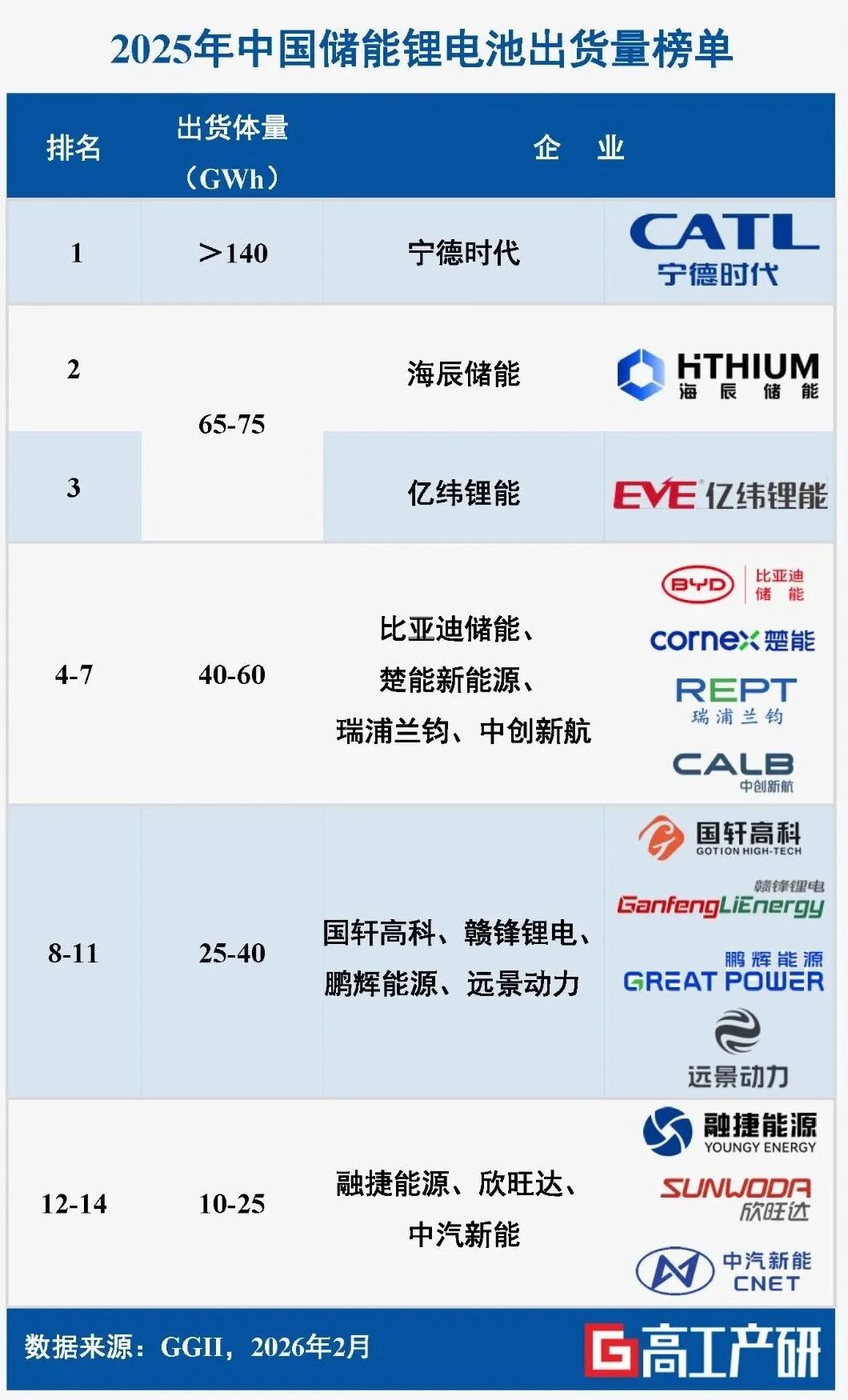
Core Viewpoint - The Chinese energy storage lithium battery market is expected to experience significant growth in 2025, with a shipment volume of 630 GWh, representing an 85% year-on-year increase, and maintaining over 90% of the global market share [1][4]. Group 1: Market Growth Drivers - The growth is driven by three main factors: the gradual exit of mandatory storage policies and the acceleration of independent storage projects in the domestic market, transitioning the industry from "passive configuration" to "active investment" [4]. - The overseas market is boosted by the U.S. installation surge, demand release in emerging markets, and the end of inventory depletion in overseas household storage, leading to strong order growth [4]. - New application scenarios, such as data centers, are contributing to the continuous increase in demand for energy storage cells [4]. Group 2: Competitive Landscape - The top 10 companies in China's energy storage lithium battery shipments for 2025 include CATL, BYD, Hicharge, EVE Energy, and others, which also rank among the top globally [1][2]. - The competition in the household storage lithium battery market in 2025 will focus on specialized production capacity and large-scale delivery capabilities, solidifying the market share and industry position of leading companies [5]. Group 3: Future Trends - In 2026, the household storage lithium battery market is expected to see a relaxation of capacity constraints, with the establishment of a dual mainline product matrix as 100Ah and 314Ah cells become standard options [4][5]. - The global supply chain layout is accelerating, with localized production becoming a key strategy to address trade barriers and raw material sourcing requirements in overseas markets [5]. - The penetration rate of large capacity cells (500+ Ah) is projected to exceed 20% in 2026, with most manufacturers expected to achieve mass production by the second half of the year [9]. Group 4: Market Projections - The energy storage battery market is anticipated to maintain a high growth trend into 2026, with an expected shipment of over 850 GWh, although capacity pressure will remain significant in the first half of the year [8][11]. - The price of energy storage cells is projected to increase by approximately 3-6 cents per Wh due to rising costs of key raw materials, which will be passed down to downstream procurement costs [12].


钠电池正式叩响主流乘用车市场大门,头部企业推动规模化上车
Xin Lang Cai Jing· 2026-02-06 11:27
过去一年,国内动力电池厂商在钠电池商用化领域加速布局,头部企业通过技术突破、产能扩张及场景 落地,推动钠电池从实验室走向规模化应用。行业内最新的重磅则是,长安汽车和宁德时代两家巨头2 月5日在极寒汽车测试地牙克石举办了一场发布会,长安汽车正式发布全球钠电战略,同时宣布旗下阿 维塔、深蓝、启源、引力等多品牌,未来都将搭载宁德时代钠新电池。(智通财经) ...

7家中企包揽84%份额!2025年全球储能电池出货550GWh
Xin Lang Cai Jing· 2026-02-06 11:25
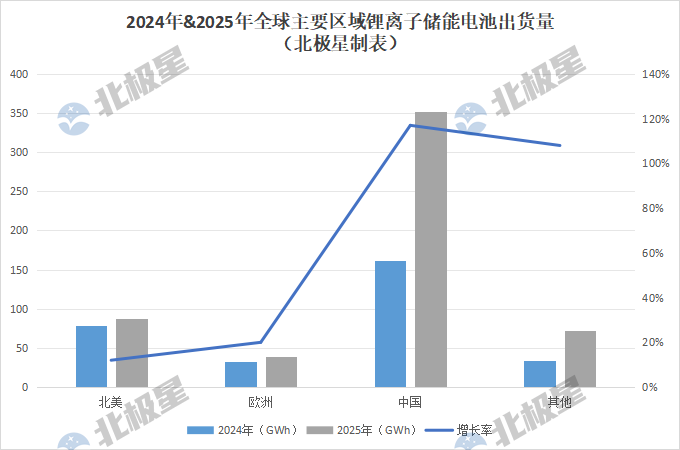
Core Insights - The global lithium-ion energy storage battery shipment reached 550 GWh in 2025, marking a 79% year-on-year increase, indicating rapid expansion in the energy storage industry [1][6][11] Group 1: Market Overview - China, North America, and Europe remain the primary target markets, with China accounting for 352 GWh (64% of global shipments) and a growth rate of 117%, highlighting its role as the core driver of global energy storage supply growth [1][6][11] - North America and Europe are experiencing growth, but their global market share is declining due to faster growth in China and emerging markets, which saw a growth rate of 108% [1][6][11] Group 2: Regional Dynamics - The slowdown in North America's growth rate and its declining global share is linked to U.S. policies, particularly high tariffs on Chinese products, which have impacted the supply of lithium iron phosphate batteries [7][10] Group 3: Company Rankings - The top nine companies in lithium-ion energy storage battery shipments are dominated by Chinese firms, with CATL leading at 167 GWh, holding a 30% market share, while the last two Korean companies account for only 4% [4][9][11] - The dominance of Chinese companies is attributed to the suitability of lithium iron phosphate batteries for energy storage needs, emphasizing safety and cost over energy density [4][9][10] Group 4: Future Outlook - Korean companies are adapting by modifying existing U.S. production lines and focusing on lithium iron phosphate technology to regain market share in North America, with expectations of a gradual recovery in their market presence [10]

【产业】宁德时代收购华为数字能源?后续来了!!
Xin Lang Cai Jing· 2026-02-06 11:25
近日市场热议的"宁德时代收购华为数字能源"传闻,有了最新进展! 知情人士透露,双方此前确实有过洽谈,但因整体收购成本过高,收购方案并未推进,取而代之的是宁 德时代拟参股华为数字能源约20%股份。 不过反转来得迅速——2月6日,多位华为数字能源员工证实,2月5日晚公司内部已逐级通知,明确不再 出售相关业务及股份。 来源:锂电派 近日市场热议的"宁德时代收购华为数字能源"传闻,有了最新进展! 知情人士透露,双方此前确实有过洽谈,但因整体收购成本过高,收购方案并未推进,取而代之的是宁 德时代拟参股华为数字能源约20%股份。 不过反转来得迅速——2月6日,多位华为数字能源员工证实,2月5日晚公司内部已逐级通知,明确不再 出售相关业务及股份。 据悉,华为数字能源成立于2021年6月,是华为100%全资子公司,注册资本30亿元,核心聚焦清洁能源 与能源数字化领域,也是华为在该赛道的核心业务载体。 目前,双方均未就此次参股传闻及后续合作作出官方回应,后续动态我们将持续关注。 来源:锂电派 据悉,华为数字能源成立于2021年6月,是华为100%全资子公司,注册资本30亿元,核心聚焦清洁能源 与能源数字化领域,也是华为在该赛道 ...