
Anthropic

Search documents
Anthropic联合创始人:学习人文科学将“比以往任何时候都更加重要”
Huan Qiu Wang Zi Xun· 2026-02-09 08:40
Core Insights - The importance of human qualities will increase in the age of artificial intelligence, according to Anthropic's co-founder and president, Daniela Amodei [1][2] Group 1: Human Qualities and Education - The study of humanities will become more important than ever, as it encompasses understanding oneself, history, and the motivations behind human behavior [2] - Critical thinking and interpersonal skills will gain significance in the future, contrary to the belief that they may become less important [2] Group 2: AI and Human Collaboration - The number of tasks that AI can perform without human assistance is described as "very few" [2] - Even the most cognitively challenging tasks that humans excel at can be enhanced through AI [2] - The combination of humans and AI is expected to create more meaningful, challenging, interesting, and productive work, opening doors to more opportunities and resources for many [2]

电子行业跟踪报告:摩尔线程推出智能编程服务
Shanghai Aijian Securities· 2026-02-09 08:12
Investment Rating - The electronic industry is rated as "Outperform" compared to the market [1] Core Insights - The report highlights the launch of the AI Coding Plan by Moer Thread, which is the first domestic full-function GPU computing base for intelligent development solutions, achieving key technological breakthroughs in AI coding [5][6] - The global AI programming tools market is rapidly evolving, with tools transitioning from "auxiliary plugins" to "full-stack development partners," indicating a significant shift towards commercial adoption [10][14] - The report emphasizes the increasing demand for AI applications, particularly in the context of AI infrastructure investments driven by the popularity of AI applications [2][5] Summary by Sections 1. Moer Thread's AI Coding Plan - Moer Thread's AI Coding Plan offers a high-performance, highly compatible domestic programming solution, leveraging the MTT S5000's full precision computing capabilities [6] - The service has been optimized across all dimensions, including computing power, model selection, and tool adaptation, ensuring seamless integration with mainstream programming tools [6][7] - The GLM-4.7 model used in the AI Coding Plan ranked first in a global blind test, outperforming even GPT-5.2 in various coding scenarios [6][10] 2. Global Industry Dynamics - AMD reported a revenue of $10.3 billion for Q4 2025, a 34% year-on-year increase, with a net profit of $1.5 billion, reflecting strong performance in the semiconductor sector [31] - Google surpassed $400 billion in annual revenue for 2025, driven by a 48% increase in cloud services revenue, highlighting the growing demand for AI infrastructure [33] - Amazon's Q4 2025 revenue reached $213.4 billion, with AWS cloud computing revenue growing by 24%, indicating robust growth in cloud services [34] 3. Market Review - The SW electronic industry index decreased by 5.23% this week, ranking 29th out of 31 sectors, while the SW primary industry index showed varied performance across sectors [2][45] - The top-performing sub-sectors within the electronic industry included brand consumer electronics and optical components, while digital chip design and integrated circuit packaging faced significant declines [49][52]
2026年人工智能+的共识与分歧
腾讯研究院· 2026-02-09 08:03
Core Viewpoint - Generative AI is transitioning from "technically feasible" to "value feasible," entering a critical validation period for its practical application, with significant industry consensus on its implementation but deep divisions on key pathways that will determine its potential as a new productive force [2]. Three Consensus Points - The bottleneck for AI implementation has shifted from the supply side to the demand side, with 88% of surveyed medium to large enterprises using AI in at least one business function, but only one-third achieving large-scale deployment. Key obstacles include unclear goals and insufficient integration readiness [4]. - Approximately 70% of current AI solutions require customization, with only 30% being standardizable. High customization leads to challenges in monetization and the inability to create reusable product capabilities, resulting in a reliance on "API calls + customization services" for enterprise AI delivery [5]. - The commercial model for AI remains unproven, with significant price competition pressures. While C-end AI applications have high user engagement, revenue conversion rates are low. B-end AI faces even greater challenges, with API prices dropping by 95%-99% since 2024, leading to a highly competitive low-price environment [6][7]. Three Divergence Points - The capabilities of intelligent agents are evolving from "answering questions" to "completing tasks," with significant advancements in long-term task execution and tool utilization. However, accuracy in complex tasks remains inconsistent, particularly in high-risk sectors like finance and healthcare [9][10]. - The focus of computing power competition is shifting from training to inference, with demand for AI applications driving exponential growth in inference calls. Companies are optimizing algorithms to enhance inference efficiency, indicating a shift in market dynamics [11][12]. - The evolution of the AI ecosystem is complex, with debates on data flow rules and user privacy. The transition from mobile internet to AI necessitates new structural solutions to address data sharing and privacy concerns, with no clear answers yet established [13][14]. Next Steps - Companies should prioritize real value and carefully select application scenarios, focusing on areas with strong data foundations and manageable risks, such as quality inspection in manufacturing and AI-assisted diagnosis in healthcare [16]. - Standardization efforts should be promoted to reduce customization costs and foster reusable product capabilities, particularly in key industries like finance and manufacturing [17]. - Quality supervision and safety audits should be strengthened in high-risk AI applications, establishing a governance framework to mitigate systemic uncertainties [18]. - Diverse commercial models should be encouraged to avoid detrimental price competition, supporting differentiated pricing strategies based on technical capabilities and industry expertise [19].

CZ错失人生最佳投资的那一天,Crypto错过了AI
3 6 Ke· 2026-02-09 07:48
Core Insights - The article discusses the significant investment made by CZ, the founder of Binance, in Bitcoin (BTC) in 2014, which has yielded substantial returns over the years, highlighting the idealistic nature of his early investment decisions [2] - It also explores the dramatic events surrounding the failed acquisition of FTX by Binance in November 2021, which ultimately led to FTX's collapse and a prolonged downturn in the cryptocurrency market [3][7] - The narrative contrasts the operational strengths of CZ with the investment acumen of SBF, the founder of FTX, particularly in relation to their respective approaches to business and investment [10] Investment Highlights - In 2014, CZ sold his apartment in Shanghai to invest approximately 1500 BTC, which could have generated a peak return of about $189 million if held until now [2] - FTX's strategic investment in AI startup Anthropic, where it invested $500 million for a 13.56% stake, is noted as a significant move in the AI sector [8] - Anthropic's valuation has skyrocketed, with recent funding rounds suggesting a potential valuation of $350 billion, making FTX's stake worth approximately $27.44 billion [10] Acquisition Attempt - On November 9, 2021, Binance and FTX announced a preliminary agreement for Binance to acquire FTX to address its liquidity crisis, but the deal fell through within a day [3][7] - The failed acquisition is seen as a pivotal moment that allowed Binance to solidify its position as the leading exchange in the cryptocurrency market [7] Market Impact - Following FTX's bankruptcy, its assets, including the stake in Anthropic, were managed by a bankruptcy team, which sold shares for over $1.3 billion [11] - The buyers of these shares were primarily traditional financial institutions, indicating a shift in the ownership of valuable assets from the crypto sector to traditional finance [12] Conclusion - The article reflects on the missed opportunities for collaboration between the crypto and AI sectors, suggesting that had FTX or Binance maintained a stake in Anthropic, it could have led to innovative developments at the intersection of these industries [13]

马斯克:向中国学习
投资界· 2026-02-09 07:19
Core Viewpoint - Space is predicted to become the preferred location for AI infrastructure within 30 to 36 months, with annual AI computing power in space expected to exceed the cumulative total on Earth within five years [1][12][20]. Group 1: AI and Space Infrastructure - The total intelligence of AI may surpass human intelligence within five to six years, with human intelligence potentially constituting less than 1% of all intelligence [2][25]. - Companies entirely composed of AI and robots are expected to outperform any company with human involvement [2][31]. - The energy supply is a critical factor for building data centers in space, as energy production outside of China is stagnating while chip production is rapidly increasing [3][6]. Group 2: Energy and Cost Efficiency - Solar panels in space can generate power at five times the efficiency of those on Earth, eliminating the need for batteries, thus reducing costs significantly [4][9]. - The cost of solar panels is currently around $0.25 to $0.30 per watt in China, and costs could decrease by up to tenfold when deployed in space [9][23]. - The average electricity consumption in the U.S. is about 500 GW, and achieving 1 TW of power generation in space would require significant advancements in energy production [5][20]. Group 3: Challenges in Energy Production - Building power plants is complex, requiring extensive infrastructure and facing regulatory hurdles, which slows down the process [6][10]. - The demand for electricity for data centers is underestimated, with actual needs being much higher due to cooling and maintenance requirements [10][21]. - The U.S. is facing a bottleneck in energy production, which could hinder the launch of large-scale AI chip operations [21]. Group 4: Manufacturing and Supply Chain - The manufacturing of chips is constrained by existing foundries, which are unable to meet the growing demand for AI chips [19][18]. - There is a significant backlog in turbine orders, which complicates the establishment of new power generation facilities [11][12]. - SpaceX and Tesla aim to produce 100 GW of solar panels annually, controlling the entire supply chain from raw materials to finished products [8][34]. Group 5: Competitive Landscape - Without breakthrough innovations in the U.S., China is poised to dominate the AI and manufacturing sectors [2][37]. - China's energy production is projected to exceed that of the U.S. by three times, indicating its industrial capabilities [37]. - The U.S. faces challenges in maintaining a competitive edge due to lower birth rates and a declining workforce, making advancements in robotics and AI crucial [36][37].


Anthropic员工效率碾压谷歌1000倍,打工人想进,必须先「杀死自我」
3 6 Ke· 2026-02-09 07:03
Core Insights - Anthropic is positioned as a leading player in the AI industry, surpassing OpenAI and becoming a benchmark for AI capabilities [2][4] - The company's operational model is characterized by a lack of traditional departmental barriers and a focus on a collaborative, hive-mind approach [10][12] - The current environment at Anthropic allows for rapid innovation, with products being developed and launched in as little as 10 days [19][21] Group 1: Company Operations - Anthropic's internal culture is described as a "hive mind," driven by atmosphere rather than traditional hierarchies [9][10] - Employees are highly elite, with the difficulty of joining compared to entering the NFL, indicating a rigorous selection process [5][6] - The company operates without political struggles, allowing for a focus on innovation and collaboration [18][30] Group 2: Innovation and Efficiency - The formula for success at Anthropic is based on having more work opportunities than employees, leading to a surge in innovation [13][17] - The efficiency of Anthropic's engineers is reported to be 10 to 100 times higher than current developers using tools like Cursor and ChatGPT, and 1000 times higher than Google engineers in 2005 [23][24] - The development process is likened to an improvisational theater, where ideas are rapidly tested and iterated upon [25][30] Group 3: Future Outlook - By 2026, Anthropic is expected to disrupt numerous companies, as many are unprepared for the impending changes in the industry [29][32] - The company embodies a belief in creating civilization-level innovations, which drives its employees' passion and commitment [31][32]

懂了很多道理,AI 依然要发疯
3 6 Ke· 2026-02-09 06:50
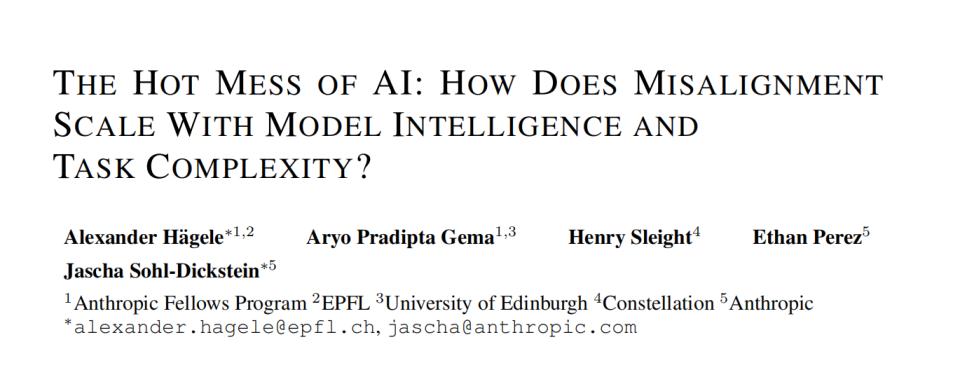
最近一段时间,很多论文都在讨论Agent目前的困境。 困境是真实存在的。在应用层,目前Agent离开了像Skill这样人造拐棍后,在处理真实世界的长程任务时根本不可靠。 这种困境通常被归结为两个原因。 第一个是上下文的黑洞。正如前两天腾讯首席AI科学家姚顺雨带领混元团队做的CL Bench所指出的那样,模型或许根本没能力吃透复杂 上下文,所以也不可能按照指令好好办事。 第二个其实更致命,它叫长期规划的崩塌。就是说一旦规划的步长长了,模型就开始犯迷糊。就和喝多了一样,走两步是直的,走十步 就开始画圈。 Anthropic 的研究员们在1月末发布了一篇重磅论文《The Hot Mess of AI 》(AI 的一团乱麻),试图解释第二个问题的因由,结果他们发 现,这一试,给自回归模型(Transformer为基础的都是)清楚的找到了阿喀琉斯之踵。 我们都听说过Yann Lecun经常提的"自回归模型只做Next Token Prediction(下一个词预测),因此根本没法达到理解和AGI。" 但之前这都是个判断或者信仰,没有什么实证证据。这篇论文,就给出了一些实证证据。 而且它还预示了一个可怕的现实,即随着模型 ...
谷歌-A:云营收加速增长,资本开支指引激进
GF SECURITIES· 2026-02-09 06:49
Investment Rating - The report assigns a "Buy" rating to Google (GOOGL) with a current price of $322.86 and a fair value of $362.78 [4]. Core Insights - Google's cloud revenue is accelerating, with significant improvements in profitability, while capital expenditure guidance is aggressive, raising concerns about return on investment [4][11]. - The company reported strong revenue and net profit for Q4 2025, exceeding expectations, with a notable increase in cloud revenue driven by AI demand [4][12][22]. - The advertising segment remains robust, although YouTube ad revenue growth is slowing [4][19]. Summary by Sections Q4 2025 Performance Review - Google achieved Q4 2025 revenue of $113.83 billion, surpassing consensus estimates by 2.15%, with a year-over-year growth of 17.99% [12]. - Advertising revenue reached $82.28 billion, up 13.6% year-over-year, with search ads growing by 16.7% [19]. - Cloud revenue for Q4 was $17.66 billion, reflecting a 47.8% year-over-year increase, with a cloud operating margin of 30.1% [22]. Business Analysis - The digital advertising market is expanding, with Google maintaining a dominant position, holding a 59.07% market share in search advertising [32]. - AI technology is increasingly integrated into Google's advertising and cloud services, enhancing efficiency and user engagement [34][40]. - The company is investing heavily in AI infrastructure, with a projected capital expenditure of $180 billion for 2026, a 96.9% increase from 2025 [23]. Profit Forecast and Investment Recommendations - Revenue projections for Google indicate a growth rate of 17.8% in 2026, with net profits expected to reach $139.7 billion [62]. - The cloud segment is anticipated to be a key growth driver, with revenue growth rates of 46.1% in 2026 [62]. - The Other Bets segment is expected to show slow growth, with revenue increasing by 3% annually [63].
AIAgent专题:Opus4.5开启AIAgent拐点,CPU需求迎高增
Guoxin Securities· 2026-02-09 06:48
Investment Rating - The investment rating for the industry is "Outperform" (maintained) [3] Core Insights - The release of the Claude Opus 4.5 model by Anthropic in November 2025 marked a significant turning point for AI agents, leading to a notable increase in CPU demand as it transitioned from a supportive unit to a central scheduling and execution hub [4][6] - The report anticipates a substantial rise in CPU demand driven by the explosion of AI agents, with server CPU configurations evolving from 1:32 to 1:4, and even reaching 1:2 in advanced products [4][60] - The CPU market is expected to experience a price increase due to rising demand, precious metal material costs, and a scarcity of advanced process capacity, with a 10% price increase already observed as of February 2026 [4][66][69] - The report highlights the competitive landscape of the global CPU market, predicting Intel's market share in server CPUs to be around 55% and AMD's to be approximately 40% by 2026, indicating a clear dominance and head effect [4][72] Summary by Sections 01 Phenomenal Events of Agents - The emergence of AI agents is transforming workflows, moving from simple question-answering to complex task execution and result delivery [4][12] 02 Evolution of Opus 4.5 Model - Opus 4.5 has achieved a qualitative leap in delivering complex tasks, acting as a highly autonomous AI engineer capable of managing extensive project files and dependencies [29][33] 03 Explosion of CPU Demand Under Agents - The demand for CPUs is expected to surge as AI agents require more processing power for task execution, orchestration, and high concurrency, with the CPU becoming a critical bottleneck in AI systems [60][61] - The report outlines the four major costs associated with agent tasks that establish the CPU's bottleneck position: tool execution, sandbox isolation, high concurrency, and KV cache [61][62] Market Dynamics - The report discusses the competitive dynamics between x86 and ARM architectures, with x86 maintaining a stronghold in the server market due to its stability and mature software ecosystem, while ARM is gaining traction in energy efficiency and specific ecosystems [80]


中信建投:自主Agent发展迅速,多模态催化内容市场迭代
Xin Lang Cai Jing· 2026-02-09 06:24
Group 1 - The core viewpoint of the article highlights the advancements in AI technologies by companies like Anthropic and OpenAI, showcasing their new products and capabilities [1] - Anthropic has released Claude Opus 4.6, which utilizes Agent Teams and adaptive thinking to enhance integration within the Office ecosystem and manage complex engineering tasks, facilitating deeper penetration of AI in vertical sectors such as finance and law [1] - OpenAI has introduced GPT-5.3-Codex, which not only sets new standards in programming and terminal operations but also demonstrates an internal cycle of AI automated development through edge environment takeover and self-building capabilities [1] Group 2 - In the multimodal field, ByteDance's Seedance 2.0 has entered internal testing, addressing consistency issues in video generation through comprehensive multimodal references and refined lens control [1] - The collaboration between Seedance 2.0, Doubao, and Seedream is expected to form a full multimodal matrix, significantly reducing content production costs and accelerating commercialization [1]
