奇瑞汽车

Search documents
2025年《财富》中国500强排行榜日前揭晓
Guo Ji Jin Rong Bao· 2025-08-13 05:51
Core Insights - The 2025 Fortune China 500 list reveals that the total revenue of the listed companies for 2024 is projected to reach $14.2 trillion, a decrease of approximately 2.7% compared to the previous year, while net profit is expected to grow by about 7% to $756.4 billion [1] Group 1: New Energy Vehicle Companies - The rise of new energy vehicle companies is a significant highlight, with Seres achieving the largest ranking increase, moving up 235 places to 169th, and reporting revenue of nearly $20.177 billion, a year-on-year growth of 298.5% [2] - Seres' sales of new energy vehicles reached 426,900 units in 2024, a year-on-year increase of 182.84%, marking its first profit in five years at $826 million [2] - Other new energy vehicle companies like Xiaopeng, Li Auto, and NIO also reported significant growth, with Xiaopeng ranking 351st and achieving revenue of $5.68 billion, a 31.1% increase [3] Group 2: Traditional Automotive Companies - BYD moved up from 40th to 27th place, with revenue and profit increasing by 26.9% and 31.8% respectively, reaching $108 billion and $5.595 billion [5] - Geely Holding advanced from 54th to 41st, with revenue growth of 13.6% to $79.89 billion, while its electric vehicle sales surged by 92% [7] - Great Wall Motors improved its ranking from 158th to 140th, with revenue growth of 14.9% to $21.8 billion and profit growth of 77.8% to $1.764 billion [7] Group 3: State-Owned Enterprises - State-owned automotive companies generally faced challenges, with Dongfeng Motor dropping from 64th to 73rd, despite turning a loss of $391 million into a profit of $318 million [8] - SAIC Motor, FAW Group, and GAC Group all experienced revenue declines, with SAIC's revenue falling by 17.1% and profit dropping by 88.4% [8] - Chery Automobile and Yutong Bus showed positive performance, with Chery's revenue reaching $59.694 billion, a 52.7% increase, largely due to overseas sales [8]




观车 · 论势 || 汽车“出海”正处于提质增量转折期
Zhong Guo Qi Che Bao Wang· 2025-08-13 01:41
Core Insights - China's automobile exports have significantly increased from 728,200 units a decade ago to 4.91 million units two years ago, and have surpassed 3 million units in just six months this year, indicating a new stage in development [1] - Experts suggest that the Chinese automotive industry is at a turning point, transitioning from "product export" to "system output," aiming for a shift from scale expansion to quality enhancement [1][2] Group 1: Transition Phases - The first transition phase involves moving from product export to system output, with projections indicating that China will export 6.41 million vehicles in 2024 and potentially exceed 7 million this year [1][2] - The second transition phase focuses on moving from "going out" to "integrating in," where local production in overseas markets is emphasized to capture greater growth opportunities [2][3] - The third transition phase is about shifting from competing on price to competing on quality, aiming to change the perception of Chinese automobiles from "cheap and low quality" to symbols of high quality [2][3] Group 2: Globalization Strategy - The three transitions signify a comprehensive restructuring of China's automotive globalization strategy, entering a new phase of "localization" [3] - Localization encompasses not only the production of parts and vehicles but also the localization of research, marketing, and after-sales services to provide tailored solutions for overseas markets [3] - Companies like Chery Automobile, which has maintained its position as the top exporter of Chinese passenger cars for 22 consecutive years, emphasize the importance of local collaboration and ecological synergy in their global operations [3] Group 3: Market Potential and Challenges - Despite challenges such as fluctuating tariffs, restrictions, and varying international political environments, the potential for growth in overseas markets remains significant, particularly in regions like ASEAN, Russia, and the Middle East [3][4] - Data shows that in the first half of this year, the top three destinations for Chinese automobile exports were Mexico, the UAE, and Russia, with the UAE seeing a year-on-year increase of 58.5% in export volume [3] - The forecast for the "14th Five-Year Plan" period suggests that China's automobile export scale may reach its peak, but the focus should be on the global layout of the automotive supply chain and the upward trajectory of Chinese automotive brands [4]
车企、科技企业VLA研发进展
Zhong Guo Qi Che Bao Wang· 2025-08-13 01:33
Group 1: Li Auto - Li Auto's i8 features the VLA "driver model," marking a significant advancement in intelligent driving following the previous VLM introduction [1] - The VLA model includes a newly designed spatial encoder that utilizes language models and logical reasoning to provide driving decisions, predicting trajectories of other vehicles and pedestrians through a diffusion model [1] - The inference frame rate of the VLA is approximately 10 Hz, more than tripling the previous VLM's rate of 3 Hz [1] Group 2: XPeng Motors - XPeng G7 officially commenced deliveries on July 7, with a clear timeline for the Ultra version's VLA and VLM software updates [2] - The VLA software OTA update is scheduled for September 2025, with VLM software upgrades following in November 2025, and personalized recommendations by December 2025 [2] - The XPeng G7 Ultra version is equipped with three self-developed Turing AI chips, boasting a total computing power of 2250 TOPS, positioning it as a leader among mass-produced models [2] Group 3: Chery Automobile - Chery plans to introduce the VLA and world model technology into fuel vehicles by 2025 through its Falcon 900 intelligent driving system, aiming to set a new benchmark for "oil-electric intelligence" [3] - The Falcon 900 system utilizes a self-developed VLA model that integrates visual perception, language understanding, and action execution [3] - The model has been trained on 20 million kilometers of real-world data, capable of understanding over 5000 traffic scenarios, achieving a 92% accuracy rate in recognizing non-standard traffic signals in complex urban conditions, a 37% improvement over traditional systems [3] Group 4: Geely Automobile - Geely is actively developing VLA technology, integrating it with world models to create a comprehensive world model system [4] - The Qianli Haohan system features a "dual end-to-end model" design, enabling a multi-modal VLA general scene model and an end-to-end model to back each other up [4] - This system is powered by dual NVIDIA Thor chips, with a total computing power of 1400 TOPS and over 40 perception units capable of detecting objects 0.75 meters in size from 300 meters away [4] Group 5: Yuanrong Qihang - Yuanrong Qihang is also investing in the VLA model, with five models expected to feature it by the third quarter of this year [5] - The company was among the earliest to publicly announce its VLA development in June of last year [5] - The VLA model focuses on defensive driving with four core functions: spatial semantic understanding, recognition of irregular obstacles, comprehension of text-based guide signs, and voice control of the vehicle, which will be gradually released with mass production [5]
朱华荣、尹同跃、冯兴亚、项兴初……为何大佬们密集“捧”华为
Zhong Guo Qi Che Bao Wang· 2025-08-13 01:26
Core Insights - Huawei's smart driving system, QianKun, has surpassed 1 million vehicles equipped with it, covering 22 cooperative models across different price ranges [1] - Multiple mainstream automakers are actively seeking collaboration with Huawei, indicating a trend towards deeper partnerships in the automotive industry [3][5][7] Group 1: Collaborations and Partnerships - Chery Automobile and Huawei have launched the "Intelligent World 2.0" initiative, investing over 10 billion yuan and expanding the R&D team to 5,000 people [3] - FAW Group has partnered with Huawei to launch the Audi A5L and Q6L e-tron family, marking Audi as the first international luxury brand to collaborate deeply with Huawei [3] - Changan Automobile's leadership has engaged with Huawei's founder, suggesting potential future collaborations, although specific projects have not been disclosed [5] Group 2: Market Strategy and Positioning - GAC Group emphasizes the synergy of "GAC Manufacturing + Huawei Intelligence" to penetrate the high-end smart electric vehicle market [7] - Jiangling Motors has positioned its "Zun Jie" brand as a core driver for its strategic transformation towards a technology-oriented enterprise [7] - Great Wall Motors has established a close cooperation network with Huawei, covering marketing, smart cockpit, and vehicle solutions [8] Group 3: Competitive Landscape - The automotive industry is experiencing intensified competition, where companies must compete not only on price but also on technology, products, and services [9] - The success of Seres, which saw its market value soar from under 15 billion yuan to approximately 210 billion yuan after partnering with Huawei, exemplifies the potential benefits of such collaborations [9] - Huawei's significant influence in partnerships, such as with Chery's "Intelligent World," indicates a trend where Huawei leads brand strategy and management while partners support operational efforts [11] Group 4: Strategic Integration - The collaboration between automakers and Huawei is characterized by a deep integration of strengths, combining automakers' manufacturing and market experience with Huawei's technological leadership [11] - The establishment of "Yin Wang," a joint venture with Huawei holding 80% and other stakeholders like Avita Technology and Seres, reflects a strategic capital partnership model [11]


华为系新车下饺子,8大新车打满20-50万市场,余承东要给车圈上强度了
3 6 Ke· 2025-08-13 01:20
Core Viewpoint - The automotive market is entering a peak sales season, and Hongmeng Zhixing is accelerating the launch of new vehicles in collaboration with major car manufacturers, aiming to strengthen its market presence and competitiveness [1][4]. Group 1: Upcoming Vehicle Launches - Hongmeng Zhixing plans to release 6 new vehicles in the next 49 days, collaborating with four major car manufacturers [2]. - The AITO Wenjie M8 pure electric version is scheduled for launch in late August, while the new models Wenjie M7, Shangjie H5, and Xiangjie S9T will be released in September [2][31]. - The new models include the Zhijie R7 and S7, which have already started pre-sales and are expected to launch by the end of August [2]. Group 2: Vehicle Specifications - The Wenjie M8 pure electric version features a peak power of 227 kW for the single motor version and 160 kW/227 kW for the dual motor version, with a maximum range of 705 km [10][12]. - The new Wenjie M7 has increased dimensions and offers both range-extended and pure electric versions, with the range-extended version achieving over 1600 km and the pure electric version exceeding 700 km [20]. - The Xiangjie S9T will have both pure electric and range-extended options, with the pure electric version offering a maximum range of 801 km [40]. Group 3: Strategic Collaborations and Market Positioning - Huawei and Chery have signed a strategic cooperation agreement, committing over 10 billion yuan and a team of 5,000 for research and development to enhance the Zhijie brand [22]. - The rapid pre-sale success of the Zhijie R7 and S7, with over 20,000 orders in just 8 hours, indicates strong market demand and consumer interest [24]. - The overall expansion of Hongmeng Zhixing's product matrix reflects a strategic response to the trend of intelligent transformation in the automotive industry, reinforcing its competitive edge in the mid-to-high-end electric vehicle market [49].
汽车早餐 | 单笔5万元及以上家用汽车消费贷款可贴息;奇瑞旗下品牌进入伊拉克市场;福特加码电动汽车投资至50亿美元
Zhong Guo Qi Che Bao Wang· 2025-08-13 01:18
Domestic News - The US and China agreed to suspend the implementation of a 24% tariff on each other's goods for 90 days, effective from August 12, 2025, while retaining a 10% tariff [2] - The Chinese government announced a fiscal subsidy policy for personal consumption loans, focusing on household vehicles, effective from September 1, 2025, to August 31, 2026 [3] - Jilin Province is establishing a talent pool focusing on key industries such as new energy and intelligent connected vehicles [4] - The China Automobile Industry Association reported that three companies have achieved a 60-day payment term for accounts payable, with major state-owned and private enterprises participating [5] International News - Ford announced an additional $2 billion investment in electric vehicles, raising its total investment to $5 billion, aiming to launch a series of affordable electric vehicles, including a mid-size electric pickup truck priced at $30,000, expected to launch in 2027 [6] Company News - Aion Automobile reported that the delivery cycle for new orders in August is expected to shorten to 5-7 weeks, with over 60,000 units delivered as of early August [8] - Chery announced its entry into the Iraqi market through a partnership with Jameel Motors, planning to distribute Omoda and Jaecoo brands starting in Q4 of this year [9] - Former Honor CEO Zhao Ming denied rumors of joining Zhijie Automobile, stating he is unaware of such claims [10] - Micron Technology confirmed it will continue to develop NAND solutions for automotive and other terminal markets, despite halting mobile NAND product development [11] - Desay SV reported a net profit of 1.223 billion yuan for the first half of 2025, a 45.82% increase year-on-year, driven by growth in smart cockpit and intelligent driving businesses [12] - Zeekr and Geely Holding Group published a patent for a method to prevent motion sickness in vehicles, focusing on smart driving technology [13]



“汽车第一省”易主
Di Yi Cai Jing· 2025-08-12 23:07
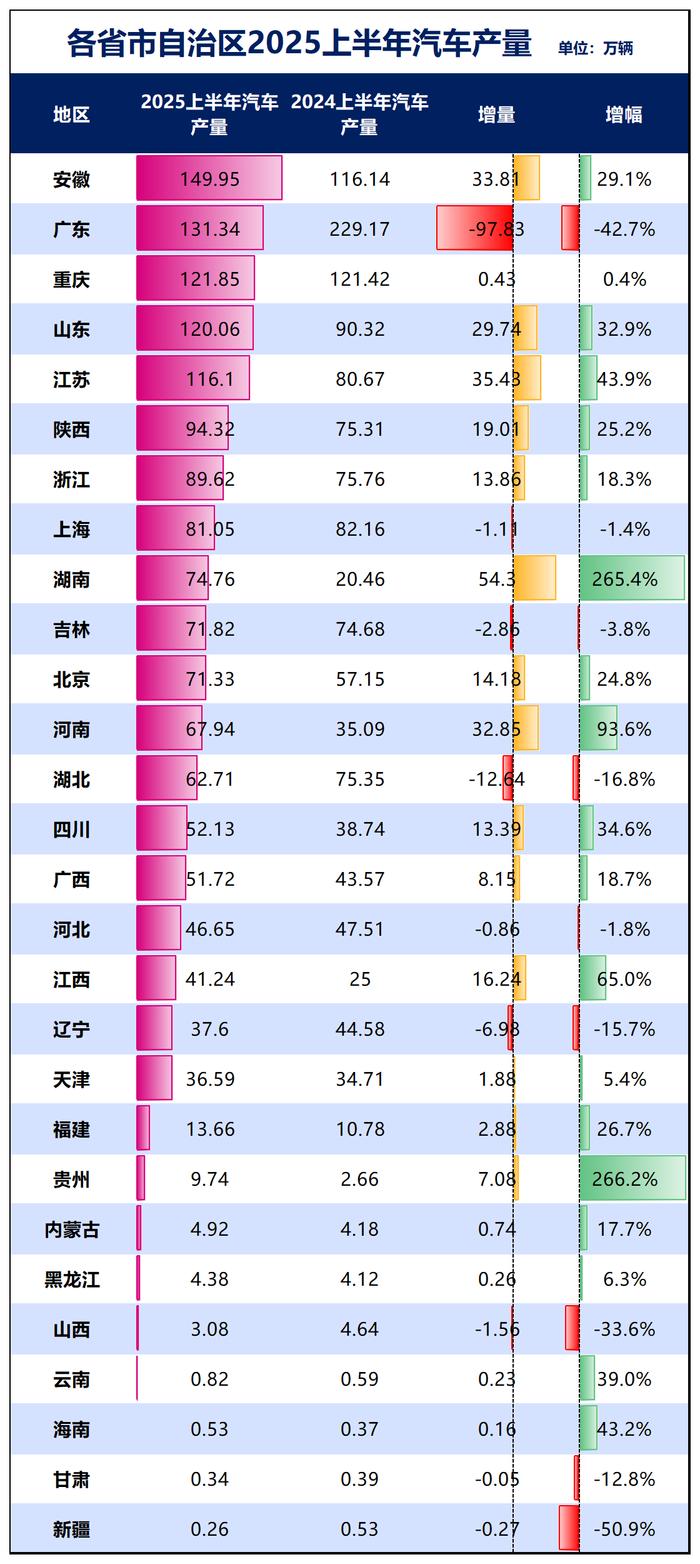
Core Insights - The recent news highlights that Anhui has surpassed Guangdong to become the "automobile first province" based on half-year production data, with Anhui producing 1.4995 million vehicles compared to Guangdong's 1.3134 million [2][4] - However, projections for 2024 indicate that Guangdong will reclaim its top position with an annual production of 5.7074 million vehicles, significantly outpacing Anhui's 2.6203 million vehicles [2] - The drastic change in production rankings is attributed to a shift in statistical methods implemented by the National Bureau of Statistics, which has been promoting a "dual production and legal entity" statistical reform since 2021 [2][11] Production Data Summary - In the first half of 2023, Anhui's vehicle production increased by 29.1% from 1.1614 million to 1.4995 million, while Guangdong's production fell by 42.7% from 2.2917 million to 1.3134 million [4][5] - Other provinces such as Hunan, Henan, Jiangxi, and Guizhou saw significant production increases, with Hunan's production skyrocketing by 265.4% from 204,600 to 543,000 vehicles [4][6] - The statistical changes have led to notable shifts in production attribution, affecting how output is reported based on the operational location rather than the legal entity's registered location [7][8] Statistical Reform Impact - The "dual production and legal entity" reform allows for a more accurate reflection of regional and industry development by attributing production to the location of operations [11][13] - This reform has been gradually implemented since 2021, with various regions adopting the new statistical methods at different times, leading to discrepancies in reported data [11][12] - The reform aims to enhance data transparency, which could drive higher quality development in the automotive industry and encourage local governments to plan production capacities more rationally [13]
“汽车第一省”易主
第一财经· 2025-08-12 16:05
Core Viewpoint - The recent shift in automotive production rankings between Anhui and Guangdong is primarily attributed to changes in statistical methods rather than actual production capabilities [3][4]. Group 1: Production Data Changes - In the first half of 2025, Anhui's automotive production reached 1.4995 million units, surpassing Guangdong's 1.3134 million units, which represents a significant drop from Guangdong's previous year's production of 2.2917 million units [4][6]. - The production increase in Anhui was 29.1% compared to the previous year, while Guangdong experienced a 42.7% decline [5][6]. - Other provinces such as Hunan, Henan, and Guizhou saw substantial increases in production, with Hunan's production rising by 265.4% [5][6]. Group 2: Statistical Methodology - The "law and production combined" statistical reform initiated by the National Bureau of Statistics in 2021 has led to a more accurate reflection of the automotive industry landscape by changing how production data is reported [3][10]. - Under the new methodology, production is reported based on the operational location rather than the legal entity's location, resulting in significant shifts in production statistics for major automotive companies [7][8]. - This reform aims to address challenges posed by the traditional legal entity principle, which often misrepresented regional and industry development due to the complexities of modern business operations [10][11]. Group 3: Implications of the Reform - The reform is expected to provide a more comprehensive and objective view of regional economic development, promoting higher quality growth in the automotive sector [12]. - Increased data transparency may encourage local governments to plan production capacities more rationally, aligning with actual industry dynamics [12].
7月份重卡市场销售同比大增46% 5家企业销量破万 重汽持续霸榜
智通财经网· 2025-08-12 13:16
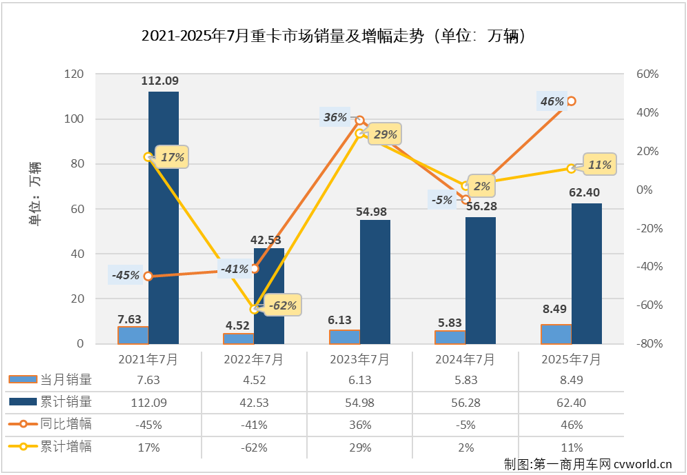
Core Insights - The heavy truck market in China experienced a significant sales increase in July 2025, with sales reaching 84,900 units, marking a year-on-year growth of 46% and achieving a "four consecutive months" increase [1][5][6] - The overall truck market, including chassis and tractors, sold 264,400 units in July, showing a month-on-month decline of 16% but a year-on-year increase of 14% [1][8] - The top five companies in the heavy truck market accounted for over 90% of the total market share, with the top ten companies holding a combined market share of 98.08% [1][5][10] Heavy Truck Market Performance - July 2025 marked the highest sales figure for heavy trucks in the last five years, with 84,900 units sold, surpassing the historical average of 70,800 units for July [2][4] - The year-on-year growth rate for heavy trucks in July 2025 expanded by 9 percentage points compared to June 2025, where the growth rate was 37% [1][5] - The cumulative sales for the first seven months of 2025 reached 624,000 units, representing an 11% increase compared to the same period in 2024 [8][9] Company Performance - In July 2025, five companies sold over 10,000 units each, with Heavy Truck leading at 22,700 units, followed by Jiefang, Dongfeng, Shaanxi, and Foton [1][5][6] - Notably, Foton, Xugong, and Chery saw substantial year-on-year growth rates of 134%, 100%, and 551%, respectively, making them the top performers in July [6] - The market share of the top four companies exceeded 100,000 units each, with Heavy Truck holding a 27.48% market share, followed by Jiefang, Shaanxi, and Dongfeng [9][10]

“汽车第一省”易主,真相是什么?
第一财经网· 2025-08-12 12:44
Core Insights - The recent shift in statistical methodology, termed "law production and emphasis," has significantly altered the automotive production landscape in China, revealing a more accurate representation of regional production capabilities [1][6][8] - Anhui province has recently surpassed Guangdong to become the "automobile first province" based on half-year production figures, with Anhui producing 1.4995 million vehicles compared to Guangdong's 1.3134 million [1][2] - The new statistical approach has led to dramatic changes in production figures, with some provinces experiencing over 200% increases in production due to the reallocation of production data based on operational location rather than corporate headquarters [2][5] Statistical Changes - The "law production and emphasis" reform was initiated by the National Bureau of Statistics in 2021, aiming to provide a more accurate reflection of the automotive industry's regional distribution by considering the operational location of production facilities [6][7] - This reform has resulted in significant production shifts, with provinces like Hunan and Guizhou seeing production increases of 265.4% and 266.2%, respectively, due to the establishment of new manufacturing bases [2][4] Production Data Overview - In the first half of 2024, the production figures for major provinces were as follows: Anhui at 1.4995 million vehicles (up 29.1% from 1.1614 million), Guangdong at 1.3134 million vehicles (down 42.7% from 2.2917 million), and Hunan at 0.7476 million vehicles (up 265.4% from 0.2046 million) [3][4] - Other provinces such as Shandong and Jiangsu also reported significant increases, with Shandong's production rising by 32.9% and Jiangsu's by 43.9% [3][4] Industry Implications - The reform is expected to enhance data transparency, allowing for a more objective assessment of regional economic development and prompting local governments to plan production capacities more rationally [8] - Major automotive companies, such as BYD, are expanding their production bases across various provinces, which will further influence regional production statistics as the new methodology takes effect [5][6]