天弘基金

Search documents
65家公募去年盈利超340亿,费率改革下“贫富分化”
Di Yi Cai Jing Zi Xun· 2025-05-06 11:47
Core Insights - The ongoing public fund fee rate reform is significantly impacting the industry, with 65 fund companies projected to achieve a combined net profit exceeding 34 billion yuan in 2024, and over 80% of these companies maintaining profitability [1][2] - There is a notable divergence in profitability among fund companies, with leading firms leveraging scale, brand influence, and diversified business models to mitigate the impact of fee reforms, while smaller firms face challenges [1][2][8] Profitability Trends - Approximately 60% of fund companies reported net profit growth despite a backdrop of declining fee rates and intensified competition [2] - E Fund remains the top performer with a revenue of 12.11 billion yuan, marking a slight revenue decline of 3.13% but a net profit increase of 15.33% to 3.9 billion yuan [2] - Other leading firms like Southern Fund, Huaxia Fund, and GF Fund also reported revenues exceeding 7 billion yuan and net profits above 2 billion yuan, showing varying degrees of growth compared to the previous year [2] Impact of Fee Rate Reform - The fee rate reform initiated in July 2023 has led to a collective reduction in management fees, particularly affecting companies with a high proportion of equity products [3][4] - Nearly 56% of fund managers with data over the past three years experienced a decline in management fee income, with over 75% of the 30 companies earning more than 1 billion yuan in management fees facing similar declines [3] Performance Disparities - Among the 11 companies in the "10 billion club," only two, Fuquan Fund and China Merchants Fund, reported declines in net profit, while the remaining nine saw varying increases, with Tianhong Fund's net profit rising over 19% [3][4] - Companies like Yongying Fund and Zhongjin Fund achieved significant growth in net profit due to increased fund management scale and effective product diversification strategies [6] Challenges for Smaller Firms - Smaller fund companies are struggling, with nine firms reporting operational losses, often due to limited product offerings and weak brand recognition [7][8] - Companies like Fuan Fund and Huaxi Fund have consistently reported negative net profits, highlighting the difficulties faced by smaller players in the current market environment [7] Industry Outlook - The public fund industry is undergoing profound changes due to the fee rate reform, with leading firms capitalizing on their advantages to find growth opportunities, while smaller firms must enhance their competitiveness through improved research capabilities and product differentiation [8]
富国基金拟2500万元自购主动权益产品,年内已有超百家公募自购
Mei Ri Jing Ji Xin Wen· 2025-05-06 09:30
Group 1 - The core point of the news is that the fund manager Fan Yan at Wanguo Fund has committed to invest at least 2.5 million yuan in the newly launched Wanguo Balanced Investment Mixed Fund, alongside the company and its senior management [1][2][3] - Since the beginning of 2025, a total of 113 public fund companies have engaged in self-purchase of their own fund products, indicating a trend in the industry [4] - The self-purchase behavior of fund companies can enhance fund scale and investor confidence, indirectly promoting the expansion of fund size [5] Group 2 - Fan Yan's management of the Wanguo Stable Growth Fund has led to significant growth in fund size, increasing from 3.409 billion yuan at the end of Q4 last year to 7.461 billion yuan by the end of Q1 this year [2][3] - The new fund, Wanguo Balanced Investment Mixed Fund, has a performance benchmark that increases the reference weight of the CSI 300 Index return to 70%, indicating a shift in investment strategy compared to the Wanguo Stable Growth Fund [3] - The top ten holdings of the Wanguo Stable Growth Fund have seen substantial increases in positions, with some exceeding 100% in the first quarter [2][3]
27只基金获评工具五星,天弘基金指数投资再攀高峰
Cai Fu Zai Xian· 2025-05-06 09:06
Core Insights - The domestic index investment scale has been rapidly increasing, with intensified competition in index product innovation and fee structures, leading to a deep competitive landscape in the market [1] - Tianhong Fund has gained a significant competitive advantage through its strong foundation in index investment and continuous innovation, particularly in diversified high-quality index layouts [1] Fund Ratings and Performance - Tianhong Fund ranked 6th among 88 participating fund companies, with 27 out of 35 index funds receiving a five-star rating in the latest tool attribute rating by Guotai Haitong Securities as of the end of Q1 2025 [2] - The number of five-star rated products has increased from 15 to 27 since Q1 2024, indicating a consistent improvement in Tianhong Fund's index investment performance [2][3] Product Diversity and Strategy - Tianhong Fund offers a wide range of five-star rated index funds, including mainstream broad-based ETFs like the Tianhong CSI 300 ETF and industry-specific funds such as the Tianhong CSI Robotics ETF and Tianhong CSI New Energy ETF [3] - The fund has established 91 index and index-enhanced funds by April 30, 2025, covering various types and styles, including broad-based, industry, thematic, and strategy-focused products [4] Market Trends and Future Directions - The index fund market is evolving from a single product to a strategy solution platform, with Tianhong Fund focusing on Smart Beta product lines and integrating quantitative factors into passive products [5] - The company aims to provide scientific investment strategy solutions through a three-dimensional research support system, addressing the growing demand for wealth management in China's financial market [5]
ETF融资融券日报:两市ETF两融余额较前一交易日减少28.82亿元,华宝中证金融科技主题ETF融资净买入达5386.29万元
2 1 Shi Ji Jing Ji Bao Dao· 2025-05-06 08:25
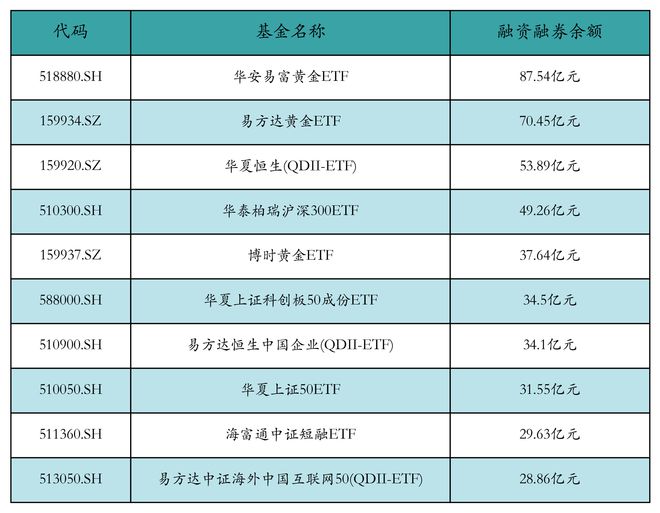
Market Overview - As of April 30, the total ETF margin balance in the two markets is 100.21 billion yuan, a decrease of 2.882 billion yuan from the previous trading day [1] - The financing balance is 95.431 billion yuan, down by 2.906 billion yuan, while the securities lending balance is 4.78 billion yuan, an increase of 24.315 million yuan [1] - In the Shanghai market, the ETF margin balance is 65.524 billion yuan, a decrease of 2.424 billion yuan, with a financing balance of 61.43 billion yuan, down by 2.452 billion yuan [1] - In the Shenzhen market, the ETF margin balance is 34.686 billion yuan, a decrease of 457 million yuan, with a financing balance of 34.001 billion yuan, down by 454 million yuan [1] ETF Margin Balance - The top three ETFs by margin balance as of April 30 are: - Huaan Yifu Gold ETF (8.754 billion yuan) - E Fund Gold ETF (7.045 billion yuan) - Huaxia Hang Seng (QDII-ETF) (5.389 billion yuan) [2] - The top ten ETFs by margin balance include: - Huatai-PB CSI 300 ETF (4.926 billion yuan) - Bosera Gold ETF (3.764 billion yuan) - Huaxia SSE STAR 50 ETF (3.45 billion yuan) [2] ETF Financing Buy Amount - The top three ETFs by financing buy amount on April 30 are: - Huaxia Hang Seng Technology (QDII-ETF) (812 million yuan) - Haifutong CSI Short Bond ETF (790 million yuan) - Huatai-PB Southern Dongying Hang Seng Technology Index (QDII-ETF) (750 million yuan) [3] - The top ten ETFs by financing buy amount include: - E Fund CSI Hong Kong Securities Investment Theme ETF (345 million yuan) - Huaxia SSE STAR 50 ETF (339 million yuan) [4] ETF Financing Net Buy Amount - The top three ETFs by financing net buy amount on April 30 are: - Huabao CSI Financial Technology Theme ETF (53.8629 million yuan) - Huaxia SSE 50 ETF (18.9622 million yuan) - Tianhong CSI Computer Theme ETF (13.9705 million yuan) [5] - The top ten ETFs by financing net buy amount include: - Bosera SSE STAR 50 Artificial Intelligence ETF (12.6421 million yuan) - GF CSI All-Index Electric Power Public Utilities ETF (11.6095 million yuan) [6] ETF Securities Lending Sell Amount - The top three ETFs by securities lending sell amount on April 30 are: - Southern CSI 500 ETF (50.0641 million yuan) - Southern CSI 1000 ETF (24.3376 million yuan) - Huatai-PB CSI 300 ETF (9.2738 million yuan) [7] - The top ten ETFs by securities lending sell amount include: - Huabao CSI Bank ETF (4.588 million yuan) - Southern CSI All-Index Real Estate ETF (4.083 million yuan) [8]

天弘上证科创综指增强开放申赎,后市科技怎么投?
Sou Hu Cai Jing· 2025-05-06 02:11
对于未来的行情,林心龙表示,短期看,A股市场已探明底部区域,下行空间显著收窄。类平准基金持续入场形成有效托 底,叠加关税战边际影响趋弱,市场最难阶段已过,风险偏好逐步修复。在政策暖意与资金轮动驱动下,前期超跌的成长 制造、消费服务等板块估值修复动能充足,指数料以震荡向上为主,逐步向前期中枢区域回升。 中期看,市场仍具有较强的上行动力。首先是货币政策宽松全球共振,当前全球主要央行尚处于降息周期,美联储2025年 内降息预期强化(预计两次合计50基点),中国有望同步实施降准降息,释放流动性。充裕的市场资金将直接利好权益资 产,提升风险资产估值中枢,为股市上行提供流动性支撑。其次宏观经济在政策托底下渐进复苏,后续财政政策有望持续 发力,4月政治局会议明确"适时推出增量储备政策",重点针对受关税冲击行业(如提高稳岗返还比例、加大出口退税)和弱 势群体(扩大服务消费补贴),直接拉动投资与内需。若中美关系边际改善,叠加地产政策优化,经济有望从"弱企稳"转 向"温和扩张",企业盈利修复将驱动市场中期走强。 4月30日,天弘上证科创板综合指数增强型证券投资基金发布申赎公告,该产品正式于5月6日开放申赎。此后,产品每个交 易日 ...

港股持仓占比创2015年以来新高
Changjiang Securities· 2025-05-05 23:31
- The weighted share of active equity funds decreased by 1.93% in Q1 2025 compared to Q4 2024, with a total scale increase to 3.47 trillion yuan due to net value growth[9][41] - The top 10 active equity funds by Q1 2025 returns received a total net subscription of approximately 233 billion yuan, with two popular funds accounting for about 77.60% of the net subscription[11][14][41] - The top 10 active equity funds by Q1 2025 net subscription received a total of approximately 402 billion yuan, with the same two popular funds ranking first and second, collectively accounting for about 44.93%[18][19][41] - The median return rate for active equity funds in Q1 2025 was 9.48%[19] - In Q1 2025, the top 10 holdings of active equity funds included humanoid robots (1.37%), innovative drugs (0.93%), and Beijing Stock Exchange stocks (0.22%)[32][33][41] - Hong Kong stock holdings in the top 10 holdings of active equity funds reached 14.63% in Q1 2025, including internet stocks (5.67%), innovative drugs (1.24%), and consumer stocks (0.91%)[35][36][40][41]
74家公募年度合赚377.74亿元!27家营收净利双增
Bei Jing Shang Bao· 2025-05-05 14:42
Core Insights - The 2024 annual reports of public fund companies reveal a mixed performance, with nearly half of the companies experiencing revenue growth, while 74 fund companies collectively earned a net profit of 37.774 billion yuan [1][3]. Group 1: Revenue Performance - A total of 64 fund companies reported a combined revenue of 114.148 billion yuan in 2024, with E Fund leading at 12.109 billion yuan, although it saw a slight decline of 3.13% year-on-year [2]. - Six other companies, including Huaxia Fund and Southern Fund, reported revenues exceeding 5 billion yuan, with figures of 8.031 billion yuan and 7.523 billion yuan respectively [2]. - Among the 63 companies with year-on-year data, 31 achieved revenue growth, accounting for 49.21%, with 13 companies seeing growth exceeding 20% [2]. Group 2: Net Profit Performance - The net profit of 74 fund companies totaled 37.774 billion yuan, with E Fund, Southern Fund, and Huaxia Fund leading the rankings with net profits of 3.9 billion yuan, 2.352 billion yuan, and 2.158 billion yuan respectively [3]. - Eleven companies entered the "10 billion club" for net profit, with notable growth from Tianhong Fund, which increased by 19.29% to 1.679 billion yuan [3]. - Two companies, China Ocean Fund and Hongta Hongtu Fund, turned losses into profits, while seven companies, including Nanhua Fund, reported losses [3]. Group 3: Company Strategies and Market Dynamics - The performance disparity among fund companies is attributed to factors such as product strategy iterations and market recognition of flagship products [6]. - Leading fund companies have leveraged brand reputation and comprehensive strength to better attract customers amid a fee reduction trend, while smaller firms face increased competition [7]. - Companies achieving revenue and profit growth have benefited from scale advantages, innovation capabilities, and enhanced service quality, allowing them to capture greater market share [7][8].
蚂蚁财富为何大力布局这个“小众”产品?
Hu Xiu· 2025-05-05 14:04
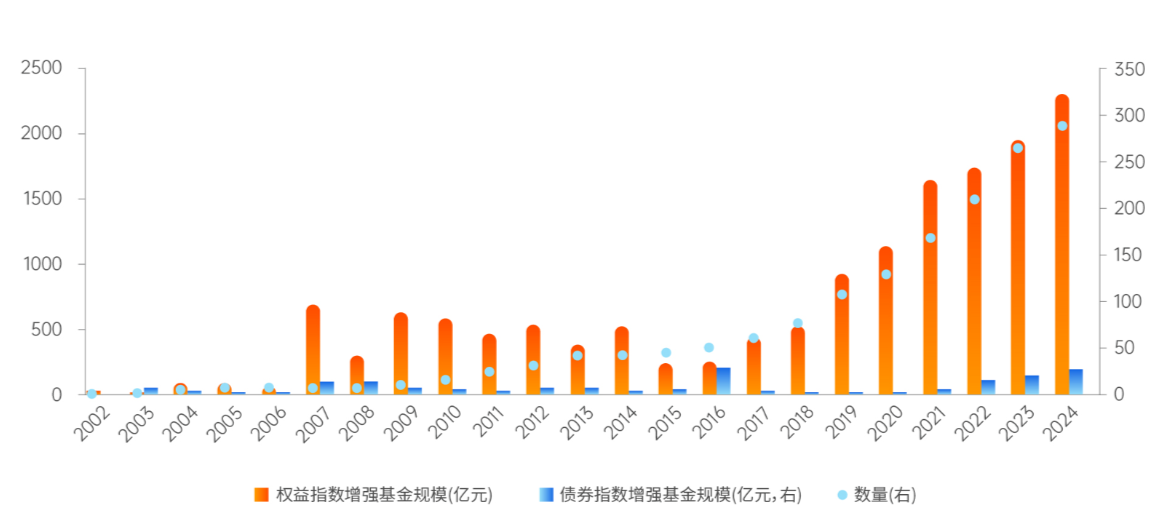
Group 1 - Public funds have been investing in GPUs for quantitative index enhancement products since several years ago [1][3] - The number of newly established and reported public index enhancement products has significantly increased this year [4][15] - Ant Group's wealth management platform has launched a comprehensive index investment service platform, enhancing product and service capabilities for index enhancement funds [5][12] Group 2 - Ant Group's wealth management platform leads the market in index fund distribution, with a total scale of 320.1 billion yuan, far surpassing competitors [6][9] - The index enhancement fund market has seen a substantial increase in attention from fund companies, with many small and medium-sized public funds focusing on this area [15][16] - The overall scale of index enhancement funds reached approximately 212.9 billion yuan by the end of 2024, showing a year-on-year growth of about 10% [18][27] Group 3 - The growth of index enhancement funds has been slower compared to ETFs, with the latter's scale increasing from 0.7 trillion yuan in 2019 to 3.78 trillion yuan in 2024 [17] - The average annual excess return of the index enhancement funds compared to the CSI 300 index is 4.3%, but only 40% of these funds have consistently outperformed the index over five years [19][28] - The complexity of strategies used by fund managers in index enhancement funds makes it challenging for investors to assess their performance [31][32]


降费这一年,65家基金公司业绩哪家强?全排名出炉
Xin Lang Cai Jing· 2025-05-05 10:34
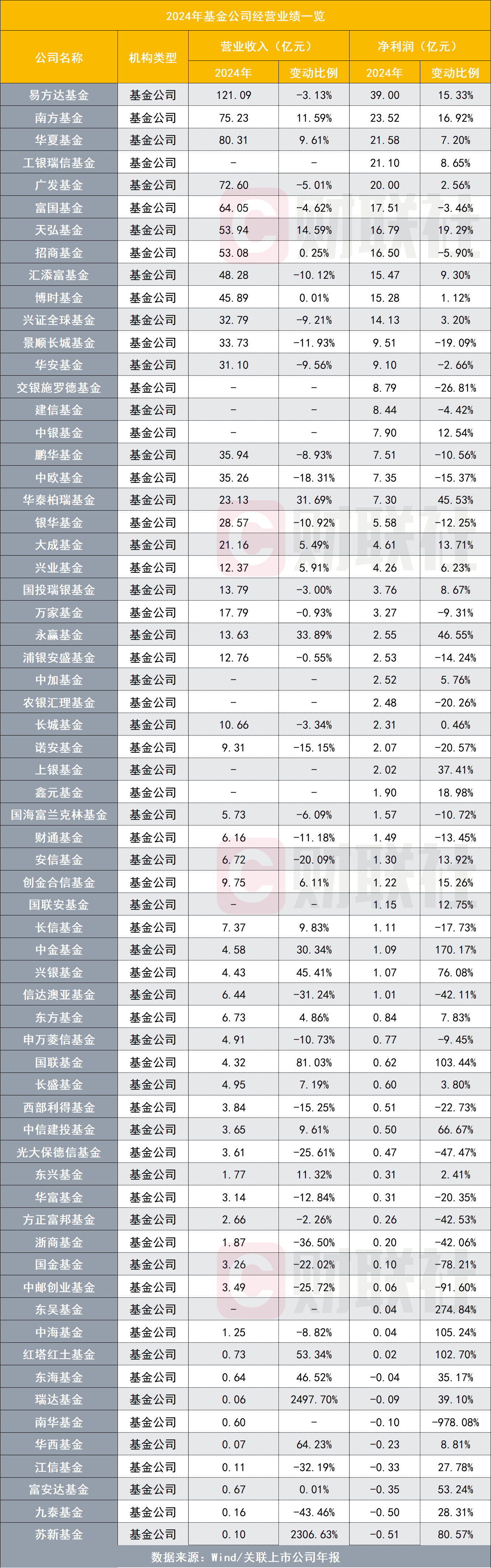
Core Insights - The overall net profit of 65 fund companies reached 34.115 billion yuan in 2024, an increase of 1.323 billion yuan compared to 2023 [1] - Only 39 out of the 65 fund companies reported a year-on-year increase in net profit, indicating that the majority of companies faced challenges [1] - Less than half of the companies reported a year-on-year increase in revenue, highlighting the impact of fee rate adjustments on the industry [1] Financial Performance Overview - The top 11 fund companies with net profits exceeding 1 billion yuan saw changes in their rankings, with more than half experiencing shifts [5][6] - Two companies, namely Invesco Great Wall Fund and Jiao Yin Schroder Fund, dropped out of the 1 billion yuan net profit tier compared to 2023 [13] - The net profit of Tianhong Fund increased by 19.29% to 1.679 billion yuan, marking the most significant rise among the top companies [8][11] Revenue and Profit Changes - The total management fee income for over half of the fund managers declined, with a total drop exceeding 10 billion yuan [5][14] - The fee rate reform has led to significant revenue impacts, with many companies seeking to enhance their competitive edge [5][19] - Companies like Dongwu Fund reported a remarkable net profit increase of 274.84%, while others like Nanhua Fund faced a staggering loss of 978.08% [15][18] Strategic Responses - Fund companies are focusing on refining their core competencies to adapt to the ongoing fee rate reforms and market changes [19][20] - Companies such as Huaxia Fund and Guotou Ruijin Fund are enhancing their product offerings and digital integration to maintain competitiveness [20][21] - The industry is witnessing a trend where smaller firms are showing significant profit growth, while larger firms are experiencing more pronounced absolute profit changes [18]
见证历史!突破1000亿元!最新解读
Zhong Guo Ji Jin Bao· 2025-05-01 13:39
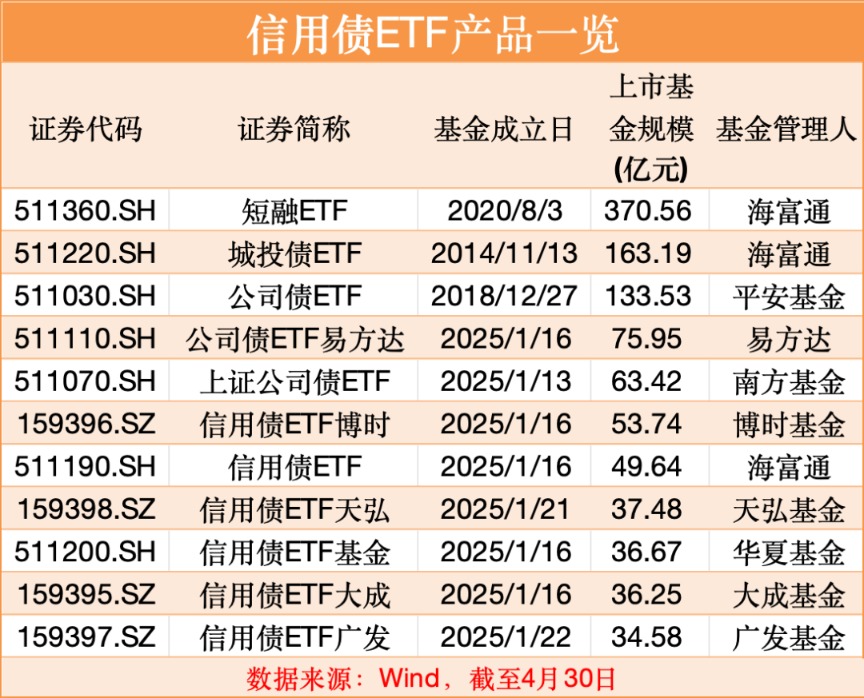
Core Insights - The credit bond ETF market has significantly expanded, with the total scale surpassing 105.4 billion yuan, marking a notable milestone in the industry [1][2] - The proportion of credit bond ETFs within the bond ETF market has increased from 31.08% at the end of last year to 42.71% currently, indicating a growing dominance [1] - The growth is attributed to favorable market conditions, policy support, and increasing investor demand for credit bond ETFs [5][6] Market Expansion - As of April 30, the total scale of credit bond ETFs reached 105.5 billion yuan, up from 54.1 billion yuan at the end of last year, representing a growth rate of over 95% [3] - The number of credit bond ETF products has increased from 3 to 11 since the end of last year, reflecting a robust expansion in product offerings [3][4] - Eight benchmark market-making corporate bond ETFs were launched in January, collectively raising 21.7 billion yuan, contributing to the rapid growth of the credit bond ETF market [3] Investor Demand - Various types of investors, including asset management accounts, pension funds, and insurance asset management, are showing strong interest in credit bond ETFs [7] - The demand for credit bond ETFs is expected to drive future growth, as they provide a convenient investment vehicle for both long-term allocation and short-term trading [7][8] Policy Support - Recent policy changes allow certain credit bond ETF products to engage in general pledge-style repurchase transactions, enhancing their attractiveness and liquidity [9] - The ability to use credit bond ETFs as collateral for financing is expected to further stimulate market participation and growth [10] Investment Opportunities - The current monetary policy environment suggests that mid-to-short-term credit bonds may offer better allocation value, making credit bond ETFs an appealing investment option [7][10] - The liquidity of credit bond ETFs is notably better than that of individual corporate bonds, which enhances their appeal to investors [10]