
荣耀

Search documents
荣耀副总裁李云鹏:AI手机不是无序叠加硬件,让用户付出额外成本
Tai Mei Ti A P P· 2025-08-11 06:37
Core Viewpoint - The consensus in the industry is that smartphones without AI will be eliminated in the future, with IDC predicting that AI smartphone shipments in China will reach 118 million units by 2025, a year-on-year increase of 59.8%, capturing 40.7% of the overall market [1] Group 1: Market Trends - Major smartphone manufacturers in China have begun to heavily invest in AI smartphones since early last year, indicating a competitive market environment [1] - Honor has launched a customized large-screen AI smartphone, the Honor Play 70 Plus, featuring a physical AI button and a Snapdragon 6s processor, priced at 1,299 yuan, with discounts available [1] Group 2: Consumer Insights - The collaboration between Honor and JD.com to produce the customized phone is based on extensive user feedback and data analysis, highlighting the need for AI to enhance user experience across different demographics, including the elderly [3] - The design of the AI smartphone aims to simplify user interactions, making tasks like cleaning the phone or ordering food more convenient [3] Group 3: Industry Challenges - The smartphone market is currently facing a lack of innovation, with even leading brands like Apple struggling to provide meaningful user experiences despite hardware advancements [4] - The challenge for manufacturers is to understand consumer needs without unnecessarily increasing costs through excessive hardware features [4] - The integration of AI technology requires collaboration across the entire industry, as it involves complex issues related to user privacy and data management [5] Group 4: Future of AI in Smartphones - The successful application of AI in smartphones depends on the ability to balance user behavior insights with privacy protection, utilizing local processing power rather than relying solely on cloud computing [5] - The development of AI technology is seen as a long-term process that requires a comprehensive approach involving hardware, software, and user engagement to fully realize its potential [5]



新股消息 | 丹诺医药、欣旺达(300207.SZ)拟港股IPO已获中国证监会接收材料
智通财经网· 2025-08-11 01:57
Group 1: Danuo Pharmaceutical - Danuo Pharmaceutical is a biotechnology company established in 2013, focusing on the discovery, development, and commercialization of innovative drug products to address unmet clinical needs in bacterial infections and related diseases [1] - The company has developed a differentiated pipeline consisting of seven innovative assets, including three core products: TNP-2198, the world's first and only new molecular entity candidate drug for treating Helicobacter pylori infection; TNP-2092 injection, a potential first-in-class candidate drug for treating implant-related bacterial infections; and TNP-2092 oral formulation, the world's first multi-target candidate drug for treating gut microbiota-related metabolic diseases [1] Group 2: Xinwanda - Xinwanda is a global lithium battery technology company dedicated to providing green and efficient integrated solutions for new energy [2] - The company is involved in the research, design, manufacturing, and sales of lithium batteries, covering a wide product matrix that includes consumer batteries, power batteries, and energy storage systems, offering comprehensive solutions from cell to module to system, as well as battery testing and recycling [2] - Xinwanda has established long-term stable partnerships with leading global technology companies, including major smartphone manufacturers such as Xiaomi, Lenovo, OPPO, vivo, Honor, and Transsion, with all top ten global smartphone manufacturers in 2024 being its customers [2]

AI应用商业化放量成规模 基金经理看好端侧创新驱动下一轮增长
Zheng Quan Shi Bao· 2025-08-10 17:41
Group 1 - The core viewpoint is that AI is entering a new phase of commercialization, driven by a virtuous cycle of computing power investment, cloud service consumption, and revenue generation [1][2] - The Chinese government has approved a plan to implement "Artificial Intelligence +" actions, aiming to accelerate the commercialization of AI applications across various sectors [1][2] - Fund managers believe that 2025 will be a pivotal year for AI application commercialization, with significant growth in annual recurring revenue (ARR) for companies like Cursor, Anthropic, and OpenAI [2][3] Group 2 - AI applications are increasingly focusing on both B-end (enterprise) and C-end (consumer) empowerment, with B-end applications optimizing costs and increasing revenue in marketing, office, and education sectors [4] - The introduction of AI Agents is seen as a key development in human-computer interaction, with OpenAI's GPT-5 series enhancing capabilities in programming and problem-solving [5][6] - The shift from traditional apps to AI Agents is expected to redefine content distribution and user interaction, making AI Agents the new core of the internet [7] Group 3 - Despite the rapid growth in AI applications, the hardware side, particularly in consumer products, is lagging behind, with expectations for significant advancements in the coming years [8][9] - The smart glasses market is projected to grow significantly, with sales expected to reach 1 million units by 2027, representing a market space of 100 billion yuan [9] - The development of AI applications is transitioning towards embedding AI into real-world scenarios, requiring skilled product managers and engineers to drive innovation [10]
中国机器人“真干活” 产业链条延伸“出海”在提速
Zheng Quan Ri Bao· 2025-08-10 16:47
Industry Trends - The 2025 World Robot Conference in Beijing showcases significant advancements in robotics, highlighting trends towards composite, AI-embodied, and scenario-based evolution of robots [1] - The Chinese robotics industry is entering a new phase of "going global," indicating a shift in market dynamics and international expansion [1] Evolution of Robots - Robots are evolving into "all-rounder" types, capable of performing complex tasks across various scenarios, breaking traditional classification boundaries [2] - Companies like Qingbao Robotics are focusing on humanoid robots that are being applied in multiple fields such as cultural tourism, security, and education [2] - XMAN-F1, a bipedal service robot, was launched by Qinglong Intelligent Technology, showcasing immersive interaction experiences in various application scenarios [2][3] Commercialization Strategies - Companies are adopting a "general + specialized" multi-robot collaboration model to accelerate commercialization, integrating large models and embodied technology [3] - The "Rena" expression robot by Zhuoyide Robotics utilizes advanced expression simulation technology, indicating a trend towards more lifelike robotic interactions [3] Market Potential and Investment - The Chinese robotics market is projected to reach $100 billion by 2028, attracting investments from tech giants across various sectors [5] - Honor plans to invest over $10 billion in building an AI terminal ecosystem, leveraging its expertise in consumer electronics for robotics development [5] - JD.com and several robotics brands announced an investment of over 10 billion yuan in the smart robotics sector, aiming to support 100 brands in achieving significant sales milestones [5] Global Expansion - Companies like Shenzhen Yujian Technology are collaborating with institutions to cover the entire industrial, commercial, and household application chain, gaining international market recognition [6] - Domestic humanoid robot manufacturers are planning to deploy key component production in ASEAN countries, extending their industrial chain overseas [6][7] - The focus on lightweight design and high endurance capabilities aligns with global outdoor operational demands, facilitating the transition from "single-point showcase" to "system empowerment" in the robotics industry [7]

逐鹿人工智能下半场,AI应用商业化起量!基金经理最新观点
券商中国· 2025-08-10 10:21
Core Viewpoint - The article emphasizes that AI is entering a virtuous cycle from computing power investment to cloud service consumption and then to commercialization revenue, with the scaling of AI applications being the key driver of this effect [1][2]. AI Application Commercialization - This year is seen as a pivotal year for the commercialization and scaling of AI applications, with significant growth in both domestic and international markets [3]. - Notable achievements include Cursor reaching $500 million in ARR, Anthropic's ARR soaring from $1 billion to nearly $4 billion, and OpenAI surpassing $10 billion in annualized revenue, reflecting an 80% increase from last year [3]. - In China, Kuaishou's AI product achieved over $10 million in ARR within 10 months, while ByteDance's model saw a 137-fold increase in daily token usage since its launch [3]. Market Sentiment and Trends - Fund managers note that AI functionalities are increasingly penetrating daily work and life, evidenced by explosive growth in token usage, indicating rapid user adoption [4]. - The focus has shifted from event-driven catalysts to actual progress in commercialization, with many AI companies in the U.S. revising their performance expectations upward due to AI-driven growth [4][5]. B2B and B2C Empowerment - AI applications are focusing on dual empowerment for B2B (business) and B2C (consumer) sectors, with B2B applications aiming to reduce costs and increase efficiency, while C2C applications are enhancing user experiences through hardware integration [5]. - By 2025, over 25% of global AI tools are expected to be applied in areas like code generation and customer service, driving enterprise spending towards AI [5]. Evolution of AI Agents - AI Agents are becoming a crucial entry point for human-computer interaction, with advancements in models like GPT-5 enhancing their capabilities [6][7]. - The concept of AI Agents has evolved from basic tools to sophisticated systems capable of complex tasks, with predictions that 2025 will mark the "year of the agent" [6][7]. Future Growth Engines - Despite slower progress in AI hardware applications, there is optimism about the potential of edge AI innovations, such as smart glasses and smart homes, to drive the next growth cycle [10][11]. - The smart glasses market is projected to grow significantly, with sales expected to reach 1 million units by 2027, representing a market opportunity of 100 billion yuan [11].

世运电路拟出资1.25亿元参与投资新声半导体
Ge Long Hui· 2025-08-10 08:46
Group 1 - The company plans to invest 125 million yuan in Shenzhen New Sound Semiconductor Co., Ltd., acquiring a 3.8238% stake in the target company [1] - Filters are core components in the electronic information industry, closely related to strategic emerging industries such as 5G/6G communication, smart vehicles, and satellite internet [2] - New Sound Semiconductor specializes in the research, production, and sales of SAW and BAW filters, holding over 170 authorized patents in China and the United States, with a complete independent intellectual property [2] Group 2 - The investment aligns with the company's strategic focus on high-tech barriers and growth segments within the electronic information industry, particularly in smart vehicles and AIOT [3] - The company aims to establish a deep cooperative relationship with the target company to promote the application of new vehicle-mounted filters and modular solutions in the industry [3]

Q2增速领跑!联想摩托罗拉手机稳居海外市场第四 亚太+北美市场成两大增长引擎
Ge Long Hui· 2025-08-10 06:57
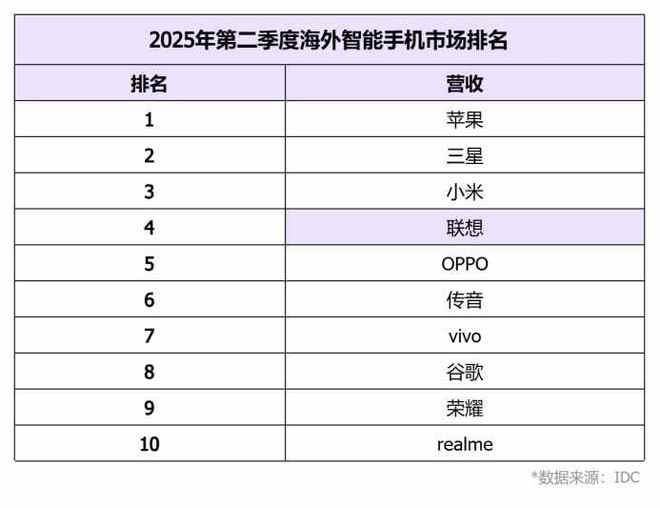
Core Insights - The global smartphone revenue outside of China reached $91.3 billion, marking a 9.2% year-on-year growth, significantly surpassing the previous growth forecast of 1.2% [1] - Lenovo's mobile business showed strong performance in overseas markets, achieving a remarkable 14.6% revenue growth and securing the fourth position globally with a market share of 5.4% [1][2] - Motorola's global revenue share increased to 3.0%, ranking eighth in the market [1] Group 1: Market Performance - Lenovo's revenue growth in the Asia-Pacific emerging markets was 66%, with India showing a robust growth rate of 44% [2] - In North America, Lenovo's revenue reached $1.07 billion, growing 18.2% year-on-year, with a market share of 5.3%, ranking third [3] - Lenovo Motorola's revenue in the global market outside of China grew by 52%, with a shipment increase of 32% [3] Group 2: Financial Highlights - In the fiscal year 2024-25, Motorola's revenue reached 62.6 billion yuan, a 27% increase, marking a historical high since Lenovo's acquisition [4] - The smartphone shipment volume increased by 75% compared to 2020 [4] - Lenovo Motorola's revenue share surpassed OPPO, Transsion, and Google, moving from fifth to fourth place in the global market [4] Group 3: Strategic Outlook - The global smartphone market is expected to continue its trend towards high-end products, with revenue growth anticipated to outpace volume growth in 2025 [4] - The rising interest in generative AI smartphones and foldable devices presents significant growth opportunities for Lenovo Motorola, leveraging its strong foundation in personal smart devices and foldable technology [4]

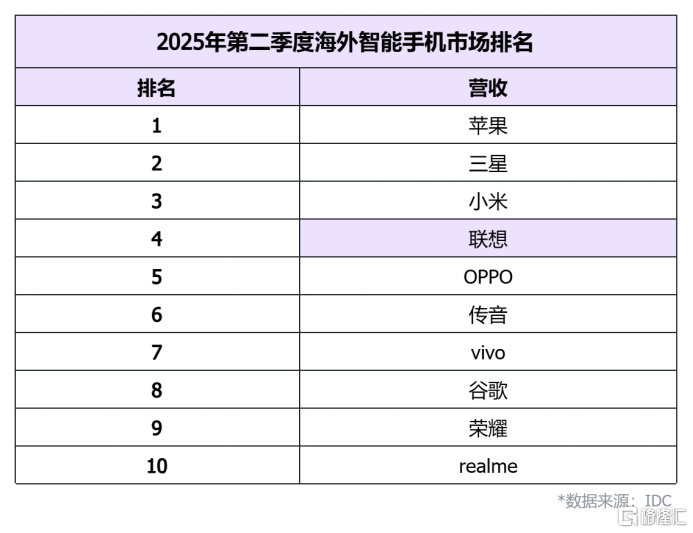
联想(00992)摩托罗拉手机Q2营收实现双位数增长 稳居海外市场第四
Zhi Tong Cai Jing· 2025-08-10 06:16
Core Insights - The international smartphone market, excluding China, generated total revenue of $91.3 billion, reflecting a year-on-year growth of 9.2%, significantly surpassing the previous growth forecast of 1.2% [1] - Lenovo Group's mobile business performed exceptionally well in overseas markets, achieving a robust revenue growth of 14.6% year-on-year, solidifying its position as the fourth largest player globally with a market share of 5.4% [1][2] - Lenovo's Motorola brand also saw its global revenue share increase to 3.0%, ranking eighth in the market [1] Revenue Growth and Market Position - Lenovo's revenue growth of 14.6% outpaced other top players in the overseas market, where Apple grew by 9.7%, Samsung by 11.3%, and Xiaomi by 3.7%, while OPPO experienced a decline of 1% [2] - The Asia-Pacific emerging markets and North America were identified as key growth drivers for Lenovo, with revenue in the Asia-Pacific region increasing by 66%, and the Indian market alone growing by 44% [2] - In North America, Lenovo's revenue reached $1.07 billion, marking an 18.2% year-on-year increase, with a market share of 5.3%, elevating its rank to third [3] Strategic Advantages - Lenovo's Motorola brand emerged as one of the fastest-growing major brands, benefiting from strong sales in India, steady expansion in the North American prepaid market, and enhanced competitiveness in the mid-range 5G product category [3] - Despite a downturn in the domestic smartphone market in China, Lenovo's Motorola experienced a significant revenue increase of 52% and a shipment growth of 32% [3] - In the fiscal year 2024-25, Motorola's revenue reached 62.6 billion yuan, a 27% increase, marking a historical high since Lenovo's acquisition, with smartphone shipments rising by 75% compared to 2020 [3][4] Future Outlook - Lenovo is expected to continue solidifying its fourth position in the global smartphone market, with double-digit revenue growth reflecting its strategic focus and execution in emerging markets [4] - The global smartphone market is anticipated to maintain a trend towards high-end products, with revenue growth expected to outpace volume growth in 2025 [4] - Lenovo's Motorola is well-positioned to capitalize on opportunities in the personal smart device sector and foldable smartphone market, driven by increasing interest in generative AI (GenAI) devices [4]
京东、荣耀联合定制首款大屏AI手机,售价1199元
Xin Lang Cai Jing· 2025-08-09 14:38
Core Insights - The launch of the Honor Play 70 Plus, a large-screen AI smartphone co-developed by JD.com and Honor, marks a significant step in the mobile industry towards AI integration [1] - The phone is priced at 1199 yuan and is the first product resulting from a C2M (Customer-to-Manufacturer) model, focusing on three main use cases: product control, smart travel, and home life [1] Company Strategy - Honor's Vice President, Li Yunpeng, emphasized that the mobile industry is entering the AI era, advocating for a balance between hardware and cost to provide optimal service [1] - JD.com's mobile division head, Xie Yi, stated that the focus will be on AI and large screens, with a strategic vision extending beyond smartphones to encompass all hardware categories [1] - Xie Yi also noted that without a supportive ecosystem for AI, the industry may struggle to achieve significant growth [1]
荣耀刘小军:供应链减排成未来关键战场
Zhong Guo Jing Ying Bao· 2025-08-09 12:01
Core Insights - The article emphasizes the importance of green environmental practices and industry responsibility in the consumer electronics sector, highlighting that collaboration across the entire supply chain is essential for achieving significant results in sustainability efforts [1][3]. Group 1: ESG Strategy and Goals - Honor has set ambitious goals to achieve carbon neutrality in its own operations by 2040 and across its entire value chain by 2050, marking green environmental practices as a top priority in its ESG strategy [3][4]. - The 2024 ESG report identifies green environmental initiatives as the primary focus, with a structured approach to achieving carbon neutrality [3][4]. Group 2: Carbon Emission Data - Honor's carbon emissions are predominantly from Scope 3, which accounts for 98.76% of total emissions, indicating that upstream and downstream activities are critical areas for reducing carbon footprints [2][4]. - The company has identified that 80% of its carbon emissions stem from the manufacturing process, with electricity usage contributing 66% of that segment [6]. Group 3: Supply Chain Management and Challenges - Data collection is highlighted as a significant challenge in reducing emissions within the supply chain, with Honor having completed an initial assessment of carbon emissions data for 80% of its suppliers [6][7]. - Honor employs a tiered supplier management strategy to enhance data transparency and support suppliers in identifying and reducing their carbon emissions [7]. Group 4: Collaboration and Support for Suppliers - The company is focused on empowering suppliers to build sustainable reduction capabilities, providing training and support to help them manage their carbon emissions effectively [7]. - Honor is exploring collective purchasing of green electricity to alleviate cost pressures on smaller suppliers who may struggle with the financial implications of transitioning to cleaner energy sources [7].