
牧原股份

Search documents
长江消费周周谈
2026-01-05 15:42
Summary of Key Points from Conference Call Records Industry or Company Involved - **Pork Industry**: Focus on companies like Muyuan, Dekang, Wens, Shennong, and Juxing Agriculture - **Beauty and Personal Care Industry**: Highlighting brands such as Mao Ge Ping and Shangmei - **Gold and Jewelry Industry**: Recommendations for Changhongqi and Caibai - **Retail Industry**: Emphasis on Xiaoshangpin City and Bubu Gao - **Education and Training Sector**: Focus on K12 education leaders and AI applications - **Restaurant and Beverage Sector**: Recommendations for Mixue and Guming - **Automotive Industry**: Focus on Huawei's smart vehicles and Changan Automobile - **Textile Manufacturing Sector**: Recommendations for companies in the ASEAN region and Nike's supply chain - **Innovative Pharmaceutical Industry**: Focus on companies with high R&D investment Core Points and Arguments - **Pork Industry**: The significant impact of pork prices on CPI, with a noted 8.5% decrease in pork prices leading to a 0.12 percentage point drop in CPI in June 2025. The strategy of capacity control to boost pork prices is crucial to mitigate CPI pressure [2][3][4] - **Beauty and Personal Care**: The industry is in a traditional off-season, but high-end brands like Mao Ge Ping and operationally strong brands like Shangmei are recommended due to low base effects from last year [6] - **Gold and Jewelry**: Despite a 20% drop in gold jewelry consumption in Q2, brands with strong same-store performance like Changhongqi and low-valuation, high-dividend companies like Caibai are recommended [6] - **Retail Sector**: Xiaoshangpin City is highlighted for its strong business certainty, while Bubu Gao is noted for potential investment opportunities post-unlock of shares [7] - **Education Sector**: K12 education leaders and AI applications are emphasized, with companies like Dou Shen and Fen Bi showing strong growth [8] - **Restaurant Sector**: The rise of takeaway services is noted, with companies like Guming and Mixue recommended for their growth potential [8][9] - **Automotive Sector**: Huawei's smart vehicles are performing well, with new models like M7 and M8 expected to launch soon, while Changan's S9 model shows stable delivery [10][11][12] - **Textile Manufacturing**: The sector is expected to see performance and stock price turning points, with a focus on companies benefiting from reduced tariffs in the ASEAN region [13][14][15] - **Innovative Pharmaceutical Industry**: A new cycle of R&D investment is anticipated, with a focus on companies sensitive to domestic demand recovery and those specializing in large molecules and oncology [26][27] Other Important but Possibly Overlooked Content - **Pork Industry**: The adjustment in the pork breeding sector is linked to broader economic conditions and CPI management strategies [3][4][5] - **Retail Sector**: The potential for supermarkets and department stores to experience operational turning points is noted [7] - **Automotive Sector**: The upcoming launch of multiple new models indicates a strategic push for market share [10][11][12] - **Textile Manufacturing**: The impact of tariff changes on the competitive landscape and the potential for recovery in the sector is highlighted [14][15] - **Innovative Pharmaceutical Industry**: The increasing trend of funding sources and the focus on early-stage research are critical for future growth [26][27]
中美关税博弈升级,4月冲击再现?A股该如何应对?
2025-10-13 14:56
Summary of Conference Call Records Industry or Company Involved - The records primarily discuss the impact of the escalating US-China trade tensions on various industries, particularly focusing on the electronics, agriculture, and pet healthcare sectors. Core Points and Arguments US-China Trade Tensions - The recent escalation in US-China trade tensions is viewed as a milder version compared to April, with the impact primarily confined to bilateral relations rather than a global scale [1][2][3] - Both parties have a clearer understanding of each other's bottom lines, making extreme measures less likely, leading to more phase-based conflicts [2][3] Market Reactions and Strategies - Short-term market sentiment is leaning towards risk aversion, with gold, US Treasury bonds, and defensive consumer stocks being highlighted as areas of interest [1][4] - In the domestic market, sectors such as rare earths, military industry, and self-sufficient fields are recommended for attention [1][4] Economic Outlook - The most pessimistic period for US economic growth has passed, with a shift towards a relatively stable state in the global capital competition between China and the US [5] - China's economy has stabilized since the fourth quarter of last year, attracting more global funds and experiencing currency appreciation [5] Electronics Industry Insights - New tariffs are seen as a psychological boost for the domestic electronics industry, with real benefits arising from increased demand in manufacturing, IC design, and downstream internet companies [1][8] - The A4 chip market is expected to grow four to five times from 2025 to 2026, with China holding a significant advantage in the PCB supply chain [12] Agriculture and Pet Food Sector - The pig farming sector is facing challenges due to oversupply and declining prices, with predictions of prices dropping to around 5 RMB per kilogram before the Spring Festival [14][15] - The pet food industry is experiencing disruptions due to tariffs, but companies are adapting by utilizing Southeast Asia and New Zealand for production to mitigate impacts [14] Pet Healthcare Market - The Chinese pet healthcare market is valued at approximately 30 billion RMB, with local brands like Ruip and Pulaike gaining market share through B2B and consumer education efforts [16][20] - The market is transitioning from initial development to rapid growth, with expectations of significant increases in revenue for local brands [17][20] Other Important but Possibly Overlooked Content - The overall risk appetite in the market remains low, with no significant changes observed in the past few months [5] - The impact of the US economic outlook on military competition with China could lead to a more aggressive stance from the US, affecting market dynamics [6] - The importance of distinguishing between opportunities driven by underlying demand versus those created by tariff-related fluctuations is emphasized [12][13] Investment Recommendations - Investors are advised to focus on sectors benefiting from tariff countermeasures, such as rare earths and military, as well as self-sufficient areas like semiconductors [4][21] - Specific companies to watch include Ruip and Pulaike in the pet healthcare sector, and pig farming companies like Muyuan, Dekang, and Bangji for their cost control and growth potential [20]
猪价跌至年内低位,生猪产能去化成关键
2 1 Shi Ji Jing Ji Bao Dao· 2025-10-13 13:16
Core Viewpoint - The holiday consumption effect on pig prices is weakening, with prices continuing to decline despite the recent National Day and Mid-Autumn Festival [1][3] Price Trends - The average price of live pigs in China was 12.90 yuan/kg in the first week of October, down 2.8% from the previous week and 29.5% year-on-year [1][3] - Prices have dropped over 22% compared to the beginning of the year, reaching a low point for the year [1] - As of October 13, the average price for external three yuan pigs was 10.81 yuan/kg, indicating a slight daily decrease [1][3] Supply and Demand Dynamics - The supply of pigs remains abundant due to previous production capacity releases and ongoing policies to control weight and reduce production [2][4] - Analysts expect a potential increase in demand as the weather cools and seasonal activities begin, which may provide some support for prices [2][4] - The market may see a dual increase in supply and demand in December, but supply growth may outpace demand, leading to further price declines [2] Industry Challenges - The continuous decline in pig prices is impacting breeding profits, with many producers facing losses [6] - As of October 10, self-breeding and pig fattening operations reported average losses of 206.91 yuan and 409.19 yuan per head, respectively [6] - Smaller producers are under significant pressure due to higher costs, while larger enterprises are better positioned to manage risks [6][7] Production Capacity Adjustments - The Ministry of Agriculture has emphasized the need for strict production capacity controls, aiming to reduce the breeding sow population by approximately 1 million [6][7] - Some companies, like Muyuan Foods, have begun to reduce their breeding sow numbers and manage slaughter weights to stabilize the industry [7] - The speed of production capacity reduction will be crucial for future price trends, with expectations of continued supply pressure if adjustments are slow [6][7]

养殖业板块10月13日跌0.35%,圣农发展领跌,主力资金净流入1.82亿元
Zheng Xing Xing Ye Ri Bao· 2025-10-13 12:38
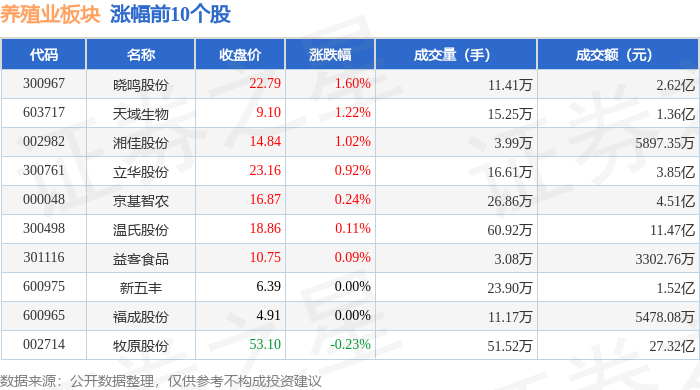
证券之星消息,10月13日养殖业板块较上一交易日下跌0.35%,圣农发展领跌。当日上证指数报收于 3889.5,下跌0.19%。深证成指报收于13231.47,下跌0.93%。养殖业板块个股涨跌见下表: | 代码 | 名称 | 收盘价 | 涨跌幅 | 成交量(手) | 成交额(元) | | --- | --- | --- | --- | --- | --- | | 300967 | 晓鸣股份 | 22.79 | 1.60% | 11.41万 | 2.62亿 | | 603717 | 天域生物 | 9.10 | 1.22% | 15.25万 | 1.36亿 | | 002982 | 湘佳股份 | 14.84 | 1.02% | 3.99万 | 5897.35万 | | 300761 | 立华股份 | 23.16 | 0.92% | - 16.61万 | 3.85亿 | | 000048 | 京基智农 | 16.87 | 0.24% | 26.86万 | 4.51亿 | | 300498 | 温氏股份 | 18.86 | 0.11% | 60.92万 | 11.47亿 | | 301116 | 益客食品 | 10 ...


东兴证券晨报-20251013
Dongxing Securities· 2025-10-13 12:16
Core Insights - The report highlights a steady growth in China's foreign trade, with a total import and export value of 33.61 trillion yuan in the first three quarters of 2025, marking a year-on-year increase of 4% [2] - The storage industry is experiencing significant price increases, particularly for DDR4 products, due to supply shortages as major manufacturers cease production [2] - The automotive market is expected to maintain stable growth in Q4 2025, driven by new energy vehicle tax incentives and seasonal demand [2] - China's express delivery volume has surpassed 150 billion packages, indicating robust logistics activity [2] - The Haier Group and Alibaba have signed a strategic cooperation agreement focusing on AI and cloud technologies [3] - Foxconn plans to invest 1.7 billion USD in Tamil Nadu, India, creating 14,000 jobs [3] Industry Summaries Coal Industry - The coal industry is witnessing an increase in coking coal prices, with the comprehensive coking coal price index reaching 1424.51 yuan/ton, a month-on-month increase of 4.64% [5] - Coking coal inventory at three major ports has risen, while steel mills' coking coal inventory has decreased, indicating a shift in supply dynamics [5][6] - The average utilization rate of independent coking enterprises has increased to 75.43%, reflecting improved production efficiency [6] - In August, coking coal production rose to 42.597 million tons, while pig iron and crude steel production saw declines [7] - Domestic thermal coal prices have increased, while international prices from Australia, South Africa, and Europe have decreased [10] Semiconductor and AI Industry - Companies like 崇达技术 are advancing in AI computing capabilities and expanding their global supply capacity [4] - 兆易创新 has established a joint laboratory focusing on digital energy solutions for emerging markets [4] Retail and Consumer Goods - 永辉超市 plans to launch 60 private label products this year, aiming for 500 by 2029, with a goal of achieving 100 "billion-level" products in three years [4]





猪肉旺季不旺陷入困境 期现价格齐跌养殖端亏损
Di Yi Cai Jing· 2025-10-13 11:29
Group 1 - The core issue in the pork market is the imbalance between supply and demand, leading to a significant drop in both futures and spot prices, with futures prices hitting a historical low of 11,125 yuan/ton, down 21% year-to-date and over 40% from last year's peak [2][3] - As of October 13, the national pork spot price has fallen to 10.92 yuan/kg, a decrease of 1.26 yuan/kg from before the National Day holiday, reflecting a year-on-year drop of 39.43% [3][4] - The high inventory of breeding sows, which stood at 40.62 million heads as of the end of September, continues to exert downward pressure on prices, with no immediate signs of improvement in supply conditions [3][4] Group 2 - The pork industry is currently in a phase of capacity reduction, but the progress is slower than expected, as indicated by the 28.6% cumulative price drop since July [4][5] - Major pork companies are facing operational challenges, with sales prices and revenues declining significantly in September, prompting some to increase slaughter volumes to compensate for lower prices [5][6] - Companies like Wen's Foodstuffs and New Hope reported increases in slaughter volumes in September, with Wen's selling 3.33 million pigs, a year-on-year increase of 32.46%, despite achieving the lowest sales prices of the year [5][6] Group 3 - Muyuan Foods has adjusted its breeding sow inventory to 3.305 million heads and is not considering adding new sows in the short term, while also reducing the average weight of slaughtered pigs [6][7] - Smaller companies like Zhengbang Technology have seen significant increases in slaughter volumes, with a year-on-year growth of 107.64% in September, but overall revenue for listed companies remains under pressure due to lower prices [7][10] - The outlook for pork prices remains pessimistic, with expectations of continued supply pressure and weak terminal demand, making it difficult to reverse the current supply-demand imbalance [7][10]
猪肉“旺季不旺”陷入困境 期现价格齐跌养殖端全面亏损
Di Yi Cai Jing· 2025-10-13 11:25
Core Viewpoint - The domestic pork market is experiencing a "peak season not booming" situation, with both futures and spot prices falling unexpectedly, indicating a significant supply-demand imbalance in the industry [2][3][4]. Supply and Demand Dynamics - As of October 13, the spot price of pork has dropped to 10.92 yuan/kg, down 1.26 yuan/kg from before the National Day holiday, reflecting a year-on-year decline of 39.43% [3][4]. - The number of breeding sows remains high, with a total of 40.62 million as of the end of September, which is 104.2% of the normal holding capacity, contributing to the oversupply of pigs [3][4]. - The industry is in a phase of "capacity reduction," but the progress is slower than expected, leading to continued price declines [4][5]. Company Performance - Major listed pig companies are facing operational challenges, with sales prices and revenues declining significantly in September. For instance, Wens Foodstuff Group sold 3.33 million pigs in September, a year-on-year increase of 32.46%, but at a lower average price of 13.18 yuan/kg, reflecting a 30.81% drop [5][6]. - Muyuan Foods reported a sales revenue of 9.066 billion yuan in September, down 22.46% year-on-year, with a notable decrease in the number of pigs sold [6][7]. - Smaller companies like Zhengbang Technology have seen significant increases in output, with a year-on-year growth of 107.64% in September, but overall revenue remains under pressure due to falling prices [7][8]. Future Outlook - The outlook for pork prices remains pessimistic, with expectations of continued downward pressure due to persistent supply and weak demand [7][8]. - The industry is closely monitoring the effectiveness of capacity reduction policies, which aim to lower the number of breeding sows to around 39.5 million to potentially stabilize prices [5][6].


猪肉“旺季不旺”陷入困境,期现价格齐跌养殖端全面亏损
Di Yi Cai Jing· 2025-10-13 11:08
Core Insights - The domestic pork market is experiencing a "旺季不旺" (peak season not prosperous) situation, with both futures and spot prices unexpectedly declining [1][2] - As of October 13, the main contract for live pig futures closed at 11,125 yuan/ton, marking a 21% decline year-to-date and over 40% drop from last year's peak [1][2] - The current supply-demand imbalance, characterized by high breeding sow inventory and weak consumer demand, is expected to keep pork prices low in the short term [1][2] Supply and Demand Dynamics - The national pork (外三元) spot price was reported at 10.92 yuan/kg as of October 13, down 1.26 yuan/kg from before the National Day holiday, reflecting a year-on-year decline of 39.43% [2] - The breeding sow inventory remains high at 40.62 million heads as of the end of September, which is 104.2% of the normal holding capacity, indicating continued pressure on supply [2][3] - The industry is undergoing a "反内卷" (anti-involution) phase, with government policies aimed at reducing breeding sow numbers and controlling production capacity [2][3] Industry Performance - The pig farming industry has entered a phase of capacity reduction since July, but prices have continued to decline, with a cumulative drop of 28.6% since early July [3] - The demand side is weak, with the consumption peak during the Mid-Autumn Festival and National Day already passed, leading to expectations of a short-term consumption lull [3] - Listed pig companies are facing operational challenges, with many increasing slaughter rates in September to compensate for lower prices [3][4] Company-Specific Developments - Major companies like Wen's Foodstuffs (温氏股份) and New Hope (新希望) reported increased slaughter volumes in September, with Wen's selling 3.33 million pigs, a 32.46% year-on-year increase [4] - Despite lower sales prices, these companies managed to achieve revenue through volume growth, with Wen's average selling price at 13.18 yuan/kg, down 30.81% year-on-year [4] - Muyuan Foods (牧原股份) reported a 22.46% decrease in revenue in September, but is adjusting its breeding strategy to enhance future growth, including increasing its piglet sales target for 2025 [5] Market Outlook - Smaller companies like Zhengbang Technology (正邦科技) saw significant increases in slaughter volumes, but overall revenue for listed pig companies is declining due to lower average prices [6] - The ongoing decline in pork prices is expected to cast a shadow over the fourth-quarter performance of pig companies, with market forecasts remaining pessimistic due to persistent supply pressures and lack of demand recovery [6]
牧原股份入围《经济观察报》2024—2025年度受尊敬企业
Jing Ji Guan Cha Wang· 2025-10-13 09:53
Group 1 - The core viewpoint of the article highlights that Muyuan Foods (002714) has been recognized as a respected enterprise for the 2024-2025 period by Economic Observer, showcasing its excellent performance in quality operations, innovation breakthroughs, and social contributions [1] - According to the comprehensive value assessment system for listed companies in China, the company has achieved positive growth in R&D expenses for three consecutive years [1]
每日期货全景复盘10.13:贵金属午后涨幅双双扩大,沪银再创新高!
Jin Shi Shu Ju· 2025-10-13 09:09
Group 1: Market Overview - The main contracts show a bearish sentiment with 21 contracts rising and 59 contracts falling today [2] - Significant inflow of funds into contracts like Shanghai Silver 2512 (2.585 billion), CSI 1000 2512 (2.334 billion), and Shanghai Gold 2512 (2.119 billion) [5] - Major outflows observed in contracts such as Shanghai Copper 2511 (-1.387 billion), Shanghai Aluminum 2511 (-507 million), and SSE 50 2512 (-437 million) [5] Group 2: Price Movements - Leading gainers include rapeseed 2511 (+3.09%), Shanghai Silver 2512 (+2.84%), and methanol 2601 (+2.05%) driven by supply-demand factors [5] - Major losers include glass 2601 (-3.68%), low-sulfur fuel oil 2512 (-3.00%), and butadiene rubber 2511 (-2.89%) likely due to increased bearish pressure or negative fundamentals [7] Group 3: Position Changes - Notable increases in open interest for cotton yarn 2601 (+37.52%), stainless steel 2512 (+24.66%), and rapeseed 2511 (+24.14%), indicating new capital inflow and high trading activity [8] - Significant decreases in open interest for Shanghai Aluminum 2511 (-12.04%), soybeans 2511 (-12.15%), and silicon iron 2511 (-18.17%), suggesting capital withdrawal and warranting attention for future performance [8] Group 4: Key Events and Insights - Malaysian palm oil production increased by 6.59% month-on-month, with expectations of continued downward pressure on oil prices due to falling crude oil prices [10] - Indonesia's refined tin exports decreased by 3.94% year-on-year but increased nearly 50% month-on-month, reaching a recent high [12] - As of October 9, cotton inventory at major ports increased by 12.09% week-on-week, totaling 310,700 tons, with regional variations noted [13] Group 5: Company-Specific Actions - Muyuan Foods announced a reduction in the breeding sow inventory to 3.305 million heads by the end of September, in response to market supply-demand dynamics [14]
