腾讯

Search documents
“9·24”行情一周年:118个“万亿日”激活市场 守护信心需多方共同发力
Mei Ri Jing Ji Xin Wen· 2025-09-23 13:28
Market Overview - The "9·24" market rally has lasted a year, leading to significant wealth effects and attracting new investors, with a surge in account openings [1] - A-shares have seen active trading, with daily turnover exceeding 2 trillion yuan for 29 consecutive trading days and over 1 trillion yuan for 118 consecutive days, while financing balances reached historical highs [1] - The interaction between mainland and Hong Kong markets has intensified, with substantial inflows into Hong Kong stocks, particularly in major tech companies like Alibaba, Tencent, and Xiaomi, enhancing the valuation recovery and creating opportunities for global capital to invest in Chinese assets [1] Structural Changes - The market has undergone a comprehensive structural reconstruction, with high-yield stocks like banks being revalued, rewarding long-term investors, while semiconductor stocks have reshaped the A-share landscape, surpassing traditional sectors like finance and real estate in total market capitalization [1] - Long-term capital from foreign and insurance funds continues to flow into A-shares, with a diverse range of investment products emerging, providing investors with more choices and introducing stable long-term capital into the market [1] Market Confidence - The positive changes in the capital market reflect a comprehensive boost in market confidence, driven by individual investors actively trading, institutions making long-term investments, and companies expanding their operations [2] - Four key conditions support the establishment of market confidence: 1. Institutional foundation with stable rules, including the new "National Nine Articles" and over 60 supporting regulations, providing a solid regulatory framework for market stability [3] 2. Policy synergy that optimizes the confidence environment through coordinated macroeconomic policies, low-cost financing support for companies, and measures to address local debt and corporate arrears [3] 3. Market dynamism activated by innovative mechanisms that enhance the market's ability to reward quality enterprises, with recent reforms in the Sci-Tech Innovation Board and M&A policies facilitating corporate integration [4] 4. Fairness maintained through strict regulation, with significant penalties for financial fraud, enhancing investor protection and deterring misconduct [5] Long-term Outlook - Sustaining market confidence requires ongoing efforts, as capital markets will experience fluctuations, but maintaining and optimizing favorable long-term factors will ensure continued market confidence and healthy operations [6]
互联网行业:语音AI驱动智能自主AI演进
招商香港· 2025-09-23 12:03
Investment Rating - The report maintains a "Buy" rating for the voice AI industry, highlighting strong growth potential driven by technological advancements and market demand [4]. Core Insights - Voice AI input speed is nearly three times faster than typing, facilitating hands-free, real-time interactions across various sectors such as automotive, food service, and hospitality, thereby driving business growth [1][2]. - The market is currently dominated by large tech companies in the US and China, while specialized smaller firms focus on niche areas, providing customized and value-added services [1][2]. - The voice e-commerce market is projected to grow at a compound annual growth rate (CAGR) of 25-29%, reaching a market size of $186 billion by 2030, fueled by smartphone adoption and continuous AI advancements [1][18]. Summary by Sections Industry Overview - Voice AI is rapidly penetrating sectors like automotive and fast food, with the automotive industry seeing increased adoption due to the complexity of in-vehicle infotainment systems and safety requirements [2][34]. - The fast food sector is experiencing a CAGR of 29%, with the North American market expected to reach $12 billion by 2034 [2][41]. - In China, iFlyTek leads the voice AI market with a 44.2% share, leveraging its strong voice technology capabilities [2][32]. Company Performance - SoundHound AI reported Q2 2025 revenue of $43 million, a 217% increase, with its Polaris platform processing over 1 billion queries monthly [3]. - Cerence's Q2 2025 revenue was $251 million, a 15% increase, holding a 52% market share in automotive voice AI [3]. - iFlyTek's revenue for the first half of 2025 was 10.91 billion RMB, a 17% increase, maintaining a leading position in the Chinese automotive voice AI market [3]. Market Dynamics - The voice AI market is characterized by a shift towards subscription and usage-based pricing models, optimizing commercialization strategies for companies like SoundHound and Cerence [50]. - Major tech companies are investing heavily in voice AI technologies, with Apple, Amazon, Google, and Microsoft enhancing their respective platforms to improve user experience and integration [45][46][49]. - The competitive landscape includes both large tech firms and specialized service providers, with the latter focusing on tailored solutions in specific industries [48][49]. Future Outlook - The voice e-commerce market is expected to grow from approximately $41 billion in 2024 to over $186 billion by 2030, driven by advancements in AI and natural language processing [18][19]. - The report anticipates continued strong growth in voice AI applications across various sectors, including healthcare, education, and logistics, enhancing operational efficiency and customer engagement [27][42].





计算机行业动态报告:互联网大厂云出海元年开启
Minsheng Securities· 2025-09-23 11:45
Investment Rating - The report maintains a positive investment outlook for the cloud computing sector, particularly focusing on major internet companies' international expansion strategies [7]. Core Insights - The year 2025 marks the beginning of a new phase for major internet companies as they embark on cloud internationalization, supported by significant debt financing initiatives [1][10]. - Major players like Alibaba Cloud, Tencent Cloud, and ByteDance's Volcano Engine are actively enhancing their global cloud infrastructure to support Chinese enterprises' overseas expansion [17][23][50]. - The dual drivers of domestic AI internationalization and local AI demand abroad are propelling the cloud expansion efforts of these internet giants [2][3]. Summary by Sections 1. Internet Giants' Internationalization - Major internet companies are launching new rounds of debt financing aimed at cloud internationalization, with Alibaba planning to invest over 380 billion RMB in cloud and AI infrastructure over the next three years [1][11]. - Tencent Cloud has embraced internationalization, achieving high double-digit growth in international business over the past three years, with a doubling of overseas customer numbers [12][13]. 2. Domestic AI Internationalization and Local AI Demand - The demand for AI applications from both domestic companies and local markets abroad is driving the cloud internationalization process [2][3]. - Tencent, Alibaba, and ByteDance are leveraging their AI capabilities to support various sectors, including e-commerce and gaming, in their international endeavors [2][35][50]. 3. Investment Recommendations - The report suggests focusing on key players in the cloud platform sector, including Alibaba, Tencent, and Baidu, as well as companies involved in computing power leasing and optical communication [3][7]. - Specific companies recommended for investment include Hongjing Technology, Xiechuang Data, and various optical communication firms [3].


智能体(Agent)爆发!数贸会成AI应用动态全景图
雷峰网· 2025-09-23 11:19
Core Viewpoint - The Fourth Global Digital Trade Expo highlights the transformative impact of AI on various industries, showcasing its evolution from a mere optimization tool to a core engine for restructuring industrial logic and enhancing operational efficiency [2][7][35]. Group 1: Event Overview - The expo will take place from September 25 to 29 in Hangzhou, covering a total area of 155,000 square meters with a focus on digital trade and AI integration [2]. - The event features a "Smart Future" theme area, emphasizing the comprehensive ecosystem of AI from foundational computing power to commercial applications [2][3]. Group 2: AI Industry Developments - AI is transitioning from laboratory research to large-scale commercial applications, with significant contributions from leading companies like Alibaba and Ant Group [3][10]. - The expo showcases a variety of AI applications, including autonomous robots and AI-driven security systems, indicating a shift towards practical, real-world implementations [6][15]. Group 3: Vertical Industry Empowerment - AI solutions are being integrated into various sectors, including agriculture, finance, and logistics, demonstrating significant advancements and benchmark cases [21][22][24]. - Innovations such as smart agricultural containers and digital finance solutions are highlighted, showcasing China's influence in global digital agriculture and financial technology [21][22]. Group 4: AIGC and Cultural Production - AIGC is evolving from a mere efficiency tool to a new productive force in cultural export and cross-border trade, transforming content creation and distribution [37][46]. - The expo features applications of AIGC in areas like online literature, short dramas, and gaming, indicating a shift towards intelligent and automated content production [38][40]. Group 5: AI Infrastructure and Global Competition - The expo emphasizes China's advancements in AI infrastructure, including computing power and chip technology, which are crucial for supporting robust AI applications [53][54]. - International collaboration is highlighted, with significant procurement interest from 23 countries, showcasing China's role in the global AI landscape [54][55]. Group 6: Conclusion - The expo illustrates that AI has moved beyond conceptual stages to become a key production factor, driving substantial industrial transformation across various sectors [57][59]. - The event serves as a platform for showcasing China's comprehensive capabilities in AI technology and its applications, reinforcing its position as a leader in the global digital economy [58][59].


拆解VIE架构:阿里、腾讯海外上市的“秘密武器”,如今还香吗?
Sou Hu Cai Jing· 2025-09-23 10:16
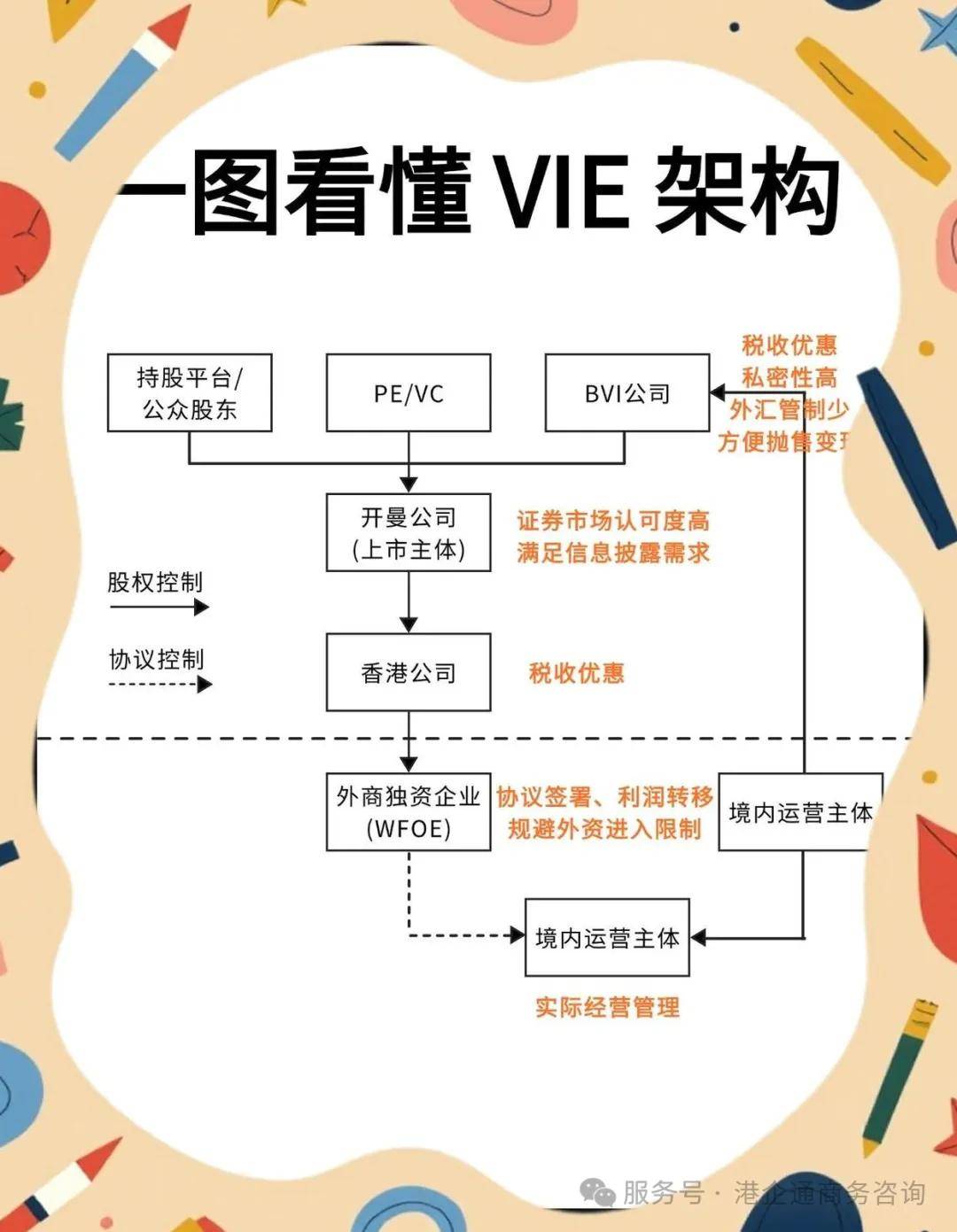
Group 1: Core Concept of VIE Structure - VIE, or Variable Interest Entity, is a financial structure that allows companies to bypass regulatory restrictions and achieve overseas financing through a series of legal agreements rather than direct equity control [3][4] - The VIE structure enables companies to maintain a domestic status while attracting foreign investment, which is crucial in sectors with foreign investment restrictions in China [5][6] Group 2: Benefits of VIE Structure - The VIE structure addresses three core challenges: circumventing foreign investment restrictions, facilitating overseas financing and listing, and providing tax optimization and flexibility [5][6] - Without the VIE structure, the current landscape of China's internet industry may not have achieved its remarkable growth [5] Group 3: Policy Evolution Related to VIE - The VIE structure has historically existed in a legal gray area, with Chinese regulators adopting a "don't acknowledge, don't deny, don't pursue" approach [6][7] - Recent regulatory changes indicate a shift from a permissive environment to a more stringent regulatory framework for VIE structures [7][8] Group 4: Classic Cases of VIE - Alibaba serves as a successful example of the VIE structure, achieving a record IPO in 2014 on the NYSE while complying with Chinese regulations [8] - Conversely, New Oriental and TAL Education faced significant challenges due to policy changes, highlighting the inherent risks of the VIE structure [8]
国投证券:深化学习型文化建设 赋能公司高质量发展
Zheng Quan Ri Bao Wang· 2025-09-23 09:19
Core Viewpoint - The company emphasizes the importance of political and people-oriented financial work, adapting to a complex operating environment and focusing on sustainable high-quality development through continuous learning and cultural cultivation [1] Group 1: Political Construction and Leadership - The company prioritizes political construction, integrating the Party's innovative theories into its core values, and ensuring alignment with national strategies and the needs of the economy and the public [2] - The company enhances political judgment, comprehension, and execution through systematic learning of key political documents and conducting various educational activities [2] - The company promotes a culture of integrity and discipline, implementing strict compliance and risk management education to foster a clean working environment [3] Group 2: Talent Development and Employee Empowerment - The company adopts a "talent is the first resource" philosophy, establishing a three-dimensional talent cultivation system that covers the entire employee growth cycle [4] - The company focuses on targeted training for different levels of leadership, enhancing the professional capabilities and purity of its workforce [4] - The company builds a digital learning ecosystem, utilizing online platforms and interactive methods to improve employee skills and engagement [5] Group 3: Digital Transformation and Technological Empowerment - The company actively embraces AI and digital transformation, integrating technology deeply into its business operations to drive high-quality development [6] - The company fosters digital talent through structured training programs and industry collaborations, enhancing its technological capabilities [7] - The company applies AI technologies in various operational areas, improving customer experience and operational efficiency through innovative product offerings [7] Group 4: Cultural Development and Organizational Cohesion - The company promotes a culture of learning and mutual growth, aligning individual development with corporate objectives [8] - The company emphasizes the dissemination of core socialist values and industry ethics, guiding employees to establish correct professional perspectives [8] - The company encourages knowledge sharing and mentorship, enhancing team cohesion and employee satisfaction [8]
GenAI:74.6%的中国财富500强企业正在部署或使用GenAI技术
First Shanghai Securities· 2025-09-23 09:12
Investment Rating - The report does not explicitly provide an investment rating for the industry Core Insights - 74.6% of China's Fortune 500 companies are deploying or using GenAI technology, indicating its deep integration into corporate development and its role in digital transformation [3][4] - Cloud giants are offering comprehensive solutions that facilitate the implementation of GenAI, with Alibaba Cloud and DeepSeek serving 40% and 38% of Fortune 500 companies respectively [3] - The rise of open-source foundational models and tools is lowering the technical barriers for companies to deploy large models, promoting a multi-vendor strategy where companies typically choose 2.1 GenAI suppliers [4] Summary by Sections GenAI Adoption - A significant majority of Fortune 500 companies in China are adopting GenAI, marking a shift in market competition and digital transformation [3] - The multi-vendor approach enhances the stability and adaptability of GenAI applications to meet specific business needs [4] Alibaba Developments - Alibaba's Tongyi DeepResearch model has been open-sourced, achieving state-of-the-art results in various evaluations, and is positioned as a leading open-source agent model [5] - The upcoming Alibaba Cloud Summit will gather over 2,000 guests to discuss trends in AI and cloud computing [5] Tencent Gaming - Tencent's game "Delta Action" has surpassed 30 million daily active users in China, marking a significant milestone in the shooting game sector [6] - The game has also achieved a peak of 226,000 concurrent users on Steam, indicating strong global appeal [6] ByteDance and TikTok - ByteDance is advancing negotiations to ensure TikTok continues to operate in the U.S. amid regulatory pressures, with 170 million monthly active users in the U.S. [8] Meituan Expansion - Meituan's international delivery brand Keeta has launched in Kuwait, aiming to expand across the Gulf region and invest $1 billion in Brazil over the next five years [9]
港股收盘 | 恒指收跌0.7% 科技股普遍走软 黄金、银行股表现活跃
Zhi Tong Cai Jing· 2025-09-23 09:08
Market Overview - The Hong Kong stock market opened slightly higher but experienced a decline throughout the day, with the Hang Seng Index closing down 0.7% at 26,159.12 points and a total turnover of HKD 2,945.61 million [1] - The Hang Seng Tech Index fell by 1.45%, while the Hang Seng China Enterprises Index decreased by 0.86% [1] Blue-Chip Stocks Performance - HSBC Holdings (00005) rose by 1.31% to HKD 108.6, contributing 28.6 points to the Hang Seng Index [2] - Other notable blue-chip movements included New Oriental-S (09901) up 1.85%, CITIC Limited (00267) up 1.5%, while CSPC Pharmaceutical Group (01093) fell by 4.73% [2] Sector Highlights - Large tech stocks generally declined, with Tencent down 0.86% and Xiaomi dropping over 1%, while Alibaba saw a slight increase of 0.13% [3] - Gold stocks continued to rise, with Tongguan Gold (00340) increasing by 6.38% [3] - Some banking stocks performed well, with Chongqing Rural Commercial Bank rising nearly 3% [3] Gold Market Insights - International gold prices reached new highs, with London gold hitting USD 3,759.16 per ounce and COMEX gold at USD 3,795.1 per ounce, marking a year-to-date increase of over 40% [4] - The rise in gold prices is supported by expectations of further interest rate cuts by the Federal Reserve and geopolitical tensions affecting energy supply chains [4] Cryptocurrency Sector - Cryptocurrency-related stocks faced significant declines, with Guotai Junan International (01788) dropping 11.57% following regulatory actions from the China Securities Regulatory Commission [5][6] - The overall cryptocurrency market saw a downturn, with total market capitalization falling below USD 4 trillion [6] Notable Stock Movements - Yunzhihui Technology (01037) surged by 103.23% after announcing a strategic partnership in humanoid robotics [7] - Different Group (06090) saw a 43.96% increase on its debut, focusing on high-end parenting products [8] - Kington Holdings (00412) rose by 22.25% following a share buyback authorization [9] - Liqin Resources (02245) reached a new high, increasing by 14.29% due to favorable cobalt export policies [10] - China Rare Earth Holdings (03788) rose by 12.53% after announcing a share issuance to support gold mining projects [11] - Zhejiang Shibao (01057) saw a 12.27% increase, driven by advancements in steering technology for smart vehicles [12]
港股收评:三大指数齐跌 恒指跌0.7%险守26000点 科技股普跌 黄金股活跃
Ge Long Hui· 2025-09-23 08:30
Market Overview - The Hong Kong stock market indices collectively declined, with the Hang Seng Technology Index dropping as much as 2.6% before closing down 1.45% [1] - The Hang Seng Index fell 0.7% to remain above 26,000 points, while the National Enterprises Index decreased by 0.86% [1] Sector Performance - Major technology stocks experienced widespread declines, with Baidu falling over 5%, JD.com down 4.4%, Meituan down nearly 3%, Xiaomi down over 1%, and Tencent down nearly 1% [1] - Alibaba managed to close slightly positive, while Apple-related stocks saw significant pullbacks, with Lens Technology down over 7% and both Wasion Group and QiuTai Technology down over 3% [1] - Other sectors such as real estate, automotive, Chinese brokerage firms, steel, lithium battery, gambling, shipping, aviation, and semiconductor stocks also showed weak performance [1] Education Sector - The Ministry of Education announced the establishment of the world's largest vocational education system, leading to a rise in vocational education stocks, with Thinker Education up over 6% and New Oriental, a leader in online education, rising nearly 2% [1] Gold Market - Spot gold reached a new historical high, resulting in active performance among gold stocks [1] Individual Stock Movements - Newly listed stocks saw significant gains, with Yunzhihui Technology soaring over 103% and other companies like Mixue Group and Kangfang Biotech rising 4.7% and 4.28% respectively [1] - Conversely, Guotai Junan International fell by 11.57% and Canggang Railway dropped by 12.5% [1] - Notable gains included Shanga Holdings up 22.25% and Hong Kong Broadband up 15.85% [1]
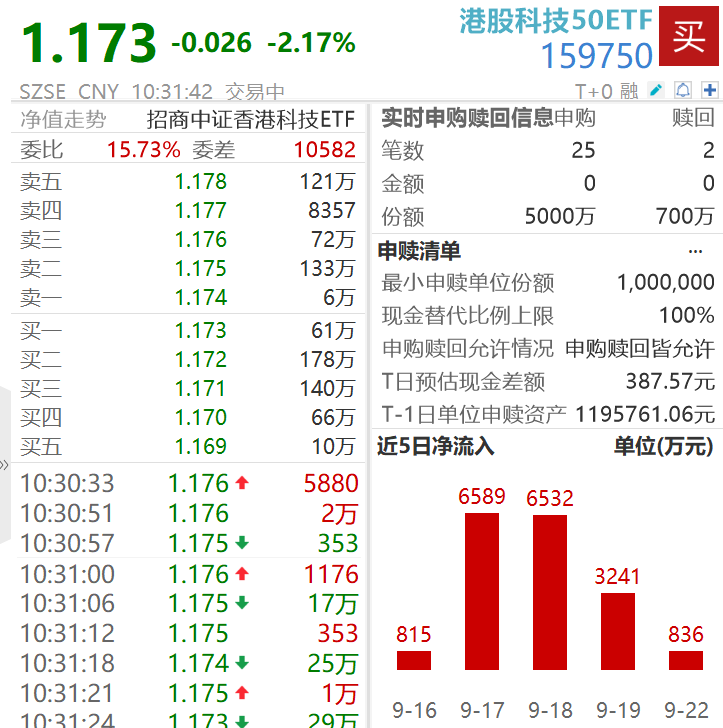
港股科技50ETF(159750)放量下挫,盘中超5000万资金逆势净买入,机构:AI与新消费仍有较大空间
Ge Long Hui· 2025-09-23 07:40
Market Performance - Hong Kong stocks experienced a decline, with NIO-SW dropping over 7% and Baidu Group falling over 6%. Other companies like ZTE, JD Group-SW, and BYD also saw declines exceeding 4% [1] - The Hong Kong Technology 50 ETF (159750) fell by 2.17%, with a trading volume of 116 million CNY, indicating significant market activity [1] - Despite the overall market decline, the Hong Kong Technology 50 ETF has seen a net inflow of over 500 million CNY in the past seven trading days [1] Foreign Investment Trends - Recent data shows a positive trend in foreign capital inflow, with the KraneShares CSI China Internet ETF (KWEB) experiencing its longest consecutive inflow period since February, totaling six weeks [2] - As of September 17, foreign capital net inflow into overseas Chinese stocks reached 1.86 billion USD, marking the highest weekly inflow since November of the previous year [3] Market Outlook - Analysts from CITIC Securities suggest that with the Federal Reserve's interest rate cuts, the liquidity situation is improving, which may lead to sustained foreign capital inflow into the Hong Kong market [3] - The Hong Kong technology index is currently valued at 24.56 times PE-TTM, which is significantly lower than the valuations of major global technology indices, indicating a favorable investment opportunity [3] - Long-term prospects for the Hong Kong market are positive, particularly in sectors such as AI technology and new consumption, which are expected to drive market growth [5]