
中国铝业

Search documents
中国铝业(601600):产销稳定,铝价上涨增厚盈利
Minsheng Securities· 2025-10-30 06:45
Investment Rating - The report maintains a "Recommended" rating for the company, with a current price of 9.91 yuan [7]. Core Insights - The company reported a revenue of 176.52 billion yuan for the first three quarters of 2025, a year-on-year increase of 1.6%, and a net profit attributable to shareholders of 10.87 billion yuan, up 20.6% year-on-year [1]. - The increase in aluminum prices has significantly boosted profitability, with a gross margin of 17.3% for the first three quarters of 2025, up 2.1 percentage points year-on-year [2]. - The company has a strong integrated supply chain, with a high self-sufficiency rate in bauxite resources, enhancing its risk resilience [4]. Summary by Sections Financial Performance - For Q3 2025, the company achieved a revenue of 60.12 billion yuan, a decrease of 4.7% year-on-year, but a net profit of 3.80 billion yuan, reflecting a 90.0% increase year-on-year [1][2]. - The gross margin for Q3 2025 was 18.4%, an increase of 6.7 percentage points year-on-year, primarily due to rising aluminum prices [2]. Production and Pricing - The production of electrolytic aluminum reached 6 million tons in the first three quarters of 2025, a year-on-year increase of 6.8% [2]. - The average aluminum price for the first three quarters of 2025 was 20,447 yuan per ton, up 3.7% year-on-year, with Q3 2025 averaging 20,710 yuan per ton, a 5.9% increase year-on-year [2]. Strategic Positioning - The company is focusing on resource security and has a significant bauxite resource of approximately 2.7 billion tons, with a self-sufficiency rate that continues to improve [4]. - The company is expected to benefit from a revaluation under the "special valuation" system due to its status as a key player in the national economy and ongoing state-owned enterprise reforms [4]. Profit Forecast - The company is projected to achieve net profits of 14.54 billion yuan, 16.66 billion yuan, and 17.26 billion yuan for the years 2025, 2026, and 2027, respectively, with corresponding price-to-earnings ratios of 12, 10, and 10 [5][6].

本轮行情具备基本面支撑,自由现金流ETF(159201)规模创新高,连续12日合计“吸金”6.05亿元
Mei Ri Jing Ji Xin Wen· 2025-10-30 06:40
Group 1 - The core viewpoint of the news highlights the performance and growing popularity of the Free Cash Flow ETF (159201), which has seen a net inflow of 605 million yuan over the past 12 trading days, reaching a new high of 5.17 billion yuan in total assets [1] - The China Securities Regulatory Commission (CSRC) has issued guidelines to enhance the protection of small investors, encouraging companies to implement multiple dividends annually, which is expected to boost the value of high free cash flow assets [1] - The Shanghai Composite Index has surpassed 4000 points for the first time in ten years, indicating a market environment with fundamental support and a structural revaluation characteristic of the current market trend [1] Group 2 - The Free Cash Flow ETF (159201) closely tracks the National Index of Free Cash Flow, focusing on companies with high free cash flow rates, which enhances its risk resistance amid macroeconomic uncertainties [2] - The fund management fee for the ETF is set at an annual rate of 0.15%, and the custody fee is at 0.05%, both of which are among the lowest in the market [2]
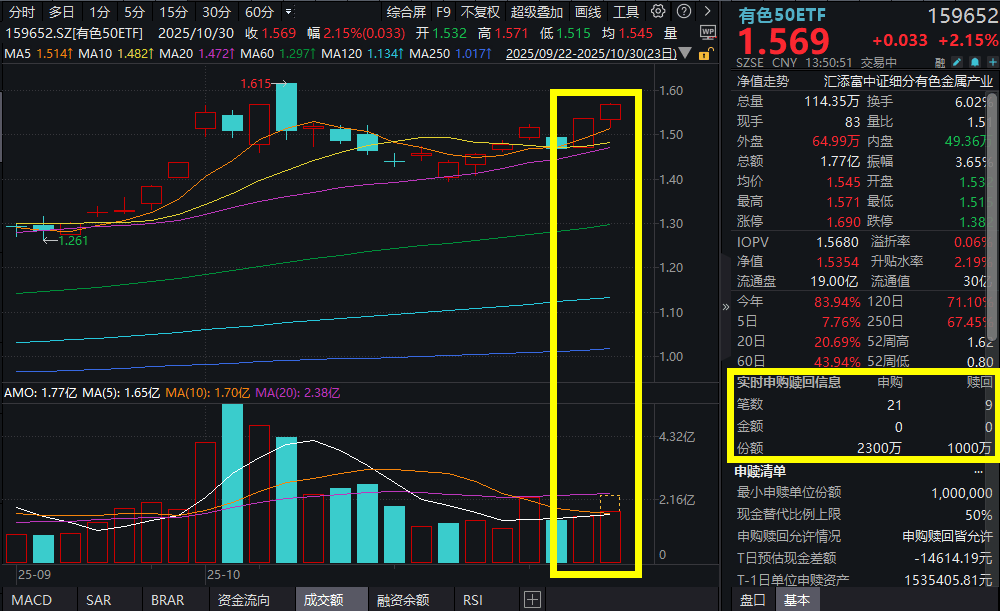
铜、锂暴涨!天齐锂业涨停,江西铜业涨超2%,有色50ETF(159652)放量涨超2%,盘中实时吸金超2000万元!AI需求爆发,数据中心"铜需求"暴增
Sou Hu Cai Jing· 2025-10-30 06:30
Core Viewpoint - The non-ferrous metal sector is experiencing a significant rally, driven by favorable factors such as the Federal Reserve's interest rate cuts, with the Copper ETF (159652) seeing substantial inflows and price increases [1][3]. Group 1: Market Performance - The non-ferrous 50 ETF (159652) has surged over 2%, attracting over 20 million yuan in capital inflows during the trading session [1]. - Key components of the non-ferrous 50 ETF, including lithium and other industrial metals, have shown strong price increases, with notable gains from Tianqi Lithium and Ganfeng Lithium [3]. - The London Metal Exchange (LME) copper price reached an all-time high of 11,200 points, indicating strong market demand [3]. Group 2: Supply and Demand Dynamics - Citic Securities forecasts that copper and cobalt prices will continue to rise due to supply constraints, while lithium prices will benefit from unexpected increases in energy storage demand [5]. - The supply side is facing significant constraints, with global copper mine supply expected to enter negative growth in Q4 2024 due to production disruptions and reduced output guidance from major producers [5]. - Emerging demand from AI data centers is projected to significantly increase copper consumption, with a compound annual growth rate of 26% expected from 2023 to 2027 [6]. Group 3: Macroeconomic Factors - The current geopolitical tensions and dollar credit risks are enhancing the financial attributes of copper, positioning it as a key reserve asset for countries [10]. - The Federal Reserve's recent interest rate cut to a target range of 3.75%-4% is expected to support the price of physical assets like copper [10]. - Citic Jin Investment predicts that copper prices may return to a range of $10,000 to $12,000 per ton by Q4 2025, supported by supply-demand fundamentals and liquidity conditions [11]. Group 4: Investment Opportunities - The non-ferrous 50 ETF (159652) is highlighted for its high copper and gold content, with a leading position in the market [11]. - The ETF's index has shown a cumulative return of 116.5% since 2022, driven by earnings rather than valuation expansion, indicating strong growth potential [13]. - The projected compound annual growth rate for net profit over the next two years for the ETF's index is 16.28%, suggesting superior growth compared to peers [13].




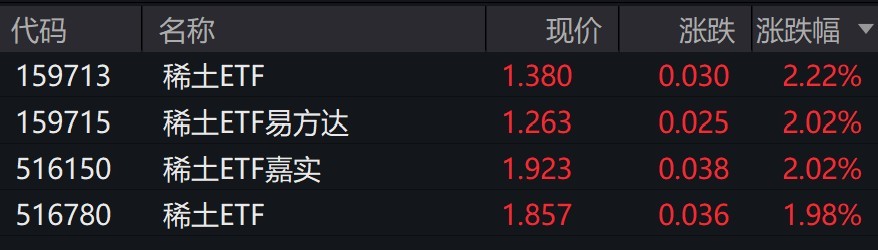
稀土概念股午后拉升,稀土ETF涨约2%
Mei Ri Jing Ji Xin Wen· 2025-10-30 06:16
Group 1 - Rare earth concept stocks experienced a significant afternoon rally, with Northern Rare Earth, Goldwind Technology, and China Aluminum rising over 4%, while China Rare Earth, Shenghe Resources, and Greeenmei increased by more than 2% [1] - The Rare Earth ETF saw an approximate increase of 2% due to market influences [1] Group 2 - Several brokerages indicate that rare earths, as core resources for high-end manufacturing and strategic emerging industries, are showing a resonant pattern on both supply and demand sides [2] - The strategic position of the rare earth industry chain is expected to be further solidified against the backdrop of increased supply concentration and upgraded demand structure, providing long-term driving force for high-end manufacturing development [2]


稀土概念午后爆发,“家里有矿,年内涨超有色”的矿业ETF(561330)今年以来涨超90%
Sou Hu Cai Jing· 2025-10-30 05:53
Core Viewpoint - The rare earth sector has seen a significant surge, with the mining ETF (561330) rising over 90% year-to-date, driven by recent export control policies and price adjustments from major rare earth companies [1][2]. Policy Impact - Recent announcements regarding export controls on rare earth items and technologies have been made, aiming to strengthen China's dominance in the global rare earth market and enhance its pricing power [2]. - The export control measures are expected to solidify China's position as a "rules power" in the rare earth sector, moving from being merely a resource-rich country [2]. Market Dynamics - Following the export controls implemented in April, rare earth prices rebounded due to factors such as easing US-China tariff tensions and increased demand [2]. - The domestic and international demand for rare earth materials is anticipated to grow, with a potential whitelist system expected to be introduced, which may lead to a new round of price increases [2]. ETF Performance - The mining ETF (561330) has outperformed the CSI Nonferrous Metals Index by over 10% year-to-date, attributed to a more concentrated selection of leading stocks [3]. - The mining ETF tracks the CSI Nonferrous Metals Mining Theme Index, which has a higher concentration of leading stocks, with the top ten constituents accounting for 56.98% of the index [3]. Sector Composition - The CSI Nonferrous Metals Mining Theme Index has a higher proportion of gold, copper, and rare earths at 56.2%, compared to 52.5% in the CSI Nonferrous Index, indicating a stronger alignment with high-demand sectors [5]. Future Outlook - The copper supply remains tight, which is expected to support copper prices in the medium term [11]. - Gold is anticipated to see increased demand as a safe-haven asset due to global economic uncertainties, with long-term price support expected from potential Federal Reserve rate cuts and geopolitical tensions [11]. - The mining ETF (561330) currently has a scale of 813 million, ranking first among similar ETFs, providing superior liquidity and investment opportunities in the gold, copper, and rare earth sectors [11].

A股稀土永磁概念股集体拉升
Ge Long Hui A P P· 2025-10-30 05:16
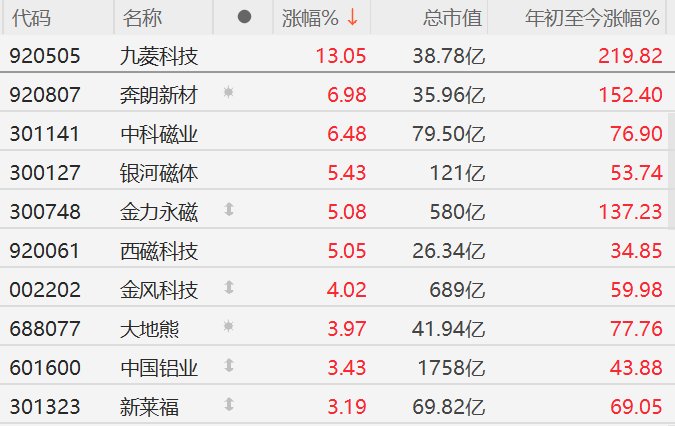
Core Viewpoint - The rare earth permanent magnet concept stocks in the A-share market experienced a collective surge, indicating strong investor interest and potential growth in this sector [1] Group 1: Stock Performance - Jiuling Technology saw a significant increase of 13.05%, with a total market capitalization of 3.878 billion and a year-to-date increase of 219.82% [1] - Benlang New Materials and Zhongke Magnetic Industry both rose over 6%, with market capitalizations of 3.596 billion and 7.950 billion respectively, and year-to-date increases of 152.40% and 76.90% [1] - Galaxy Magnet, Jinli Permanent Magnet, and Xici Technology all experienced gains exceeding 5%, with market capitalizations of 12.1 billion, 58 billion, and 2.634 billion respectively, and year-to-date increases of 53.74%, 137.23%, and 34.85% [1] Group 2: Market Indicators - The MACD golden cross signal has formed, suggesting a positive trend in these stocks [1]

有色股涨幅居前 中国铝业(02600.HK)涨10.34%
Mei Ri Jing Ji Xin Wen· 2025-10-30 03:33
Group 1 - The core viewpoint of the article highlights significant gains in the non-ferrous metal sector, with several companies experiencing notable stock price increases [1] Group 2 - China Aluminum (02600.HK) saw a rise of 10.34%, reaching HKD 10.14 [1] - Ganfeng Lithium (01772.HK) increased by 9.53%, trading at HKD 51.7 [1] - Jiangxi Copper (00358.HK) rose by 5.97%, with a price of HKD 34.78 [1] - Zijin Mining (02899.HK) experienced a 5.08% increase, priced at HKD 32.66 [1] - Luoyang Molybdenum (03993.HK) gained 4.38%, reaching HKD 17.38 [1]

港股异动 | 有色股涨幅居前 宏观因素向好支撑有色金属 机构料大宗商品投资热度有望延续
智通财经网· 2025-10-30 03:20
Core Viewpoint - The article highlights a significant rise in the prices of non-ferrous metal stocks, driven by favorable macroeconomic factors and market sentiment following a meeting between the leaders of China and the U.S. [1] Group 1: Stock Performance - China Aluminum (02600) increased by 10.34%, reaching HKD 10.14 [1] - Ganfeng Lithium (01772) rose by 9.53%, reaching HKD 51.7 [1] - Jiangxi Copper (00358) saw a 5.97% increase, reaching HKD 34.78 [1] - Zijin Mining (02899) increased by 5.08%, reaching HKD 32.66 [1] - Luoyang Molybdenum (03993) rose by 4.38%, reaching HKD 17.38 [1] Group 2: Market Factors - The LME copper price showed strong fluctuations, reaching a historical high [1] - International gold prices rebounded after a decline to a three-week low [1] - Everbright Futures noted that the meeting between the U.S. and Chinese leaders boosted market sentiment, despite a hawkish stance from the Federal Reserve [1] Group 3: Future Outlook - CITIC Securities anticipates supply tightness will drive prices of copper and cobalt higher, while lithium prices may benefit from unexpected demand in energy storage [1] - Despite recent volatility in precious metal prices, the overall bullish outlook remains unchanged [1] - The article suggests that with continued liquidity and increased efforts by countries to secure key resources, the investment interest in commodities is likely to persist [1]
中国铝业股价涨5.05%,上银基金旗下1只基金重仓,持有10.34万股浮盈赚取5.17万元
Xin Lang Cai Jing· 2025-10-30 03:04
Group 1 - China Aluminum's stock increased by 5.05%, reaching 10.41 CNY per share, with a trading volume of 3.12 billion CNY and a turnover rate of 2.33%, resulting in a total market capitalization of 178.59 billion CNY [1] - The company, established on September 10, 2001, and listed on April 30, 2007, is based in Haidian District, Beijing, and its main business includes exploration and mining of bauxite and coal, production and sales of alumina, primary aluminum, and aluminum alloy products, as well as international trade and logistics [1] - The revenue composition of the company shows that 97.41% comes from product sales, 1.56% from other business income, and 1.03% from service provision [1] Group 2 - One fund under Shangyin Fund holds a significant position in China Aluminum, with 103,400 shares, accounting for 3.73% of the fund's net value, making it the seventh-largest holding [2] - The Shangyin National Free Cash Flow Index A fund, established on June 26, 2025, has a current size of 6.564 million CNY and has achieved a return of 11.67% since inception [2] - The fund managers, Lu Yang and Huang Huang, have tenures of 11 years and nearly 2 years respectively, with Lu Yang managing assets totaling 926 million CNY and achieving a best return of 59.02% during his tenure [2]
金属铝板块再度走强,常铝股份2连板
Xin Lang Cai Jing· 2025-10-30 02:36
金属铝板块再度走强,常铝股份2连板,南山铝业、中国铝业、顺博合金、中孚实业、丽岛新材跟涨。 ...
