
腾讯

Search documents
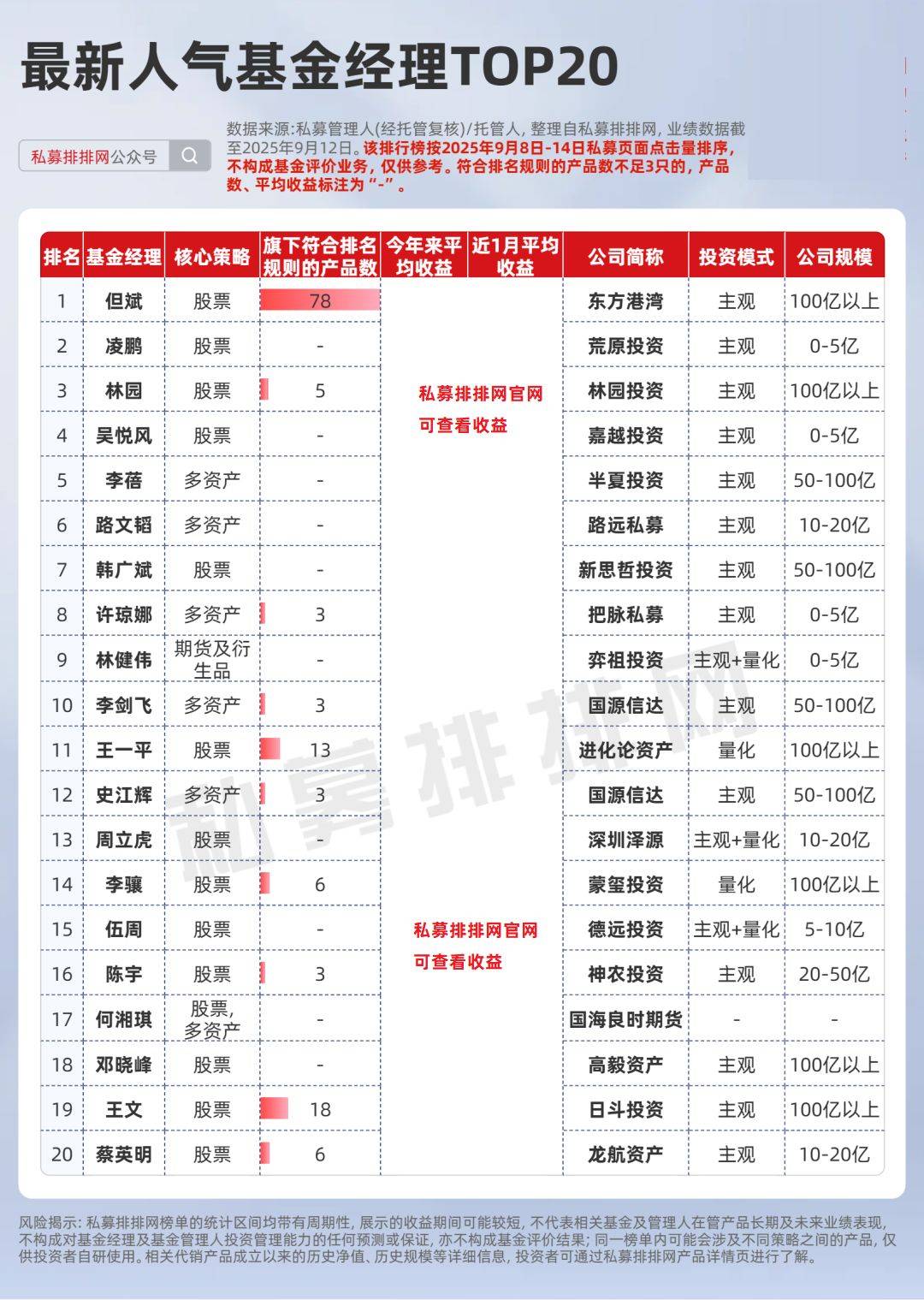
主观逆袭?但斌、李剑飞等9位主观基金经理进入人气十强!
Sou Hu Cai Jing· 2025-09-22 09:27
Core Insights - The A-share market has been performing strongly, but there is a noticeable divergence in sector performance, with previously popular quantitative products now struggling to outperform the market [1] - A resurgence of subjective products has been observed, with many previously quiet funds beginning to recover in net value, indicating a "subjective comeback" trend [1] Fund Manager Rankings - As of September 14, among the top 20 fund managers, 15 are from subjective private equity, dominating the rankings [1] - The top-ranked fund manager is Dan Bin, whose products have shown significant returns over the past month and year [3] - The second-ranked manager, Shi Zhi, and others in the top 8 are primarily from smaller private equity firms with assets under 5 billion [2] Performance of Specific Funds - Dan Bin's "Oriental Harbor Marathon Global A Class" has achieved a high cumulative net value and significant returns since inception [3] - Xu Qiongna, ranked 8th, has also seen impressive performance from her funds, particularly "Jinban Capital No. 5," which has shown the highest returns this year [6][7] Market Trends and Predictions - The current market is seen as being in a "slow bull" phase, with expectations of continued recovery driven by policy support and changes in industry supply-demand dynamics [8] - Chen Yu, a prominent fund manager, believes the market is at a pivotal point, similar to historical trends, and anticipates a long-term bull market driven by technological advancements [12][13] Notable Fund Managers - Li Jianfei and Shi Jianghui from Guoyuan Xinda are notable for having two fund managers listed among the top ranks, indicating strong performance across their funds [9] - Cai Yingming from Longhang Asset is recognized for focusing on undervalued, high-cost-performance targets, with his fund "Longhang No. 1" showing significant returns [14][15]

AI岗位同比增超十倍 实习生最高日薪四千
Nan Fang Du Shi Bao· 2025-09-22 08:56
Group 1 - The AI talent market is experiencing high demand, with major tech companies offering substantial incentives to attract talent, including stock options and high salaries [1][2][3] - MiniMax has launched a million-dollar stock option incentive program to attract talent, offering varying amounts based on employee contributions, with opportunities even for interns [2][3] - ByteDance is implementing a stock option plan for its Seed department, with monthly opportunities for employees to receive stock options valued at 90,000 to 130,000 RMB [2] Group 2 - The demand for AI-related positions has surged, with over 10 times the number of new AI job postings compared to last year, totaling over 72,000 positions across various roles [4] - Alibaba's recruitment plan includes over 7,000 positions, with AI roles making up more than 60%, while Baidu's AI-related positions account for over 90% of its 4,000 planned hires [4] - Companies like Meituan and Tencent are also increasing their recruitment efforts in the AI sector, with Meituan introducing a special program for AI product managers [4] Group 3 - Job seekers are increasingly prioritizing companies' practical applications of AI technology over just high salaries, focusing on the richness of data and real-world scenarios [7][8] - A report indicates that the core hiring criteria for AI talent has shifted, with practical experience and foundational knowledge in mathematics and algorithms being the most valued attributes [7] - Companies are now requiring candidates to demonstrate their capabilities through internships or trial periods before full-time hiring, reflecting the industry's need for practical skills [8]


2025,游戏股崛起
投资界· 2025-09-22 08:04
Core Viewpoint - The gaming industry is experiencing a significant recovery, with many companies reporting strong financial performance in the first half of 2025, indicating a broader market rebound [5][9]. Group 1: Overall Market Performance - Over 80% of the 64 listed gaming companies achieved profitability in H1 2025, with nearly half reporting revenue growth in their gaming segments [7][10]. - The total gaming revenue and profit for these companies reached the highest levels in five years, with a total revenue of 235.6 billion RMB, representing a year-on-year growth of 20.1% [10][11]. - Eight companies saw their stock prices increase by over 100% in the first half of the year, reflecting a generally positive market sentiment [7][8]. Group 2: Company-Specific Performance - Bilibili achieved profitability for the first time since its IPO, while Century Huatong's gaming revenue surpassed 10 billion RMB for the first time, leading to a nearly threefold increase in market capitalization [5][10]. - Tencent and NetEase, among the top ten gaming companies, reported significant revenue and profit growth, with Tencent's gaming revenue reaching 1,186.5 billion RMB, up 22.8% year-on-year [11][19]. - Companies like Flying Fish Technology and Extreme Interaction reported revenue growth rates exceeding 100%, indicating strong product performance [13][14]. Group 3: Profitability Trends - 84% of the companies reported profits, with 65% experiencing profit growth, significantly higher than the previous year's figures [15][18]. - The number of companies turning losses into profits increased to 25%, while only 2% reported losses after previously being profitable [15][19]. - The top three companies in profit growth saw increases exceeding 700%, showcasing exceptional recovery and performance [18][19]. Group 4: Cost Management and Efficiency - Many companies have implemented cost-cutting measures, with over two-thirds of firms maintaining or reducing R&D costs, contributing to improved profitability [29][30]. - Marketing costs have increased for several companies, but those that managed to control these expenses while maintaining revenue growth include NetEase and 37 Interactive Entertainment [33][30]. - The overall trend indicates that companies are focusing on efficiency and product performance to drive growth, with many preparing for long-term development through new product launches [37][26].

英媒:AI助阿里百度腾讯涨幅超过50%,中国科技股跑赢纳斯达克
Feng Huang Wang· 2025-09-22 07:24
Group 1 - Chinese technology stocks have significantly outperformed their Nasdaq counterparts this year, with the Hang Seng Tech Index rising 41% compared to a 17% increase in the Nasdaq Composite Index [1] - The surge in Chinese tech stocks is attributed to advancements in AI and the government's push for self-sufficiency in chip production, with major companies like Alibaba, Tencent, and Baidu seeing stock price increases of 96%, 55%, and 59% respectively [1][5] - The emergence of DeepSeek in the AI sector has marked a pivotal moment, changing investor sentiment towards capital expenditures in Chinese tech companies [5] Group 2 - The AI-driven investment enthusiasm extends beyond major Hong Kong-listed companies to include chip manufacturers like Cambricon and SMIC, as well as innovative biotech firms, with the Shanghai-Shenzhen AI Index rising over 61% and the Hang Seng Biotech Index increasing by 98% this year [5] - Foreign investors are beginning to rebuild their positions in Chinese tech stocks, attracted by low valuations and positive technological developments [6]

云栖大会即将开幕,资金持续买入港股通科技ETF基金(159101)
Mei Ri Jing Ji Xin Wen· 2025-09-22 07:13
Core Insights - The 2025 Cloud Summit will open on September 24, featuring three main forums and three exhibition halls focused on exploring cutting-edge AI directions [1] - AI empowerment is revitalizing technology companies, with Hong Kong-listed firms like Alibaba, Baidu, and Tencent exceeding market expectations in cloud business revenue [1] - The technology sector in Hong Kong is experiencing a strong internal drive, with previous intense competition in sectors like food delivery and automotive cooling down, shifting market focus back to AI narratives [1] Company Developments - Alibaba and other internet leaders are utilizing self-developed chips in AI model training, achieving performance metrics that can compete with similar overseas products, laying a foundation for long-term industry development [1] - The Hong Kong Stock Connect technology ETF (159101) has seen nearly a 9% increase since its launch, with recent continuous capital inflows [1] Market Trends - The AI sector's narrative logic has become the core focus of the market, supported by the strong internal dynamics of the Hong Kong technology sector [1] - Notable stocks such as AAC Technologies, Sunny Optical Technology, WuXi Biologics, and SMIC have shown upward trends, with AAC Technologies leading the gains [1]
半导体ETF(159813)涨超4.3%,存储涨价+大厂自研芯片落地推升行情
Xin Lang Cai Jing· 2025-09-22 06:01
Group 1 - Semiconductor chips have seen a strong rally, driven by two major positive news: significant price increases in storage chips and the successful application of self-developed chips by companies like Huawei, Alibaba, and Baidu [1] - The price of DDR4/LPDDR4X storage chips has surged over 200% from the bottom in Q1 2025, with contract prices doubling and some models increasing by over 30%, indicating a tight supply-demand balance influenced by AI-driven demand and production cuts [1] - Alibaba has integrated its self-developed PPU chip into AI model training, partially replacing NVIDIA products, showcasing its potential in training scenarios, while other cloud companies are adapting domestic chips to enhance AI applications [1] Group 2 - As of September 22, 2025, the National Securities Semiconductor Chip Index (980017) rose by 4.46%, with significant gains in constituent stocks such as Haiguang Information (688041) up 13.02% and Longxin Zhongke (688047) up 8.04% [2] - The semiconductor ETF (159813) increased by 4.31%, reflecting the performance of listed companies in the semiconductor industry [2] - The top ten weighted stocks in the National Securities Semiconductor Chip Index account for 70.69% of the index, with companies like Cambricon (688256) and SMIC (688981) among the leaders [2]


瑞声科技涨超9%,港股通科技ETF基金(159101)强势吸金,近2日日均流入超1亿
Mei Ri Jing Ji Xin Wen· 2025-09-22 05:37
Group 1 - The Hang Seng Index fell by 0.99%, the Hang Seng Tech Index dropped by 1.18%, and the Hang Seng China Enterprises Index decreased by 1.3% on September 22, with a half-day trading volume of HKD 164.784 billion [1] - The Hong Kong Stock Connect Technology ETF (159101) experienced a flat performance, while component stocks like AAC Technologies surged over 9%, Sunny Optical Technology rose over 6%, and SMIC and WuXi Biologics increased by over 3% [1] - There has been a continuous net inflow into the Hong Kong Stock Connect Technology ETF for five consecutive trading days, with the last two days seeing a net inflow exceeding HKD 100 million [1] Group 2 - The recent interest rate cut does not signify the end of rate reductions, as the dot plot indicates two more expected cuts by 2025, which will continue to support the Hong Kong stock market and tech sector [2] - The internal drivers for the Hong Kong tech sector remain strong, with reduced competition in industries like food delivery and automotive, and a renewed focus on AI as a core narrative [2] - Recent interim reports from Hong Kong tech companies show that cloud business revenues exceeded market expectations, reinforcing the growth logic driven by AI, alongside strong future capital expenditure plans [2] Group 3 - The Hong Kong Stock Connect Technology ETF (159101) covers major internet giants like Tencent and Alibaba, as well as emerging players like Li Auto and BeiGene, providing a comprehensive investment tool for Chinese tech leaders [3] - The top five holdings account for 57% of the ETF's weight, while the top ten holdings make up 77%, indicating a concentrated yet broad exposure to key sectors including software, hardware, new consumption, innovative pharmaceuticals, and new energy vehicles [3]
产品表现、股价走势都出乎意料 游戏产业迎来“高光时刻”
Zheng Quan Shi Bao Wang· 2025-09-22 05:32
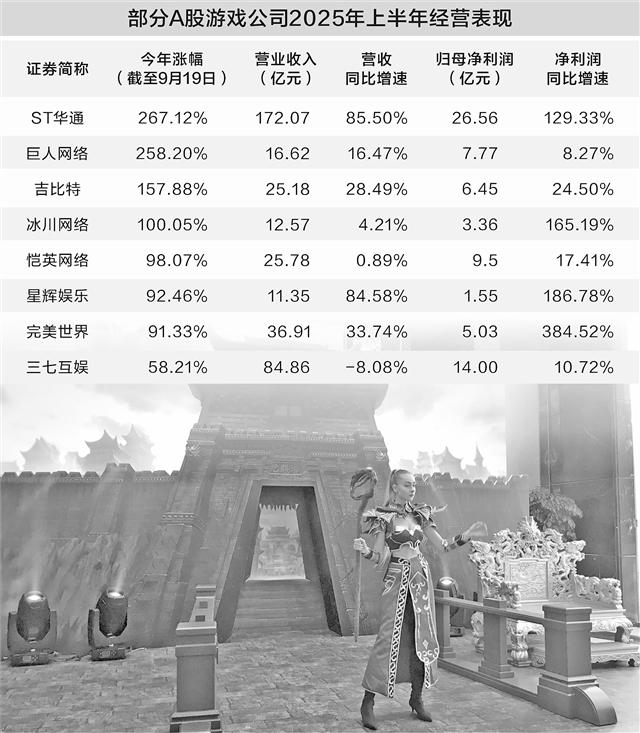
Core Viewpoint - The gaming industry in China has experienced a significant rebound in performance and stock prices, driven by multiple favorable factors including the continuous issuance of game licenses, strong product performance, and successful expansion into overseas markets [1][5][6]. Industry Performance - The A-share gaming sector has seen a remarkable increase, with the Shenyin Wanguo gaming industry index surpassing 4000 points, marking a new high since 2017. The index has risen nearly 80% year-to-date, ranking third among secondary industry indices [5][6]. - From 2017 to 2024, China's gaming market revenue has grown from 203.6 billion to 325.8 billion yuan, with a notable turnaround beginning in the second half of last year [4][5]. Company Highlights - Several gaming companies have reported impressive stock price increases, with ST Huatuo and Giant Network both exceeding 200% growth this year. ST Huatuo's market capitalization has surpassed 140 billion yuan, making it the highest in the A-share media sector [5][6]. - Specific companies like ST Huatuo and Giant Network have seen substantial revenue growth, with ST Huatuo's revenue increasing by 70.3% in 2024 and continuing to rise by 85.5% in the first half of this year [7][8]. Factors Driving Growth - The resurgence in the gaming sector is attributed to several factors: overall industry performance recovery, cost reduction and efficiency gains from AI technology, disclosure of high-revenue products, and the explosion of mini-game ecosystems [6][7]. - The number of game licenses issued has significantly increased, with 1,119 licenses granted by August this year, reflecting a strong policy support for the industry [6][8]. Future Outlook - The gaming industry is expected to maintain its growth momentum due to the deep accumulation of resources by domestic gaming companies, which have developed a robust pipeline of new products [8][9]. - Analysts predict that the current prosperous situation may continue for the next 1 to 2 years, although the growth model and market dynamics may evolve, focusing more on quality and long-term operational capabilities rather than sheer quantity [9].
港股午评:恒指跌0.99%,科技股、金融股弱势,半导体股继续活跃
Ge Long Hui A P P· 2025-09-22 04:09
Market Overview - The Hong Kong stock market experienced a collective decline in the morning session, with all three major indices dropping over 1.1% [1] - As of the midday break, the Hang Seng Index fell by 0.99%, the Hang Seng China Enterprises Index decreased by 1.3%, and the Hang Seng Tech Index dropped by 1.18% [1] Sector Performance - Major technology stocks, which serve as market indicators, collectively declined, with Meituan, Kuaishou, and JD.com each falling nearly 3%, and NetEase down by 2% [1] - Other significant players like Xiaomi, Tencent, and Alibaba also reported losses, while Baidu saw a contrary increase of over 2% [1] - The financial sector, including banks, insurance, and brokerage firms, showed weak performance overall [1] Shipping and Logistics - The impending implementation of high port fees led to a broad decline in shipping and port-related stocks, with China Merchants Energy and Seaspan International among the hardest hit [1] Other Sector Movements - Stocks related to Tesla, sports goods, automotive, home appliances, coal, catering, and military industries all experienced declines [1] - Conversely, strong pre-order demand for new iPhone models in China, coupled with anticipated AI features, boosted Apple-related stocks, with Hong Teng Precision surging over 17% [1] - Semiconductor stocks, particularly those involved in domestic replacements, saw a general increase, with leading firm SMIC rising over 3% [1] - Additionally, paper, biopharmaceutical, and gold stocks mostly experienced upward movements [1]
多股涨超100%,多重利好推动游戏板块价值重估
Zheng Quan Shi Bao· 2025-09-22 03:50
Core Insights - The gaming industry has unexpectedly performed well this year, with both product performance and stock price trends exceeding expectations [1] - The A-share gaming sector has seen a significant rise since last year, driven by continuous issuance of game licenses, strong performance of new games, and effective expansion into overseas markets [1][2] Industry Performance - From 2017 to 2024, China's gaming market revenue is projected to grow from 203.6 billion to 325.8 billion yuan, with a notable turnaround beginning in the second half of last year [2] - As of September 17, the Shenwan gaming industry index closed above 4000 points, marking a new high since 2017, with a year-to-date increase of nearly 80% [2] - Individual stocks have shown remarkable performance, with companies like ST Huatuo and Giant Network seeing increases of over 100% this year, and ST Huatuo's market value surpassing 140 billion yuan [2][5] Factors Driving Growth - The continuous issuance of game licenses has been a significant policy support for the industry, with 1,119 licenses granted by August, a substantial year-on-year increase [3] - The gaming sector's recovery is attributed to several factors, including overall industry performance improvement, cost reduction and efficiency gains from AI technology, high-revenue product disclosures, and the explosion of mini-game ecosystems [3][4] - In the first half of the year, the domestic gaming market achieved actual sales revenue of 168 billion yuan, a year-on-year increase of 14.08%, with the user base reaching 679 million [3] Product and Market Dynamics - The successful launch of high-revenue games has bolstered investor confidence, particularly in validating the business models of mobile games going overseas [4] - The performance of domestic games in international markets has also been strong, with overseas sales reaching 9.5 billion USD (approximately 68 billion yuan), a year-on-year increase of 11% [3][4] Future Outlook - The gaming industry is expected to maintain its positive trajectory due to the deep accumulation of resources in terms of IP, products, and technology by domestic game manufacturers [6] - Companies are diversifying their strategies, focusing on both mature product operations and key projects to find new growth points [7] - The ongoing technological advancements, particularly in AI, are anticipated to enhance the ability of gaming companies to produce high-quality content efficiently [7]