中国人民银行

Search documents
事关人民币!央行最新发布
第一财经· 2025-07-04 14:40
一、修订背景及必要性 (一)更好适应CIPS参与者拓展和管理要求。近年来,随着CIPS业务发展和参与者规模扩大,《业 务规则》相关内容无法有效满足参与者拓展和管理要求。有必要根据CIPS业务发展实际,对《业务 规则》进行修改完善,进一步健全参与者管理机制,有效满足CIPS参与者拓展需要,提高CIPS参与 者管理水平。 (二)更好满足CIPS业务发展的需要。《业务规则》明确了CIPS参与者的账户管理、注资、资金结 算等详细流程。随着CIPS功能和服务的持续优化,有必要调整《业务规则》相关内容,仅对参与者 业务行为提出原则性要求,确保规范性文件的前瞻性和科学性,有效适应CIPS业务发展和功能升级 的需要。 二、修订的主要内容 《业务规则(征求意见稿)》共六章三十一条,具体如下。 (一)总则。明确制定依据、适用对象和业务范围。 中国人民银行官网今日发布消息,为适应人民币跨境支付系统(CIPS)业务发展需要,中国人民银 行组织修订了《人民币跨境支付系统业务规则》(银发〔2018〕72号文印发,简称《业务规 则》),形成《人民币跨境支付系统业务规则(征求意见稿)》(简称《业务规则(征求意见 稿)》)。现说明如下: (二 ...


央行发文!拟修订这一业务规则
Zheng Quan Shi Bao· 2025-07-04 13:42
在CIPS运营机构(下称"运营机构")账户开立方面,《业务规则(征求意见稿)》要求运营机构为直接 参与者在CIPS开立的账户应当为零余额账户,该账户不计息、不得透支,场终(日终)余额为零。运 营机构账户内资金属于所有CIPS直接参与者,不得在商业银行开立清算账户、不得形成清算资金沉 淀。 《业务规则(征求意见稿)》规定,运营机构应制定操作指引,明确直接参与者和间接参与者通过 CIPS处理跨境人民币业务的具体流程和相关业务、纪律要求。对于通过CIPS处理跨境港元等外币支付 业务的,运营机构另行制定相关规则。 央行拟修订CIPS业务规则,健全参与者管理机制。 为适应人民币跨境支付系统(CIPS)业务发展需要,中国人民银行拟修订《人民币跨境支付系统业务 规则》(下称《业务规则》)并于7月4日发布《业务规则(征求意见稿)》,拟进一步健全参与者管理 机制,提高CIPS参与者管理水平。 CIPS为境内外参与者的跨境人民币业务提供资金清算结算服务,是符合国际标准的重要金融基础设 施。央行通过组织建设CIPS,有力支持实体经济发展和"走出去"战略实施。近年来,人民币国际化稳步 推进,人民币国际地位显著提升,CIPS业务也同步 ...
货币市场日报:7月4日
Xin Hua Cai Jing· 2025-07-04 12:41
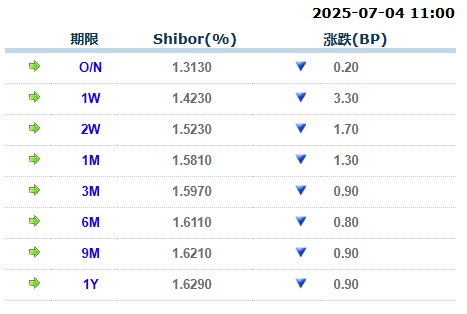
Group 1 - The People's Bank of China (PBOC) conducted a 340 billion yuan reverse repurchase operation with an interest rate of 1.40%, maintaining the previous level, resulting in a net withdrawal of 4,919 billion yuan due to 5,259 billion yuan of reverse repos maturing on the same day [1] - For the week, the PBOC executed a total of 6,522 billion yuan in reverse repos, with 20,275 billion yuan maturing, leading to a cumulative net withdrawal of 13,753 billion yuan [1] - The Shanghai Interbank Offered Rate (Shibor) for various tenors has been declining, with the overnight Shibor down by 0.20 basis points to 1.3130%, and the 7-day Shibor down by 3.30 basis points to 1.4230% [1] Group 2 - In the interbank pledged repo market, the rate declines have slowed, with the overnight weighted average rates for DR001 and R001 down by 0.1 basis points and 1.1 basis points, respectively, while transaction volumes increased significantly [4] - The overall funding environment on July 4 was described as relaxed, with overnight rates for various transactions showing a downward trend, indicating a continued loose monetary condition [8] - As of July 4, there were 114 interbank certificates of deposit issued, with an actual issuance volume of 124.64 billion yuan, reflecting active market participation [9]
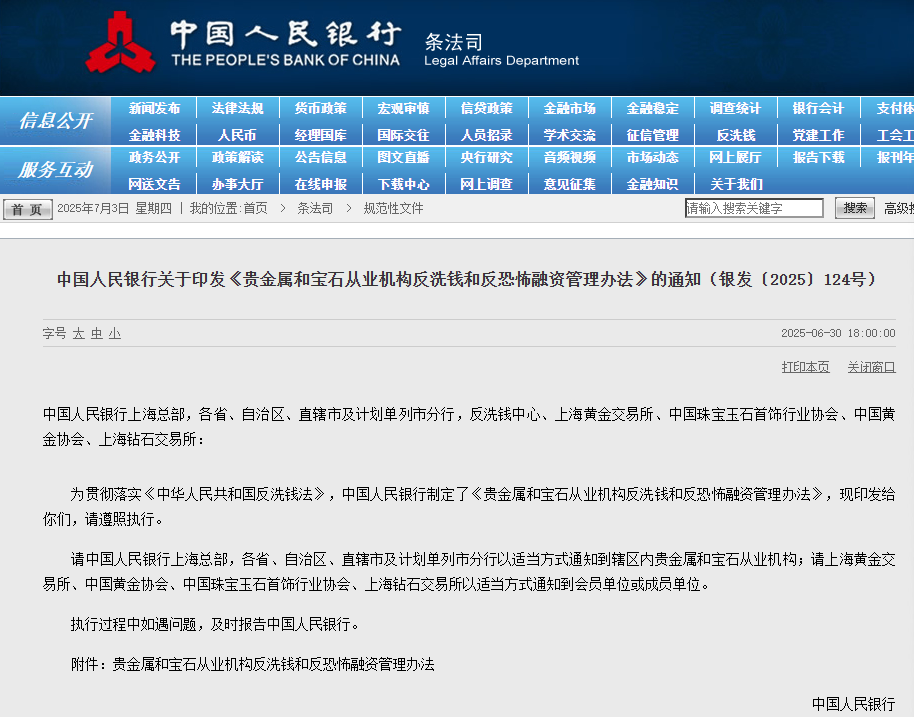
现金购金宝石超10万需上报,央行反洗钱新规8月1日生效
Huan Qiu Wang· 2025-07-03 02:24
Core Viewpoint - The People's Bank of China has issued new regulations aimed at enhancing anti-money laundering (AML) measures for precious metals and gemstones trading institutions, effective from August 1 [1][3]. Group 1: Regulatory Changes - The new regulation raises the reporting threshold for cash transactions from 50,000 RMB to 100,000 RMB, expanding the number of precious metals and gemstones businesses subject to regulation [3]. - Precious metals, defined to include gold, silver, platinum, and their various forms, along with gemstones like diamonds and jade, are now under stricter AML obligations [3]. Group 2: Compliance Requirements - Institutions engaged in cash transactions of 100,000 RMB or more must fulfill AML obligations, including customer due diligence and reporting large transactions within five working days to the Anti-Money Laundering Monitoring and Analysis Center [3]. - The regulation emphasizes the "Know Your Customer" principle, requiring enhanced scrutiny in cases of significant cash transactions or suspicion of money laundering activities [3]. Group 3: Impact on Financial Stability - The introduction of these regulations is expected to close loopholes used by criminals for money laundering, thereby contributing to the maintenance of financial order and social stability [4]. - In 2024, the People's Bank of China, in collaboration with other departments, has already made significant progress in combating money laundering, receiving over 11,000 suspicious transaction reports and assisting in the resolution of numerous cases [4].
★额度5000亿元 央行设立服务消费与养老再贷款
Zhong Guo Zheng Quan Bao· 2025-07-03 01:56
Group 1 - The People's Bank of China (PBOC) has established a "Service Consumption and Elderly Refinance" tool to encourage financial institutions to increase support for key service consumption areas and the elderly industry [1][2] - The total refinancing quota for this initiative is set at 500 billion yuan, with an annual interest rate of 1.5% and a maximum term of 3 years [1] - The policy will be executed until the end of 2027, involving 26 national financial institutions that can independently decide on loan issuance based on risk [1][2] Group 2 - The focus of current economic policy in China is on expanding domestic demand and boosting consumption, with service consumption being a key area for consumption upgrade [2] - The new refinancing tool is part of an innovative measure by the PBOC to support consumption and is designed to work in coordination with fiscal and other industry policies [2]
央行:8月1日起 现金买金超10万元需上报
news flash· 2025-07-02 07:12
近日,中国人民银行发布"中国人民银行关于印发《贵金属和宝石从业机构反洗钱和反恐怖融资管理办 法》的通知(银发〔2025〕124号)"(以下简称《办法》)。其中提到,从业机构开展人民币10万元以上(含 10万元)或者等值外币现金交易的,应当根据《办法》规定履行反洗钱义务。客户单笔或者日累计金额 人民币10万元以上(含10万元)或者等值外币现金交易,从业机构应当勤勉尽责,遵循"了解你的客户"原 则,根据客户特征和交易活动的性质、洗钱风险状况,开展客户尽职调查。客户单笔或者日累计金额人 民币10万元以上(含10万元)或者等值外币现金交易的,从业机构应当按照规定在交易发生之日起5个工 作日内向中国反洗钱监测分析中心提交大额交易报告。《办法》自2025年8月1日起施行。(央视新闻) ...
货币市场日报:7月1日
Xin Hua Cai Jing· 2025-07-01 14:01
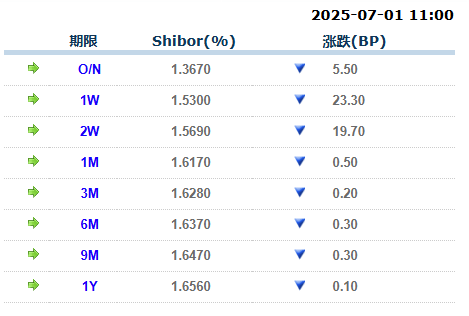
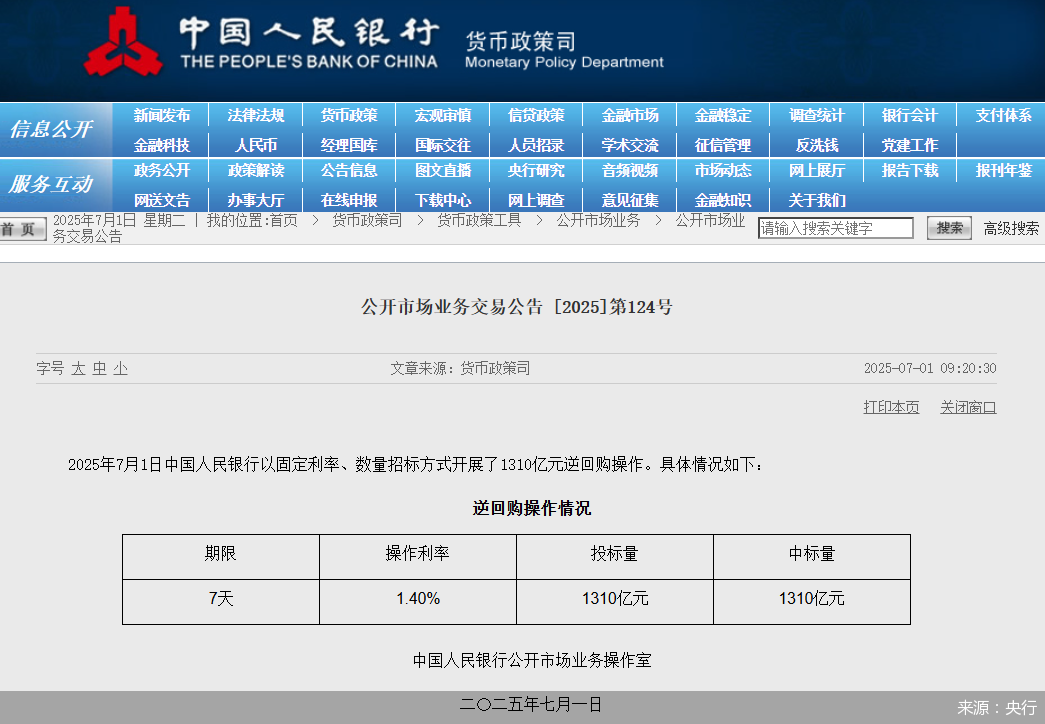
Group 1 - The People's Bank of China conducted a 131 billion yuan 7-day reverse repurchase operation at an interest rate of 1.40%, maintaining the previous rate, resulting in a net withdrawal of 275.5 billion yuan due to 406.5 billion yuan of reverse repos maturing on the same day [1] - The Shanghai Interbank Offered Rate (Shibor) saw declines across all maturities, with the 7-day and 14-day rates leading the drop; specifically, the overnight Shibor fell by 5.50 basis points to 1.3670%, the 7-day Shibor decreased by 23.30 basis points to 1.5300%, and the 14-day Shibor dropped by 1.10 basis points to 1.7660% [1][2] Group 2 - In the interbank pledged repo market, the R001 rate plummeted by over 80 basis points, with significant increases in transaction volumes; the weighted average rates for DR001 and R001 fell by 14.3 basis points and 84.6 basis points, respectively, with transaction amounts rising to 9.64 billion yuan and 222.68 billion yuan [6] - The money market rates showed a trend towards easing, with overnight rates trading around 1.40% and 7-day rates around 1.58% by the end of the day, indicating a shift to a more relaxed liquidity environment [10] Group 3 - The China Banking Research Institute reported that the net interest margin for commercial banks in the first quarter of 2025 was 1.43%, a year-on-year decrease of 0.11 percentage points, marking a historical low; however, the decline rate has narrowed compared to the same period in 2024 [13] - The China Fund Industry Association indicated that in May 2025, 132 new asset-backed special plans were registered, with a total new registration scale of 120.619 billion yuan [13]
逾2万亿元逆回购到期!跨季后资金面怎么走
Bei Jing Shang Bao· 2025-07-01 12:16
Core Viewpoint - The People's Bank of China (PBOC) has initiated a 7-day reverse repurchase operation of 131 billion yuan at a fixed rate of 1.40%, indicating a seasonal liquidity easing in July, with expectations for a slight decline in funding rates [1][4][5]. Monetary Policy Actions - On July 1, the PBOC conducted a reverse repo operation of 1310 billion yuan, with both bidding and winning amounts matching this figure, and the operation rate set at 1.40% [1][4]. - A total of 4065 billion yuan in reverse repos is set to mature, leading to a net withdrawal of 2755 billion yuan from the open market [1]. Market Conditions - The market is expected to experience seasonal easing in July, with funding rates likely to stabilize and slightly decline [5][6]. - The Shanghai Interbank Offered Rate (Shibor) showed mixed movements, with overnight Shibor rising by 5.1 basis points to 1.422% and 7-day Shibor increasing by 9.5 basis points to 1.763% prior to July 1 [4]. Economic Outlook - The first half of the year showed strong economic performance, reducing the likelihood of significant interest rate cuts or reserve requirement ratio reductions in the short term [7][8]. - The PBOC aims to maintain ample liquidity and guide financial institutions to increase credit supply, aligning the growth of social financing and money supply with economic growth targets [5][9]. Future Expectations - The liquidity easing trend is expected to continue, with the PBOC likely to implement measures to ensure market liquidity remains abundant [6][9]. - The central bank may utilize various tools, including Medium-term Lending Facility (MLF) and reverse repos, to manage liquidity effectively throughout the second half of the year [8][9].
不用等明年元旦,7月1日起,深圳下调存量公积金贷款利率
Nan Fang Du Shi Bao· 2025-07-01 11:36
Core Viewpoint - The People's Bank of China has announced a reduction in the personal housing provident fund loan interest rates, effective from May 8, 2025, impacting both new and existing loans [2] Group 1: Interest Rate Adjustments - The interest rates for first-time homebuyers will be adjusted to 2.1% for loans under 5 years and 2.6% for loans over 5 years [2] - For second-time homebuyers, the rates will be set at no less than 2.525% for loans under 5 years and 3.075% for loans over 5 years [2] - Existing loans will see a rate adjustment starting January 1, 2026, with quarterly adjustments thereafter as per local regulations [2] Group 2: Current Mortgage Rates and Policies - The latest mortgage rates in Shenzhen are 3.05% for first-time homebuyers and 3.45% for second-time homebuyers [3] - The minimum down payment for first-time and second-time homebuyers is 20%, while it is 15% for purchasing affordable housing [3] - A simulation shows that for a 1 million yuan, 30-year provident fund loan, the monthly payment will decrease by approximately 132.17 yuan, saving about 48,000 yuan in interest over the loan term [3]

央行加大货币政策调控强度,应对内需不足、物价低位双重挑战
Sou Hu Cai Jing· 2025-06-30 01:43
Core Viewpoint - The People's Bank of China (PBOC) is adjusting its monetary policy to enhance its effectiveness and responsiveness to the current complex economic environment, indicating a more proactive approach in policy implementation [1][3]. Economic Analysis - The meeting highlighted the increasingly complex and severe external environment, with weakened global economic growth and rising trade barriers. Internally, it emphasized insufficient domestic demand and the new challenge of persistently low prices, providing a more detailed analysis compared to previous meetings [3][4]. Policy Adjustment - The monetary policy committee stressed the importance of maintaining ample liquidity and guiding financial institutions to increase credit supply. It aims to align the growth of social financing and money supply with economic growth and price level expectations, reflecting a coordinated approach between monetary policy and economic development goals [4][5]. - Recommendations were made to strengthen the central bank's policy interest rate guidance and improve the market-based interest rate transmission mechanism, with a focus on reducing overall financing costs [4]. Structural Policy Tools - The meeting called for specific measures to deepen financial supply-side structural reforms, urging large banks to enhance their role in supporting the real economy while smaller banks focus on their core responsibilities. This indicates a clear understanding of the differentiated roles of various financial institutions [5]. - Emphasis was placed on effectively implementing various structural monetary policy tools, particularly in supporting technology innovation and boosting consumption. The meeting also highlighted the need to stabilize the capital market through mechanisms like stock repurchase and loan facilitation [5]. - In the real estate sector, the focus shifted from merely stabilizing the market to consolidating its stability, with calls to enhance the vitality of existing properties and land, reflecting a slight adjustment in policy focus [5].