吉利汽车

Search documents
吉利汽车(00175)因认股权获行使而发行合共33.6万股
智通财经网· 2025-12-31 07:17
智通财经APP讯,吉利汽车(00175)发布公告,于2025年12月31日因认股权获行使而发行合共33.6万股; 根据日期为2025年7月15日的合并协议以2025年9月5日股东特别大会获批准的特别授权而发行1.58亿股 代价股份。 ...
李书福2026新年致辞:关键时刻 不惑不辍
Yang Shi Wang· 2025-12-31 07:01
Core Viewpoint - Geely Holding Group emphasizes its commitment to electric and intelligent transformation while reflecting on its 40-year journey and calling for collaboration and talent development to create a sustainable future [3][4][5]. Group 1: Company Development and History - Geely has evolved from manufacturing refrigerator parts to becoming a significant player in the automotive industry, overcoming numerous challenges along the way [4]. - The company pioneered the production of affordable cars in China, marking a significant milestone for private enterprises in the automotive sector [4]. - In 2007, Geely shifted its focus from low-cost competition to technology, quality, and brand development, laying the groundwork for future growth [4]. - The acquisition of Volvo in 2010 was a pivotal moment, allowing Geely to support the revitalization of a historic brand while maintaining a commitment to safety and sustainability [4]. - The launch of the "Smart Geely 2025" strategy in 2021 marked a comprehensive embrace of new energy and intelligent technologies [4]. Group 2: Current Strategies and Innovations - Geely is focusing on technological innovation, brand enhancement, globalization, and green development to strengthen its core capabilities [5][6]. - The company has made significant advancements in battery technology and AI integration, launching flagship models that embody its commitment to electric and intelligent vehicles [6]. - Geely's "天地一体化" (Heaven and Earth Integration) strategy aims to create a comprehensive mobility ecosystem, enhancing the development of smart connected vehicles [6][7]. Group 3: Globalization and ESG Initiatives - Geely is actively pursuing globalization through regional cooperation, local operations, and strategic partnerships, including collaborations in Malaysia and Brazil [7]. - The company is committed to achieving carbon neutrality by 2045, with ongoing projects in green factory construction and the launch of the world's first dual-use hydrogen-electric vessel [7]. - Geely's focus on ESG principles reflects its dedication to sustainable development and social responsibility [7]. Group 4: Future Outlook and Goals - Looking ahead to 2026, Geely aims to deepen its electric and intelligent transformation, focusing on innovation in core areas such as new energy technology and smart connectivity [9]. - The company plans to invest significantly in youth innovation and entrepreneurship, establishing a supportive environment for talent development [9][10]. - Geely recognizes the evolving competitive landscape, emphasizing the importance of a platform and ecosystem approach to remain relevant in the automotive industry [9].


吉利汽车(00175) - 翌日披露报表
2025-12-31 07:00
FF305 翌日披露報表 (股份發行人 ── 已發行股份或庫存股份變動、股份購回及/或在場内出售庫存股份) 表格類別: 股票 狀態: 新提交 公司名稱: 吉利汽車控股有限公司 呈交日期: 2025年12月31日 如上市發行人的已發行股份或庫存股份出現變動而須根據《香港聯合交易所有限公司(「香港聯交所」)證券上市規則》(「《主板上市規則》」)第13.25A條 / 《香港聯合交易所有限公司GEM證券 上市規則》(「《GEM上市規則》」)第17.27A條作出披露,必須填妥第一章節 。 | 第一章節 | | | | | | | | | | | --- | --- | --- | --- | --- | --- | --- | --- | --- | --- | | 1. 股份分類 | 普通股 | | 股份類別 不適用 | | | 於香港聯交所上市 | | 是 | | | 證券代號 (如上市) | 00175 | | 說明 | | | | | | | | 多櫃檯證券代號 | 80175 | RMB | 說明 | | | | | | | | A. 已發行股份或庫存股份變動 | | | | | | | | | | | 事件 ...
2025汽车行业年鉴 | 出海篇:时隔40年的历史呼应:中国汽车开启“技术换市场”时代
Jing Ji Guan Cha Wang· 2025-12-31 06:28
Core Insights - The Chinese automotive export sector has shown resilience and exceeded expectations in 2025, with a projected total export volume of 8 million vehicles, driven primarily by a 62% increase in new energy vehicle exports [2][4] - The export landscape is evolving, with a shift towards emerging markets and innovative export models, including local resource integration and technology transfer [2][4][6] Group 1: Export Performance - In the first eleven months of 2025, cumulative automotive exports reached 7.33 million units, marking a 25.7% year-on-year increase [2] - The strong performance in exports has prompted a reassessment of earlier predictions, which anticipated only a 10% growth rate due to geopolitical challenges and tariff pressures [2][4] Group 2: Market Dynamics - The export market is witnessing a reconfiguration, with Chinese automakers aggressively targeting Europe while simultaneously expanding into emerging markets such as Southeast Asia, Africa, and Latin America [4][5] - Mexico is emerging as a key overseas market for Chinese vehicles, with brands like BYD and Xpeng establishing a presence [4][5] Group 3: Strategic Shifts - The export strategy is transitioning from merely selling vehicles to a more integrated approach involving technology, standards, and supply chain collaboration [6] - Localized production is becoming a focal point, with several Chinese automakers establishing factories in Europe to enhance their market presence [5][6] Group 4: Future Challenges - The upcoming years will present significant challenges, particularly in navigating stringent European regulations and establishing brand credibility [7][8] - The 2026 landscape will see a focus on smart technology exports, with L3 autonomous driving expected to become commercially viable, further enhancing the value proposition of Chinese automotive brands [7][9] Group 5: Collaborative Approaches - Companies are exploring innovative models to mitigate risks associated with entering the European market, including partnerships with established suppliers and local entities [9] - The trend of "technology for market access" is resurfacing, as some European nations seek collaboration with Chinese firms in the face of their own technological challenges [9]
飞荣达:消费电子客户包括H公司、三星、荣耀、联想、戴尔、Meta及其他重要客户等
Xin Lang Cai Jing· 2025-12-31 06:23
Core Viewpoint - The company Feirongda (300602.SZ) has a diverse range of applications for its products across various sectors, including consumer electronics, network communication, data centers, servers, new energy vehicles, photovoltaic energy storage, artificial intelligence, medical devices, and home appliances [1][4]. Group 1: Client Segments - Data center and server clients include major companies such as H Company, ZTE, Cisco, Inspur, Datang Mobile, Yonghong Super Micro, H3C, Super Fusion, Lenovo, Wistron, Wistron NeWeb, Compal, Asus, Oriental Communication, and Shenzhou Kuntai [1][4]. - Consumer electronics clients feature prominent names like H Company, Samsung, Honor, Lenovo, Dell, HP, Xiaomi, and Meta, among others [1][4]. - Other consumer clients include GoerTek and Sony [1][4]. Group 2: New Energy and Automotive Clients - New energy vehicle battery manufacturers include CATL, BYD, Xinwangda, LG New Energy, Zhongchuang Xinhang, Ruipu Lanjun, Guoxuan High-Tech, and Funeng Technology [1][4]. - Automotive clients consist of GAC, BAIC, Changan, Geely, Li Auto, NIO, Xiaopeng, and Seres [1][4]. Group 3: Inverter and Control Clients - Inverter clients include H Company, GoodWe, and Solis, among other significant customers [1][6]. - Control system clients comprise Huichuan and Weimais [1][6].


2025,车企跨界造“人”
Tai Mei Ti A P P· 2025-12-31 06:22
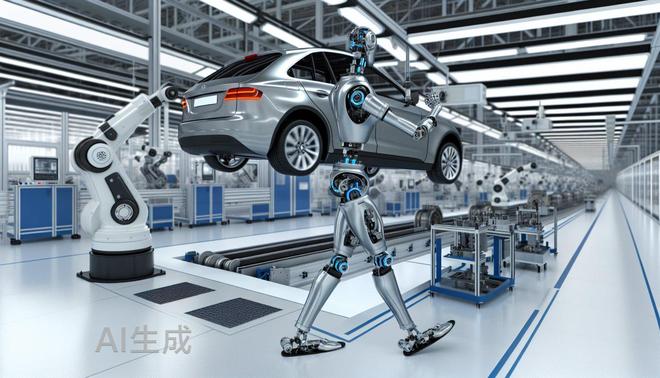
Core Insights - The rise of humanoid robots has become a significant trend in the tech industry, with automotive companies increasingly investing in humanoid robot development as a new growth avenue amidst slowing market growth in traditional automotive sectors [2][20][26] - Tesla's humanoid robot, Optimus, is positioned as a key product for the company's future, with expectations that it will contribute significantly to Tesla's overall value [3][4][20] - Chinese automakers, including Xpeng and BYD, are also making strides in humanoid robotics, with Xpeng's IRON robot showcasing advanced capabilities and aiming for mass production by the end of 2026 [8][10][26] Industry Trends - The automotive sector is witnessing a collective push towards humanoid robotics, with nearly all major car manufacturers increasing their involvement in this field [2][7] - Companies are adopting various strategies, including full-stack self-research and partnerships with established robotics firms, to accelerate their entry into the humanoid robot market [10][11] - The market is expected to see a significant increase in humanoid robot deployment, with projections suggesting a market size of $5 trillion by 2050 [27] Technological Challenges - The development of humanoid robots faces significant technical hurdles, particularly in achieving stability and functionality in real-world environments [12][13][15] - Key challenges include the complexity of creating dexterous hands, stable locomotion, and advanced AI capabilities for real-time decision-making [14][16][17] - Current production methods are still largely manual, limiting the scalability of humanoid robot manufacturing [18] Market Dynamics - The entry of automotive companies into humanoid robotics is seen as a strategic move to diversify and mitigate risks associated with traditional automotive business cycles [20][21] - The overlap in technology and components between electric vehicles and humanoid robots provides automotive companies with a competitive advantage in this new market [21][22] - The industry is at a critical juncture, with the potential for significant breakthroughs or the risk of stagnation due to unresolved challenges [27]


汽车延续两新补贴,利好中高端车
HTSC· 2025-12-31 05:38
证券研究报告 汽车 汽车延续两新补贴,利好中高端车 华泰研究 2025 年 12 月 31 日│中国内地 动态点评 SAC No. S0570525020001 wanglixian@htsc.com +(86) 755 8249 2388 张高栋* 联系人 SAC No. S0570124120007 zhanggaodong@htsc.com +(86) 10 6321 1166 行业走势图 (5) 5 14 24 33 Jan-25 May-25 Sep-25 Dec-25 (%) 汽车 沪深300 资料来源:Wind,华泰研究 重点推荐 | | | 目标价 | | | --- | --- | --- | --- | | 股票名称 | 股票代码 | (当地币种) | 投资评级 | | 小鹏汽车-W | 9868 HK | 122.71 | 买入 | | 吉利汽车 | 175 HK | 27.07 | 买入 | | 比亚迪 | 002594 CH | 136.93 | 买入 | | 理想汽车-W | 2015 HK | 84.80 | 买入 | 汽车 增持 (维持) | 12 月 30 日,国家发展改革委 ...

2025年终盘点|“握指成拳、刀口向内”回归聚焦战略 车企整合大幕开启
Xin Lang Cai Jing· 2025-12-31 04:08
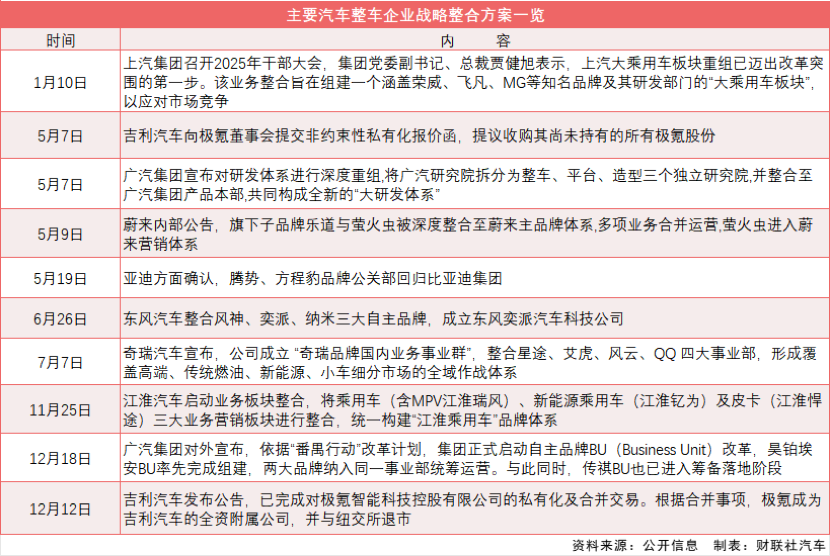
Core Viewpoint - The automotive industry is undergoing significant transformation, prompting major companies to consolidate and streamline operations to enhance efficiency and competitiveness in a challenging market environment [1][3]. Group 1: Industry Trends - Major domestic automakers, including SAIC, Dongfeng, GAC, Chery, and Geely, are adopting internal consolidation strategies to prepare for future market challenges by reducing inefficiencies and focusing resources [1][2]. - The shift from a multi-brand strategy to a more unified approach is seen as essential for survival in the increasingly competitive automotive landscape [5]. Group 2: Company Actions - SAIC Group has initiated a restructuring of its passenger vehicle segment, integrating brands like Roewe, Feifan, and MG into a single unit to better compete in the market [2]. - Geely has completed the privatization and merger of Zeekr Intelligent Technology, consolidating its brands under a unified structure, marking a significant shift in its multi-brand strategy [2][3]. - GAC Group has launched a Business Unit reform, consolidating its brands into a more cohesive operational structure to enhance efficiency and market responsiveness [3][4]. - JAC Motors has also begun integrating its passenger vehicle, new energy vehicle, and pickup truck segments into a unified brand system to strengthen its market position [4]. Group 3: Market Dynamics - The number of manufacturers achieving sales of 100,000 units or more by November 2025 is projected to be eight, collectively holding 57% of the passenger vehicle market share, indicating a trend towards consolidation [5]. - The competitive landscape is shifting from product-centric strategies to a focus on resource integration and organizational agility, emphasizing the need for companies to adapt to new market demands [4][5].

江苏欧瑞森检测进入吉利汽车研究院供应商体系
Xin Lang Cai Jing· 2025-12-31 04:06
据凯龙高科消息,其全资子公司江苏欧瑞森检验技术服务有限公司中标吉利汽车研究院整车转毂委外试 验项目,进入吉利汽车研究院供应商体系,成为核心供应商体系成员。 ...
车企孵化的智能化公司,为何多数都难善终?
雷峰网· 2025-12-31 03:44
Core Viewpoint - The article discusses the challenges faced by automotive companies in their pursuit of smart driving technology, highlighting the high expectations and subsequent failures of many startups in this sector, often resulting in a rapid rise and fall [2][3]. Group 1: Challenges in Smart Driving Startups - Two notable events in 2025 marked a downturn in the smart driving industry, with major companies like Maomao Zhixing and Dazhuo Intelligent facing significant operational challenges [2]. - The decline of these companies reflects broader issues within the automotive industry's approach to smart technology, including unclear positioning, resource misallocation, and cultural clashes between traditional automotive and tech talent [2][4]. Group 2: Equity Structure Issues - Many smart driving companies established by traditional automakers suffer from problematic equity structures, often leading to conflicts in decision-making and operational inefficiencies [5][6]. - For instance, Maomao Zhixing is over 53% controlled by Great Wall Motors, which has led to a lack of decision-making power for its management team, ultimately contributing to its struggles [6][10]. - Dazhuo Intelligent's structure, with 80% ownership by Chery, similarly restricts its founder's ability to drive technological innovation due to a lack of authority [10][11]. Group 3: Strategic Positioning Confusion - The strategic positioning of many smart driving companies remains ambiguous, often serving as mere suppliers to their parent companies rather than independent market players [17][18]. - Maomao Zhixing's initial focus was to provide smart driving solutions exclusively for Great Wall Motors, which tied its success to the parent company's market performance [18][19]. - This dependency on a single client has led to operational difficulties, especially when Great Wall Motors sought alternative suppliers for smart driving technology [19][20]. Group 4: Cultural Conflicts - The cultural clash between traditional automotive companies and tech startups creates significant barriers to innovation and talent retention [29][30]. - Traditional automotive firms often have rigid hierarchical structures and lengthy approval processes, which hinder the agility required in the fast-paced tech environment of smart driving [29][30]. - This cultural mismatch has resulted in missed opportunities for smart driving companies to attract top talent and respond swiftly to market changes [30][31]. Group 5: Competitive Pressures - The emergence of tech giants like Huawei and Baidu has intensified competition, as they offer comprehensive solutions that outpace the capabilities of traditional automaker startups [38][39]. - Huawei's substantial investment in smart driving technology, exceeding 10 billion annually, has positioned it as a market leader, further squeezing the viability of smaller, automaker-affiliated startups [39][40]. - As traditional automakers enhance their own R&D capabilities, the original purpose of these smart driving companies—to fill technological gaps—has diminished, leading to their integration or dissolution [40][41].