易方达基金

Search documents
多只跟踪日经225指数的产品发布溢价风险提示
Zheng Quan Shi Bao Wang· 2025-11-19 08:28
Core Viewpoint - Several ETFs tracking the Nikkei 225 index, including the Huazhong Mitsubishi UFJ Nikkei 225 ETF and the E Fund Tomorrow Nikkei 225 ETF, have issued premium risk alerts, advising investors to be cautious of premium risks in secondary market trading [1] Group 1 - The ETFs have highlighted the potential for significant losses if investors purchase at high premiums [1]
ETF市场日报 | 黄金股、有色金属相关ETF全线走强!传媒板块回调居前
Sou Hu Cai Jing· 2025-11-19 08:22
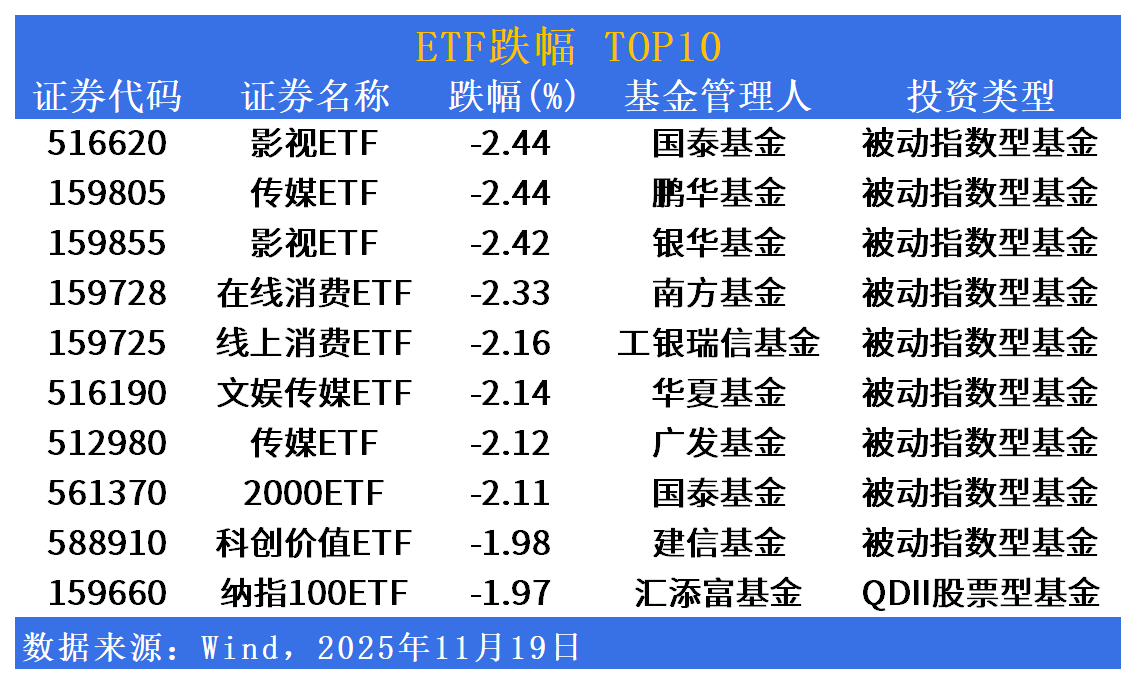
Market Overview - The A-share market showed mixed performance with the Shanghai Composite Index rising by 0.18%, while the Shenzhen Component Index slightly declined, and the ChiNext Index increased by 0.25% [1] - The total trading volume in the Shanghai and Shenzhen markets reached 1,725.9 billion [1] ETF Performance - Gold-related ETFs led the gains, with several ETFs rising over 4%, including Gold Stock ETF (517520) and Gold Stock ETF (517400) [2] - Conversely, film and media-related ETFs experienced significant declines, with the top three ETFs in this category dropping by approximately 2.44% [4] Industry Insights - The Ministry of Industry and Information Technology highlighted the critical role of industrial policies in promoting stable growth in the non-ferrous metals industry, which has become the largest producer and consumer globally [3] - In the first half of 2025, the added value of the non-ferrous metals industry grew by 7.6% year-on-year, outpacing the average growth rate of the industrial sector by 1.2 percentage points [3] Trading Activity - The Silver Hua Daily ETF (511880) recorded the highest trading volume at 20.155 billion [6][7] - The turnover rate for the Government Bond ETF (511580) was notably high at 303.97% [7] New ETF Launch - The Southbound Hong Kong Dividend ETF (159127) is set to launch, tracking the CSI Hong Kong Stock Connect High Dividend Investment Index, targeting investors seeking stable returns and cash flow [8]

超270亿,连续加仓!
Zhong Guo Ji Jin Bao· 2025-11-19 06:49
Group 1 - On November 18, the stock ETF market saw a net inflow of over 5.5 billion yuan, despite a collective decline in the three major A-share indices [2][3] - The total scale of all stock ETFs reached 4.58 trillion yuan, with a total trading volume of 192.6 billion yuan on the same day [3] - The net inflow of funds into the stock ETF market has accumulated to over 27 billion yuan over the past three days [2][3] Group 2 - The top inflow products included the ChiNext ETF with 1.12 billion yuan, followed by the AI ETF and the old technology index ETF with 794 million yuan and 725 million yuan respectively [5] - The battery ETF, the largest in its category, received a net inflow of 240 million yuan on November 18, totaling over 900 million yuan in the last three trading days [3][5] - The Hong Kong Stock Connect non-bank ETF also attracted 232 million yuan in net inflow, bringing its latest scale to 25.3 billion yuan [4] Group 3 - Conversely, industry theme ETFs experienced a net outflow of 1.58 billion yuan, with significant withdrawals from semiconductor, banking, and other sector ETFs [6][7] - The largest outflow was seen in the non-ferrous metals ETF, which lost 420 million yuan, followed by the FIF 50 ETF with a 372 million yuan outflow [7] - The overall scale of broad-based ETFs decreased by 13 billion yuan, indicating a shift in investor sentiment [6] Group 4 - Leading public fund companies, such as E Fund, reported continued inflows into their ETFs, with a total scale of 812.83 billion yuan and a net inflow of 2.91 billion yuan on November 18 [8] - E Fund's ChiNext ETF saw a net inflow of 1.12 billion yuan, while the gold ETF and the Hang Seng Technology ETF also attracted significant investments [8] - The market outlook suggests a focus on technology and high-end manufacturing sectors, with AI hardware expected to be a key market driver in the coming year [8][9]

超270亿,连续加仓!
中国基金报· 2025-11-19 06:45
昨日(11月18日), A股三大指数集体收跌 。市场调整中,股票ETF获得资金加仓,全市场 股票ETF(含跨境ETF)资金净流入超55亿元,港股ETF净流入居前 。 近日市场调整以来,股票ETF市场已经连续三日加仓,累计净流入资金超270亿元。 【 导读 】 昨日股票ETF市场净流入资金55亿元 中国基金报记者 王建蔷 股票ETF净流入资金55亿元 Wind数据显示,截至11月18日,全市场1258只股票ETF总规模达4.58万亿元。 当日股票ETF成交合计1926亿元,与前一交易日1796亿元相比有所放大。其中,香港证券 ETF成交88.08亿元,位居首位。 市场持续震荡,股票ETF再度获得资金净申购。 Wind数据显示,11月18日,股票ETF市场总 份额增加52.26亿份,按照成交均价测算,当日净流入资金约为55.24亿元。 从全市场ETF来看,11月18日资金净流入 73.8亿元 。从大类型来看,债券ETF与港股市场 ETF净流入居前,分别为44.92亿元与35.17亿元。 具体到指数维度,11月18日恒生科技 指数 单日净流入居前,达27.71亿元。从5日角度观 测,资金流入SGE黄金9999指数超 ...

11月以来公告上市股票型ETF平均仓位20.97%
Zheng Quan Shi Bao Wang· 2025-11-19 03:18
Core Insights - Two stock ETFs have announced their listing, with the highest stock position being 46.74% for the Bosera National Industrial Software Theme ETF [1] - A total of 17 stock ETFs have announced listings in November, with an average position of only 20.97% [1] - The average fundraising for the newly announced ETFs is 422 million shares, with the leading funds being the China Merchants National Hong Kong Stock Connect Technology ETF and others [1] ETF Positioning - The Bosera National Industrial Software Theme ETF has the highest stock position at 46.74%, followed by the Southern CSI Hong Kong Stock Connect Internet ETF at 45.33% and the China Merchants CSI 800 Free Cash Flow ETF at 44.72% [1] - The lowest positions are held by the Tianhong CSI Agricultural Theme ETF and the Industrial Technology ETF, both at 0.00% [1] Institutional Ownership - The average shareholding by institutional investors is 11.11%, with the highest being 31.99% for the Guolian An Hong Kong Stock Connect Technology ETF [2] - The Tianhong National Hong Kong Stock Connect Technology ETF has the lowest institutional ownership at 0.59% [2] Fundraising and Listing Dates - The newly established stock ETFs have varying fundraising sizes, with the Bosera National Industrial Software Theme ETF raising 613 million shares and the Tianhong CSI Agricultural Theme ETF raising 445 million shares [3] - Listing dates for these ETFs range from November 6 to November 24, 2025 [3]
297只ETF获融资净买入 富国中债7—10年政策性金融债ETF居首
Zheng Quan Shi Bao Wang· 2025-11-19 02:14
Core Viewpoint - As of November 18, the total margin balance for ETFs in the Shanghai and Shenzhen markets reached 123.813 billion yuan, reflecting an increase of 3.81 billion yuan from the previous trading day [1] Summary by Category ETF Financing and Margin Balance - The ETF financing balance stood at 115.675 billion yuan, up by 3.9 billion yuan from the previous trading day [1] - The ETF margin short balance was recorded at 8.138 billion yuan, showing a decrease of 90 million yuan compared to the previous trading day [1] Net Inflows and Top Performers - On November 18, 297 ETFs experienced net financing inflows, with the top performer being the Fortune China Government Bond ETF (7-10 years), which saw a net inflow of 1.739 billion yuan [1] - Other notable ETFs with significant net inflows included the Bosera China Government Bond ETF (0-3 years), Guotai Junan 5-Year Government Bond ETF, Huaan Gold ETF, Hai Fu Tong China Short-term Bond ETF, E Fund ChiNext ETF, and E Fund China Overseas Internet ETF [1]
影响市场重大事件:千问APP国际版将在近期上线;ETF年内发行近2500亿份创历史新高,头部机构占主导;瑞银预计明年中国股市将迎来又一个丰年,更多由盈利驱动
Mei Ri Jing Ji Xin Wen· 2025-11-18 22:14
Group 1: Medical Device Industry in Shanghai - Shanghai Pudong is focusing on micro-nano robots, brain-like intelligence, and new biological materials in the medical device sector [1] - The region has established a solid foundation for the medical device industry, with over 1,200 Class III medical device registrations, accounting for approximately 40% of Shanghai's total [1] - Five innovative medical device products have been launched this year, with several pioneering products showing potential to become major market players [1] Group 2: AI Application Development - Alibaba's Qianwen APP international version is set to launch soon, aiming to compete directly with ChatGPT in the AI to C market [2] - The app quickly rose to the fifth position in the Apple App Store's free applications chart shortly after its public testing began [2] Group 3: Chinese Stock Market Outlook - UBS forecasts a prosperous year for the Chinese stock market in 2026, driven by factors such as innovation and supportive policies for private enterprises [3] - The MSCI China Index target for the end of next year is set at 100, indicating a potential 14% increase from current levels [3] - The market is expected to be more driven by earnings performance, with a positive outlook on internet, hardware technology, and brokerage sectors [3] Group 4: Lithium Battery Industry Challenges - The lithium battery industry is facing severe "involution" challenges, particularly in the lithium iron phosphate materials sector, which is experiencing intense competition and profit pressure [4] - The China Chemical and Physical Power Industry Association is advocating for capacity warning mechanisms to guide the industry [4] Group 5: Pharmaceutical Manufacturing Innovation - The world's first drug manufacturing system for antibody-drug conjugates (ADC) and nucleotide monomer synthesis has been launched in Shanghai [5] - This system significantly reduces the development and optimization cycle from weeks to days, with over 95% of core components being domestically sourced and costs reduced by over 50% compared to similar imported solutions [5] Group 6: ETF Market Growth - The ETF market has seen a historic high in issuance, with 322 ETFs launched this year, an 80% increase from the previous year [6] - Total issuance volume reached 2,446.44 million units, a nearly 92% increase year-on-year, with equity funds being the primary driver [6] - Leading institutions dominate the ETF market, with E Fund, China Universal, and Huaxia Fund being the top issuers [6] Group 7: Financial Support for Automotive Consumption - Beijing is increasing financial support for automotive consumption, particularly for new energy vehicles, through various loan and credit initiatives [7] - The plan includes optimizing financial products for different purchasing scenarios, such as first-time buyers and trade-ins [7] Group 8: Technology Enterprise Development Goals - Beijing aims to incubate 3,000 technology-based enterprises and 600 specialized and innovative enterprises by 2027 [8] - The initiative focuses on transforming significant technological achievements to meet national strategic needs and stimulate economic growth [8] Group 9: Power Interconnection Projects - Five power interconnection projects have been approved, enhancing China's cross-regional power exchange capabilities with a total investment of 24.4 billion yuan [9] - These projects will add 15 million kilowatts of inter-provincial power transmission capacity upon completion [9] Group 10: Technology Innovation Projects in Chongqing - Chongqing has announced 48 technology innovation projects with funding up to 40 million yuan per project, focusing on modern manufacturing and technological innovation [10] - The projects span four categories and twelve key industrial sectors, aligning with the city's strategic development goals [10]
持有期基金成清盘主力流动性风险不可不防
Zhong Guo Zheng Quan Bao· 2025-11-18 20:05
Core Insights - The number of public fund products (excluding asset management plans) that have been liquidated this year is approaching 200, with periodic open and holding period funds being the main contributors, accounting for over 40% of the total liquidated funds [1][2] - The design of holding period funds aimed to reduce friction costs from investors' frequent trading, but many of these funds were launched at market peaks, leading to poor investment experiences for investors [1][5] - The survival space for actively managed equity funds is being increasingly squeezed due to the rapid growth of index investing, with over 70 actively managed equity funds liquidated this year, making up nearly 40% of the total liquidated funds [1][2] Fund Liquidation Trends - As of November 18, nearly 200 public funds have been liquidated this year, a decrease compared to the same period last year [1] - Among the liquidated funds, over 70 are actively managed equity funds, including various types such as mixed equity, flexible allocation, and balanced funds [2] - The majority of liquidated funds are periodic open and holding period funds, with over 30 FOF products also included in this category [2] Shrinking Fund Sizes - In the third quarter, the total number of holding period fund shares decreased by nearly 800 billion, with mixed equity holding period funds seeing a reduction of over 600 billion shares [3][4] - Specific funds like E Fund Quality Momentum and others experienced significant share reductions, with some losing over 50 billion shares [4] - Despite the overall decline, certain categories like "fixed income+" and FOF funds saw growth in their share sizes [4] Considerations for Investors - Holding period funds require careful consideration of liquidity risks, as they restrict redemption while allowing for purchases, which may not suit investors seeking flexibility [6] - The initial intent of holding period funds was to help investors avoid frequent trading, but market conditions and fund management capabilities significantly impact actual investment returns [5][6] - Investors are advised to evaluate the fundamental aspects of holding period funds, including the experience of the research team, investment processes, historical performance, and fee structures before investing [6]

公募机构密集提示跨境ETF高溢价风险
Zheng Quan Ri Bao· 2025-11-18 16:17
Core Viewpoint - Investors should be cautious of the premium risk associated with cross-border ETFs, as recent market conditions indicate a potential overvaluation of these products [1][4]. Group 1: Premium Risks - Multiple public fund institutions have issued warnings regarding premium risks for their cross-border ETFs, particularly those tracking overseas indices like the US and Japan [1][2]. - As of November 18, 34 cross-border investment products from 19 public fund institutions have issued over 330 premium risk alerts, with specific ETFs like the Huaxia Nikkei 225 ETF showing significant premium levels [2][4]. - The average premium rate for 192 cross-border ETFs was 0.79%, with 32 ETFs exceeding 1% and 2 ETFs surpassing 10% [4]. Group 2: Market Conditions - Major overseas indices are experiencing corrections, with the Nikkei 225 index down 3.22% and the Nasdaq, S&P 500, and Dow Jones indices also showing declines in November [4]. - Despite short-term risks, there remains a strong long-term demand for cross-border ETFs, with a net inflow of 34.105 billion yuan in November and a 116.86% increase in total scale to 919.949 billion yuan this year [2][4]. Group 3: Investment Strategies - Analysts emphasize the importance of rational investment frameworks, suggesting that while cross-border ETFs can diversify risks, the focus should be on enhancing research capabilities and investor education rather than merely expanding scale [4][5]. - Investors are advised to maintain a net asset value orientation and a long-term perspective to benefit from global investments, especially in volatile market conditions [5].
单季度合计超500条!跨境ETF溢价风险被密集提示,美日主题产品成“高发区”
Di Yi Cai Jing Zi Xun· 2025-11-18 13:33
Core Insights - The recent surge in cross-border ETFs has led to significant premium risks, with 33 products issuing over 500 premium risk alerts since the fourth quarter began, particularly in US and Japan-themed products [2][4] - The Invesco Great Wall Nasdaq Technology Market Cap Weighted ETF has seen its IOPV premium rate exceed 10% for 25 consecutive trading days, indicating a persistent high premium status [2][5] - The overall scale of cross-border ETFs has increased by nearly 117% year-to-date, significantly outpacing the growth of A-share ETFs, which grew by approximately 28% in the same period [6][7] Premium Risk Alerts - As of November 18, 20 cross-border ETFs issued premium alerts, with the previous trading day seeing 22 alerts, highlighting a trend of frequent premium warnings [3][4] - The frequency of premium alerts has become normalized, with 11 products issuing over 20 alerts each since the start of the fourth quarter [4][5] - The premium situation is not isolated, as multiple products tracking popular indices like Nasdaq 100 and Nikkei 225 are experiencing similar high premium rates [3][4] Market Dynamics - The premium phenomenon reflects a mismatch between QDII quotas and investor demand, alongside factors like index scarcity and foreign exchange volatility, contributing to supply-demand imbalances [6][7] - The cross-border ETF market has seen explosive growth, with the total scale reaching approximately 920.29 billion yuan as of November 17, compared to 424.22 billion yuan at the end of the previous year [6][7] - The number of products exceeding 10 billion yuan in scale has doubled, indicating a strong demand for cross-border investment options [7] Institutional Innovations - Recent regulatory changes have expanded the cross-border investment channels, with six new ETF products included in the "Southbound ETF Connect" list, marking a significant development in the market [8][9] AI Market Sentiment - The discussion around whether the AI sector is experiencing a bubble or genuine growth has intensified, with market volatility increasing due to geopolitical tensions and economic factors [10][11] - Despite short-term fluctuations, many institutions maintain a cautiously optimistic outlook on the US stock market, suggesting that the underlying trends in technology and AI remain strong [11][12]