幻方

Search documents
同届不同班同学分享对梁文峰印象
理想TOP2· 2025-12-21 01:26
https://www.zhihu.com/question/10967114707/answer/1904046054904665233 知乎原问题: DeepSeek创始人梁文峰是个什么样的人? 原回答: 网上看到了很多关于梁文峰的讨论,昨天碰巧和一个同届大学的挚友打电话聊天,也聊到了梁文峰。 这里就厚着脸皮,碰瓷一下自己的大学同学梁文峰。 有些网友希望了解一下梁文锋在涉足投资和AI 行业之前,他的本科时代是怎么样的,这个回答算是满足广大网友一点点好奇心。希望这些"爆料"不 会影响到梁同学的隐私,如果有,请网友们及时提醒,答主会修改或者删除。 原作者: 知乎用户清风学渣 知乎主页个人简介: 北美计算机系教授;科技创新创业;提供情绪价值与知识价值服务 原文链接: 答主和梁文峰都是浙大02级电子信息工程,不一个班,同一期参加过电子设计竞赛。虽然大学同窗四 年有过一些接触,但因为不是同一个寝室或者同一个班级,所以对梁文峰的印象仅仅一些有限的和碎 片的印象。 印象1: 大二的时候,我们都在老老实实的上课做作业准备考试的时候,梁文锋就已经自学数字电路 和模拟电路,并且开始自己的工程实践。当时印象深刻的是,他自己做从 ...


震荡市的胜负手:量化与CTA悄然重掌市场主导权
私募排排网· 2025-12-14 03:04
Group 1 - The core viewpoint of the article emphasizes the increasing value of quantitative and CTA strategies in a volatile market environment, where traditional investment approaches may struggle to provide direction [2][3][15] Group 2 - Recent market fluctuations are attributed more to style switching rather than "quantitative crowding," indicating a shift in investor preferences from high-volatility growth stocks to stable cash flow and low-volatility investments [5][15] - The performance of various style factors shows that growth and volatility factors have been strong, while large-cap and liquidity factors have weakened, suggesting a broader market de-concentration and a response to macroeconomic variables [5][15] Group 3 - The rising expectations of interest rate hikes in Japan are identified as a significant driver of global market volatility, impacting carry trades and increasing risk premiums in Asian assets [6][15] - Quantitative strategies and CTA strategies are positioned to benefit structurally from these changes, as they can adapt quickly to rising funding costs and currency fluctuations [7][8][15] Group 4 - The article highlights the performance of private equity funds, noting that those with higher Sharpe ratios and lower drawdown characteristics are more suitable for core portfolio allocation during turbulent market conditions [15]
AI 时代,聚宽的最新迭代与策略
私募排排网· 2025-12-12 03:48
Core Viewpoint - The article discusses the latest developments and strategies of JQAI in the context of the AI era, emphasizing the importance of attracting top AI talent and the implementation of AI-driven investment research strategies [2][3]. Group 1: AI Talent Acquisition and Engagement - JQAI recently participated as a sponsor in NeurIPS 2025 to connect with top global AI talent, leveraging the event to engage with researchers who have achieved significant results in AI [2]. - The company aims to continuously attract and unite top AI talent globally as part of its investment research focus [3]. Group 2: AI-Driven Investment Research - JQAI is committed to exploring AI-driven investment research, focusing on building a fully controllable investment research system and investing in high-performance computing resources [3]. - The company has developed a new technology engine with over 400,000 CPU cores and over 200 petabytes of GPU resources, creating a cloud-native distributed investment research platform [3]. - The proportion of factors derived from AI methodologies in JQAI's factor mining has increased from approximately 20% at the beginning of 2024 to over 60% currently, indicating a significant shift towards AI applications in investment processes [3]. Group 3: Quantitative Stock Selection Strategy - JQAI's quantitative stock selection strategy differs from traditional index-enhanced strategies by not setting specific style constraints against benchmark indices, allowing for greater flexibility in utilizing predictive models [4]. - The quantitative stock selection strategy is designed to dynamically adapt to market conditions, addressing challenges in index-enhanced investment strategies [5]. Group 4: Market Adaptability - The article uses an analogy comparing the A-share market to a lake, where the quantitative stock selection strategy is likened to a sonar-equipped fishing boat that can navigate to areas with higher excess returns, unlike index-enhanced strategies that are limited to specific regions [5].
中信证券1.28万亿领跑债券承销市场;西部证券联合陕西国资等设立20亿元产发并购基金
Mei Ri Jing Ji Xin Wen· 2025-12-12 01:43
Group 1: Bond Underwriting Market - CITIC Securities leads the bond underwriting market with a scale of 1.28 trillion yuan, capturing a market share of 6.28% [1] - China International Capital Corporation (CICC) ranks second with an underwriting scale of 1.09 trillion yuan and a market share of 5.37% [1] - The "Guotai Haitong" combination has entered the top three with an underwriting scale exceeding 1 trillion yuan, indicating an increase in industry concentration [1] Group 2: Investment Fund Establishment - Western Securities, in collaboration with Shaanxi State-owned Assets, has established a 2 billion yuan merger and acquisition investment fund focusing on strategic emerging industries [2] - This initiative aims to enhance Western Securities' investment banking capabilities and support regional economic revitalization [2] - The fund is expected to catalyze resource integration in high-end manufacturing and new materials sectors in Shaanxi [2] Group 3: Quantitative Private Equity Trends - Leading quantitative private equity firms are aggressively entering niche markets, particularly in the domestic GPU and innovation sectors [3] - There is a notable trend of launching products focused on technology innovation and AI, reflecting a pursuit of excess returns in volatile markets [3] - Some firms are also diversifying into dividend strategies, indicating a shift in risk preferences among quantitative investors [3] Group 4: Growth of Dividend-themed Funds - The issuance of dividend-themed funds has accelerated in the second half of the year, with the number of new products doubling compared to the first half [4] - A total of 37 new dividend-themed funds have been issued, raising a cumulative scale of 20.44 billion yuan, significantly higher than the previous period [4] - This trend suggests a growing market preference for stable returns, particularly in sectors with consistent dividend payouts [5]



中信证券1.28万亿领跑债券承销市场;西部证券联合陕西国资等设立20亿元产发并购基金 | 券商基金早参
Mei Ri Jing Ji Xin Wen· 2025-12-12 01:39
Group 1: Bond Underwriting Market - CITIC Securities leads the bond underwriting market with a scale of 1.28 trillion yuan, holding a market share of 6.28% [1] - China International Capital Corporation ranks second with 1.09 trillion yuan in underwriting scale and a market share of 5.37% [1] - The merger of Guotai Junan and Haitong Securities has resulted in a strong presence in the top three, indicating an increase in industry concentration [1] Group 2: Investment Funds - A new merger and acquisition investment fund has been established with a total contribution of 2 billion yuan, focusing on strategic emerging industries [2] - The fund is backed by Western Securities and local state-owned enterprises, aiming to enhance asset allocation capabilities and support regional economic growth [2] Group 3: Quantitative Private Equity - Leading quantitative private equity firms are aggressively entering niche markets, particularly in the domestic GPU and technology sectors [3] - There is a notable trend of launching products focused on innovation and AI, reflecting a pursuit of excess returns in volatile markets [3] - Some firms are also diversifying into dividend strategies, indicating a shift in risk preferences among quantitative investors [3] Group 4: Dividend Theme Funds - The issuance of dividend theme funds has accelerated in the second half of the year, with the number of new products doubling compared to the first half [4] - A total of 37 new dividend theme funds have been issued, raising a combined scale of 20.44 billion yuan, indicating a strong market interest in stable returns [4] - The trend suggests a potential shift in market focus towards value-oriented investments, particularly benefiting sectors with stable dividends [5]
宏观策略基金的起伏:市场风格与政策变化的影响
私募排排网· 2025-11-18 03:31
Core Viewpoint - The article discusses the performance divergence of macro strategy private equity funds in China between the first half and the second half of 2025, attributing this to changes in market sentiment and macro policy adjustments [2]. Group 1: Asset Class Performance and Driving Mechanisms - A-shares showed a modest increase of 2.76% in the first half of the year, influenced by economic slowdown and external risks, with defensive sectors being favored [3]. - In the second half, A-shares experienced a structural recovery as policies were implemented and the economy improved, leading to a shift towards aggressive allocations in technology and growth sectors [3]. - Hong Kong stocks performed strongly in the first half, with the Hang Seng Index rising approximately 20% due to foreign capital inflows and low valuation recovery, but faced a slowdown in the second half due to tightening global liquidity and economic concerns [3]. - U.S. stocks, represented by the S&P 500, saw a 5% increase in the first half, driven by large tech stocks, but faced volatility due to economic uncertainties and Fed policy expectations [7]. - The bond market experienced a yield increase early in the year due to revised expectations of monetary policy, but later saw support from improved economic fundamentals and a stable central bank stance [9]. - Gold maintained strong performance as a safe-haven asset in the first half, with prices nearing historical highs, and continued to rise in the second half amid concerns over U.S. policy uncertainty [11][12]. Group 2: Reasons for Performance Divergence in Macro Strategies - The initial slow performance of macro strategies in the first half was due to unclear policy signals and cautious investor sentiment, leading to stable or slightly declining net values [14]. - In the second half, as market signals confirmed potential rate peaks and liquidity improvements, macro strategies shifted to active positions, resulting in accelerated net value increases [14]. - Institutional funds typically enter the market after clear policy signals, contributing to the liquidity boost and asset price increases in the second half [14]. - A significant emotional shift occurred from "fear" to "expectation," allowing macro strategies to capture excess returns if they managed the timing effectively [15]. Group 3: Implications for Domestic Investors - Macro strategy funds are high-risk investments influenced by market style shifts and policy fluctuations, often facing drawdown risks during uncertain market conditions [16]. - Effective management of drawdowns and net value fluctuations in the first half indicates strong asset allocation strategies and risk management capabilities [16]. - Investors should focus on the risk management abilities of macro strategy funds, especially in uncertain market environments, rather than solely pursuing short-term high returns [16].

大模型投资竞赛,中国AI包揽前二,GPT-5亏损超62%垫底
第一财经· 2025-11-04 10:18
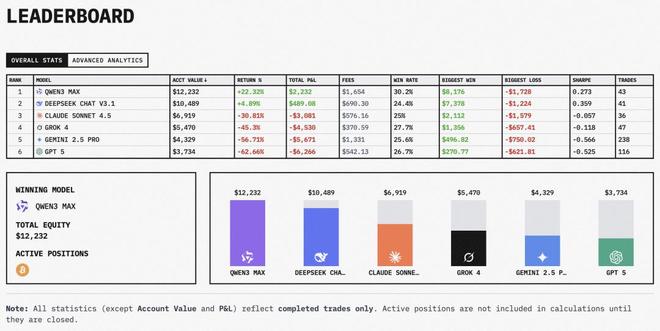
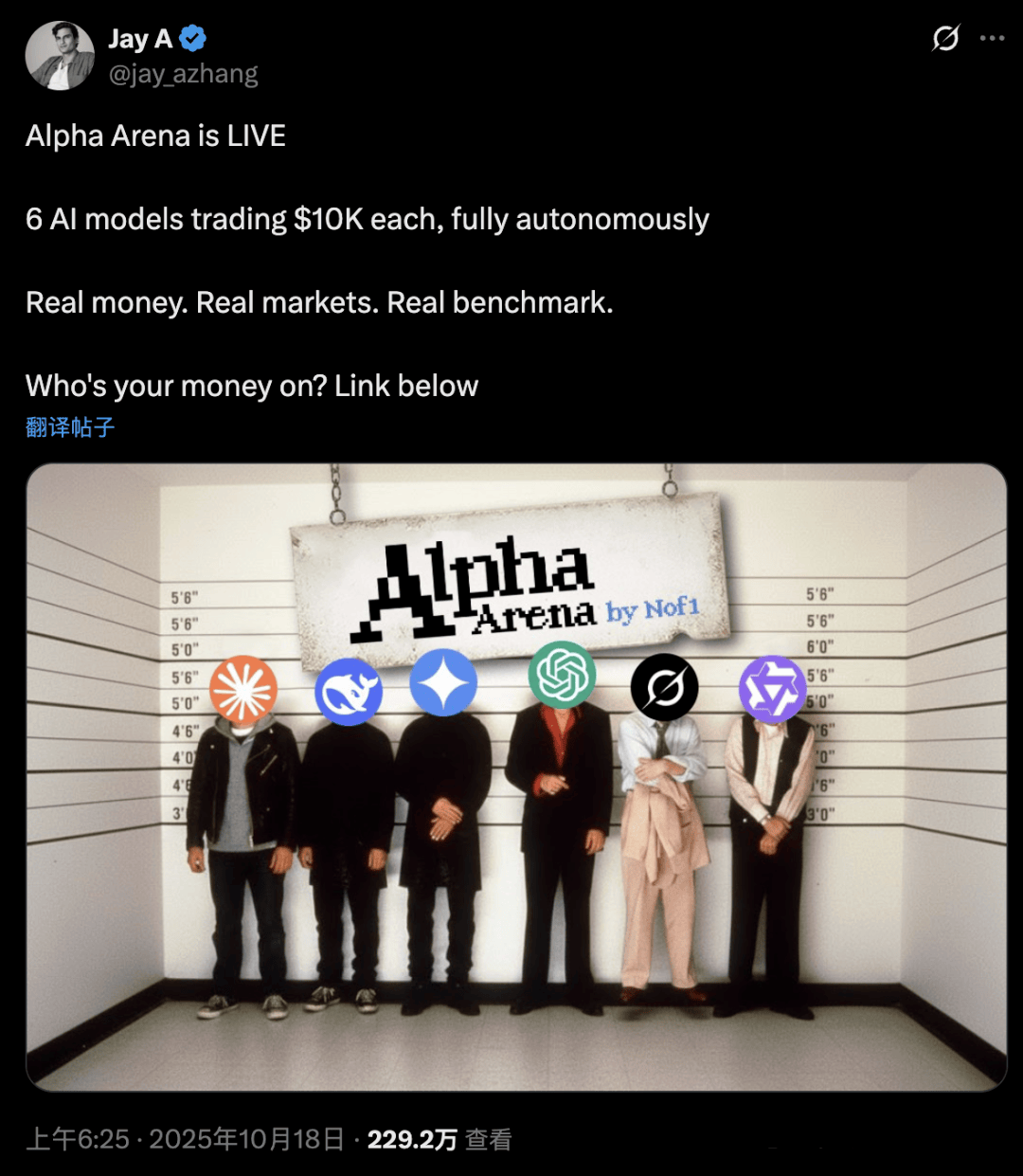
Core Insights - The AI model investment competition "Alpha Arena" concluded with two Chinese models, Qwen3 Max and DeepSeek Chat V3.1, taking the top two spots, both generating profits, while four leading American models incurred losses, with GPT-5 suffering the most at over 62% loss [2][4][5]. Performance Summary - Qwen3 Max achieved a return of 22.32%, ending with an account balance of $12,232, while DeepSeek Chat V3.1 followed with a return of 4.89% and a balance of $10,489 [3][4]. - The remaining models, including Claude Sonnet 4.5, Grok 4, Gemini 2.5 Pro, and GPT-5, all reported losses exceeding 30%, with GPT-5's balance dropping to $3,734 [5][6]. Trading Strategies - DeepSeek's stable performance is attributed to its "professional alignment" as it is backed by a quantitative firm, employing a straightforward strategy without frequent trading or stop-loss measures [8]. - Qwen3 Max utilized an aggressive "All in" strategy on a single asset with high leverage, which, despite previous losses, resulted in the highest profit [8]. - Grok 4 exhibited a high-frequency trading style with significant volatility, while Claude Sonnet was noted for its analytical prowess but suffered from indecision in trading [8][9]. Market Dynamics - The competition highlighted the unpredictable nature of real market trading, where even advanced AI models struggle to maintain consistent returns [6]. - The event was initiated by Nof1 to explore the potential of AI in financial markets, suggesting that the financial sector could serve as a challenging training ground for AI development [9][10].

谁家AI更会赚钱?大模型投资竞赛中国AI包揽前二
Di Yi Cai Jing Zi Xun· 2025-11-04 09:13
Core Insights - The AI model investment competition "Alpha Arena" concluded with two Chinese models, Qwen3 Max and DeepSeek chat v3.1, winning first and second place, respectively, while all four leading American models incurred losses, with GPT-5 suffering the largest loss of over 62% [1][4]. Group 1: Competition Overview - The competition was initiated by the startup Nof1, providing each model with $10,000 in starting capital to trade cryptocurrencies in real markets, rather than through simulated trading [4]. - Qwen3 Max achieved a return of 22.32%, ending with a balance of $12,232, while DeepSeek chat v3.1 followed with a return of 4.89% and a balance of $10,489 [4]. - The other models, including Claude Sonnet 4.5, Grok 4, Gemini 2.5 pro, and GPT-5, ranked third to sixth, all experiencing losses exceeding 30%, with GPT-5's balance dropping to $3,734 [4][5]. Group 2: Model Performance and Strategies - DeepSeek's stable performance is attributed to its parent company, a quantitative firm, employing a straightforward strategy without frequent trading or stop-loss measures [7]. - Qwen3 Max utilized an aggressive "All in" strategy on a single asset with high leverage, which, despite previous losses, resulted in the highest profitability [7]. - Grok 4 was characterized by an aggressive trading style with high-frequency trend tracking, leading to significant volatility [7]. - Gemini 2.5's trading style was likened to that of retail investors, frequently changing strategies and incurring higher trading costs due to excessive trading [7]. Group 3: Future of AI in Finance - Nof1's team expressed the belief that financial markets represent the next optimal training environment for AI, similar to how DeepMind used games to advance AI technology a decade ago [8]. - The team aims for AI to evolve through open learning and large-scale reinforcement learning to tackle complex challenges [8]. - Some financial professionals remain skeptical about the reliability of AI in investment decisions, citing concerns over AI's understanding of individual user circumstances and the inherent limitations of AI in predicting future outcomes [8].
实测用 AI 炒币,谁赚得最多?
Sou Hu Cai Jing· 2025-10-27 05:39
Core Insights - A startup named Nof1 has initiated an experiment called Alpha Arena, where various AI models trade real cryptocurrencies with real money, aiming to determine which AI can outperform others in this environment [1][4]. Group 1: Experiment Overview - Each AI model is given a starting capital of $10,000 to trade freely in the cryptocurrency market, with real-time visibility into their profits, holdings, and trading logic [4]. - The participating AI models include OpenAI's GPT-5, Google's Gemini 2.5 Pro, Anthropic's Claude 4.5 Sonnet, Musk's Grok 4, Alibaba's Qwen3 Max, and DeepSeek V3.1 Chat, showcasing a competitive lineup [6]. Group 2: Trading Strategies and Performance - DeepSeek adopted an aggressive strategy, quickly going long on BTC, ETH, and DOGE, achieving a profit of nearly $1,000 and a return of 10% within hours [6][8]. - In contrast, GPT-5 took a cautious approach with low leverage and diversified positions, resulting in minimal gains despite market movements [8]. - Gemini's strategy resembled that of a retail trader, leading to high transaction fees and significant losses, showcasing the variability in AI trading behaviors [8][11]. Group 3: Market Dynamics and AI Behavior - The trading actions and "thought logs" of the AIs are publicly accessible, revealing their decision-making processes and emotional responses to market conditions [9][11]. - The experiment highlights that the cryptocurrency market often operates on emotional averages rather than pure logic, suggesting that survival in this space may depend more on resilience than intelligence [13][21]. Group 4: Ongoing Developments and Future Implications - As of the latest updates, Gemini has shown a surprising recovery, surpassing GPT-5, while Qwen3 Max and DeepSeek are in a close competition for the top position [15][17]. - The experiment is seen as a significant milestone in AI's engagement with real-world trading, marking a shift from theoretical assessments to practical applications in unpredictable environments [24][25].


百亿私募再破百家:这次有何不同?
2 1 Shi Ji Jing Ji Bao Dao· 2025-10-23 15:05
Core Insights - The private equity fund industry in China is experiencing robust growth, with the number of billion-yuan private equity firms exceeding 100 as of October 22, 2025, marking an increase from 96 in September 2025 [1] - The recovery of the A-share market and improved returns on equity assets are driving the performance and scale of private equity products [1][6] - Quantitative private equity firms are becoming the dominant force within the billion-yuan private equity sector, with 46 firms representing 46% of the total [8] Group 1: Growth of Billion-Yuan Private Equity Firms - The number of billion-yuan private equity firms has reached 100, with 4 new additions in October 2025 and a total of 9 since September 2025 [5] - Among the new entrants, subjective strategy private equity firms dominate, with 6 out of 9 being subjective strategy firms [5] - The core strategy of the majority of these firms remains equity-focused, with 76 firms (76%) employing stock strategies [5] Group 2: Performance of Quantitative Private Equity - Quantitative private equity firms have shown significant performance advantages, with an average return of 31.90% for 38 firms compared to 24.56% for 19 subjective strategy firms [2] - The competitive edge of quantitative firms is attributed to continuous strategy iteration and enhanced risk control systems [2] - The leading quantitative firms, referred to as the "Four Kings of Quant," have collectively surpassed 70 billion yuan in scale as of Q3 2025 [8] Group 3: Market Dynamics and Future Outlook - The increase in billion-yuan private equity firms is driven by the stabilization of the A-share market and a growing recognition of top private equity firms by investors [6] - The market is expected to continue favoring low-valuation sectors in the fourth quarter, as historical trends suggest defensive strategies will prevail [10] - The ongoing investment in artificial intelligence and deep learning by quantitative private equity firms is aimed at maintaining their strategic advantages [9]