韦尔股份

Search documents
002655,1900万股股权转让,什么信号?
Shang Hai Zheng Quan Bao· 2025-12-27 08:31
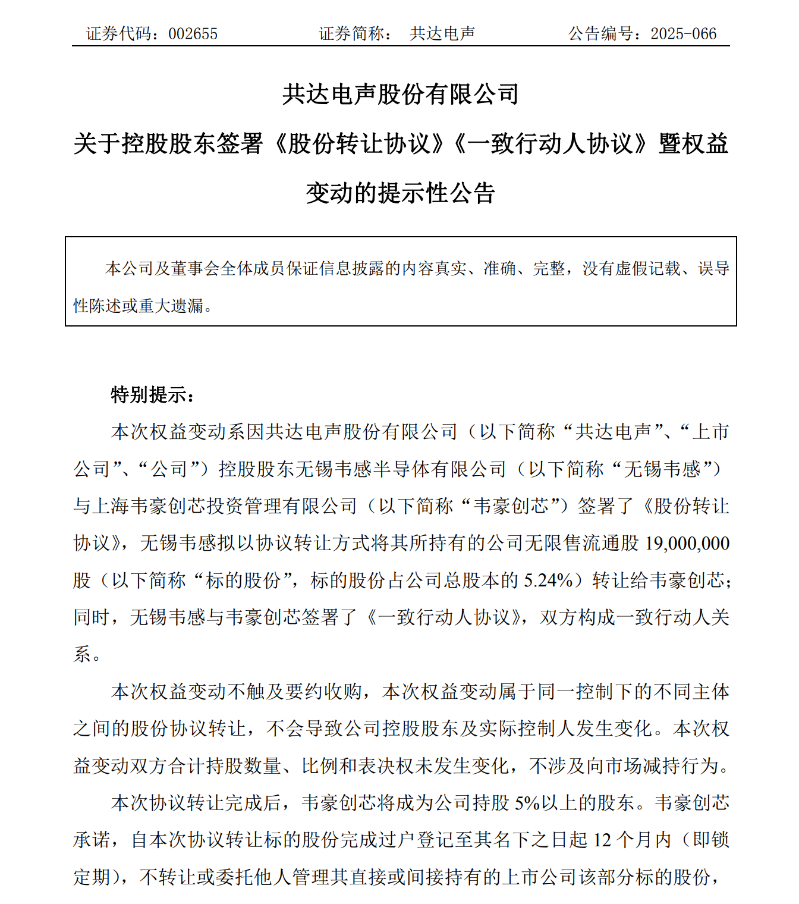
Core Viewpoint - The equity restructuring involving Wuxi Weiguan Semiconductor and Shanghai Wehao Chuangxin will not change the control of Gongda Electronics, as the share transfer is between entities under the same control [6][8]. Group 1: Share Transfer Details - Wuxi Weiguan plans to transfer 19 million shares of Gongda Electronics at a price of 12.03 yuan per share, totaling 229 million yuan [1]. - After the transfer, Wuxi Weiguan will hold 27.85 million shares (7.67% of total shares), while Wehao Chuangxin will hold 19 million shares (5.24% of total shares) [5]. Group 2: Control and Management - The actual controller of both Wuxi Weiguan and Wehao Chuangxin is Zhou Siyuan, who will have a combined voting power of 46.85 million shares (12.91% of total shares) [5]. - The agreement between Wuxi Weiguan and Wehao Chuangxin establishes them as acting in concert, ensuring stability in control [5]. Group 3: Strategic Implications - Wehao Chuangxin, backed by Weir Semiconductor (now "Haowei Group"), focuses on investments in high-growth companies in the semiconductor sector [6]. - Gongda Electronics anticipates that the new control structure will enhance its business development in automotive electronics, acoustic components, and semiconductor devices [8]. - The company plans to leverage a newly established investment partnership to explore more quality semiconductor projects, aiming for industry synergy and resource sharing [8].


德银深度研究:2026年科技硬件行业七大核心主题与投资机会
Zhi Tong Cai Jing· 2025-12-11 14:19
Group 1: Semiconductor Market Trends - Severe memory shortages are driving a reevaluation of semiconductor equipment targets, with DRAM spot prices soaring by 300%-400% in the past three months, reaching $17 per GB for DDR4 and $13-14 per GB for DDR5 [2] - NAND flash market is experiencing similar trends, with core benchmark products seeing a 200% price increase over the last three months, and contract prices rising by 20%-60% [2] - The memory shortage is expected to continue until at least 2027, leading to significant increases in wafer fab equipment spending, particularly benefiting companies like ASML, VAT Group, and SUSS MicroTec [3][4] Group 2: AI and Component Supply Challenges - AI investments are crowding out supply for non-AI components, leading to potential shortages in memory, passive components, and optical components, which could impact consumer electronics, smartphones, PCs, and automotive electronics [4] - The automotive electronics sector is less affected due to dedicated production lines for automotive-grade products [5] Group 3: Optical and Testing Innovations - AI data centers are driving a surge in bandwidth demand, leading to advancements in optical components and the transition to higher-speed pluggable optical devices [3] - The testing sector is undergoing a structural transformation due to increased chip complexity and rising failure costs, with companies like Technoprobe expanding testing coverage to improve quality [6] Group 4: GaN and Power Semiconductor Opportunities - The shift to 800V architecture in AI data centers, driven by Nvidia, is creating opportunities for GaN technology, similar to the impact of SiC in Tesla applications [8] - AI processor power consumption is projected to grow from 7GW in 2023 to over 70GW by 2030, creating significant market opportunities for suppliers addressing power challenges [9] Group 5: Edge AI and Local Processing - Edge AI is gaining traction, with companies like AMD noting its growth potential, although it remains in the experimental phase [10] - Ambarella anticipates that its defined "edge AI" market will account for 80% of its total revenue by 2025, covering various applications [10] Group 6: Localization of Semiconductor Production in China - There is a significant shift in China's semiconductor capabilities, with local manufacturers facing increased pressure for domestic procurement and improving their scale and quality [11] - The year 2026 is expected to be pivotal as the market recognizes the potential shrinkage of Western companies' market size in China [11][12]
突破“卡脖子”!清华学覇干出又一个世界第一
创业家· 2025-11-19 10:13
Core Viewpoint - The article highlights the rapid advancement of Chinese companies in the CMOS image sensor (CIS) market, particularly focusing on the success story of Geke Micro, which has transitioned from low-end to high-end products in the industry [5][24]. Group 1: Company Background and Development - Geke Micro was founded in 2003 by Zhao Lixin and his partners, who recognized the potential of the CMOS image sensor market after the launch of the first camera phone by Sharp [6][8]. - The company initially faced significant challenges, including a lack of market experience and management issues, but eventually found success by starting with lower pixel products and gradually moving up the value chain [17][18]. - By 2014, Geke Micro had become the leading supplier of CMOS sensors in China, with shipments exceeding 940 million units and sales surpassing $350 million [22]. Group 2: Market Position and Challenges - Despite achieving high shipment volumes, Geke Micro lagged in revenue compared to global leaders like Sony, which dominated the high-end market [24]. - In 2020, Geke Micro's revenue from CIS chips was approximately 5.86 billion yuan, accounting for only 5% of the global market, while Sony's revenue was $9.4 billion, capturing 40% of the market [24]. Group 3: Strategic Transformation and Future Goals - To address the revenue gap, Geke Micro initiated a transformation towards high-end products, aiming for $3 billion in revenue by optimizing its business model from Fabless to Fab-Lite [25][26]. - The company went public in August 2021, raising approximately 3.593 billion yuan to fund its transition to a Fab-Lite model, which combines in-house manufacturing with outsourcing [26]. - By 2023, Geke Micro's new factory was operational, significantly reducing the production cycle for high-end products, with revenue from products over 13 million pixels reaching 1 billion yuan [27].

一汪创投活水,润泽大湾区“科创雨林”
Zheng Quan Shi Bao· 2025-11-14 02:26
Core Insights - The integration of private venture capital, state-owned capital, and Hong Kong-Macau resources is creating a comprehensive capital network that supports the entire lifecycle of enterprises in the Guangdong-Hong Kong-Macau Greater Bay Area [1] - The Greater Bay Area is rapidly becoming a global hub for technological innovation and venture capital, driven by the collaboration of various capital sources [1] Group 1: Private Venture Capital - Private venture capital is a significant highlight in the Greater Bay Area, with firms like Dongfang Fuhai, Dacheng Caizhi, and others deeply engaged in the market [3] - The professional specialization among private venture capital firms is deepening, with specific focuses such as consumer sectors, hard technology, and precision medicine, enhancing investment accuracy and creating a collaborative ecosystem [3] - The success story of Ying Shi Innovation, which saw a 164% increase in R&D investment and a 90% rise in revenue, exemplifies the effective partnership between capital and technological innovation [2][3] Group 2: State-Owned Capital - State-owned venture capital plays a crucial role in the investment landscape, acting as a key funding source and shaping the investment framework in the Greater Bay Area [4] - The establishment of various funds, including a 150 billion yuan angel fund and a 500 billion yuan venture capital fund, demonstrates the commitment to fostering innovation and supporting emerging industries [4][5] - Shenzhen's state-owned capital has built a comprehensive innovation ecosystem, facilitating significant projects in the semiconductor industry and supporting early-stage investments through a network of seed funds [5][6] Group 3: Cross-Border Collaboration - Cross-border collaboration is being enhanced through institutional innovations, with many investment firms establishing connections between mainland China and Hong Kong to explore diverse investment opportunities [7][8] - The establishment of funds like the Qianhai Shenzhen-Hong Kong Youth Dream Factory Fund illustrates the growing trend of integrating resources and capital across borders to support early-stage projects in various sectors [7][8] - The unique conditions of the Greater Bay Area, characterized by "one country, two systems," present both challenges and opportunities for regional integration and development [8]
赵宗庭2025年三季度表现,华夏国证半导体芯片ETF基金季度涨幅53.81%
Sou Hu Cai Jing· 2025-10-27 23:31
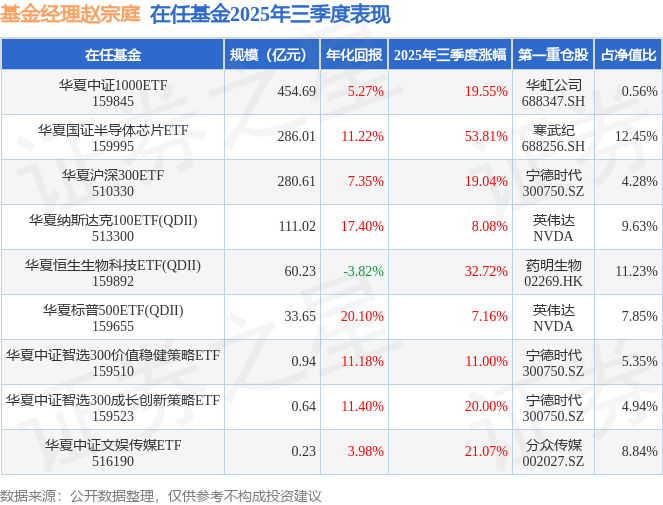
Core Insights - The best-performing fund managed by Zhao Zongting is the Huaxia National Index Semiconductor Chip ETF (159995), which achieved a quarterly net value increase of 53.81% as of Q3 2025 [1][2]. Fund Performance Summary - Zhao Zongting manages a total of 9 funds, with the following notable performances: - Huaxia National Index Semiconductor Chip ETF: 286.01 billion CNY, annualized return of 11.22%, and a quarterly increase of 53.81% [2]. - Huaxia CSI 300 ETF: 280.61 billion CNY, annualized return of 7.35%, and a quarterly increase of 19.04% [2]. - Huaxia Nasdaq 100 ETF (QDII): 111.02 billion CNY, annualized return of 17.40%, and a quarterly increase of 8.08% [2]. - Huaxia S&P 500 ETF (QDII): 33.65 billion CNY, annualized return of 20.10%, and a quarterly increase of 7.16% [2]. Stock Trading Cases - Notable stock trading cases managed by Zhao Zongting include: - Wuliangye (000858): Purchased in Q3 2017 and sold in Q4 2022, with an estimated return of 194.34% and a company profit growth of 175.90% during the holding period [5]. - Xingyuan Material (300568): Purchased in Q2 2021 and sold in Q3 2021, with an estimated return of 97.42% and a company profit growth of 133.49% during the holding period [5]. - Zijin Mining (601899): Purchased in Q4 2023 and sold in Q3 2024, with an estimated return of -86.51% despite a company profit growth of 51.76% during the holding period [5]. Fund Manager's Performance - Zhao Zongting's cumulative return as the manager of Huaxia CSI 300 ETF Link A (000051) is 56.2%, with an average annualized return of 5.36% [2]. - The fund had 75 adjustments in heavy stocks, with a success rate of 58.67% [2].
产业洞察系列报告(四):科技产业合作与竞争(下):其他先进制造业的发展对比与机遇
Ping An Securities· 2025-10-22 11:28
Core Insights - The report highlights the accelerating competition and cooperation in advanced manufacturing between China and the US, particularly in the semiconductor, general aviation, and innovative pharmaceuticals sectors [6][11][18]. Semiconductor Industry - China is rapidly catching up in the semiconductor sector, focusing on self-sufficiency in AI chip production amidst a global supply chain heavily dominated by the US [2][19]. - The semiconductor industry has a complex global supply chain with multiple stages, where the US leads in high-value design and equipment, while China excels in manufacturing and testing [19][24]. - In terms of market share, China and the US together account for nearly 60% of global semiconductor sales, with the US holding a significant supply share of over 50% compared to China's less than 10% [22][24]. - China's semiconductor trade has been in a long-term deficit, with a projected deficit of $226.67 billion in 2024, while the US maintains a trade surplus of $10.25 billion [27][28]. - US semiconductor companies exhibit stronger fundamentals, with revenue and net profit significantly higher than their Chinese counterparts, and a return on equity (ROE) median approximately four times that of A-share companies [31][32]. General Aviation Industry - The US holds a first-mover advantage in the general aviation sector, while China is leveraging low-altitude economic policies to drive innovation and transformation [3][12]. - The global demand for general aviation aircraft is evenly distributed, with China and North America each accounting for about 20% of the market, but the US dominates supply with Boeing and Airbus [3][12]. - China's aerospace sector has a long-term trade deficit, while it is a leading exporter of drones [3][14]. - Current market performance shows that US aviation equipment companies outperform their Chinese counterparts in terms of scale and ROE [3][14]. Innovative Pharmaceuticals Industry - The US leads in the innovative pharmaceuticals sector, but Chinese companies are making significant strides in original innovation and international expansion [4][17]. - The pharmaceutical market share remains stable, with the US holding about 40% and China around 10%, primarily focusing on generic drugs [4][17]. - Both countries face trade deficits in pharmaceuticals, but Chinese innovative drug companies have accelerated their international presence, with increasing license-out revenues [4][19]. - US innovative pharmaceutical companies show better fundamentals, with many Chinese companies' valuations hovering around historical averages [4][20]. Market Outlook - The report anticipates a continuation of the mid-to-long-term technology market trends, with advanced manufacturing sectors like semiconductors, general aviation, and innovative pharmaceuticals presenting significant investment opportunities [7][18].
存储芯片涨价“造福”香农芯创,基石资本6年“爆赚”90亿
Huan Qiu Lao Hu Cai Jing· 2025-09-22 13:57
Core Viewpoint - The significant increase in storage chip prices has driven the stock price of Shannon Semiconductor to a historical high, reflecting strong market demand and investor interest in the semiconductor sector [1][2]. Group 1: Stock Performance - On September 22, Shannon Semiconductor's stock surged by 13.07%, reaching a closing price of 87.66 yuan per share, with a market capitalization of 406.5 billion yuan [1][2]. - Since August 15, the company's stock has increased by 148.96%, and from a low point on April 9, the cumulative increase is 232.4% [2]. - Major storage chip manufacturers, including SanDisk and Micron Technology, have announced price increases of over 10% and 20-30%, respectively, indicating a potential new wave of price hikes in the storage chip market driven by AI demand [2][3]. Group 2: Company Overview - Shannon Semiconductor is a leading semiconductor distributor in China, having secured agency rights for SK Hynix, MTK, and distribution qualifications for AMD [1][3]. - The company has established a new entity, Shenzhen Haipu Storage Technology Co., Ltd., in collaboration with DaPu Microelectronics and SK Hynix, focusing on the development of enterprise-level SSDs [3]. Group 3: Financial Performance - For the first half of 2025, Shannon Semiconductor reported revenue of 171.23 billion yuan, a year-on-year increase of 119.35%, with a net profit of 1.58 billion yuan, reflecting a slight increase of 0.95% [3]. - The majority of the company's revenue, 166.14 billion yuan (97.03%), comes from electronic component distribution, while manufacturing revenue is only 3.31 billion yuan (1.93%) [3]. - Over 80% of the company's revenue is generated from overseas markets, with 144.22 billion yuan (84.22%) coming from international sales [3]. Group 4: Investment Insights - The stock price surge has resulted in significant profits for Cornerstone Capital, which invested approximately 11 billion yuan in Shannon Semiconductor in 2019 and currently holds a 20.41% stake valued at 82.97 billion yuan [1][4][7]. - Cornerstone Capital's investment in Shannon Semiconductor has yielded over 90 billion yuan in profits, highlighting the successful transformation of the company from traditional manufacturing to the semiconductor industry [4][6].

拟赴港IPO,存储芯片龙头北京君正加速全球化
Huan Qiu Lao Hu Cai Jing· 2025-09-16 10:25
Core Viewpoint - Beijing Junzheng has submitted an application for H-share listing on the Hong Kong Stock Exchange to enhance its global strategy and accelerate overseas business development [1] Group 1: Company Overview - Beijing Junzheng was listed on the Shenzhen Stock Exchange in 2011, with a market capitalization of 39.98 billion as of September 15 [1] - The company operates a fabless model, providing computing, storage, and analog chips applicable in automotive electronics, industrial medical, AIoT, and smart security markets [1] - According to Frost & Sullivan, Beijing Junzheng holds a leading market position in niche DRAM, SRAM, NOR Flash, and IP-Cam SoC sectors based on 2024 revenue projections [1] Group 2: Product Development - The company is expanding its product line, with the new computing chip T33 already in production, targeting the H.265 security market, and T42 expected to launch in 2026 [1] - DRAM products based on 20nm/18nm/16nm processes are being sampled, along with automotive-grade LED drivers and interconnect chips [1] Group 3: Financial Performance - Beijing Junzheng's revenue for 2022, 2023, and 2024 was 5.412 billion, 4.531 billion, and 4.213 billion respectively, with net profits of 0.779 billion, 0.516 billion, and 0.364 billion [1] - In the first half of 2025, the company reported revenue of 2.249 billion and net profit of 0.203 billion, with computing chip revenue growing by 15.59% [2] - For Q2 2025, revenue was 1.189 billion, reflecting an 8.10% year-over-year increase and a 12.13% quarter-over-quarter increase, while net profit was 0.129 billion, up 17.22% year-over-year and 74.83% quarter-over-quarter [2] Group 4: Shareholder Activity - Prior to the IPO application, a major shareholder, Beijing Yitang Shengxin, reduced its stake by 0.999999% from July 18 to September 12, 2025, selling 4.8254 million shares [2] - The shareholder's stake decreased from 14.43% to 7.999991%, with a total reduction of approximately 21.9435 million shares over the past year [2] - Other shareholders, including Beijing Sihai Junxin and controlling shareholder Li Jie, also announced plans to reduce their holdings, totaling around 2.53 million shares [2]

豪威集团:视觉芯片的“车载之王”
Bei Jing Shang Bao· 2025-08-31 15:55
Core Viewpoint - The article discusses the transformation of Weir Shares into Haowei Group, highlighting its strategic shift from consumer electronics to the automotive sector, particularly in the field of vehicle-mounted visual chips, amidst the backdrop of domestic substitution trends in the semiconductor industry [1][4][11]. Group 1: Company Transformation - Haowei Group, formerly known as Weir Shares, has transitioned from being a cyclical player in consumer electronics to a leader in the vehicle-mounted visual chip market, capitalizing on the growth of smart vehicles [4][6]. - The company has achieved significant revenue growth from the automotive sector, with income from this market reaching 5.905 billion yuan, a year-on-year increase of 29.85%, accounting for over 30% of its total revenue from image sensor solutions [5][7]. - The shift to automotive applications is seen as a key driver for Haowei's valuation transition from a cyclical stock to a growth stock, as it moves into a high-barrier, long-cycle market [4][7]. Group 2: Strategic Support - The company's success is attributed to three main factors: substantial investment in R&D to strengthen its technological capabilities, strategic acquisitions to fill technology gaps and capture market share, and diversification into multiple business lines to mitigate risks associated with consumer electronics cycles [2][4]. - Haowei's acquisition of Beijing Haowei in 2019 was a pivotal move that allowed it to quickly enhance its technological capabilities and market presence [2][9]. Group 3: Financial Performance - Haowei Group's financial results reflect its business transformation, with a reported revenue growth of 13.49% to 15.97% year-on-year in the first half of the year, and a net profit increase of 39.43% to 49.67% [7][11]. - The company has maintained a market share of nearly 30% in the domestic vehicle-mounted CIS sector, benefiting from its advanced technology and competitive advantages [6][11]. Group 4: Challenges and Concerns - Despite its growth, Haowei faces challenges, including high levels of share pledges by its controlling shareholder, which may threaten control stability and raise concerns about financial health [11][12]. - The company's R&D expenditure has shown volatility and a declining rate, which could impact its competitive edge in the rapidly evolving automotive chip market [13][14]. - There is a notable disparity between the increase in executive compensation and R&D investment, raising questions about the allocation of resources and potential impacts on market trust [15].


国产替代浪潮中的隐形冠军② | 豪威集团:视觉芯片的“车载之王”
Bei Jing Shang Bao· 2025-08-28 16:06
Core Viewpoint - The article discusses the transformation of Weir Shares into Haowei Group, highlighting its strategic shift from consumer electronics to automotive visual chips, driven by the growth of the intelligent automotive market and the company's successful acquisitions [3][4][6][8]. Company Transformation - Haowei Group, formerly Weir Shares, underwent a significant transformation after acquiring Beijing Haowei, which was a key player in the global CMOS image sensor market, leading to a substantial increase in net profit and a shift in business focus [4][6][12]. - The company has successfully transitioned from being heavily reliant on the consumer electronics sector to becoming a leader in the automotive visual chip market, capitalizing on the growing demand for intelligent driving technologies [6][8][10]. Financial Performance - In 2024, Haowei Group reported automotive market revenue of 5.905 billion yuan, a year-on-year increase of 29.85%, contributing over 30% to the total revenue of its image sensor solutions [8][10]. - The company’s revenue is projected to grow by 13.49% to 15.97% in 2025, with net profit expected to increase by 39.43% to 49.67%, indicating strong growth potential in the automotive sector [10][16]. Market Position and Strategy - Haowei Group holds a market share of nearly 30% in the domestic automotive CIS sector, benefiting from its advanced technology and competitive product offerings [9][10]. - The company has strategically positioned itself to take advantage of the shift towards intelligent vehicles, with major automotive manufacturers increasing their adoption of advanced camera systems [9][10]. Challenges and Risks - Despite its growth, Haowei Group faces challenges such as high share pledges by its controlling shareholder, which may impact its control stability and investor confidence [14][15][16]. - The company’s R&D expenditure has shown volatility, with a declining R&D expense ratio, raising concerns about its ability to maintain competitive advantages in a rapidly evolving market [16][17][18].