OneWeb

Search documents
爱建电子深度报告:卫星通信加速进入发展元年
Shanghai Aijian Securities· 2026-01-05 09:46
Investment Rating - The report rates the electronic industry as "Outperform" compared to the market [1] Core Insights - Satellite communication is accelerating into a development year, complementing traditional networks and addressing the connectivity gap for over 2 billion people globally [2][21] - Low Earth Orbit (LEO) satellites are expected to play a crucial role in the future 6G non-terrestrial networks, enhancing global internet coverage [2][20] - The global satellite communication industry is entering a launch-intensive period, with significant investments and advancements expected in 2026 [23][24] Summary by Sections Industry Overview - As of 2025, 73.6% of the global population has internet access, leaving 26.4% offline, particularly in rural areas where traditional network expansion faces challenges [6][11] - The cost and technical difficulties of expanding high-speed infrastructure in rural areas hinder internet penetration, making satellite communication a viable alternative [2][11] Satellite Communication Development - The number of small satellite launches is projected to reach approximately 2,790 in 2024, indicating rapid growth in the sector [2] - The global government support for space initiatives has increased from $4.2 billion in 2014 to $13.5 billion in 2024, with China being a significant contributor [2] Market Dynamics - The satellite communication market is expected to grow significantly, with the global space industry revenue potentially exceeding $1 trillion by 2040, driven largely by satellite broadband [46][49] - The satellite service sector, including satellite TV, broadband, and fixed communication, is projected to dominate the market, with personal consumption accounting for a substantial share [52][57] Cost and Coverage Advantages - Satellite communication offers significant advantages over traditional cellular networks, including wide coverage and lower costs in sparsely populated areas [26][62] - The cost of deploying LEO satellites is decreasing due to advancements in manufacturing and launch technologies, making satellite communication more economically viable [34][36] Industry Chain - The satellite communication industry chain includes satellite manufacturing, launching, and ground equipment, with key players in each segment contributing to the overall ecosystem [79][80] - The development of satellite communication is critical, as limited frequency resources and orbital slots necessitate rapid deployment to secure these assets [84][87]
中国版“猎鹰”加速!蓝箭航天冲刺科创板,卫星产业仍将狂飙?
Jin Rong Jie· 2026-01-05 06:39
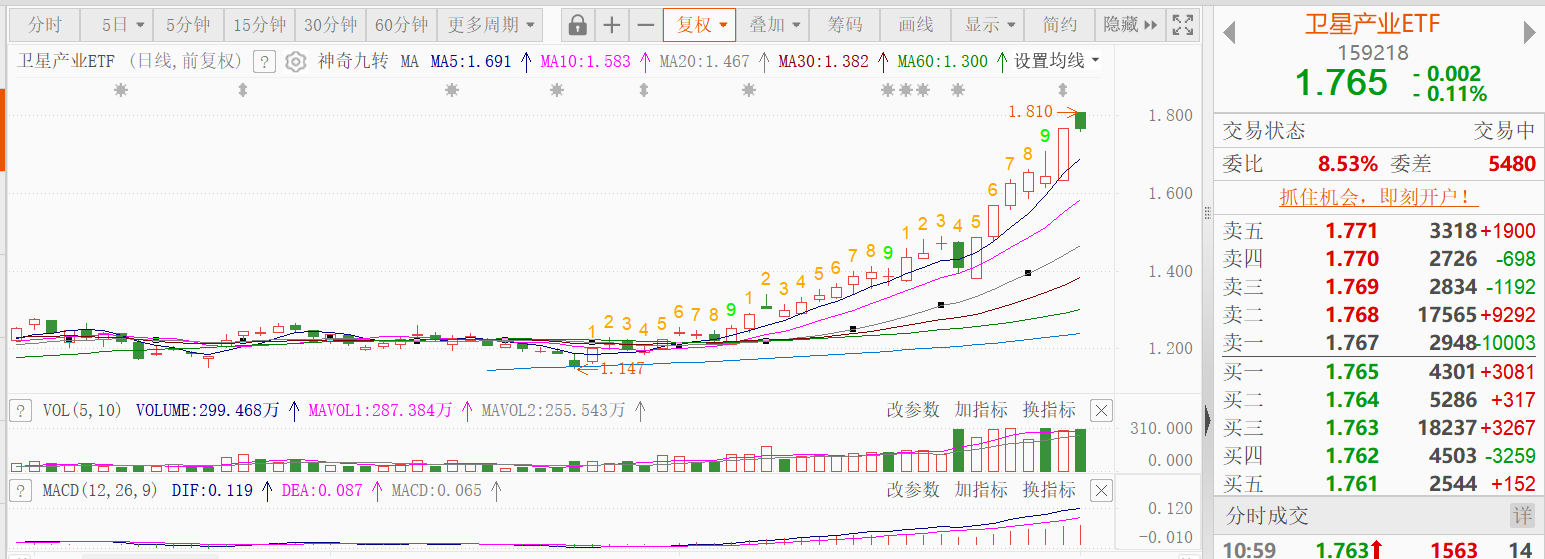
Group 1: Market Overview - On the first trading day of the year, global capital markets experienced a strong start, with the Shanghai Composite Index successfully breaking through 4000 points [1] - The satellite industry ETF showed strong performance but faced profit-taking sell-offs, leading to a decline near midday [1] - The daily trend indicates that the bullish arrangement of moving averages remains unchanged, and a pullback to the 5-day line can be seen as a good opportunity for positioning [1] Group 2: Industry Developments - Blue Arrow Aerospace, a leading player in China's commercial space sector, has had its IPO application accepted, aiming to raise 7.5 billion yuan for the production and R&D of reusable rockets, marking a key step towards commercialization [3] - The industry is driven by several factors, including policy support, with the "14th Five-Year Plan" outlining a clear roadmap for the launch of multiple new rocket types by 2026 [3] Group 3: Commercialization and Applications - Since 2025, China has completed 87 space launches, with private commercial rocket companies executing 23 of these, successfully placing 324 spacecraft into orbit [4] - The application scenarios are continuously expanding, with China Telecom reporting over 25 million units of mobile terminals supporting direct satellite connectivity sold by November 2025 [4] - The initiation of satellite IoT commercial trials and advancements in reusable rocket technology are accelerating the formation of integrated communication networks, injecting strong momentum into the digital economy [4] Group 4: Global Competition - The global competition in the commercial space sector is intensifying, with major players like SpaceX and Amazon leading low Earth orbit communication constellations, while traditional giants like Lockheed Martin and Boeing focus on high-value government markets [5] - In Europe, companies like Airbus and Thales are balancing government projects with commercial services, while OneWeb offers differentiated competitive advantages [6] - In China, major groups like Aerospace Science and Technology and Aerospace Science Industry lead significant projects, while commercial companies focus on small satellite manufacturing and launches [6] Group 5: Industry Outlook - Major countries worldwide are increasing their investments in the commercial space sector, which will enhance the overall industry climate and further promote technological development [7] Group 6: Investment Tools - The satellite industry ETF (159218) tracks the CSI Satellite Industry Index (931594.CSI), covering the entire industry chain from manufacturing and launching to operational services and terminal applications, providing investors with a streamlined way to invest in this high-growth sector [9] - The index's core advantage lies in its unique compilation rules, which adjust weights based on the proportion of revenue from satellite-related businesses, meaning companies with higher revenue contributions have greater weight in the index [9]

研判2025!中国航天数字仿真行业产业链全景、发展现状、竞争格局和未来趋势分析:航天工业信息化升级,航天数字仿真行业规模不断增长[图]
Chan Ye Xin Xi Wang· 2026-01-01 03:15
Core Insights - The aerospace digital simulation industry is essential for optimizing aerospace mission plans and has become a necessary choice for countries to gain a competitive edge in space strategy [1][11] - The market size of China's aerospace digital simulation industry is projected to reach 38.5 billion yuan in 2024, an 11% increase year-on-year, and further grow to 42.3 billion yuan in 2025 [1][11] Industry Overview - Aerospace digital simulation is a specialized field within the aerospace industry that combines digital simulation with aerospace engineering, providing a simulated environment for various stages of aerospace missions [4] - The industry can be categorized into different types based on the mission object, including rocket launch simulation, satellite orbit operation solutions, and aircraft flight simulation solutions [5] Industry Barriers - **Technical Barriers**: The industry involves complex technologies across multiple disciplines, requiring deep knowledge and understanding of aerospace dynamics, control, and various technical fields [5] - **Talent Barriers**: There is a limited supply of high-end talent with the necessary expertise and experience in aerospace engineering, making talent reserve a key indicator of a company's core competitiveness [6] - **Qualification Barriers**: Companies must obtain various qualifications to engage in complex aerospace tasks, which creates a high barrier to entry due to the stringent requirements [6] - **Financial Barriers**: The industry requires significant upfront investment and has long return cycles, creating financial barriers for new entrants lacking sufficient funding [7] Industry Chain - The aerospace digital simulation industry has a supply chain that includes hardware (high-performance servers, precision sensors) and software support (algorithm libraries, operating systems) [8] - The downstream demand covers special, civilian, and commercial aerospace sectors, with commercial aerospace being a major application area [8] Competitive Landscape - The industry is becoming increasingly competitive with numerous enterprises emerging across various segments, including major players like China Aerospace Science and Technology Corporation and Beijing Huaru Technology Co., Ltd. [11][12] Development Trends - **Technological Optimization**: Continuous improvement in simulation technology is necessary to handle the complexities of large-scale satellite constellations and their intercommunication [14] - **Increased Demand in Special Fields**: The demand for aerospace digital simulation in special fields is expected to rise due to increased military spending and the modernization of military equipment [15] - **Policy Support**: The Chinese government is expected to introduce policies to promote the development of the aerospace digital simulation industry, creating a favorable environment for growth [16]


AI沦为暗线?从商业航天入手“十五五”投资机会!
Ge Long Hui A P P· 2025-12-16 10:24
Core Viewpoint - The article discusses the ongoing AI bubble concerns and the impact of various negative news on the AI technology sector, while emphasizing that the fundamental logic and trends of the global AI industry remain unchanged in the long term [2][5]. Group 1: Investment Opportunities in Key Technology Directions - Commercial Space: The "strong nation in space" goal in the 14th Five-Year Plan, along with policies, demand, and technology, creates a robust investment opportunity in commercial space [2][3]. - Demand for low-orbit satellite resources is urgent, with China's GW and Qianfan constellations planning over 10,000 satellites, of which less than 1% are currently in orbit [3]. - The successful launch of the Zhuque-3 and the upcoming Long March 12 rocket are expected to significantly reduce launch costs, which is crucial for satellite networking [3]. Group 2: Specific Technology Areas - Autonomous Driving: The recent approval of L3 autonomous vehicle licenses marks a critical transition from testing to commercialization, with a projected market size of 270 billion for Robotaxi by 2030 [5]. - Nuclear Fusion: While still in the experimental phase, nuclear fusion is recognized as a future key industry, with significant investment opportunities tied to technological breakthroughs [6]. - Artificial Intelligence: The focus has shifted from speculative investments to practical applications, with the 14th Five-Year Plan promoting AI integration across various industries [6][7]. Group 3: Market Dynamics and Trends - The commercial space sector has shown resilience despite recent launch delays, indicating strong market recognition and investment potential [9][11]. - The core logic of commercial space revolves around the urgent need for satellite networking and decreasing costs, with various companies positioned to benefit from this trend [11]. - The article highlights the importance of selecting the right sectors and companies for sustained investment, particularly in the context of the 14th Five-Year Plan's long-term technological focus [15].





AI沦为暗线?从商业航天入手“十五五”投资机会!
格隆汇APP· 2025-12-16 09:44
Core Viewpoint - The article discusses the ongoing trends in various technology sectors, particularly focusing on the AI industry, commercial aerospace, autonomous driving, nuclear fusion, and quantum technology, emphasizing the long-term potential despite short-term market fluctuations [5][6][10][13][16]. Group 1: Commercial Aerospace - The Chinese government has prioritized commercial aerospace in its strategic goals, establishing a dedicated department and action plans, indicating strong policy support [8]. - The demand for low-orbit satellite resources is urgent, with plans for thousands of satellites, and recent technological advancements in reusable rockets are expected to significantly reduce launch costs [8][20]. - Key players in the commercial aerospace sector include China Satellite, which leads in satellite manufacturing, and various companies involved in rocket manufacturing and satellite components [20][22]. Group 2: Autonomous Driving - The autonomous driving sector is entering a critical commercialization phase, supported by government policies and technological advancements, with a projected market size of 2.7 trillion by 2030 for Robotaxi services [10]. - The recent approval of L3 autonomous vehicle models marks a significant step towards commercial deployment [10]. Group 3: Nuclear Fusion - Nuclear fusion is recognized as a future clean energy source, but it remains in the experimental stage, with significant breakthroughs needed before commercialization [11][12]. - Current investments are focused on technological milestones, making it a long-term investment opportunity [12]. Group 4: Artificial Intelligence - The AI sector is transitioning from speculative investments to practical applications, with a focus on real-world implementations that enhance efficiency and reduce costs [13]. - The emphasis is on AI applications across various industries, including manufacturing and healthcare, rather than on speculative infrastructure investments [13]. Group 5: Robotics - The development of embodied intelligence and humanoid robots is a key focus area, with increasing demand in manufacturing due to labor shortages and rising costs [14]. - Companies like Tesla are advancing humanoid robot production, while domestic firms are achieving significant progress in core components [14]. Group 6: Semiconductor Industry - The semiconductor sector is a priority for domestic self-sufficiency, with a focus on overcoming key technological challenges [15]. - Domestic wafer manufacturers are expanding production, and there is a growing demand for domestic semiconductor components [15]. Group 7: Quantum Technology - Quantum communication is positioned as a strategic priority for national security, with ongoing efforts in standardization and pilot projects in financial and governmental applications [16]. - Companies in the quantum sector are beginning to secure significant contracts, indicating a move towards commercialization [16][24]. Group 8: Market Trends and Investment Strategy - The article suggests that commercial aerospace is currently the most promising sector for investment, driven by policy, demand, and technological advancements [26]. - It also highlights the importance of focusing on sectors with clear policy support and performance validation, such as AI applications and robotics, while recognizing the long-term potential of quantum technology and semiconductor advancements [26].

AST SpaceMobile, Inc. (NASDAQ: ASTS) Insider Trading and Financial Analysis
Financial Modeling Prep· 2025-12-11 05:06
Core Insights - AST SpaceMobile, Inc. is focused on developing space-based cellular broadband networks to provide mobile connectivity directly from satellites to standard mobile phones [1] - The company operates in a competitive space industry with rivals such as SpaceX and OneWeb [1] Insider Transactions - On December 10, 2025, Director Keith R. Larson purchased 675 shares of Class A Common Stock at $72.71 each, amidst insider selling activities that have negatively impacted the stock's performance [2][6] - Chief Accounting Officer Maya Bernal sold 6,000 shares at an average price of $73.76, totaling $442,560, reducing her stake by 4.67% [3] - Chief Technology Officer Huiwen Yao sold 40,000 shares, contributing to the downward pressure on the stock [3] Financial Metrics - ASTS has a negative price-to-earnings (P/E) ratio of -54.20, indicating a lack of profitability [4] - The company has a high price-to-sales ratio of 4,826.33, suggesting investors are paying a premium for each dollar of sales [4] - The enterprise value to sales ratio is 4,642.25, reflecting a high valuation relative to sales [4] Financial Health - ASTS maintains a low debt-to-equity ratio of 0.02, indicating minimal reliance on debt [5] - The company has a strong current ratio of 8.23, suggesting robust liquidity and the ability to cover short-term liabilities [5] - These factors may provide some stability amid current market conditions [5]


拟募资远超300亿美元!曝SpaceX将推进首次公开募股,有望成为人类史上最大规模上市交易【附卫星互联网行业分析】
Qian Zhan Wang· 2025-12-11 04:01
Core Viewpoint - SpaceX is planning its initial public offering (IPO) with a fundraising target exceeding $30 billion, aiming for a total valuation of approximately $1.5 trillion, potentially making it the largest IPO in history [2]. Group 1: IPO Plans and Financial Projections - SpaceX is pushing forward with its IPO plan, with a fundraising goal that could reach up to $40 billion if 5% of shares are sold, surpassing Saudi Aramco's record of $29 billion from 2019 [2]. - The IPO is expected to be completed by mid to late 2026, although it may be delayed until 2027 due to market conditions [2]. - The funds raised from the IPO will be allocated towards developing space-based data centers and acquiring high-performance chips [2]. Group 2: Starlink's Growth and Revenue - Starlink, SpaceX's satellite internet service, is projected to generate $12.3 billion in revenue for the fiscal year 2025, accounting for 80% of SpaceX's total revenue [3]. - By December 2025, Starlink is expected to have over 8 million active users globally, with its "direct-to-mobile" service and the Starship rocket development supporting the valuation of $1.5 trillion for the IPO [3]. Group 3: Satellite Internet Landscape - Starlink aims to provide global high-speed internet through thousands of low Earth orbit satellites, targeting underserved areas and mobile scenarios [5]. - As of August 2025, Starlink has launched 8,926 satellites, with plans to deploy 12,000 by the end of the year [5]. - The low Earth orbit satellite internet sector is characterized by a "one strong, many strong" dynamic, with SpaceX being the most influential player, followed by OneWeb and Amazon Kuiper [5]. Group 4: Industry Context and Competition - The Chinese satellite internet industry has surpassed 33 billion yuan in scale as of 2023, driven by strong government policy support [8]. - Domestic smartphone manufacturers like Huawei, Xiaomi, and OPPO have launched commercial terminals supporting satellite communication, indicating a significant advancement in the industry [9].

商业航天:从国家博弈到市场浪潮
Sou Hu Cai Jing· 2025-12-03 12:57
Group 1 - The article discusses the evolution of commercial space industry from government-dominated initiatives to a thriving private sector, highlighting key milestones such as the establishment of Intelsat in 1964 and the Space Launch Act of 1984, which opened the market to private enterprises [3][5] - Elon Musk's SpaceX played a pivotal role in transforming the commercial space landscape, achieving significant milestones like the successful launch of Falcon 1 in 2008 and the first rocket recovery in 2015, drastically reducing launch costs and establishing a new industry standard [5][9] - The article notes that by 2025, SpaceX's revenue is projected to reach $15.5 billion, indicating a dominant position in the market alongside competitors like Blue Origin and Virgin Galactic [5] Group 2 - China's commercial space sector has seen rapid development over the past decade, with significant policy changes encouraging private investment and participation in satellite development and launches, marking a shift from a state-controlled environment [7][10] - The successful launch of the Zhuque-2 rocket in 2023 marked a significant achievement for China's private space companies, demonstrating advancements in technology and increasing the share of private launches in the national total [9][10] - The Chinese commercial space market is expected to exceed ¥2.5 trillion by 2025, with an annual growth rate of over 20%, reflecting the sector's strategic importance and potential for economic impact [10][14] Group 3 - The article emphasizes the strategic importance of commercial space for national security and resource competition, as low Earth orbit resources are limited and the deployment of satellites is crucial for maintaining competitive advantages [12] - The integration of commercial space capabilities with national defense is highlighted, showcasing how private satellite services can enhance disaster response and national security communications [12][14] - The commercial space industry is positioned as a new growth engine for the economy, with projections indicating a market size exceeding ¥2.3 trillion in 2024, driving innovation across various sectors [14] Group 4 - The future of commercial space is characterized by ambitious goals, including the potential for significantly reduced launch costs and the proliferation of satellite constellations, which could enable widespread connectivity and new applications [16] - The article outlines challenges faced by domestic private companies, including reliance on imported technology and the need for improved regulatory frameworks to manage satellite operations and safety [18] - The narrative of commercial space is framed as a reflection of human curiosity and geopolitical competition, with China emerging as a key player in the global space arena [18]
没红绿灯的太空开始“堵车”了,“感知卫星”成了商业航天的新战场
Tai Mei Ti A P P· 2025-11-30 09:36
Core Viewpoint - The rapid growth of commercial space activities is leading to increased satellite launches and a crowded orbital environment, raising concerns about space debris and safety [2][3][9]. Group 1: Market Growth and Trends - The global commercial space market is projected to grow from $62 billion in 2020 to $75 billion in 2024, with an estimated revenue of $93.7 billion by 2029, reflecting a compound annual growth rate (CAGR) of 4.6% from 2024 to 2029 [3]. - The number of satellites is expected to increase from 12,000 to 57,000 over the next five years, with significant contributions from companies like SpaceX and OneWeb, as well as China's ambitious satellite deployment plans [3][5]. Group 2: Space Debris and Safety Concerns - The proliferation of satellites has led to a significant increase in space debris, with over 50,000 pieces larger than 10 cm and approximately 1.2 million pieces between 1 cm and 10 cm, posing a serious threat to operational spacecraft [5][6]. - Recent incidents, such as the damage to the Chinese Shenzhou 20 spacecraft due to space debris, highlight the urgent need for effective monitoring and mitigation strategies [2][6]. Group 3: Regulatory and Strategic Developments - The National Space Administration of China has established a Commercial Space Bureau to oversee the burgeoning commercial space sector, emphasizing the importance of safety and sustainable development [2][9]. - Various countries have implemented policies to address space debris, with China also accelerating its regulatory framework to ensure responsible satellite operations and debris mitigation [9][12]. Group 4: Space Situational Awareness and Technology - Space situational awareness (SSA) satellites are being developed to monitor space debris and potential collision risks, with both domestic and international companies investing in this technology [11][12]. - The commercial application of SSA satellites is expected to include data services, insurance risk assessment, and launch window optimization, creating a new business model in space management [12][13]. Group 5: Future Challenges and Collaboration - The complexity of commercial space operations necessitates collaboration across the industry to effectively manage space traffic and debris, distinguishing it from traditional aerospace sectors [16]. - The development of SSA capabilities is seen as a critical first step, but challenges remain in achieving high-precision tracking and addressing dynamic space environments [16].

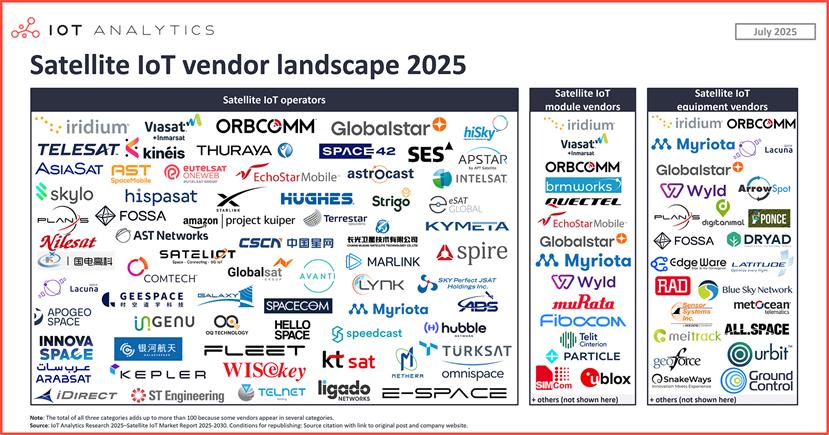
重新思考卫星物联网:需求、技术选择和市场格局
3 6 Ke· 2025-11-18 09:55
Core Insights - Satellite IoT has emerged as a significant branch of the IoT sector, with a continuously evolving industry chain and growing market demand, making it a hot topic of discussion [1] - Recent reports from market research organizations highlight the complexities and challenges in the deployment of satellite IoT, despite its increasing attention [1] Demand and Technology Selection - Current applications of satellite IoT are concentrated in areas such as agriculture, maritime and logistics, energy and utilities, and emergency response, with potential uses in mining, aviation, remote infrastructure management, and defense [2] - Each application has unique requirements regarding data volume, latency, and power consumption, necessitating careful evaluation of the appropriate technology for each use case [2][3] Operational Considerations - Coverage requirements vary, with some applications needing global satellite coverage while others operate within national or regional boundaries [3] - The data volume generated by IoT devices can differ significantly, impacting the choice of satellite technology [3] - Latency is a critical factor, with GEO satellites having higher latency compared to LEO satellites, which can meet lower latency requirements [3] Technical Landscape - The choice of standards is crucial, with 3GPP's NTN standard gaining traction among suppliers due to its established ecosystem, while proprietary systems excel in ultra-low power applications [4] - The integration of satellite and terrestrial networks is becoming a focal point, allowing seamless switching between the two environments [5] Market Dynamics - By 2024, satellite IoT connections are projected to reach 7.5 million, representing a small fraction of the total IoT connections, but with a significantly higher average revenue per user (ARPU) compared to cellular IoT [7] - The market is expected to become more fragmented with the entry of new players, increasing competition among satellite IoT operators [7] Challenges and Future Outlook - The satellite IoT market faces challenges such as limited connection scale and increasing competition, leading to a potential market consolidation [8] - In China, the satellite IoT market is still emerging, with significant growth potential as domestic applications are expected to proliferate [8][9] - Recent initiatives by the Ministry of Industry and Information Technology aim to stimulate the satellite IoT market, enhancing service capabilities and regulatory frameworks [9]