中国进出口银行

Search documents
罚没9.81亿元!前三季度银行收近千张罚单,信贷违规高频踩“雷”
Bei Jing Shang Bao· 2025-10-09 14:37
Core Viewpoint - In 2025, the financial regulatory environment remains stringent, with a "zero tolerance" approach towards banks and financial institutions, leading to a significant number of penalties issued for various compliance violations [1][3]. Regulatory Overview - In the first three quarters of 2025, a total of 997 penalties were issued to various banking institutions, amounting to approximately 981 million yuan [3][4]. - The National Financial Supervision Administration issued 14 penalties with a total fine of approximately 314.67 million yuan, indicating a strong regulatory signal [3]. - The number of penalties and total fines in 2025 has decreased compared to the same period in 2024, where 1,533 penalties totaling about 1.18 billion yuan were issued [4][5]. Penalty Distribution - The first quarter of 2025 saw the highest number of penalties, with 394 issued and fines totaling around 299 million yuan [4]. - The second quarter experienced a decline in both the number of penalties and fines, with 231 penalties totaling about 143 million yuan [4]. - The third quarter saw a resurgence, with 372 penalties and fines soaring to 538 million yuan, marking it as the peak period for regulatory actions [4]. Focus on Credit Violations - Credit-related violations accounted for nearly 60% of total penalties, highlighting the sector as a primary focus for regulatory scrutiny [6]. - Notable penalties include Zhejiang Merchants Bank's Shanghai branch fined 16.8 million yuan for multiple credit-related violations [6]. - In September, several banks, including Huaxia Bank and Guangfa Bank, received significant fines for credit violations, with amounts reaching up to 87.25 million yuan [7]. Reasons for High Violation Rates - Credit business is critical for banks but also poses high risks due to potential misuse of funds and regulatory evasion [8]. - Increased scrutiny on non-performing loans and the exposure of hidden risks in real estate and local government financing have intensified regulatory actions [8][9]. - The competitive landscape has led some banks to relax risk management standards, resulting in frequent violations [9]. Internal Control and Compliance Issues - Beyond credit violations, other areas such as wealth management and credit card operations also exhibit significant compliance gaps [10][11]. - Banks are urged to enhance their internal control systems and shift their focus from short-term growth to long-term compliance and risk management [10][11]. - A comprehensive upgrade in internal governance is necessary, emphasizing a culture of compliance across all business units [11].


货币市场日报:10月9日
Xin Hua Cai Jing· 2025-10-09 13:34
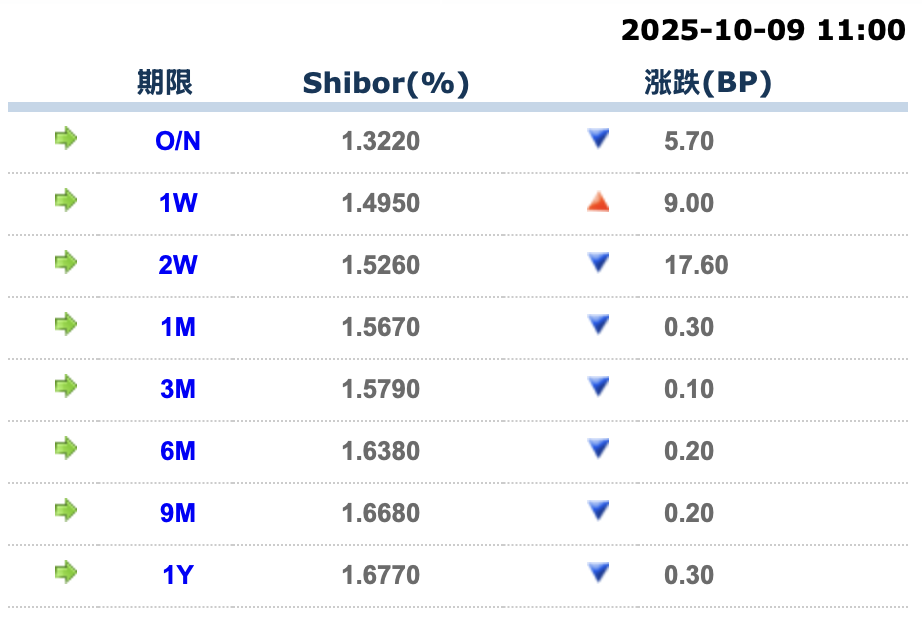
Core Points - The People's Bank of China conducted a 7-day reverse repurchase operation of 612 billion yuan at an interest rate of 1.40%, maintaining the previous rate, resulting in a net withdrawal of 1,451.3 billion yuan from the open market [1] - The Shanghai Interbank Offered Rate (Shibor) showed mixed movements, with the overnight Shibor decreasing by 5.70 basis points to 1.3220%, while the 7-day Shibor increased by 9.00 basis points to 1.4950% [1][2] - The overall funding environment post-National Day holiday was balanced and slightly loose, with overnight repo rates fluctuating between 1.35% and 1.58% [8] Summary by Category Monetary Policy - The People's Bank of China executed a reverse repurchase operation of 612 billion yuan, with a net withdrawal of 1,451.3 billion yuan due to maturing reverse repos [1] Interest Rates - Shibor rates on October 9 showed a decline in the overnight rate and an increase in the 7-day rate, indicating a mixed trend in short-term borrowing costs [1][2] - The weighted average rates for overnight and 7-day repos were reported at 1.3271% and 1.5073%, respectively, with varying transaction volumes [4] Market Conditions - The funding market was characterized by a balanced and slightly loose atmosphere, with significant trading activity in overnight repos and interbank certificates of deposit [8][9] - The issuance of interbank certificates of deposit totaled 6.16 billion yuan on the same day, reflecting ongoing liquidity in the market [8]
5000亿新型政策性金融工具陆续投放,或带来四大影响
Xin Lang Cai Jing· 2025-10-09 12:25
Core Viewpoint - The establishment of a new type of policy financial tool aims to stabilize credit and investment, with an expected total investment of 500 billion yuan by the end of October 2023 [1][2]. Group 1: Establishment and Purpose - Three major policy banks, including the National Development Bank, Agricultural Development Bank, and Export-Import Bank, registered the new financial tool company on September 29, 2023, with a total scale of 500 billion yuan dedicated to project capital [2][4]. - The new financial tool is designed to support technological innovation, expand consumption, and stabilize foreign trade, as proposed in the April 2023 Central Political Bureau meeting [2][5]. Group 2: Funding and Investment - The National Development Bank's new financial tool company has already begun funding projects, with the first investment of 20.76 million yuan allocated to a water supply project in Taicang City [4]. - The financial tool will not only target traditional infrastructure but also emerging sectors such as digital economy, artificial intelligence, and low-altitude economy [6]. Group 3: Market Impact - The new financial tool is expected to lead to a resurgence in the growth of pledged supplementary loans (PSL), which had decreased to 1.1 trillion yuan by the end of August 2023 [7][10]. - The introduction of the financial tool may result in a significant increase in entrusted loans under social financing, as funds will be injected into projects through shareholder loans or equity investments [10][11]. - The financial tool is projected to stabilize public loan increments and attract social capital, enhancing the financing model of policy banks and commercial banks [11][12]. Group 4: Infrastructure Investment - The new financial tool is estimated to have a multiplier effect of approximately 3.5 times on infrastructure investment, potentially driving 1.5 to 2 trillion yuan in fixed asset investment [11][12]. - Recent data indicates a decline in infrastructure investment growth, with a 2% increase from January to August 2023, compared to a 3.6 percentage point drop from earlier in the year [12].
5000亿新型工具落地,有望拉动超5万亿投资
21世纪经济报道· 2025-10-09 11:03
9月29日,国家发展改革委对外宣布, 新型政策性金融工具规模共5000亿元,全部用于补充项 目资本金 。当天,国家开发银行、中国农业发展银行、中国进出口银行全额出资的专门公司 成立,分别是国开新型政策性金融工具有限公司、农发新型政策性金融工具有限公司、进银新 型政策性金融工具有限公司。 随后,新型政策性金融工具在加快投放。9月29日以来, 江苏、安徽、广西、广东、河 北、海南、福建、重庆等 多地对外宣布,首批新型政策性金融工具资金完成投放。这些资 金 投向了城市更新、交通、水务、物流、能源、农业农村、供热管网、环境保护等领域的 项目 。 21世纪经济报道记者梳理地方披露信息发现,新型政策性金融工具的融资期限较长, 部分项 目获批融资期限在15—20年;该新型工具全部用于重点领域重大项目资本金,但是不得超过全 部资本金比例的50% ——这些资金能较大缓解项目资本金不足的问题,还能与项目回报周期 较长的状况相匹配。 新型工具跑步前进 从地方披露信息来看, 交通、城市更新、能源等领域项目较快落地 。 无锡市发展改革委消息显示,无锡至宜兴城际轨道交通工程此次获批新型政策性金融工具资金 31.99亿元(其中一期14.3 ...
前三季银行业被罚超16亿,股份行占三成!违规重灾区有哪些
Nan Fang Du Shi Bao· 2025-10-09 10:20
Core Insights - The banking industry in China has faced significant regulatory penalties in 2023, with a total of 16.64 billion yuan in fines, marking a 14.71% increase compared to the same period last year [2][5][6]. Summary by Category Regulatory Penalties Overview - In the first three quarters of 2023, the banking sector received 4,583 regulatory fines, with September alone accounting for 4.37 billion yuan, which is 26.26% of the total fines for the year [2][5]. - The total fines for the banking industry have surpassed 16 billion yuan, indicating a growing trend in regulatory scrutiny [2]. Breakdown by Bank Type - Joint-stock banks have been the most penalized, with fines totaling 4.97 billion yuan, representing 30% of the total fines. They received 271 fines, with an average penalty of 1.85 million yuan [5][6]. - Agricultural commercial banks were fined 4 billion yuan, with 552 penalties issued and an average fine of 728,700 yuan [6]. - State-owned banks faced fines of 2.74 billion yuan, with 406 penalties and an average fine of 682,300 yuan [6]. - City commercial banks received fines totaling 1.88 billion yuan, with 169 penalties and an average fine of 1.13 million yuan [6]. Foreign and Policy Banks - Foreign banks had a high average penalty of 1.76 million yuan, with 13 fines issued. Notably, Yuanta Bank was fined 14.85 million yuan for regulatory violations [7]. - Policy banks received 52 fines with an average penalty of 1.46 million yuan [7]. Common Violations - The most frequent violations were related to credit business, with 349 fines issued for inadequate loan checks, accounting for 20% of all penalties [9]. - There were 54 fines related to inaccurate classification of credit assets, which can obscure the true risk faced by banks [9][10]. - Violations in anti-money laundering practices were also common, with 16% of penalties related to failure to properly identify customer identities [10].

“中国一粒都没买”!大豆滞销,美国农民卖设备维持生计,“对特朗普的忠诚将接受考验”!特朗普满世界找买家,美协会急了:赶紧和中国谈
新浪财经· 2025-10-09 09:48
Core Viewpoint - The U.S. soybean farmers are facing significant challenges due to the cessation of soybean purchases by China since May 2025, leading to a surplus and plummeting prices, which threaten their livelihoods [2][9][12]. Group 1: Impact on U.S. Soybean Farmers - U.S. soybean farmers are experiencing immense difficulties as they are unable to sell their crops, despite record agricultural yields this year [3][11]. - The trade war has led to a drastic reduction in soybean exports, with China previously accounting for over half of U.S. soybean exports, valued at $12.64 billion in 2024 [9][24]. - Farmers are resorting to selling equipment to maintain their livelihoods due to falling soybean prices, with a 30% increase in auctioned agricultural machinery in Iowa [18][12]. Group 2: Government Response and Agricultural Subsidies - The U.S. government had planned to introduce an agricultural subsidy program worth $12 to $13 billion to assist struggling farmers, but this has been delayed due to a government shutdown [14][16]. - The lack of immediate financial support is exacerbating the dire situation for farmers, who describe their current circumstances as the worst they have ever faced [16][18]. Group 3: Market Dynamics and Competition - The U.S. is losing its market share as Brazil and Argentina capitalize on the situation, with Brazil's soybean exports expected to exceed 100 million tons in 2025, surpassing previous records [25][27]. - Brazil has established a dedicated soybean supply chain to increase exports to China, while Argentina has eliminated export taxes, leading to a surge in soybean orders [24][27]. - The shift in Chinese demand towards South American suppliers poses a long-term threat to U.S. soybean farmers, as they struggle to find alternative markets [23][24].

“中国一粒都没买”!大豆滞销,美国农民卖设备维持生计,“对特朗普的忠诚将接受考验”!特朗普满世界找买家,美协会急了:赶紧和中国谈
Mei Ri Jing Ji Xin Wen· 2025-10-09 04:16
每经编辑|段炼 美国大豆协会称,自5月以来,中国就不再购买美国大豆了。随着美国大豆进入收获季节,因大豆滞销而面临巨额损失的豆农心急如焚…… 美国媒体报道称,虽然今年农业产量创纪录,但农民可能无处出售农产品,"农民对特朗普(政府)的忠诚即将接受考验"。英国《金融时报》报道也说, 美国今年大豆满仓、但价格下跌,农民难以维持生计。"美国头号出口农产品的海外销售量骤降,给美农造成'毁灭性'打击。" 美国豆农:受关税战反噬 美农村正承受巨大痛苦 眼下,美国大豆已经进入收获季,美国豆农坦言,受关税战的反噬,目前美国农村正陷入巨大困境。 美国农场主 克里斯·古尔德:目前美国农村正承受着巨大痛苦。中国一直是我们大豆的头号买家,我们很大一部分大豆都销往了中国。然而,当我们(美 国)开始扰乱国际贸易后,中国就开始寻找其他供应来源了。 大豆对于美国农业及农产品出口至关重要。根据美国农业部的数据,2024年大豆以245.8亿美元的出口额位居美国农产品出口首位,占农产品出口总额的 14%。 中国此前是美国大豆的最大买家,2024年购买了价值126.4亿美元的大豆,占美国大豆出口总额一半以上。美媒称,自2025年5月起,中国再也没有从美 ...

进出口银行“十四五”期间投放制造业贷款超5万亿元
Xin Hua Wang· 2025-10-09 02:22
Core Insights - During the "14th Five-Year Plan" period, the Export-Import Bank of China has focused resources on the manufacturing sector, providing over 5 trillion yuan in loans, with an annual growth rate of manufacturing loans exceeding the overall credit growth rate of the bank [1] Group 1 - The Export-Import Bank of China is leveraging its professional advantages to enhance support for the real economy and assist manufacturing enterprises in their international expansion [1] - The bank employs diversified financial tools to support the development of advanced manufacturing and the transformation of traditional manufacturing [1] - The bank aims to cultivate and strengthen emerging and future industries, acting as a long-term patient capital to support technological innovation and high-quality development in manufacturing [1]
国开、农发、进出口银行新设新型政策性金融工具公司
Qi Cha Cha· 2025-10-09 02:20
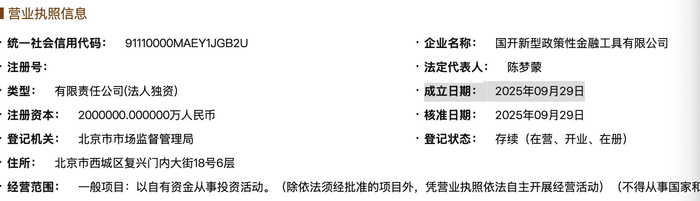
企查查APP显示,近日,国开新型政策性金融工具有限公司、农发新型政策性金融工具有限公司、进银 新型政策性金融工具有限公司成立,注册资本分别为200亿元、100亿元、50亿元,经营范围均为以自有 资金从事投资活动。企查查股权穿透显示,三者分别由国家开发银行、中国农业发展银行、中国进出口 银行全资持股。 (原标题:国开、农发、进出口银行新设新型政策性金融工具公司) ...
何谓新型政策性金融工具?|宏观经济
清华金融评论· 2025-10-08 09:52
文/国金宏观 宋雪涛 此 次新型政策性金融工具的出台更多为了长期目标,与2 0 2 2年相比,在 投向、资金来源和经济影响等方面并不相同。 9月29日,国家发改委在新闻发布会上表示:"推进新型政策性金融工具有关工作,规模共5000亿元,全部用于补充项目资本金"。新型政策性 金融工具最早于今年4月政治局会议提出,最终在基数较高、同比增速压力较大的四季度落地,符合此前市场预期。 早在2022年,央行曾支持国开行、农发行和进出口银行设立类似的政策性开发性金融工具,当时为了托底投资,主要投向交通水利能源等基 础设施和信息科技物流的产业升级,投放7399亿元,带动当年基建投资增速从上半年的9.3%提升至11.5%。对比2022年,这一次的政策性金 融工具有三个不同之处。 出台背景和投向不同 与2022年稳增长压力较大的背景相比,今年实现全年5%的 国内生产总值(GDP) 增长目标压力并不大,此次出台新型政策性金融工具更多 是为了支持扩大内需和科技创新的长远目标,这也符合"十五五"规划的两条主线。因此,新型政策性金融工具在支持项目方面,更加聚焦新 质生产力,重点支持数字经济、人工智能、低空经济、消费基础设施、绿色低碳、农 ...