商汤科技

Search documents
招银国际每日投资策略-20250829
Zhao Yin Guo Ji· 2025-08-29 03:35
Group 1: Semiconductor Industry - AI infrastructure investment continues to rise, with Nvidia's outlook indicating strong demand [2] - Nvidia reported Q2 FY2026 revenue of $46.7 billion, a year-on-year increase of 56% and a quarter-on-quarter increase of 6%, exceeding Bloomberg consensus estimates [2] - The company's Q2 net profit reached $25.8 billion, reflecting a year-on-year growth of 52% and a quarter-on-quarter growth of 30% [2] Group 2: Ctrip (携程) - Ctrip's Q2 FY2025 revenue was RMB 14.9 billion, a year-on-year increase of 16%, surpassing both internal and market expectations [9] - The non-GAAP operating profit was RMB 4.7 billion, exceeding expectations by 7% and 9% due to better-than-expected operational leverage [9] - The company is expected to maintain resilient growth in travel demand, supported by strong supply chain capabilities and customer service [9] Group 3: SenseTime (商汤科技) - SenseTime reported H1 FY2025 revenue of RMB 2.36 billion, a year-on-year increase of 36%, exceeding expectations by 6% [10] - The adjusted net loss narrowed by 50% to RMB 1.16 billion, driven by operational leverage and organizational adjustments [10] - The company anticipates a 25% year-on-year revenue growth in H2 FY2025, supported by strong demand for AI computing and applications [10] Group 4: Anta Sports (安踏) - Anta's retail sales trends showed a mixed performance, with the main brand experiencing weaker growth while other brands like Descente and Kolon continued to perform strongly [24][25] - The company adjusted its retail growth targets for FY2025, lowering Anta's from high single digits to mid single digits, while maintaining FILA's at mid single digits [25] - Despite challenges, Anta's operational profit margin is expected to remain between 20%-25% due to strict control over operating expenses [25]


商汤科技发布半年报:生成式AI业务爆发性增长
Jing Ji Guan Cha Wang· 2025-08-29 02:29
Core Insights - SenseTime reported a total revenue of 2.358 billion yuan for the first half of 2025, marking a year-on-year increase of 35.6%, primarily driven by explosive growth in its generative AI business [1] - The company's net loss narrowed to 1.489 billion yuan, a nearly 40% decrease year-on-year, reflecting the success of its strategy to focus on core operations and improve efficiency [1] - The gross margin decreased from 44.1% in the same period last year to 38.5%, attributed to rising hardware costs and operational expenses of AI data centers [1] Revenue Breakdown - The generative AI business generated 1.815 billion yuan in revenue, a year-on-year increase of 72.7%, and accounted for 77.0% of total revenue, up from 60.4% in the previous year [1] - Traditional visual AI business revenue was 436 million yuan, down 14.8% year-on-year, due to a shift in collaboration model with a major client [2] - The "X Innovation Business," which includes smart driving and healthcare, reported revenue of 107 million yuan, a decline of approximately 39.6% year-on-year, primarily due to a drop in smart driving revenue [2] R&D and Strategic Developments - R&D expenditure for the first half of 2025 was 2.1185 billion yuan, an increase of 12.0% compared to 1.8922 billion yuan in the same period of 2024, driven by investments in foundational model training and generative AI applications [2] - The company has restructured its revenue reporting categories, now classifying its business into generative AI, visual AI, and X innovation, with AI GPU chip companies excluded from consolidated financial statements [1] - SenseTime's "1+X" strategy has made substantial progress, with generative AI further solidifying its position in revenue, and the company has established a specialized leadership structure to enhance the operational vitality of its X innovation business [3]
商汤生成式AI收入增73%,亏损收窄但传统业务迎挑战
Nan Fang Du Shi Bao· 2025-08-28 22:14
Core Insights - Generative AI is becoming a cornerstone and growth engine for SenseTime, with a significant revenue increase reported in the mid-year financial results for 2025 [2] - The company's revenue for the first half of the year reached 2.358 billion yuan, marking a year-on-year growth of 35.6%, while the adjusted net loss narrowed significantly by 50% to 1.162 billion yuan [2] Generative AI Business Performance - The generative AI segment generated revenue of 1.816 billion yuan, reflecting a year-on-year increase of 72.7%, and now accounts for 77% of the total revenue [2] - The growth is attributed to the successful implementation of the "computing power infrastructure - large model research - large model application" strategy [2][3] Infrastructure and Model Development - As of August this year, the total computing power of SenseCore has reached approximately 25,000 PetaFLOPS [3] - The "Riri New" multimodal large model has been iteratively improved, with the latest version V6.5 matching the capabilities of leading international models [3] Application and User Engagement - The "Raccoon" product family for enterprise users has surpassed 3 million users, processing around 10 billion data analysis tokens daily [3] - The "Kapi" series for consumer users has exceeded 10 million users, with a year-to-date growth of 400% in daily active users [3] Strategic Restructuring and Challenges - The "1+X" strategy has redefined the business structure, categorizing core operations under "1" (generative AI and visual AI) and innovative incubations under "X" [4] - The visual AI segment, once a key revenue driver, reported a revenue decline of 14.8% to 436 million yuan due to a shift in collaboration with a major client [4] - The "X" innovation segment generated 107 million yuan, down from 177 million yuan year-on-year, primarily due to challenges in the smart driving "Jueying" business [4] Profitability and Cost Challenges - Despite a significant reduction in overall losses, the company's gross margin fell to 38.5% from 44.1% year-on-year, attributed to increased costs related to hardware and AIDC operations [5]

iPhone17要来了!苹果秋季发布会定档9月9日;追觅单月发近四千万奖金;安踏李宁回应收购彪马;京东官宣进军团播丨邦早报
创业邦· 2025-08-27 00:12
Group 1 - The core viewpoint of the article emphasizes the importance of a competitive incentive mechanism at Chasing Technology, which includes substantial bonuses beyond base salaries to encourage innovation and performance [1][3][4] - Chasing Technology has distributed significant additional incentives this year, amounting to several tens of millions, with over 22 million yuan in June and nearly 40 million yuan in July alone [1][3] - The company aims to recognize and reward the spirit of innovation and hard work among its employees, with bonuses ranging from tens of thousands to millions of yuan [1][3][4] Group 2 - The article highlights that at least three teams received million-yuan bonuses in the past three months, indicating a strong performance culture within the company [1] - The CEO's letter reflects a commitment to valuing employees and fostering a sense of belonging and respect, which is seen as crucial for retaining talent [3][4] - The overall message conveys that the company's growth and innovation are driven by the aspirations and efforts of its employees, reinforcing the idea that people are the foundation of the business [3][4]



2025H1AIGC:移动应用营销观察
广大大· 2025-08-26 05:47
Investment Rating - The report does not explicitly state an investment rating for the industry. Core Insights - The global AIGC (Artificial Intelligence Generated Content) market is experiencing significant growth, with various sectors such as healthcare, education, and marketing showing promising trends and opportunities for investment [5][67][80]. - The North American market leads in AI technology adoption, with major players like OpenAI and NVIDIA dominating the landscape [9][14][80]. - The report highlights the increasing acceptance of AI technologies among consumers, particularly in the U.S. and China, where a significant percentage of the population regularly uses AI applications [10][19][80]. Summary by Sections 1. AIGC Application Global Market Status - The report outlines the current state of AIGC applications, emphasizing the diverse industry structures, overseas value, business models, competitive landscape, and market environment [6]. 2. AIGC Application Overseas Marketing Observation - The report provides insights into the marketing strategies of AIGC products across various global regions, noting the competitive nature of the advertising landscape [24][28]. 3. AIGC Hit Case Observations - The report analyzes successful AIGC applications and their marketing trends, showcasing how certain products have achieved significant market penetration and user engagement [38][40]. 4. Future Trends of AIGC Going Overseas - The report discusses the future trajectory of AIGC applications in international markets, highlighting the potential for growth driven by technological advancements and increasing consumer demand [67][80]. 5. Market Size and Growth Rates - The global AI market is projected to grow significantly, with specific sectors like healthcare expected to see a CAGR of approximately 39.1% from 2023 to 2032 [80]. - The report notes that the North American AI market holds a substantial share, with a projected capital expenditure of $338.5 billion by 2025 [9]. 6. Competitive Landscape - Major players in the AI market include OpenAI, which holds over 50% of the generative AI market share, and NVIDIA, which dominates the AI chip market in North America [9][14]. - The report also highlights emerging players in Europe and Asia, indicating a competitive and rapidly evolving landscape [14][19]. 7. Core Consumer Trends - The report identifies key consumer trends, such as the high acceptance of AI technologies among younger demographics and the demand for personalized experiences across various sectors [10][19]. 8. Sector-Specific Insights - In the healthcare sector, AI applications are expected to enhance diagnostic accuracy and improve patient outcomes, with a market size projected to grow significantly [11][80]. - The education sector is also highlighted as a key area for AI growth, with applications providing personalized learning experiences and immediate feedback [67][80]. 9. Advertising Trends - The report notes a decline in the number of AI advertising clients, but those remaining are increasing their creative input to enhance brand visibility and user engagement [28][31]. - Video content is the preferred format for AI application advertising, with a significant portion of ads being short videos [35][36]. 10. Emerging Markets - The report discusses the growth potential in emerging markets, particularly in Latin America and the Middle East, where government support and digital transformation initiatives are driving AI adoption [21][80]. 11. Challenges and Opportunities - The report outlines the challenges faced by AI companies in overseas markets, including regulatory hurdles and the need for localized marketing strategies [96][104]. - Despite these challenges, the report emphasizes the high willingness of overseas users to pay for AI applications, presenting a lucrative opportunity for companies [98].
广大大&中文在线:2025H1全球AIGC移动应用营销观察报告
Sou Hu Cai Jing· 2025-08-23 01:08
Group 1: Core Insights - The report analyzes the global AIGC mobile application market for the first half of 2025, highlighting significant regional differences and growth trends [1][2] - North America is projected to reach a market size of $327 billion with a year-on-year growth of 28.6%, accounting for 38% of the global market [9][10] - The European market is expected to grow by 24.3%, with local companies competing against major US tech firms, while 44% of consumers recognize AI's positive impact [10][14] - The Asia-Pacific region is also growing at 24%, representing 34% of the global market, with 63% of Chinese internet users regularly using AI [18][19] Group 2: Advertising and Marketing Trends - In the first half of 2025, the number of advertisers in the global AI application market decreased by 47.07% to 2,041, while the average monthly creative materials per advertiser increased by 84.22% to 416 [2][32] - Video advertising dominates, making up 84.05% of total ad formats, with 15-30 second videos accounting for over 50% [36][37] - The highest number of advertisers is in Europe, despite a significant decline of 45.7% [34] Group 3: Successful Case Studies - Meitu Company reported a revenue of 1.8 billion yuan in the first half of 2025, a 12.3% increase year-on-year, driven by AI applications and a rise in paid subscription users [39] - In the AI + image sector, Meitu's products topped app store charts in multiple countries, showcasing the effectiveness of AI in enhancing user engagement [40] Group 4: Future Opportunities and Challenges - The report identifies opportunities for AIGC applications to expand internationally, including high willingness to pay among overseas users and gaps in AI marketing products [2] - Challenges include increased costs of going abroad, heightened localization requirements, and intense market competition [2]


激光雷达VS纯视觉 两年后迎来终极对决?
Zhong Guo Qi Che Bao Wang· 2025-08-22 10:32
Core Viewpoint - The debate between pure vision and LiDAR technology for autonomous driving continues, with no clear resolution expected by 2027, as both technologies gain supporters and evolve in capabilities and costs [2][5][10] Group 1: Technology Adoption - Both pure vision and LiDAR technologies have gained significant traction, with various automakers adopting either approach. New entrants and established companies are increasingly choosing sides, with some switching from LiDAR to pure vision [2][3] - Recent models like the Tank 500 and Li Auto i8 have adopted LiDAR, while companies like Xiaomi and Audi are also integrating LiDAR into their vehicles [2][3] - Conversely, companies like Xiaopeng and NIO are firmly committed to pure vision technology, with Xiaopeng's models like the MONA M03 and the new P7 exclusively using this approach [4][5] Group 2: Market Trends - The market for LiDAR-equipped vehicles is expanding, with significant growth in the number of LiDAR units delivered in China, reaching 1.0439 million units in the first half of the year, a year-on-year increase of 83.14% [3] - LiDAR is no longer limited to high-end models, as companies like Leap Motor and Changan are introducing LiDAR-equipped versions in the lower price segments [3] Group 3: Cost and Safety Debate - The ongoing debate between the two technologies centers on cost and safety. Pure vision systems are seen as more cost-effective and easier to scale, while LiDAR is favored for its superior performance in extreme conditions [5][6] - The cost of LiDAR has significantly decreased, with prices for L2-level LiDAR now around $200, down from previous prices of $20,000 to $30,000, representing a reduction of over 99.5% [5][9] Group 4: Future Outlook - Experts suggest that both technologies will likely coexist, with pure vision being sufficient for urban commuting and LiDAR providing safety redundancy in complex scenarios [10] - The advancement of computing power and algorithms is expected to enhance the capabilities of pure vision systems, potentially making them the preferred choice for many automakers [8][9]


恒指止跌回升,后市可重拾升轨
Guodu Securities Hongkong· 2025-08-21 02:03
Group 1: Market Overview - The Hang Seng Index experienced a rebound after four consecutive days of decline, closing up 43 points or 0.17% at 25,165, with a total trading volume of 285.29 billion HKD [3] - The index opened lower at 24,968, dropping as much as 234 points before recovering, driven by strong performance in A-shares [3] Group 2: Fund Manager Sentiment - HSBC's survey indicates a reduction in bearish sentiment among fund managers towards Chinese stocks, with technology and consumer stocks being added to investment portfolios [6] - The allocation of Chinese stocks in nearly 300 actively managed emerging market funds has increased to approximately 28%, up from 22.5% a year ago, although still underweight by 340 basis points [6] Group 3: AI Development Market - The market size for large model development platforms in China is projected to reach 1.69 billion RMB in 2024, with expectations for sustained high growth over the next three years [7] - Key players in this market include Baidu Smart Cloud, Alibaba Cloud, SenseTime, and others, with a focus on enhancing productivity applications through AI [7] Group 4: Company News - Pop Mart - Pop Mart's founder expressed confidence in achieving 30 billion RMB in revenue this year, significantly higher than the previously stated target of 20 billion RMB [9][10] - The company reported a surge in adjusted net profit to 4.709 billion RMB in the first half of the year, a year-on-year increase of nearly 362% [10] Group 5: Company News - Xiaomi - Xiaomi's automotive business is expected to become profitable in the second half of the year, with significant reductions in losses reported [11] - The cumulative investment in the automotive sector has exceeded 30 billion RMB, indicating a strong commitment to this growth area despite previous losses [11]


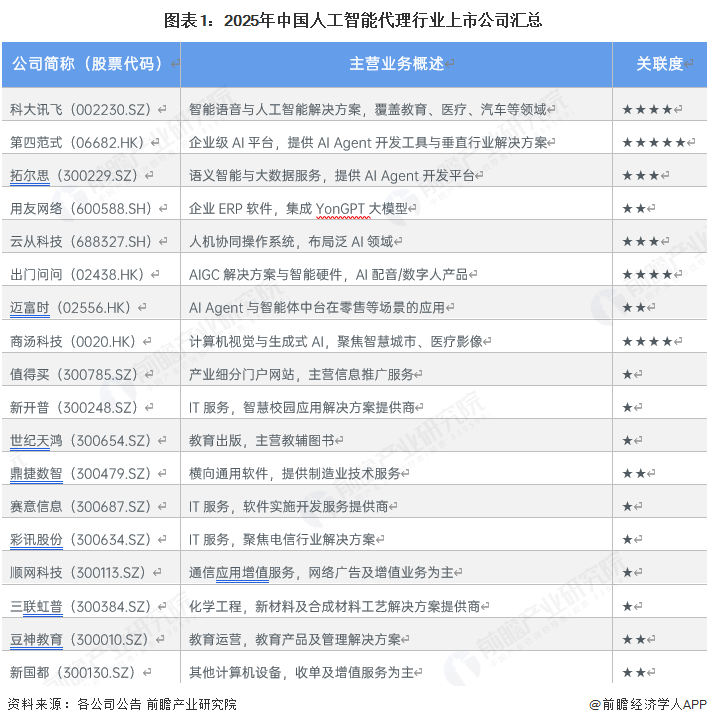
2025 年中国人工智能代理行业上市公司全方位对比(附业务布局汇总、业绩对比、业务规划等)
Sou Hu Cai Jing· 2025-08-20 13:32
Group 1: Industry Overview - The artificial intelligence agency industry is an emerging sector in China, with extensive downstream demand and a strong correlation between development stages and R&D investment intensity [1] - Key players in the industry include Keda Xunfei (002230), Fourth Paradigm (06682), Tuolisi (300229), and others, focusing on various applications and solutions [2][3] Group 2: Company Comparisons - Keda Xunfei leads with a significant R&D investment of 4.58 billion yuan in 2024, representing a 19.37% increase year-on-year, with revenue reaching 23.343 billion yuan [4][5] - Fourth Paradigm reported a revenue of 5.261 billion yuan in 2024, a 25.1% increase, with a gross margin of 41.2% [14] - Companies like SenseTime and CloudWalk face challenges with high R&D costs and low revenue, with SenseTime's R&D expense ratio reaching 106% in 2024 [5][6] Group 3: Business Layout and Performance - The industry exhibits a dual pattern of "vertical deepening" and "cross-domain expansion," covering sectors such as finance, education, and healthcare [10][11] - Keda Xunfei's AI education products generated 7.229 billion yuan in revenue, while Fourth Paradigm focuses on risk management in the financial sector [10][14] - CloudWalk's revenue fell by 36.69% to 398 million yuan in 2024, despite a 136% growth in its AI business [14][15] Group 4: Strategic Planning and Future Directions - Keda Xunfei aims to deepen its industry model strategy, focusing on education and healthcare [18] - Fourth Paradigm plans to enhance its AI Agent platform and expand into energy and finance sectors [18] - Companies like CloudWalk are transitioning to become AI service providers, focusing on smart home scenarios [18]




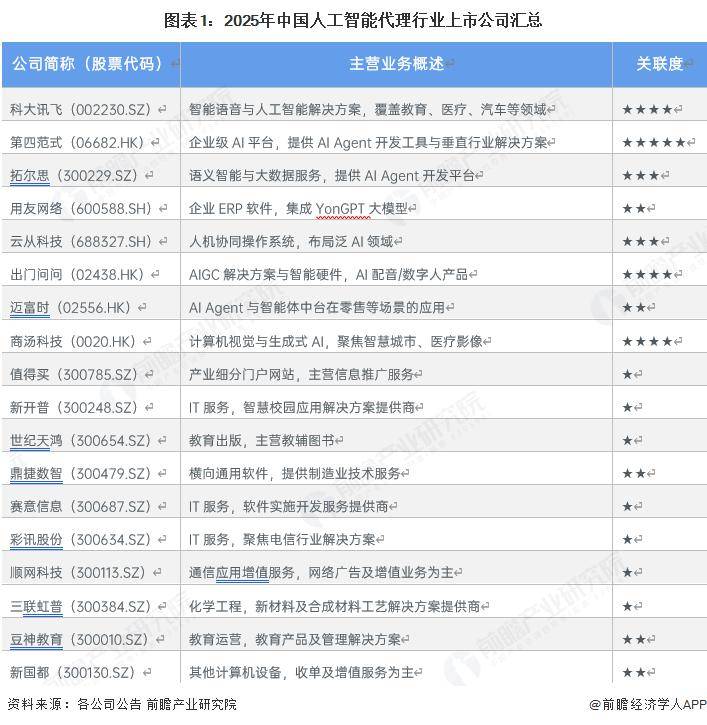
【最全】2025年中国人工智能代理行业上市公司全方位对比(附业务布局汇总、业绩对比、业务规划等)
Qian Zhan Wang· 2025-08-20 10:59
Group 1 - The core viewpoint of the article highlights the rapid development and diverse applications of the artificial intelligence (AI) agency industry in China, emphasizing the importance of R&D investment and the competitive landscape among key players [1][2][3]. Group 2 - The article provides a summary of major listed companies in the AI agency sector, including Keda Xunfei, Fourth Paradigm, and others, showcasing their business layouts and competitive advantages [1][2]. - Key companies are focusing on vertical fields and leveraging large model technology to create differentiated AI agency products, with leading firms like Keda Xunfei and SenseTime utilizing self-developed large models across multiple scenarios [2][3]. - The industry is characterized by three main features: deep vertical scene implementation, ecological cooperation, and standardization of industry solutions [3]. Group 3 - A comparison of basic information among AI agency companies reveals that some firms excel in specific verticals, while others adopt a cross-domain expansion strategy, covering various sectors such as finance, education, and healthcare [2][10]. - Keda Xunfei's AI learning machine has been a top seller in major e-commerce platforms, with its smart education business generating significant revenue [10]. - Fourth Paradigm has established partnerships with major financial institutions to implement AI solutions in risk control and asset management [10]. Group 4 - R&D investment is a critical factor for success, with Keda Xunfei's R&D expenditure reaching 4.58 billion yuan in 2024, representing a 19.37% increase year-on-year [4][5]. - Some companies, like SenseTime, exhibit high R&D spending but struggle with revenue generation, indicating a mismatch between R&D resources and commercialization capabilities [5][6]. - The proportion of R&D personnel is a key indicator of a company's technological drive, with Keda Xunfei having a significantly higher percentage of R&D staff compared to industry averages [6]. Group 5 - The business performance of AI agency companies varies, with Fourth Paradigm achieving a total revenue of 5.261 billion yuan in 2024, marking a 25.1% year-on-year increase [15]. - In contrast, CloudWalk Technology experienced a revenue decline of 36.69% to 398 million yuan in 2024, despite some segments showing high growth [16]. - Companies like Tuolisi maintain high gross margins despite slower revenue growth, indicating a focus on high-margin customized services [16]. Group 6 - The strategic planning of AI agency companies reflects differentiated approaches in technology investment and product roadmaps, impacting their market positioning and operational efficiency [18]. - Keda Xunfei is pursuing a strategy of deepening its industry model while expanding its presence in education and healthcare [19]. - Fourth Paradigm is focusing on integrating agent technology with world models to enhance its service offerings across various industries [19].