任天堂

Search documents
“内容+科技”双引擎驱动!索尼(SNOY.US)Q2业绩超预期 上调全年利润指引
Zhi Tong Cai Jing· 2025-11-11 07:01
Core Viewpoint - Sony reported better-than-expected Q2 financial results, driven by strong performance in its entertainment business and a rebound in demand for high-end smartphone image sensors, leading to an upward revision of its full-year profit outlook [1] Financial Performance - For the quarter ending in September, Sony achieved revenue of 3.108 trillion yen, a 5% year-on-year increase, surpassing market expectations of 2.985 trillion yen - Operating profit reached 429 billion yen, a 10% year-on-year growth, significantly exceeding analyst expectations of 398.44 billion yen [1] - The company raised its full-year operating profit forecast to 1.43 trillion yen (approximately 9.3 billion USD), a 7.5% increase from previous estimates, and increased annual revenue expectations by 300 billion yen (3% growth) [1] Business Segments - The music business saw a profit surge of 27.65% to 115.4 billion yen, driven by blockbuster films like "Demon Slayer: Mugen Train" - The imaging business experienced a nearly 50% profit increase to 138.3 billion yen, becoming the most profitable segment for the quarter, focusing on advanced semiconductor products for smartphones, automotive, and industrial systems [2] - The gaming and network services segment remains Sony's largest revenue source, but profits declined by 13.26% to 120.4 billion yen, with 3.9 million PS5 consoles sold during the quarter, showing a year-on-year increase [2] Market Outlook - Sony is optimistic about the smartphone market's recovery, as it raised sales and profit forecasts for its smart sensor division, despite some market share loss to Samsung [2] - The company is preparing for the next generation of gaming consoles, with indications that the PS5's lifecycle is longer than expected, even without major game releases in the first half of the fiscal year [3] - Sony's management has revealed plans to reduce marketing spending on the PS5, focusing instead on profitability, which is a typical signal of preparing for new hardware [3]

游戏展会背后的游戏经济密码
3 6 Ke· 2025-11-10 11:45
Core Insights - The number and scale of offline gaming-themed events have significantly increased this year, showcasing broad economic and social impacts, with attendance at events like ChinaJoy exceeding 400,000 and participation from nearly 800 companies across various sectors [1][3][31] - Game exhibitions have evolved into comprehensive economic ecosystems, driving new productivity through technology releases, cross-industry collaborations, and consumer engagement, with major players like Xbox, Nintendo, and Tencent showcasing a plethora of products [3][5][25] - The integration of advanced technologies such as AI, XR, and cloud computing into gaming exhibitions highlights their role as platforms for future digital innovations, with events like ChinaJoy introducing next-generation entertainment experiences [5][25][28] Industry Trends - Game exhibitions are becoming vital platforms for non-gaming companies to penetrate Gen Z culture, with traditional brands successfully launching gaming IP collaborations to attract younger consumers [7][25] - The rise of independent games is notable, with the number of showcased indie titles at events like BW tripling compared to four years ago, reflecting a diverse and vibrant gaming ecosystem [3][5] - The global gaming market is projected to reach $188.8 billion in 2025, with a 3.4% year-on-year growth, indicating a robust demand for gaming products and experiences [31][33] Economic Impact - Game exhibitions are pivotal in driving local economies, with events like ChinaJoy generating approximately 661 million yuan in surrounding service consumption, and the Cologne Game Show transforming the city into an immersive entertainment space [33][34] - The synergy between gaming and urban economies is evident, as gaming events stimulate related sectors such as hospitality and transportation, creating significant multiplier effects [33][34] - The cultural significance of gaming is growing, with events fostering community engagement and youth culture, as seen in the popularity of esports and gaming-related activities [35][38] International Dynamics - Chinese gaming companies are increasingly participating in international exhibitions, with nearly 110 firms attending the Tokyo Game Show in 2025, marking a significant rise from previous years [12][28] - The differentiation between domestic and international gaming events is becoming more pronounced, with overseas shows like Gamescom emphasizing high internationalization and technological foresight, while domestic events focus on user experience and market conversion [28][30] - The evolution of gaming exhibitions from product showcases to cross-industry platforms reflects the growing importance of gaming as a cultural and economic driver in the digital age [29][30]



游戏展会背后的游戏经济密码
腾讯研究院· 2025-11-10 11:08
Core Viewpoint - The gaming industry is experiencing significant growth, with offline gaming events becoming key drivers of economic and cultural influence, showcasing a vibrant ecosystem that connects various sectors and demographics [2][36]. Group 1: Growth of Gaming Events - The number and scale of gaming-themed offline events have significantly increased, with over 400,000 attendees at ChinaJoy and nearly 800 companies participating, including traditional brands entering the youth market [2][7]. - Major gaming exhibitions like Tokyo Game Show and Gamescom have seen substantial participation, with the latter attracting 35.7 million visitors from 128 countries, highlighting the global appeal of gaming [2][4][12]. - The rise of independent games is notable, with the number of independent game exhibitors at BW increasing more than threefold compared to four years ago, reflecting the diverse and dynamic nature of the gaming industry [4][5]. Group 2: Technological Integration - Gaming exhibitions are becoming platforms for showcasing future digital technologies such as AI, XR, and cloud computing, with events like ChinaJoy introducing innovative experiences like smart entertainment robots and brain-machine interfaces [5][27]. - The integration of cutting-edge technologies is driving new productivity in the gaming sector, with companies like NVIDIA presenting advanced rendering technologies and AI solutions at these events [5][27]. Group 3: Cross-Industry Collaboration - Non-gaming companies are leveraging gaming exhibitions to tap into Gen Z culture, with brands like Old Fengxiang and Yadi launching co-branded products to connect with younger consumers [7][27]. - The presence of global brands such as LEGO and Disney at gaming events underscores the economic value of the "gaming plus" cross-industry model, enhancing brand visibility and engagement [7][27]. Group 4: Economic Impact - Gaming events are becoming vital for urban economies, generating significant ancillary spending in areas like food, accommodation, and transportation, with ChinaJoy alone driving approximately 661 million yuan in surrounding service consumption [39][40]. - The gaming industry is projected to reach a global market revenue of $188.8 billion by 2025, with a user base of 3.6 billion gamers, indicating a robust growth trajectory [36][38]. Group 5: Cultural Significance - Gaming is increasingly recognized as a cultural cornerstone for youth, fostering community and identity through unique cultural practices and social interactions at events [40][42]. - Events like ChinaJoy and KPL finals are not only entertainment spectacles but also serve as platforms for cultural expression and community building among young audiences [40][42].

游戏IP正在成为影视行业的下一座“超级金矿”
3 6 Ke· 2025-11-10 09:10
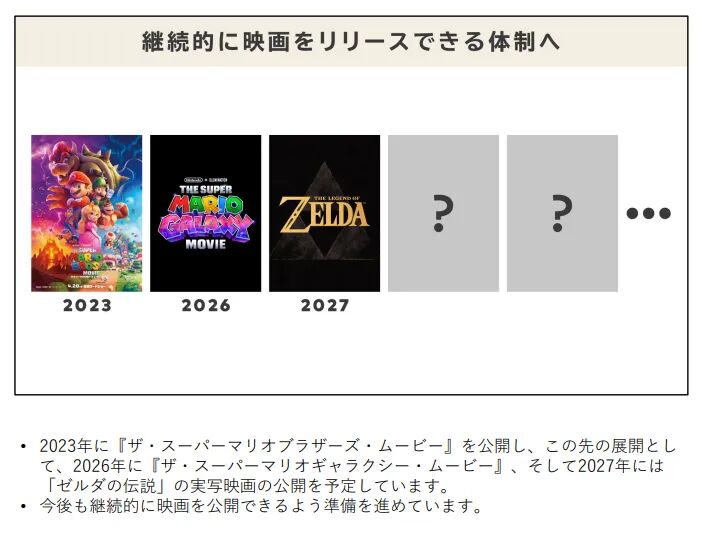
Core Insights - Nintendo is focusing on film adaptations of its IPs as a key strategic direction for the future, with multiple projects in various stages of production set to follow the release of the live-action "The Legend of Zelda" movie in 2027 [1][3] - Unlike most game companies that prefer licensing agreements, Nintendo plans to be deeply involved in the production and investment of these films, believing that creator involvement is crucial for ensuring quality adaptations [3] - The success of "The Super Mario Bros. Movie," which grossed over $1.3 billion globally, has reinforced Nintendo's commitment to this strategy [3] Industry Trends - The trend of video game adaptations is moving towards mainstream acceptance, with a complete project development and global distribution chain emerging [5] - Successful adaptations are no longer seen as isolated incidents but as part of a mature industry chain involving leading companies, IPs, and teams [12] - The collaboration between Netflix and Riot Games on "Arcane" exemplifies a shift in narrative focus from gameplay to universal themes, marking a new stage in the artistic expression of game adaptations [8] Market Developments - In China, similar trends are emerging, with the announcement of an animated film based on "Honor of Kings," aiming for a broader audience beyond just gamers [9][12] - The film is positioned as a "national-level narrative experiment," indicating that Chinese game companies are also entering the global IP film adaptation strategy [12] Cultural Shifts - The generational shift in audience demographics is changing the core narrative sources of global cultural content, with video games becoming significant cultural symbols for those who grew up with them [13] - Traditional narrative frameworks are facing growth limitations, leading to a faster evolution of the film industry's narrative systems, with game IPs offering high adaptability and rich storytelling potential [14][17] - The focus of game adaptations is shifting from merely replicating gameplay to expressing emotional structures that resonate with a wider audience, thus broadening the cultural significance of video games [17]

“双11”天猫3C数码品类成交额占比达42% 多款新品参与补贴活动
Feng Huang Wang· 2025-11-10 05:18
Core Insights - Tmall leads the e-commerce market in the 3C digital category during the Double 11 shopping festival, with a transaction share of 42% according to a report by Analysys [1] - The transaction scale of Tmall's 3C digital products reached 44.9%, maintaining its leading position from previous shopping events [1] - Significant growth in the 3C digital industry is driven by new product launches, including the iPhone 17 series, which surpassed last year's total sales within two hours of release [1] Group 1 - Tmall's 3C digital category transaction share is the highest among all e-commerce platforms [1] - New product launches, such as iQOO 15 and vivo X300 Pro, have significantly contributed to sales growth [1] - AI smart hardware has emerged as a consumer hotspot, with smart glasses sales increasing by 25 times year-on-year [1] Group 2 - The Taobao Flash Purchase service has generated significant sales growth for 3C digital brands, with Huawei stores seeing a week-on-week increase of 1910% [2] - E-sports products, including gaming laptops and DIY computers, have shown notable sales growth [2] - AI laptops experienced substantial sales increases during the pre-sale phase, with brands like Lenovo and ASUS doubling their transaction amounts [2]

Toy and Game Makers Target a 'Kidult' Market That Is Chasing Both Nostalgia—and Gains
Yahoo Finance· 2025-11-08 10:00
Core Insights - The toy and game industry is experiencing growth driven by adult consumers who are purchasing items typically aimed at children, fueled by nostalgia and financial motivations [3][5][6] Group 1: Market Trends - Companies are targeting adult customers by releasing products that evoke nostalgia for cultural icons from the '80s and '90s, such as Nintendo's revival of the Virtual Boy console games and Lego's set inspired by "The Goonies" [2] - Adults have outspent other age groups on toys in 2024, with this trend continuing into the first half of 2025, indicating a shift in consumer demographics within the toy market [3] Group 2: Consumer Behavior - The rise of "pop toys," like Labubu and Wakuku, reflects a shift from niche items to lifestyle essentials for adults, as consumers seek comfort and connection through their purchases [4] - Adults are motivated to buy toys not only for nostalgia but also for community engagement and potential financial investment, as some seek rare items that may appreciate in value [5][6] Group 3: Industry Dynamics - The growing adult audience is prompting toy and game companies to cater to this demographic with products that reference popular movies and bands from the past [7] - Social media and innovative packaging strategies have contributed to the phenomenon of adult toy purchasing, alongside favorable market conditions [7]
Nintendo: Earnings Show Switch 2 Demand Surging As Margin Recovery Becomes The Next Test
Seeking Alpha· 2025-11-07 04:45
Core Insights - The analysis focuses on future-oriented industries where culture, technology, and valuation intersect, particularly in gaming and digital assets [1] Group 1: Industry Focus - The sectors covered include gaming publishers such as Nintendo, Capcom, and Square Enix, which are pivotal in reshaping global entertainment [1] - Digital assets like XRP, Bitcoin, and Ethereum are highlighted as transformative forces in global finance [1] Group 2: Consumer Brands - Selected consumer brands such as Monster Beverage, Sprouts, and Macy's are analyzed, emphasizing the importance of brand and consumer behavior in driving long-term value [1] Group 3: Analytical Approach - The analytical methodology combines Discounted Cash Flow (DCF) and relative valuation with macroeconomic and narrative context, aiding in identifying early investment opportunities [1]


选择过剩的2025,钱该往哪花?
虎嗅APP· 2025-11-06 12:00
Core Insights - The article emphasizes a shift in consumer behavior towards thoughtful consumption, where spending reflects personal values and lifestyle choices rather than mere impulse or necessity [2][3][41] - The concept of "super consumers" is introduced, highlighting the importance of understanding genuine consumer preferences through in-depth conversations with diverse individuals from various industries [7][8][42] Consumer Behavior Trends - Consumers are increasingly overwhelmed by choices due to the influence of AI algorithms, marketing information, and KOL endorsements, leading to a need for curated lists to guide purchasing decisions [5][6] - The article suggests that spending more does not equate to better decision-making, as consumers struggle to determine what is truly "worth it" [6][41] Product Recommendations - A list of recommended products is provided, showcasing items that enhance quality of life and align with the values of modern consumers [9] - Categories include technology products like the DJI Pocket 3 and the iPad Mini 7, which are praised for their practicality and design [10][14][17] - Lifestyle products such as fresh flowers from Yunnan and unique home decor items are highlighted for their emotional value and ability to enhance living spaces [25][27] Emotional and Practical Value - The article stresses that consumers are now prioritizing emotional satisfaction and practical solutions over mere cost-effectiveness, indicating a shift towards "heart price" rather than "cost performance" [26][18] - The importance of community brands and unique experiences is noted, as consumers seek products that resonate with their individual tastes and lifestyles [29][30] Future Consumption Outlook - The core of consumption in 2025 is identified as a reflection of personal lifestyle choices, with a focus on making informed decisions that lead to a more ideal future [41][42] - The article concludes with an invitation to engage with innovative trends and connect with industry leaders at the 2025 F&M Innovation Festival [43]

资讯日报:美国10月ADP就业人数超预期-20251106
Guoxin Securities Hongkong· 2025-11-06 05:06
Market Overview - The ADP employment report for October showed an increase of 42,000 jobs, significantly exceeding the expected 28,000, marking the largest gain since July 2025[12] - Major U.S. indices closed higher, with the Nasdaq up 0.65%, the Dow Jones up 0.48%, and the S&P 500 up 0.37%[9] - The Hang Seng Index and the Hang Seng Tech Index fell by 0.07% and 0.56%, respectively, while the Shanghai Composite Index rose by 0.23%[3] Sector Performance - Large tech stocks showed mixed results, with JD.com, Alibaba, and Xiaomi declining, while Meituan rose by 1.3%[9] - The energy sector saw significant investment, with State Grid's fixed asset investment exceeding 420 billion CNY, leading to gains in related stocks[9] - Financial and gaming stocks generally performed well, while education, restaurant, automotive, and semiconductor stocks were weak[9] International Indices - The Nikkei 225 index fell by 2.5%, influenced by a broader tech sell-off, while the DAX in Germany rose by 0.42%[3][12] - The Nasdaq Golden Dragon China Index increased by 0.15%, with JinkoSolar and Canadian Solar seeing gains of 16% and 13.7%, respectively[12] Notable Company Movements - Tesla shares rose over 4% amid news of a significant compensation proposal for CEO Elon Musk[9] - Pinterest's stock dropped over 21%, marking its second-worst single-day performance since its U.S. IPO due to tariff impacts on advertising revenue[12] - AMD's stock increased by 2.5% after reporting Q3 earnings that exceeded expectations, although Q4 guidance was less impressive[9]
一则利好,万亿巨头大涨
中国基金报· 2025-11-06 02:09
Market Overview - The Korean stock market opened significantly higher today, recovering from its largest single-day drop since August, with an initial increase of over 2% before narrowing to a 1.09% gain [4][5] - The Seoul Composite Index reached 4048.19, up by 43.77 points [5] - Key stocks such as LG Energy, Korea Electric Power, and LG Electronics showed notable gains [6] Economic Indicators - South Korea's trade surplus expanded to $14.245 billion in September, with a current account surplus of $13.467 billion [6] - Japan's Nikkei 225 index also saw a rise of over 2%, currently reported at 50964.96 points [8] Company Performance - Nintendo's stock surged by over 6%, reaching a new high in over 11 weeks, following the release of its Q3 financial results for FY 2025-2026, which exceeded market expectations [9][10] - Nintendo reported Q3 revenue of 527.2 billion yen, significantly above the expected 461.76 billion yen, marking a year-on-year growth of over 90% [11] Wage Trends - Japan's nominal wages increased by 1.9% year-on-year in September, aligning with economists' expectations, while real cash earnings fell by 1.4% for the ninth consecutive month [12][13] - The Bank of Japan is closely monitoring wage trends as a key factor for future interest rate decisions, with the next policy meeting scheduled for December 19 [13]