古茗

Search documents
从蜜雪冰城到鸣鸣很忙,中国县城为何走出一个又一个成功的新消费?
Xin Lang Cai Jing· 2026-01-21 07:10
Core Insights - The central economic work conference in December 2025 will prioritize boosting consumption as a key macro policy, highlighting its importance in China's economic strategy [2] - The report by Black Ant Capital focuses on the county-level economy, which is crucial for understanding the future of consumption in China, emphasizing the need for in-depth field research [2][3] Group 1: County Market Dynamics - The county market represents about one-third of China's population (450 million people) and GDP (33%), making it a significant area for consumption growth [3] - The county economy exhibits stronger consumption resilience compared to first-tier cities, with unique challenges such as "scale inefficiency" [3][4] - The rise of brands like Mixue Ice Cream and Mingming Busy from lower-tier markets indicates the potential of county economies in shaping future consumption trends [3][4] Group 2: Consumer Behavior Changes - From 2022 to 2025, county residents have become more cautious in their spending, particularly on non-essential items, reflecting a shift from identity-driven consumption to practical and emotional needs [13][24] - The demand for identity symbols has decreased, with consumers prioritizing practical value and emotional connections in their purchasing decisions [24][28] - There is a notable increase in the importance of "gaining knowledge" as a consumer need, indicating a shift towards valuing experiences and personal growth [24][28] Group 3: Spending Patterns - County households are experiencing stable income levels, yet they are actively reducing discretionary spending, particularly on clothing and identity-related items [13][50] - Essential expenditures such as education and healthcare remain a priority, while personal discretionary spending is being redirected towards experiences that provide immediate satisfaction and long-term health benefits [35][37] - The trend indicates a transformation in spending from acquiring more goods to enhancing quality of life and emotional well-being [35][50] Group 4: Channel Evolution - There is a growing preference for high-value, convenient shopping channels in county markets, with a decline in traditional retail and an increase in modern formats like discount stores [45][48] - The rise of interest-driven e-commerce and local life platforms reflects changing consumer habits, aligning more closely with trends seen in higher-tier cities [45][48] Group 5: Future Outlook - The report emphasizes the importance of continuous research on county-level consumer behavior to identify emerging trends and investment opportunities [10][12] - The evolving landscape of consumer expectations and spending habits in county markets will be critical for brands aiming to penetrate these areas effectively [11][12]


大行评级|小摩:微升古茗目标价至36港元,继续列为行业首选
Ge Long Hui· 2026-01-21 06:24
Core Viewpoint - Morgan Stanley has raised the target price for Gu Ming from HKD 35 to HKD 36, maintaining an "Overweight" rating and continuing to list it as an industry favorite [1] Group 1: Store Expansion and Financial Projections - The company management holds a positive outlook on the franchise network, although it anticipates a slight negative impact on gross margin [1] - The forecast for net new store openings in 2025 and 2026 has been increased from 3,100 and 3,300 to 3,300 and 3,500 respectively, with an expected year-on-year growth of 26% in store count by 2026 [1] - Core net profit for 2025 is estimated to reach CNY 2.3 billion, representing a year-on-year growth of 51% [1] Group 2: Revenue and Profitability Expectations - With the addition of 3,500 new stores in 2026 and a slight decrease in average selling price, revenue is expected to grow by 21% year-on-year [1] - Due to operational leverage expected to offset slight gross margin pressure, the net profit margin is anticipated to remain stable, with core earnings projected to reach CNY 2.8 billion in 2026 [1]
古茗(01364.HK)一度涨超3%
Mei Ri Jing Ji Xin Wen· 2026-01-21 05:57
每经AI快讯,古茗(01364.HK)一度涨超3%,截至发稿涨2.82%,报29.18港元,成交额6693.27万港元。 ...
古茗再涨超3% 小摩上调公司今明两年净开店预测
Zhi Tong Cai Jing· 2026-01-21 05:51
Core Viewpoint - The management of Gu Ming (01364) anticipates a recovery in organic same-store transaction value (GMV) by 2026, with potential growth driven by new product penetration and an optimistic outlook on the franchise network [1] Financial Projections - Morgan Stanley has revised its net store opening forecasts for Gu Ming, increasing the estimates for 2025 and 2026 from 3,100 and 3,300 stores to 3,300 and 3,500 stores respectively, projecting a 26% year-on-year growth in store count by 2026 [1] - The estimated core net profit for Gu Ming in 2025 is projected to reach 2.3 billion RMB, representing a 51% year-on-year increase [1] - Revenue is expected to grow by 21% year-on-year in 2026, driven by the opening of 3,500 new stores and a slight reduction in average selling prices [1] - The net profit margin is anticipated to remain stable due to operating leverage offsetting slight gross margin pressure, with core earnings projected to reach 2.8 billion RMB in 2026 [1] Investment Rating - Morgan Stanley has raised its earnings per share forecasts for Gu Ming for 2025 to 2027 by approximately 1%, with the target price slightly increased from 35 HKD to 36 HKD, maintaining an "Overweight" rating and continuing to list it as an industry favorite [1]
港股异动 | 古茗(01364)再涨超3% 小摩上调公司今明两年净开店预测
智通财经网· 2026-01-21 05:44
Core Viewpoint - Company Guming (01364) has seen a stock price increase of over 3%, currently trading at 29.18 HKD with a transaction volume of 66.93 million HKD, following a report from Morgan Stanley that highlights positive growth expectations for the company [1] Group 1: Management Expectations - Guming's management anticipates that the organic same-store transaction value (GMV) will stabilize from a year-on-year decline of 5% to flat by 2026; if new products like breakfast gain faster penetration, there is potential for a 5% year-on-year increase [1] - The management holds a positive outlook on the franchise network, indicating confidence in expansion [1] Group 2: Store Opening Projections - Morgan Stanley has revised its net store opening forecasts for 2025 and 2026 from 3,100 and 3,300 stores to 3,300 and 3,500 stores, respectively, projecting a 26% year-on-year growth in store count by 2026 [1] Group 3: Financial Performance Estimates - The firm estimates that Guming's core net profit will reach 2.3 billion RMB in 2025, representing a 51% year-on-year increase; with the addition of 3,500 new stores in 2026 and a slight decrease in average selling prices, revenue is expected to grow by 21% year-on-year [1] - Due to operational leverage potentially offsetting slight gross margin pressure, the net profit margin is expected to remain stable, with core earnings projected to reach 2.8 billion RMB in 2026 [1] Group 4: Earnings Forecast and Target Price - Morgan Stanley has raised its earnings per share forecasts for Guming for 2025 to 2027 by approximately 1%, with the target price slightly increased from 35 HKD to 36 HKD, maintaining an "Overweight" rating and continuing to list the company as an industry favorite [1]
古茗20260120
2026-01-21 02:57
Summary of Gu Ming's Conference Call Company Overview - Gu Ming is a rapidly growing tea beverage company established in 2010, located in Wenling, Zhejiang. The company has focused on supply chain as a core driver of its growth, deploying an automated distribution system since 2013 and initiating cold chain delivery in 2017. As of 2023, Gu Ming has over 60,000 cubic meters of cold storage capacity and more than 300 cold chain transport vehicles, establishing an industry-leading warehousing and distribution network [4][4]. Financial Performance - In 2024, Gu Ming achieved a revenue of 8.791 billion yuan, representing a year-on-year growth of 14.54%. The adjusted net profit reached 1.493 billion yuan, with a year-on-year increase of 5.69%, demonstrating resilience amid a slowing industry growth backdrop. The mid-year report for 2025 indicates a profit growth rate exceeding 40%, leading the industry [2][4]. Industry Insights - The ready-to-drink tea market has become a trillion-yuan new consumption sector, evolving from a novelty to a stable consumer base with high repurchase rates, supporting continuous market expansion [5][6]. - Tea beverages have transcended basic product functionality, becoming an integral part of young people's daily lives, allowing them to express lifestyle choices and seek emotional value [6]. Market Position - Gu Ming holds a leading position in the mass price segment, with an 18% market share in 2023. Despite intensified competition from brands like Heytea adjusting their positioning, Gu Ming has shown stronger resilience, achieving superior operational results in both single-store performance and store openings [2][7]. Unique Business Strategies - Gu Ming's effective business strategies include: 1. **Supply Chain Advantage**: Significant investment in cold chain logistics, making it an industry leader [8]. 2. **Regional Store Opening Strategy**: Implementing a dense network of stores to enhance logistics efficiency and reduce costs while increasing brand recognition [8]. 3. **High-Frequency New Product Launch Strategy**: A research team comprising food enthusiasts and engineers releases approximately 100 new products each quarter to attract repeat purchases [10]. 4. **Strict Franchise Management**: Empowering front-end franchisees and enhancing back-end supply chain management to ensure uniform standards across all stores [10]. Future Outlook - Gu Ming plans to enhance same-store performance through scenario innovation and category expansion (e.g., coffee) while entering over a dozen untapped provinces. The company anticipates adding 3,000 new stores by 2026, representing a 24% growth. The scale effect is expected to further improve profit margins. Currently, the company's valuation is close to 20 times earnings, indicating strong growth potential in the medium to long term [3][9].
未知机构:光仔收盘观察系列中国中免收盘价AH股创下202311以来-20260121
未知机构· 2026-01-21 02:20
Summary of Key Points from the Conference Call Industry Overview - The conference call highlights significant stock price increases in various companies within the tourism and hospitality sectors, indicating a positive market trend. - The focus is on a K-shaped recovery, cyclical reversal, silver economy, and strong innovation and operational leaders as key investment themes for 2026. Company Highlights - **China Duty Free Group (中国中免)**: - Achieved a new high in A/H share prices since November 2023, indicating strong market performance and investor confidence [1]. - **ShouLai Hotel (首旅酒店)**: - Recorded a new high in stock price since September 2023, reflecting positive developments in the hospitality sector [2]. - **Three Gorges Tourism (三峡旅游)**: - Stock price reached a new high since January 2016, suggesting a robust recovery in tourism-related activities [3]. - **Jiuhua Tourism (九华旅游)**: - Achieved a new high in stock price since July 2016, indicating a resurgence in interest and investment in this segment [4]. - **Gu Ming (古茗)**: - The stock price reached a new high since its IPO, showcasing strong market performance and growth potential [5]. Investment Themes - The call emphasizes the following investment directions for 2026: - K-shaped recovery, indicating that some sectors are recovering faster than others. - Cyclical reversal, suggesting a shift in market dynamics that could benefit certain industries. - Silver economy, focusing on the growing market for products and services catering to the aging population. - Strong innovation and operational leaders, highlighting companies that excel in these areas as prime investment opportunities [6]. Conclusion - The conference call presents a positive outlook for the tourism and hospitality sectors, with several companies achieving significant stock price milestones. The identified investment themes for 2026 suggest a strategic focus on recovery trends and demographic shifts that could drive future growth.
马年将至消费板块修复在即,摩根大通研报:中国消费股已具备足够吸引力
Zhi Tong Cai Jing· 2026-01-20 14:28
Core Insights - The Chinese consumer sector is showing signs of recovery in early 2026 after a five-year underperformance period from 2021 to 2025, driven by a combination of policy support and structural differentiation in demand [1] - The report highlights that the risk-reward ratio for Chinese consumer stocks is now attractive due to valuation advantages and profit resilience, with a focus on sector differentiation and company-specific opportunities [1] Industry Fundamentals: Mild Recovery Under Pressure - The current landscape of the Chinese consumer industry is characterized by "weak demand recovery and profit repair," with retail sales growth slowing to 1.3% year-on-year in November 2025 [2] - Forecasts suggest retail sales growth will remain at 2.6% and 2.5% for 2026 and 2027, respectively, amid a GDP growth slowdown to 4.5% and 4.1% [2] - Profit expectations for 2025 have been downgraded, with projected sales and net profit growth of only 3.7% and 8.8%, respectively, indicating potential further downward revisions if no additional stimulus is implemented [2] Core Trends Iteration: Restructuring Competitive Landscape - Price deflation has become a significant characteristic of the industry, with notable declines in key products, such as the price of Feitian Moutai dropping over 60% from its peak [3] - The trend of industry consolidation is accelerating, with leading companies leveraging cost control and digital technologies to capture market share from smaller brands [3] Changes in Consumer Behavior: Affordable Self-Indulgence and Experience-Driven Consumption - In the context of consumption downgrade, "affordable self-indulgence" has emerged as a core logic for younger consumers, who are price-sensitive yet willing to pay for emotional value and experiences [4] - Successful strategies in this segment involve differentiation, as seen with companies like Pop Mart, which utilizes a multi-IP matrix to mitigate risks associated with single IP lifecycle [4] Overseas Expansion and Demographic Restructuring Growth Logic - To counter domestic growth challenges, leading companies in sectors like home appliances and sportswear are accelerating their overseas expansion, benefiting from stronger demand and more rational competition [6] - The ongoing demographic shift, including a declining birth rate and an aging population, presents both challenges and opportunities for various sectors, driving demand growth in areas like personal care and elder services [6] Global Perspective: Valuation Advantages of Chinese Consumer Stocks - After five years of adjustment, the valuation bubble in the Chinese consumer sector has significantly compressed, with a projected P/E ratio of 17 times for 2026, lower than several other markets [7] - Notable performers since early 2026 include brands like Gu Ming and Li Ning, reflecting market recognition of quality leading companies [7] Transition from High Growth to Steady Defensive Full-Spectrum Layout - The Chinese consumer industry is transitioning from a "same rise and fall" cycle to an era where "structure is king," supported by policy measures and evolving consumption trends [8] Recommended Investment Targets - JPMorgan highlights six key investment targets across different sectors, including Laopu Gold, Luckin Coffee, and Pop Mart, focusing on companies that benefit from policy support and have strong competitive advantages [9] - Investment strategies should concentrate on sectors benefiting from policy stimulus, affordable self-indulgence trends, and those with overseas expansion capabilities to navigate domestic growth challenges [9]
胡润研究院发布《2025胡润未来独角兽:全球瞪羚企业榜》——寻找三年内最有可能达到独角兽级十亿美金估值的高成长性企业
Feng Huang Wang Cai Jing· 2026-01-20 13:07
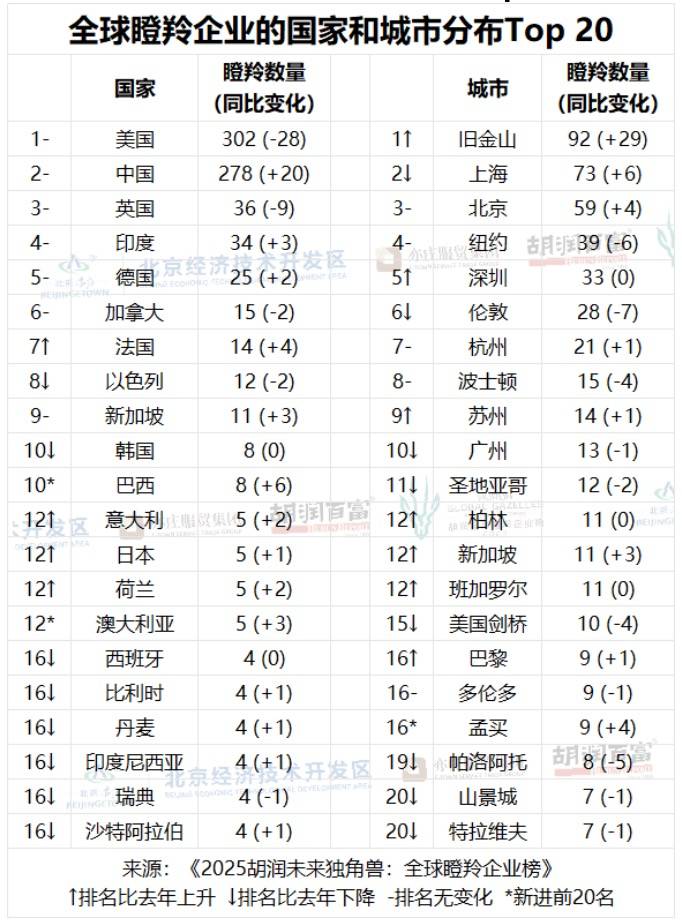
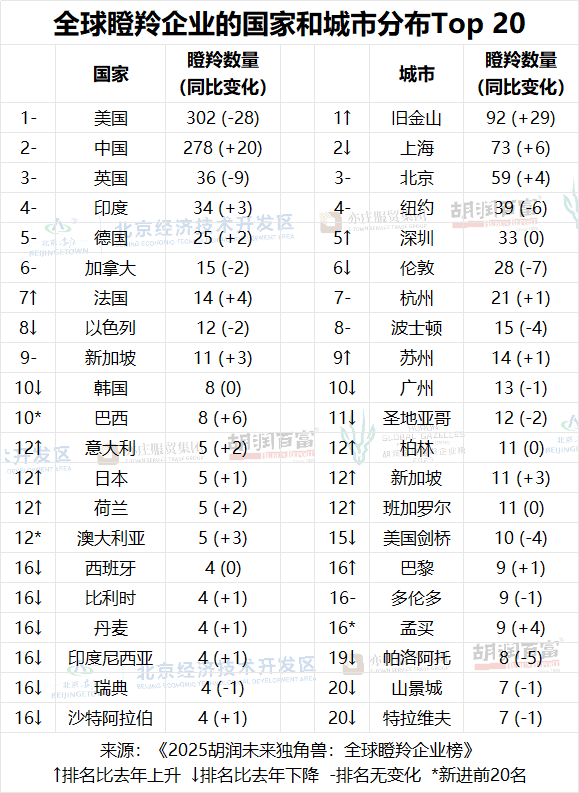
Core Insights - The Hurun Research Institute identified 819 gazelle companies globally, an increase of 16 from last year and 131 (19%) from two years ago [1] - The United States leads with 302 gazelles, a decrease of 28 (8%) from last year, while China ranks second with 278 gazelles, an increase of 20 (8%) [1][6] - The report highlights significant growth in sectors such as fintech, AI, SaaS, and robotics, with 206 new entries, including 64 from the US and 55 from China [1][2] Company Insights - 71 companies upgraded to unicorn status, with notable examples including Sierra (AI, valued at 71 billion RMB) and Abridge (AI, valued at 38 billion RMB) [1][19] - 33 companies went public, with the highest value being Gu Ming, a tea brand from Hangzhou, valued at 55 billion RMB [1][19] - 42 companies were downgraded, with 9 from the US and 8 each from China and India, primarily in biotech and fintech [1][21] Industry Insights - The leading industries for gazelle companies are biotechnology (119), fintech (87), SaaS (77), AI (71), and health tech (65) [1][17] - Medical health is the most impacted sector, followed by financial services and enterprise management solutions [3][16] - 63% of gazelle companies focus on software and services, while 37% sell physical products [3][16] Geographic Insights - The distribution of gazelle companies spans 43 countries and 220 cities, with the US and China accounting for 71% of the total [6][12] - San Francisco surpassed Shanghai as the "Gazelle Capital," with Beijing and New York following [1][13] - The Yangtze River Delta region has 134 gazelles, an increase of 30 from last year, while the Beijing-Tianjin-Hebei region has 64, up by 13 [1][12] Investment Insights - Sequoia Capital is the most successful investor in gazelle companies, with 62 investments, followed by CICC, SoftBank, Hillhouse, and Tiger Global [22][23] - The report emphasizes the importance of identifying and supporting these high-growth companies to foster innovation and economic growth [5][22]
2025胡润全球瞪羚企业榜发布:美国和中国分别有302家和278家上榜,占比七成
Sou Hu Cai Jing· 2026-01-20 10:08
Core Insights - The HuRun Research Institute released the "2025 HuRun Future Unicorn: Global Gazelle Enterprises List," identifying high-growth companies likely to reach a billion-dollar valuation by the end of 2028 [1] - The list includes 819 gazelle companies, with the US and China leading with 302 and 278 companies respectively, accounting for 71% of the total [1] - 146 companies upgraded to unicorn status, while 42 companies were downgraded, primarily in the biotech, fintech, media, entertainment, and agri-tech sectors [1] Group 1: Company Performance - Among the 146 upgraded companies, 71 became unicorns, with notable mentions including Sierra (AI, valued at 71 billion RMB) and Abridge (AI, valued at 38 billion RMB) [1] - 33 companies went public, with the highest valued being the tea brand Gu Ming from Hangzhou, valued at 55 billion RMB [1] Group 2: Geographic Distribution - The top countries for gazelle companies are the US (302, down by 28) and China (278, up by 20) [2] - Major cities contributing to gazelle company numbers include San Francisco (92, up by 29) and Shanghai (73, up by 6) [2]