谷歌

Search documents
高盛上调英伟达业绩预期,股价近期上涨超11%
Xin Lang Cai Jing· 2026-02-11 21:00
Core Viewpoint - Goldman Sachs has raised its earnings forecast for NVIDIA's Q4 FY2026 and maintains a target price of $250, emphasizing that revenue visibility for FY2027 is a key catalyst [1] Financial Report Analysis - NVIDIA is set to release its Q4 FY2026 financial report on February 25, 2026, which is viewed as a barometer for the sustainability of the AI boom [2] - Goldman Sachs predicts that revenue from the data center business will reach $61.3 billion in Q4, with Q1 FY2027 revenue expected to be $76.84 billion, both exceeding market consensus [2] - Investor focus has shifted from current performance to the company's guidance for FY2027, particularly regarding the long-term goals for the data center business [2] Recent Stock Performance - Recently, NVIDIA's stock price has increased by 11.47%, peaking at $193.66 [3] - On February 6, the stock surged by 7.87%, driven by large cloud providers' capital expenditure plans [3] - As of February 11, the stock closed at $191.60, up 1.62% for the day, with a trading volume of approximately $18.57 billion; year-to-date, the stock has risen by 2.74% with a P/E ratio of 47.43 [3] Recent Developments - NVIDIA's next-generation Rubin GPU has entered mass production, with shipments expected to begin in Q3 2026, potentially supporting long-term growth [4] - In terms of partnerships and supply chain, SK Hynix plans to begin mass production of HBM4 this month, with NVIDIA as its first customer; however, there are discrepancies regarding previous reports of a multi-billion dollar collaboration with OpenAI, raising market concerns [4] - In the competitive landscape, companies like Google and AMD are enhancing their product performance, while NVIDIA is strengthening its CUDA ecosystem and has established an ASIC department to mitigate risks [4]

AMD发布2025年Q4财报,数据中心业务创新高但股价波动显著
Jing Ji Guan Cha Wang· 2026-02-11 20:54
Core Viewpoint - AMD reported strong Q4 2025 earnings with revenue of $10.27 billion, a 34% year-over-year increase, and adjusted EPS of $1.53, exceeding market expectations [1] Financial Performance - Data center revenue reached a record high of $5.38 billion, growing 39% year-over-year [1] - Q1 2026 revenue guidance is set at $9.8 billion, indicating a 5% quarter-over-quarter decline, with a projected gross margin of approximately 55% [1] Recent Stock Performance - AMD's stock experienced significant volatility, rising 8.28% to $208.44 on February 6, 2026, with a trading volume exceeding $11.2 billion [2] - The stock continued to rise by 3.63% to $216.00 on February 9, 2026, but faced slight pullbacks of 1.13% and 0.24% on February 10 and 11, respectively, closing at $213.05 [2] - The stock's price fluctuation reached 12.06%, reflecting market divergence regarding earnings and AI business prospects [2] Recent Events - On February 9, 2026, the tech sector saw a broad rally, with AMD's stock rising 3.63%, driven by Google's plan to issue $20 billion in bonds to boost AI spending [3] - Concerns arose regarding AMD's partnership with OpenAI, particularly about OpenAI's financial health potentially impacting AMD's long-term order stability [3] Institutional Perspectives - Guojin Securities reported on February 4, 2026, that AMD's data center business remains robust, with expectations for AI GPU deployment in the second half of 2026 to drive growth, maintaining a "buy" rating [4] - Huachuang Securities noted on the same date that the MI400 series is progressing well, but cautioned about potential risks related to AI chip production capacity and market competition [4]
维谛技术财报超预期股价创新高,AI算力需求驱动业绩增长
Jing Ji Guan Cha Wang· 2026-02-11 20:04
Core Viewpoint - The significant stock price increase of VRT.N on February 11, 2026, was driven by better-than-expected Q4 2025 financial results and strong performance guidance [1]. Stock Performance - Following the earnings report, market sentiment was positive, with the stock opening at $233.25 and closing at $244.64, marking a single-day increase of 22.55%. The intraday high reached $249.95, setting a new historical peak. The trading volume was $3.68 billion, with a turnover rate of 4.02%, indicating substantial capital inflow. The stock had already risen 9.34% in the week prior (February 5-10) before the earnings report further amplified gains [2]. Operational Performance - The Q4 2025 financial report, released on February 11, 2026, showed several key metrics significantly exceeding market expectations: - Organic orders surged by 252% year-over-year, with the order shipment ratio rising to 2.9 times, and backlog orders increased to $15 billion (up 109% year-over-year), providing high revenue certainty for the future. - Adjusted operating profit rose by 33% year-over-year to $668 million, and adjusted free cash flow increased by 151% year-over-year to $910 million, with a net leverage ratio of only 0.5 times, indicating a healthy financial structure. - For fiscal year 2026, the company projected net sales of $13.25 billion to $13.75 billion (up 28% year-over-year) and adjusted earnings per share of $5.97 to $6.07 (up 43% year-over-year), reinforcing market confidence in the demand for AI computing infrastructure [3]. Industry Policy Status - Despite the introduction of new competitor Invidk (002837) through Nvidia's GB300 liquid cooling certification, VRT.N's leading position in the global AI infrastructure sector remains intact. The company has strong ties with major clients like Nvidia, Google, and Amazon, and possesses barriers in core technologies such as liquid cooling and high-voltage power supplies. Analysts generally maintain a positive outlook on the company's order fulfillment capabilities, with Evercore analysts reiterating a "buy" rating and a target price of $210 [4]. Event Impact - The stock's new high was primarily attributed to the earnings report confirming an explosion in orders driven by AI, improved profitability, and enhanced cash flow, combined with the management's optimistic guidance for fiscal year 2026, which alleviated market concerns about competition [5].
美股尾盘跳水,AI软件股走强,储存芯片大跌,中概股逆势飘红
Sou Hu Cai Jing· 2026-02-11 18:32
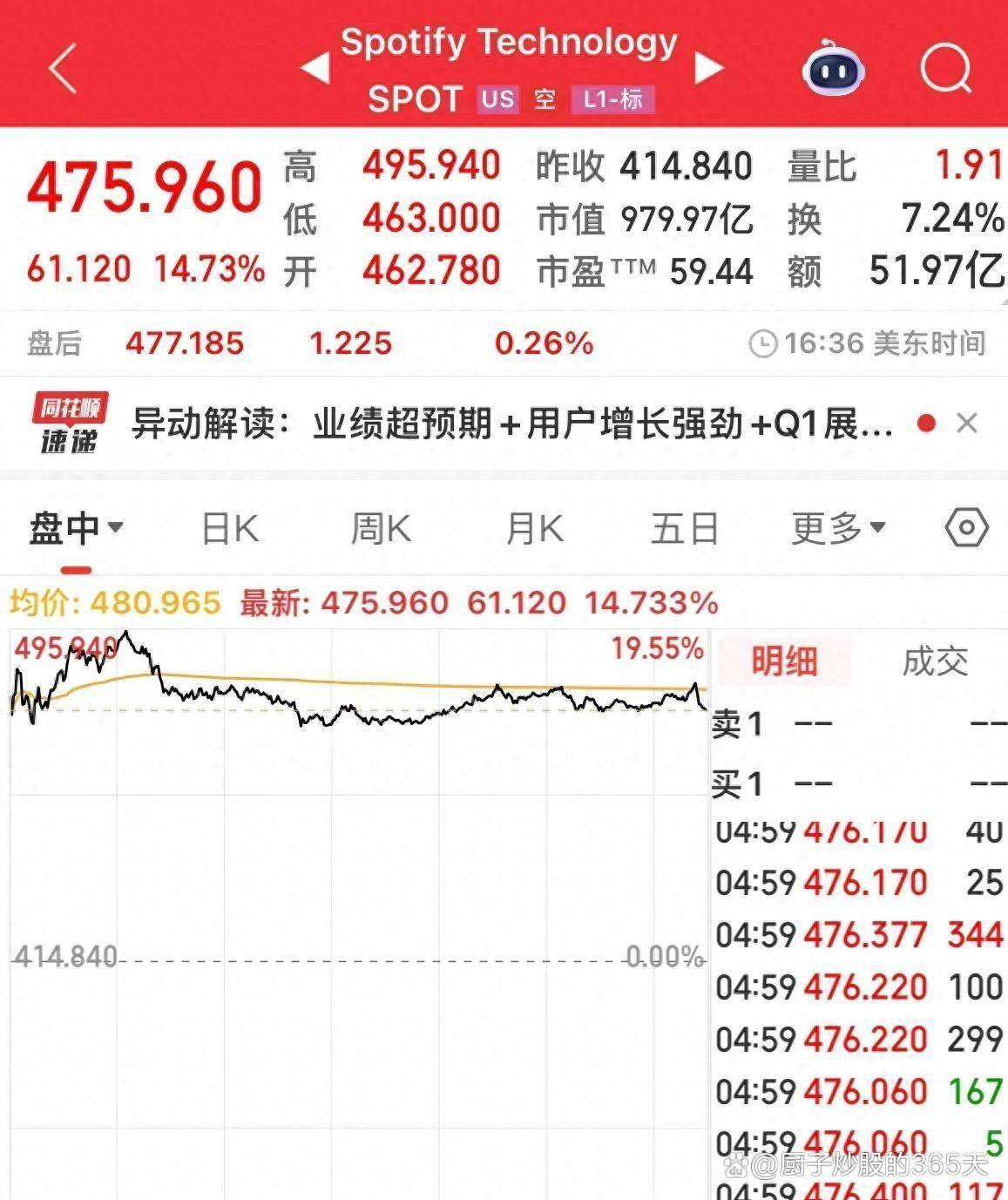
Core Viewpoint - The U.S. stock market experienced a stark divergence, with AI software stocks rebounding sharply while storage chip stocks faced significant declines, illustrating a clear "ice and fire" scenario on the Nasdaq stage [1][3]. Group 1: AI Software Stocks - A notable AI software stock surged 14.73% to close at $475, recovering from a nearly 40% decline from its peak of $785 last June [1][4]. - The recent rebound was supported by significant industry developments, including ByteDance's launch of its new AI video model Seedance 2.0 and Google's plan to acquire a customer service software company to enhance its AI capabilities [4]. - Analysts on Wall Street are shifting their views, suggesting that AI will enhance existing software rather than completely replace it, as enterprise workflows are complex and sticky [4]. Group 2: Storage Chip Sector - The storage chip sector faced a collective collapse, with SanDisk dropping 7.16%, Western Digital plummeting 8.65%, and Seagate Technologies falling 6.77% [1][8]. - The primary reason for the decline was the excessive price increases over the past six months, driven by surging demand for high-performance storage from AI servers, leading to profit-taking [8]. - Recent industry data indicated a slight decline in DRAM prices, breaking the market's expectation of continuous price increases, which contributed to investor concerns about the sustainability of the storage chip supercycle [8][12]. Group 3: Market Dynamics - The Nasdaq index fell by 0.59%, while sectors related to AI applications, such as cultural media and toys, saw gains of 1.5% to 3.5% [5]. - The ETF focused on software investments has seen its scale grow to 6.658 billion yuan, with valuations at a near one-year low, indicating a shift in capital from overvalued hardware sectors to underpriced software and application companies [5]. - The overall market structure is experiencing a split, with the Dow Jones index slightly up by 0.10%, while the Nasdaq and S&P 500 indices fell by 0.59% and 0.33%, respectively [12]. Group 4: Chinese Concept Stocks - Chinese concept stocks demonstrated resilience, with the Nasdaq China Golden Dragon Index rising by 1.09%, outperforming the major U.S. indices [11][12]. - The strong performance of Chinese stocks is attributed to their valuation being at a low point, alongside supportive domestic policies for platform economy and technological innovation [12]. - Key companies like Alibaba Cloud reported a 26% revenue growth in the latest quarter, indicating robust core business performance [12].


美股跳水翻绿 超3500只个股下跌 多只中概龙头股下挫!加密货币大跌 12万人爆仓,金银短线跳水丨美股开盘
Mei Ri Jing Ji Xin Wen· 2026-02-11 16:22
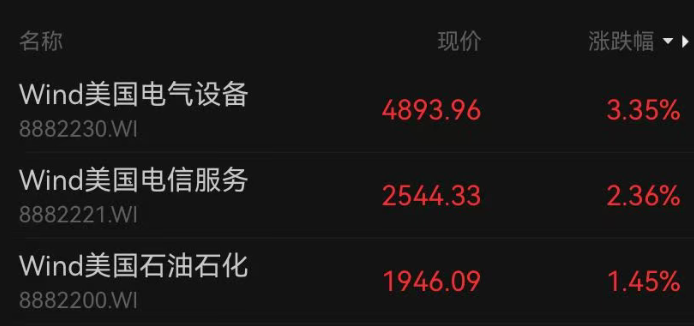
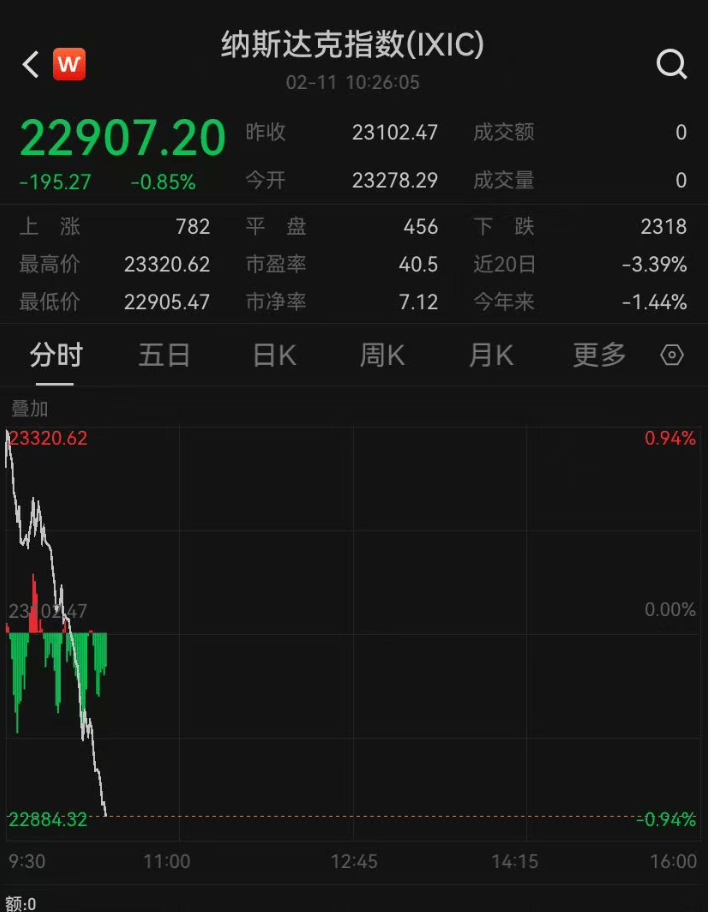
Market Overview - The US stock market experienced a collective decline after initially opening higher, with the Nasdaq down 0.84%, the Dow Jones down 0.45%, and the S&P 500 down 0.41% [1] - A total of 3,575 stocks fell while 1,609 stocks rose [1] Sector Performance - The electric equipment, telecommunications, and petrochemical sectors led the gains, while the real estate and software sectors saw significant declines [1] - Specific sector performance includes: - Electric Equipment: +3.35% [2] - Telecommunications: +2.36% [2] - Petrochemical: +1.45% [2] - Real Estate: -4.57% [2] - Software Services: -3.00% [2] Major Companies - Among the tech giants, Nvidia rose over 1%, while Microsoft fell over 2% [2] - Notable stock performances include: - Apple: +0.97% [3] - Nvidia: +1.01% [3] - Tesla: -0.32% [3] - Amazon: -0.73% [3] - Meta: -1.03% [3] - Alphabet: -1.33% [3] - Microsoft: -2.13% [3] Chinese Stocks - The Nasdaq Golden Dragon China Index declined, with notable movements in individual stocks: - Kingsoft Cloud surged 10% [4] - Xiaomi ADR rose over 3% [4] - Alibaba fell 2% [4] - Tencent Holdings ADR dropped 1.39% [4] - NetEase fell over 2% [4] Cryptocurrency Market - The cryptocurrency market saw a significant drop, with over 120,000 liquidations totaling $191 million within 24 hours [6] - Liquidation amounts included $85.36 million in one hour and $154 million in four hours [8] Employment Data - The US labor market showed unexpected strength with non-farm payrolls increasing by 130,000, significantly above the expected 65,000, marking the largest increase since April 2025 [6] - The unemployment rate unexpectedly decreased to 4.3%, while the previous and expected rates were 4.4% [6] Federal Reserve Expectations - Following the employment data, traders adjusted their expectations for the Federal Reserve's interest rate cuts, pushing the anticipated timing from June to July [9] - The probability of a 25 basis point rate cut in March dropped from 19.6% to 6%, while the probability of maintaining current rates rose to 94% [9] Commodity Prices - Gold and silver prices experienced volatility, with gold peaking at a 1.8% increase before settling at a 0.69% rise, priced at $5062.5 per ounce [9] - Brent crude oil prices rose above $70, currently at $70.7 [9]
任泽平带你看前沿科技:2026研学计划
泽平宏观· 2026-02-11 16:07
以下文章来源于泽平宏观商学 ,作者泽平宏观商学 泽平宏观商学 . 前沿科技企业实战研学 读万卷书行万里路 2025 年 12 月 用心打造最有品质的实战研学。读万卷书,行万里路。把教室搬到世界上最优秀的企业, 请最优秀的企业家和科学家讲课。顺势而为,把握机遇。正心正念,坚持做长期正确的 事! 我们期待与更多的企业家朋友们携手同行,共赴 2026 实战研学之旅! 泽 ZEP 平 INGM 宏 ACR 观 O RE 商 SEAR 学 CH 1-6月日程安排 · 2月27日 北京 国内头部智驾科技企业 人形机器人 年研学安 型成 11月4日-11日 洛杉矶、拉斯维加斯、旧金山 CES、英伟达、特斯拉 谷歌、罗宾汉、playground 斯坦福大学、伯克利大学 3月27日-28日 苏州 追觅科技、魔法原子、灵猴机器人 闭门投研会-2026 Al 的中国力量(一) 3月29日 上海 长三角校友会 4月20日-21日 香港 2026 香港 Web3 嘉年华 复星财富、HashKey、港交所 5月22日-23日 1151 11:47:50 深圳 华为、新凯来、江波龙、莫界科技 闭门投研会—2026 Al 的中国力量(二) ...




深夜突发,美股跳水翻绿,超3500只个股下跌,多只中概龙头股下挫!加密货币大跌,12万人爆仓,金银短线跳水丨美股开盘
Sou Hu Cai Jing· 2026-02-11 15:45
Market Overview - The U.S. stock market indices opened high but experienced a sudden drop, with the Nasdaq down by 0.84%, the Dow Jones down by 0.45%, and the S&P 500 down by 0.41% [1] - A total of 3,575 stocks declined while 1,609 stocks advanced [1] Sector Performance - The electric equipment, telecommunications, and petrochemical sectors led the gains, with electric equipment up by 3.35%, telecommunications up by 2.36%, and petrochemicals up by 1.45% [3] - Conversely, the real estate and software sectors saw significant declines, with real estate down by 4.57% and software down by 3.00% [4] Major Companies - Among the tech giants, Nvidia rose over 1%, while Microsoft fell over 2% [4] - Specific stock performances included Apple up by 0.97%, Nvidia up by 1.01%, and Microsoft down by 2.13% [5] - In the Chinese ADR market, Kingsoft Cloud surged by 10%, while Alibaba and Tencent saw declines of 2% and 1.39%, respectively [5] Employment Data - The U.S. labor market showed stronger-than-expected job growth in January, with non-farm payrolls increasing by 130,000, significantly above the forecast of 65,000 [8] - The unemployment rate unexpectedly decreased to 4.3%, compared to the expected and previous rate of 4.4% [8] Federal Reserve Expectations - Following the employment data, traders adjusted their expectations for the Federal Reserve's interest rate cuts, pushing the anticipated timing from June to July [9] - The probability of a 25 basis point rate cut in March dropped from 19.6% to 6%, while the probability of maintaining the current rate rose to 94% [9] Commodity Prices - Gold and silver prices experienced volatility, with gold initially rising by 1.8% before settling at a 0.69% increase, priced at $5,062.5 per ounce [10] - International oil prices also saw an increase, with Brent crude surpassing $70, currently priced at $70.7 [12]
5000亿光模块巨头紧急辟谣,市值一日蒸发265亿
21世纪经济报道· 2026-02-11 13:12
| | 531.91 -23.80 -4.28% | 76.60(USD) | | | | | 中际旭创 | | --- | --- | --- | --- | --- | --- | --- | --- | | | | | | | | | 300308 | | SZSE CNY 15:30:36 闭市 | | | | | | | 通 融 △ ● + | | 委比 | 21.01% 委差 | | 25 | Wind ESG评级 A | | | 详情 | | 委主 | 531.96 | | 26 | रुक्ट | -12.80% 120日 | | 123.67% | | 卖四 | 531.95 | | 2 | 5日 | -5.02% 250日 | | 396.00% | | 际三 | 531.94 | | 1 | 20日 | -10.30% 52周高 | | 658.80 | | 炭二 | 531.92 | | 1 | 60日 | 10.08% 52周低 | | 66.86 | | | 531.91 | | 17 | | 2023 | 2024 | 2025Q3 | | 杀一 | 531.90 | | 19 ...


跨境资产配置产业链系列研究(一):全球战略资产配置新框架
Guoxin Securities· 2026-02-11 11:25
Group 1: Strategic Asset Pool Definition and Long-Term Characteristics - The report defines a global strategic asset allocation framework, covering equity, fixed income, alternative assets, and cash[1] - It analyzes long-term characteristics of equity assets in global, developed, and emerging markets, including sovereign and credit bonds, real estate, commodities, and private equity[1] - The analysis provides a solid data and theoretical foundation for subsequent return forecasts and portfolio construction[1] Group 2: Long-Term Economic Assumptions and Return Forecast Models - The report establishes long-term economic assumptions and return forecast models based on key macroeconomic variables such as economic growth, inflation, and interest rates[2] - It creates corresponding long-term return prediction models for various asset classes and estimates correlations and potential risk scenarios among different assets[2] Group 3: Strategic Portfolio Construction and Optimization - Strategic portfolio construction considers investor constraints and goal settings, including return targets, risk tolerance, liquidity needs, and regulatory/tax constraints[3] - Optimization methods include the classic mean-variance model, Black-Litterman model, Kelly-CVaR model, and risk parity model, with the mean-variance model and Kelly-CVaR showing superior long-term returns compared to single asset strategies[3] - The report emphasizes the importance of establishing a global market-weighted portfolio as a benchmark for strategic asset allocation[3] Group 4: Market Trends and Performance Metrics - The MSCI indices indicate that the U.S. market dominates with a weight of 64% in the MSCI ACWI index, followed by Japan at 4.9% and the UK at 3.3%[15] - The report highlights that the long-term volatility of MSCI EM is significantly higher than that of MSCI World, with both indices showing similar return patterns over time[23] - The Sharpe ratio for MSCI World and MSCI EM is similar, with long-term limits around -0.5 to +0.8, indicating comparable risk-adjusted returns[23]
美股下一个“AI受害者”已经出现,市场正在提前定价!
美股研究社· 2026-02-11 11:06
Core Viewpoint - The article discusses the recent internal rotation in the U.S. stock market, highlighting a shift from a few large-cap stocks leading the market to a broader participation across various sectors, while also addressing the impact of AI on traditional business models and the resulting market volatility [5][7][8]. Market Performance - On Tuesday, the S&P 500 fell by approximately 0.3%, while the Dow Jones Industrial Average rose by about 0.1%, reaching a new historical high [5]. - The equal-weighted S&P index also reached a record high, indicating a shift in market dynamics with around 300 stocks in the S&P 500 rising [7]. Retail Sales Data - The U.S. Commerce Department reported that December retail sales were flat month-over-month, significantly below the expected 0.4% growth, indicating a slowdown in consumer spending [9]. - Core retail sales, excluding autos and gas, even showed a decline, reflecting weakened consumer spending momentum during the holiday season [9]. Interest Rate Expectations - The weak retail data led to a rise in U.S. Treasury prices and a decline in yields, with the futures market increasing the probability of three rate cuts within the year, with two already priced in [9]. - Historical trends suggest that rate cut expectations typically support risk assets, but the current market shows a divergence where rates are falling but stocks are not rising, particularly in the tech sector [11]. AI Impact on Market Sentiment - Market participants are shifting their interpretation of AI's impact from a growth narrative to concerns about short-term disruptions, leading to a "sell first, think later" mentality [12]. - Investors are moving from an "AI is a panacea" mindset to a more pragmatic "performance realization" phase, anticipating greater differentiation between winners and losers in the market [12]. Institutional Perspectives - There is a noticeable divergence in institutional views on the tech sector, with Goldman Sachs warning about the risks of overestimating AI's growth potential and emphasizing the need for actual earnings and cash flow improvements to support tech valuations [13]. - UBS downgraded its rating on the U.S. tech sector from "overweight" to "neutral," citing key risks while still acknowledging the long-term potential of AI [14]. Wealth Management Sector - The wealth management sector has come under scrutiny following the launch of an AI tool by Altruist Corp., which automates tasks traditionally reliant on human expertise, raising concerns about the core revenue models of wealth management firms [17][18]. - The market reacted sharply, with significant declines in stocks of major wealth management firms, indicating fears about the long-term competitive structure of the industry under AI pressure [19][21]. Broader Market Reactions - The sell-off in the market has been attributed to fears that AI tools could undermine the intermediary value of insurance brokers, leading to a significant drop in the insurance brokerage sector [22]. - The recent downturn in the software sector has seen substantial market capitalization losses, with estimates indicating a combined loss of approximately $611 billion across software, financial services, and asset management sectors [26]. Conclusion - The current market environment reflects a transition from viewing AI as a beneficiary narrative to recognizing potential victims, with traditional software companies facing heightened scrutiny and volatility [27]. - The article suggests that this phase serves as a valuation and business model stress test, prompting a reevaluation of which revenue models are based on irreplaceable value versus those reliant on information asymmetry [34].