大成基金

Search documents
141只公募基金年内净值增长超100%
Zheng Quan Ri Bao· 2025-12-24 16:15
Group 1 - As of December 24, 141 public fund products have achieved a net value growth exceeding 100% this year, with 2 products surpassing 200%, the highest being 233% [1] - Technology-themed funds have shown significant returns, with products like Yongying Technology Smart Selection A, Dachen Technology Innovation A, and Fuguo Innovation Technology A ranking high in annual performance [1] - Over 60 mixed funds have reported a net value growth exceeding 100%, while nearly 600 funds have seen growth between 50% and 100% [2] Group 2 - Stock funds have demonstrated resilience, with 19 funds achieving over 100% net value growth and more than 380 products growing between 50% and 100% [2] - Several QDII funds have also performed well, with 2 products exceeding 100% growth and 36 products growing between 50% and 100% [2] - New fund products established in the last two years have shown strong performance and rapid growth, such as Huaxia Digital Industry A with a growth rate of 124.85% and Yongying Ruiheng A with 117.27% [2] Group 3 - Analysts attribute the strong performance of public funds to the improving Chinese economy, optimistic trading sentiment in the A-share market, and increased capital flow into technology and communication sectors [3] - Fund managers have effectively captured industry rotation opportunities, aligning strategies with market styles and accurately positioning in high-growth technology stocks [3] - There is an increased risk appetite among investors, leading to a preference for high-growth thematic funds, which has resulted in a concentration of capital in these funds [3]
从金到铜 - 铜金比低位下的有色金属另类投资机会
2025-12-24 12:57
Summary of Conference Call on Non-Ferrous Metals Investment Opportunities Industry Overview - The conference discusses the non-ferrous metals industry, particularly focusing on copper and its investment potential amid changing macroeconomic conditions and supply-demand dynamics [1][5][6]. Key Points and Arguments Market Dynamics - The non-ferrous metals futures price index is heavily weighted towards copper and aluminum, with copper accounting for over 50% and both metals together exceeding 65% of the index [1][3]. - The expectation of continued interest rate cuts by the Federal Reserve is anticipated to weaken the dollar, thereby supporting demand for commodities priced in dollars, which is a fundamental condition for a commodity bull market [1][5]. Supply Constraints - Global copper supply is expected to face significant disruptions by 2025, with a projected supply gap of approximately 150,000 tons by 2026 due to insufficient capital investment in new mining capacities [1][7]. - Major supply disruptions in 2025 from regions like the Democratic Republic of Congo, Chile, and Indonesia have raised concerns about future copper production, with growth rates expected to drop to 0.9% in 2026 from 3.4% in 2025 [7][26]. Demand Drivers - Long-term demand for copper is strongly supported by sectors such as electric vehicles (EVs), artificial intelligence (AI), and upgrades to electrical grids. For instance, an electric vehicle uses 80-90 kg of copper, significantly more than traditional fuel vehicles [8][9]. - The construction of high-voltage transmission lines to facilitate the transfer of renewable energy resources from western regions to eastern coastal areas in China will also drive copper demand [9]. Investment Opportunities - The current macroeconomic environment is favorable for investing in copper, with expectations of a price increase due to structural supply shortages and strong demand growth [6][10]. - Historical trends suggest that when the copper-to-gold ratio is low, copper prices tend to rise, indicating a potential investment opportunity in 2026 [10]. Metal Performance in Economic Cycles - Metals exhibit a rotation pattern during interest rate cuts, with gold leading, followed by silver, and then industrial metals like aluminum [11][12]. - The current economic environment is shifting from a recessionary mode to an inflation recovery mode, which is expected to enhance the performance of industrial metals [12]. ETF and Investment Strategies - The Da Cheng Non-Ferrous ETF tracks a price index of six non-ferrous metals, providing a more stable investment vehicle compared to traditional stock indices, which are influenced by market sentiment [2][4]. - Investors are encouraged to consider the non-ferrous metals futures price index for asset allocation, particularly in light of the anticipated industrial recovery [13][22]. Future Outlook - The non-ferrous metals sector is expected to see a gradual recovery in demand, supported by the return of manufacturing to developed countries and advancements in AI technology [14][15]. - The aluminum market is also projected to perform well due to tightening supply and increased use in various applications, such as air conditioning and automotive wiring [19]. Strategic Shifts in Leading Companies - Leading companies in the non-ferrous metals sector are increasingly focusing on gold mining rather than copper, as gold offers more certainty and potential for higher returns [18]. Additional Important Insights - The investment landscape for metals is shifting towards lower volatility and risk, with long-term funds increasingly entering the market, which may stabilize prices and enhance growth potential [22]. - The anticipated interest rate cuts by the Federal Reserve are expected to exert downward pressure on the dollar index while supporting non-ferrous metal prices [25]. This summary encapsulates the key insights from the conference call regarding the non-ferrous metals industry, particularly copper, and outlines the investment opportunities and risks associated with the current market dynamics.
连续九年做出行业超额!易方达杨桢霄的创新药投资秘籍……
聪明投资者· 2025-12-24 07:03
Core Viewpoint - The article emphasizes that in the pharmaceutical industry, especially after 2020, significant breakthroughs often stem from small adjustments and persistent efforts rather than dramatic revelations, highlighting the importance of understanding "micro and critical nodes" in investment strategies [2][3]. Group 1: Investment Performance and Fund Management - The article reviews the performance of active equity funds focused on the pharmaceutical sector, particularly those managed by fund managers with a tenure starting before 2017 and maintaining over 80% allocation to the pharmaceutical industry [4]. - Among the funds analyzed, only two have shown positive returns over the past three and five years, with the best performance attributed to the fund managed by Yang Zhenshao, which has consistently outperformed the pharmaceutical index since 2017 [5][6]. - Yang Zhenshao's fund, the E Fund Healthcare Industry Mixed Fund, has achieved a return of 198.63% since its inception in August 2016, with an annualized return of 12.43% and a year-to-date return of 28.92% as of December 21, 2025 [8]. Group 2: Investment Strategy and Market Insights - Yang Zhenshao's investment strategy involves in-depth research across various sub-sectors within the pharmaceutical industry, focusing on commercial models, market conditions, catalysts, and valuations to identify underrepresented sectors [10]. - The strategy has evolved from a purely bottom-up stock selection approach to a balanced focus on both alpha and beta, particularly after 2023, allowing for more comprehensive market engagement [11][12]. - The fund manager has demonstrated a keen ability to identify and capitalize on high-potential stocks, such as Nanwei Medical and Te Bao Biological, which saw significant price increases shortly after being added to the portfolio [13][14]. Group 3: Industry Trends and Future Outlook - The article notes that the Chinese pharmaceutical industry is experiencing a transformation, with companies increasingly moving towards global competitiveness and innovation, as evidenced by the rising number of new drug approvals and international collaborations [39][40]. - Yang Zhenshao has highlighted the importance of focusing on innovative drugs and high-value medical consumables, indicating a strategic shift towards sectors that are expected to thrive in the evolving market landscape [35][36]. - The outlook for the innovative drug sector is optimistic, with expectations for continued growth and increased global market presence for Chinese pharmaceutical companies [41].


解析股市叙事国家队!管涛挂帅、戴彦“破例”,少壮派筑理论引擎
2 1 Shi Ji Jing Ji Bao Dao· 2025-12-24 04:05
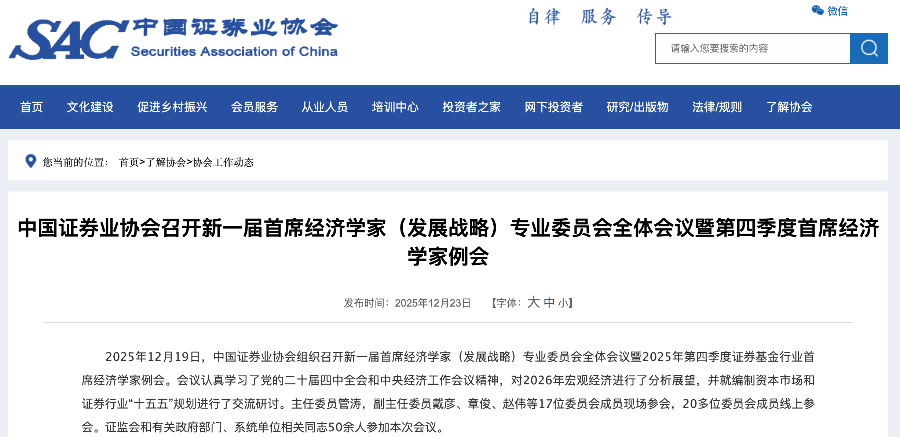
Group 1 - The core viewpoint of the news is the establishment of a newly adjusted Chief Economist Committee by the China Securities Association, aimed at contributing professional insights for the "14th Five-Year Plan" of the capital market [1][2][11] - The committee consists of over 40 top experts from the securities and fund industry, indicating a significant integration of industry intellectual resources [1][2] - The committee's structure has been upgraded, with the addition of positions such as Secretary-General and Advisors, reflecting a shift towards a more professional and diverse team [1][5][8] Group 2 - The committee's first meeting focused on two main missions: providing recommendations for the "14th Five-Year Plan" and enhancing the narrative around the Chinese stock market [2][12][13] - Key topics discussed included "RMB internationalization" and "increasing household consumption rates," which are crucial for the planning process [2][12] - The committee aims to serve as both a policy think tank and a voice for rational market expectations, contributing to the high-quality development of the capital market [2][12][13] Group 3 - The new committee features a diverse membership, including individuals holding significant administrative roles, which indicates a growing emphasis on the role of chief economists in leadership positions [9][10] - The committee's leadership includes prominent figures such as Guan Tao from Bank of China International as the Chairman and Dai Yan from Dongfang Caifu as the Vice Chairman [8][9] - The restructuring of the committee is seen as a response to the evolving complexities of the capital market, aiming to stabilize expectations and guide public discourse [13]
食品主题基金时隔四年再度新发
Zhong Guo Zheng Quan Bao· 2025-12-23 23:17
Group 1 - The consumer sector is showing signs of recovery under the policy direction of expanding domestic demand, with public funds increasing their investments in this area [1][2][4] - Several leading fund companies, including GF Fund, Penghua Fund, and Huaxia Fund, have launched new food-themed funds for the first time in four years, indicating renewed interest in the consumer sector [2][3] - The tourism and airline sectors have performed well recently, with a notable net inflow of over 680 million yuan into the tourism ETF managed by Fortune Fund, approaching historical highs [4][5] Group 2 - Fund managers are increasingly focusing on the consumer sector, with some actively increasing their positions in stocks related to service consumption, such as airlines and tourism [4][6] - The recovery momentum in consumer spending has been evident since the fourth quarter, with improvements in CPI and prices in service consumption and food sectors [5][6] - Experts suggest that expanding domestic demand will be a key task for the upcoming year, with potential structural changes in consumption that could enhance consumer spending [6][7] Group 3 - The current valuations of many segments within the consumer sector are at historically low levels, which may benefit from policy support and lead to performance improvements for companies [6][7] - Seasonal factors, such as the upcoming New Year and Spring Festival, are expected to boost consumer spending, particularly in service-oriented sectors [7]
前度刘郎今又来 消费重回聚光灯下 食品主题基金时隔四年再度新发
Zhong Guo Zheng Quan Bao· 2025-12-23 22:32
Core Viewpoint - The consumer sector is showing signs of recovery under the policy direction of expanding domestic demand, with public funds actively investing in this area [1][2]. Group 1: Fund Activity - Public funds have accelerated their investment in the consumer sector, with several major fund companies launching new products focused on food and consumption themes [2][3]. - The first food-themed ETF in four years was launched, with a notable initial scale of 250 million yuan, and significant interest from institutional investors [2]. - Multiple fund companies have introduced active funds targeting consumer themes, indicating a renewed focus on this sector [3]. Group 2: Performance and Trends - The consumer sector, particularly service consumption such as tourism and aviation, has shown strong performance, with some funds reporting over 7% weekly gains [4]. - Recent data indicates a significant inflow of over 680 million yuan into tourism ETFs, pushing their total size close to historical highs [4]. - Analysts note that the current valuations in various consumer sub-sectors are at historically low levels, suggesting potential for valuation recovery driven by policy support [5][6]. Group 3: Future Outlook - Experts believe that the expansion of domestic demand will be a key focus in the coming year, with structural changes in consumption expected to drive growth [6][7]. - The likelihood of increased policy support for the consumer sector is anticipated, particularly for essential and discretionary consumption areas [6][7]. - Seasonal trends, especially around the New Year and Spring Festival, are expected to boost consumer activity, further strengthening the sector [7].
2026年投资展望来临:风格回归,高股息策略迎来配置良机!
市值风云· 2025-12-23 09:10
Core Viewpoint - The article emphasizes the potential for a style reversal in the A-share market, particularly highlighting the investment value of dividend assets in 2026 after a year of underperformance in 2025 [3][5][7]. Market Performance Overview - In 2025, the A-share market was driven by emerging industries such as AI, semiconductors, and high-end manufacturing, with the CSI 2000 index rising over 30% [3]. - Gold prices reached historical highs, with spot gold rising over 1.7% on December 22 [4]. - Dividend assets underperformed in the tech-driven market of 2025, with the dividend low volatility index showing the lowest performance [5][6]. Dividend Asset Investment Value Analysis - Despite a lackluster performance in 2025, dividend assets are expected to have room for growth in 2026 due to temporary pricing deviations caused by extreme market style divergence [7]. - Over the past decade, dividend strategies have shown unique defensive value and potential for excess returns, outperforming the CSI 300 index on average [7][8]. - The introduction of the new "National Nine Articles" policy in 2024 aims to enhance shareholder returns, providing a solid institutional guarantee for dividend strategies [9][10]. Policy Impact on Dividend Ecosystem - The new policy is expected to systematically improve the willingness, ability, and sustainability of overall dividend payouts in the A-share market, driving a continuous value discovery process [9][10]. - As of November 28, 2025, the overall dividend rate in the A-share market reached 34.6%, indicating an increase in dividend willingness and capability [10]. Investment Strategies in Dividend Assets - The article suggests using ETFs to invest in dividend assets, with the E Fund Dividend ETF (515180.SH) being a representative product that tracks the CSI Dividend Index [15][21]. - The CSI Dividend Index includes 100 stocks with high cash dividend yields and stable dividends, focusing on traditional value sectors such as banking and manufacturing [16][21]. - The article also highlights the performance of various dividend ETFs, noting that the E Fund Dividend ETF has consistently paid dividends over the past six years, averaging around 0.5% annually [19][21]. Low Volatility Dividend ETFs - The article discusses the Low Volatility Dividend ETF (512890.SH), which tracks the CSI Low Volatility Dividend Index, selecting stocks with high dividends and low price volatility [22][23]. - This index has a significant allocation to the banking sector, emphasizing the "high dividend + low volatility" characteristic [23]. Sector-Specific Dividend ETFs - The article mentions sector-specific ETFs, such as the Coal ETF (515220.SH), which focuses on high-dividend sectors like coal and energy, showing strong historical performance [31]. - These sector ETFs are noted for their higher volatility and are suitable for investors with a deeper understanding of the industry [32]. Conclusion - The article concludes that while dividend strategies have inherent limitations and external risks, they serve as a defensive asset in complex market environments, providing a stable foundation for long-term investment portfolios [35].

万集科技股价跌5.03%,大成基金旗下1只基金位居十大流通股东,持有57.05万股浮亏损失93.56万元
Xin Lang Cai Jing· 2025-12-23 02:34
Group 1 - The core point of the news is that Wanjie Technology's stock price dropped by 5.03% to 30.98 CNY per share, with a trading volume of 550 million CNY and a turnover rate of 12.77%, resulting in a total market capitalization of 6.603 billion CNY [1] - Wanjie Technology, established on November 2, 1994, and listed on October 21, 2016, is located in Beijing and specializes in providing dynamic weighing, short-range communication, and laser detection products for road and urban traffic clients, along with related design, installation, software development, and maintenance services [1] - The company's main business revenue is entirely derived from the intelligent transportation industry, accounting for 100% of its revenue [1] Group 2 - Among the top ten circulating shareholders of Wanjie Technology, a fund under Dacheng Fund has increased its holdings by 39,200 shares, bringing its total to 570,500 shares, which represents 0.42% of the circulating shares [2] - The Dacheng CSI 360 Internet + Index A fund, established on February 3, 2016, has a latest scale of 788 million CNY and has achieved a year-to-date return of 38.01%, ranking 1065 out of 4197 in its category [2] - The fund has a one-year return of 29.83%, ranking 1388 out of 4154, and a cumulative return of 225.5% since its inception [2]

银河微电股价涨6.23%,大成基金旗下1只基金位居十大流通股东,持有60万股浮盈赚取100.2万元
Xin Lang Cai Jing· 2025-12-23 02:19
Group 1 - The core viewpoint of the news is that Galaxy Microelectronics has experienced a significant stock price increase, rising 6.23% to 28.46 CNY per share, with a total market capitalization of 3.669 billion CNY [1] - Galaxy Microelectronics has seen its stock price rise for four consecutive days, with a cumulative increase of 5.39% during this period [1] - The company, established on October 8, 2006, specializes in the research, production, and sales of semiconductor discrete devices, with 96.02% of its revenue coming from this main business [1] Group 2 - Among the top ten circulating shareholders of Galaxy Microelectronics, a fund under Great Wall Fund ranks, specifically the Great Wall CSI 360 Internet + Index A, which holds 600,000 shares, accounting for 0.47% of circulating shares [2] - The Great Wall CSI 360 Internet + Index A fund has achieved a year-to-date return of 38.01% and a one-year return of 29.83%, ranking 1065 out of 4197 and 1388 out of 4154 respectively [2] - The fund manager, Xia Gao, has a tenure of 11 years and 21 days, with the best fund return during this period being 224.3% [2]

大部分基金公司都是陪跑
Xin Lang Cai Jing· 2025-12-23 01:44
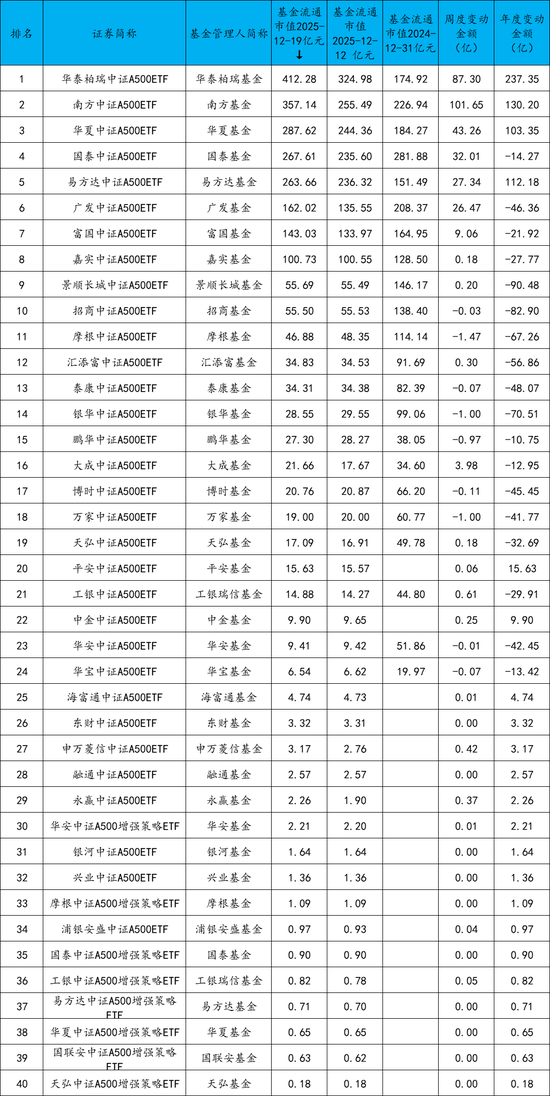
Core Viewpoint - The launch of the CSI A500 index has created a competitive landscape in the ETF market, where only a few major players dominate, while many smaller firms end up as "also-rans" [1][2][10]. Group 1: Market Dynamics - The CSI A500 index was launched in September 2024 and is considered a significant opportunity for public funds, leading to a rush of product submissions from various fund companies [2][17]. - By mid-December 2025, the total market size of A500 ETFs approached 250 billion yuan, indicating a rapid growth in this segment [2][17]. - The market has shown a clear "head effect," where a few leading funds capture the majority of the assets, leaving smaller firms struggling to compete [3][18]. Group 2: Fund Performance - The top five A500 ETFs, including Huatai-PB, Southern, and Huaxia, have assets ranging from 260 billion to 412 billion yuan, collectively dominating the market with nearly 1.6 trillion yuan [6][22]. - Recent inflows have been substantial, with Huatai-PB and Southern ETFs attracting 87.30 billion and 101.65 billion yuan, respectively, in just one week [7][22]. - The performance of smaller funds has been lackluster, with many experiencing significant redemptions and struggling to maintain their market presence [7][22]. Group 3: Challenges for Smaller Firms - Smaller public funds face significant challenges due to resource constraints, making it difficult to compete with larger firms that have established marketing and distribution channels [11][12]. - The cost of marketing and maintaining sales channels is high, with management fees for A500 ETFs around 0.15%, making it hard for smaller firms to achieve profitability without substantial scale [11][12]. - Some smaller firms have opted to withdraw from the competition, adopting a strategy of waiting rather than engaging in a costly race for market share [12][13]. Group 4: Future Outlook - The competitive landscape suggests that the development of index funds should be gradual, focusing on building differentiated competitive advantages rather than following trends blindly [13]. - Smaller firms may need to explore niche markets such as thematic, strategy-based, QDII, bond, or actively managed ETFs to find sustainable growth opportunities [13]. - The prevailing trend indicates that a few giants will continue to dominate the market, while many participants may remain on the sidelines [14].