瑞幸咖啡

Search documents
库迪将取消全场9.9元,肯德基、麦当劳、瑞幸、奈雪的茶集体涨价
21世纪经济报道· 2026-01-31 03:56
Core Viewpoint - The article discusses the recent price adjustments made by major fast-food and beverage brands in response to rising operational costs and competitive pressures in the delivery market, indicating a shift in pricing strategies across the industry [1][5][14]. Price Adjustments - KFC has raised the prices of its delivery products by an average of 0.8 yuan while keeping dine-in prices unchanged, citing the need to respond to operational cost changes [5][9]. - McDonald's has also increased the prices of some menu items by 0.5 to 1 yuan, with delivery prices adjusted accordingly [9]. - Other brands like Salvia and Luckin Coffee have followed suit, with price increases ranging from 1 to 2 yuan for certain items, often through indirect methods such as eliminating discounts [5][9]. Market Dynamics - The article highlights the impact of the intense competition in the delivery market, which has led to a "price war" that is reshaping the competitive landscape, with new entrants continuously driving prices lower [5][13]. - The rising costs of raw materials, as indicated by a 4.4% increase in fresh fruit prices, are also contributing to the need for price adjustments among these brands [10][11]. Consumer Behavior - The shift in pricing strategies may alter consumer perceptions, as many have become accustomed to lower prices due to previous promotional activities, potentially leading to resistance against higher prices [13][14]. - The reliance on delivery services has increased significantly, with KFC's delivery sales growing by 33% year-on-year, accounting for 51% of its restaurant revenue [9]. Strategic Adjustments - Many smaller brands are adopting more discreet pricing strategies to avoid direct price hikes, focusing on high-margin meal bundles to improve delivery profitability [13][14]. - The article suggests that the adjustments in pricing are part of a broader strategy to regain pricing power and reduce dependency on delivery channels, which have been detrimental to profit margins [14].




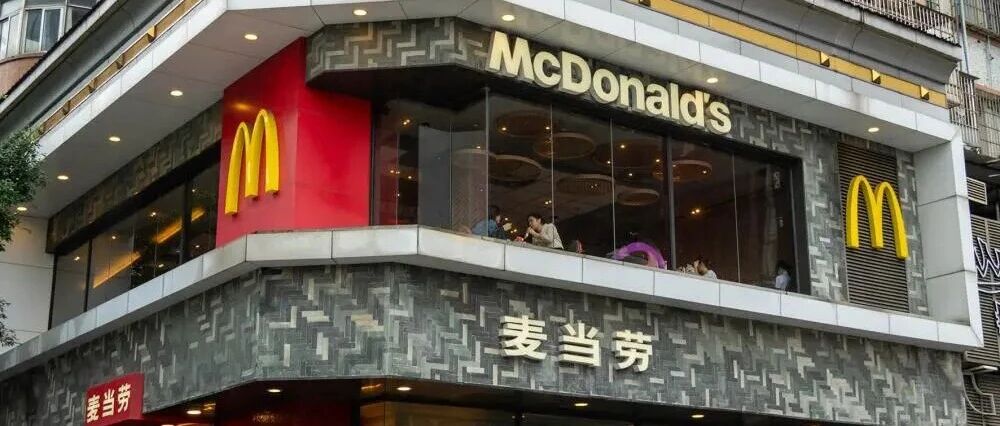
库迪将取消全场9.9元,肯德基、麦当劳、瑞幸、奈雪的茶、蜜雪冰城集体涨价
2 1 Shi Ji Jing Ji Bao Dao· 2026-01-31 02:36
Core Viewpoint - The recent price adjustments by major fast-food chains like KFC and McDonald's, along with various coffee and tea brands, reflect a response to rising operational costs and the competitive pressures of the takeaway market [1][2][3] Price Adjustments - KFC China announced a slight price increase of 0.8 yuan for its delivery products while keeping dine-in prices unchanged, citing operational cost changes as the reason [1][3] - Other brands, including McDonald's and various tea brands, have also raised prices by 1-2 yuan, often through indirect methods like eliminating discounts [1][3][4] Market Dynamics - The competitive landscape has shifted due to an intense price war in the takeaway sector, leading to a "mixed battle" environment where prices continue to drop, potentially harming overall industry profitability [2][7] - KFC's delivery sales grew by 33% year-on-year, accounting for 51% of its restaurant revenue, indicating a significant reliance on the delivery segment [3] Cost Pressures - Rising raw material costs are a contributing factor to the price increases, with the Consumer Price Index (CPI) rising by 0.8% in December 2025, and fresh fruit prices increasing by 4.4% [4][6] - The price of lemons, a key ingredient for many beverages, rose by 28.3% from April to June 2025, coinciding with increased demand from takeaway services [6] Strategic Adjustments - Smaller brands are adopting more discreet pricing strategies to cope with the competitive pressures, often increasing the prices of high-margin combo meals to improve profitability [7][8] - The industry is witnessing a shift towards reducing reliance on takeaway channels, with brands adjusting their pricing structures and enhancing dine-in experiences to balance profitability [8]
库迪将取消全场9.9元
新华网财经· 2026-01-31 02:06
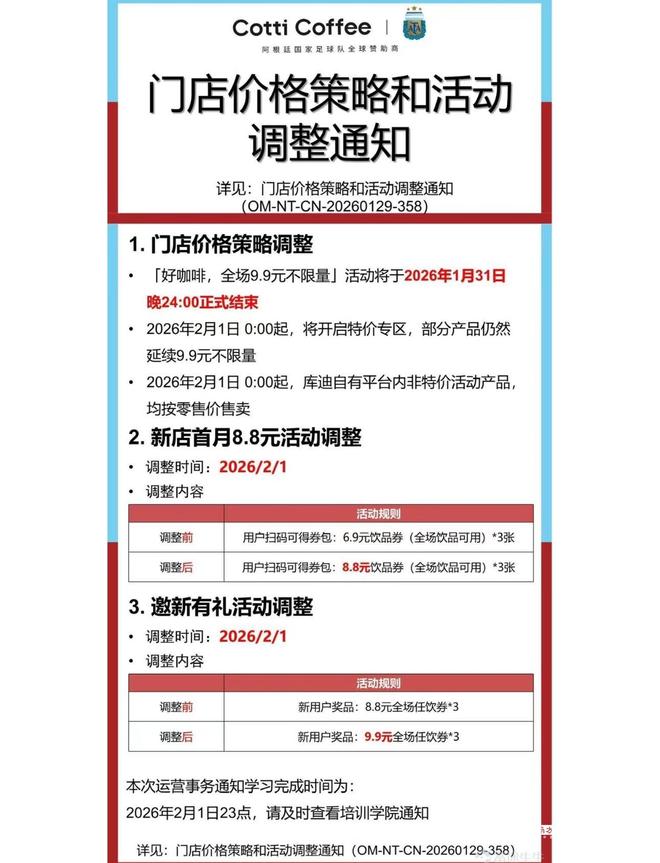
库迪咖啡将收缩全场9块9补贴。 详见:门店价格策略和活动调整通知 (OM-NT-CN-20260129-358) 1. 门店价格策略调整 2. 新店首月8.8元活动调整 | | 活动规则 | | --- | --- | | 调整前 | 用户扫码可得券包:6.9元饮品券(全场饮品可用)*3张 | | 调整后 | 用户扫码可得券包: 8.8元饮品券(全场饮品可用)*3张 | 近日,有消息称,库迪咖啡发布门店价格策略和活动调整通知。通知指出,"全场9.9元不限量"活动将于2026年1月31日24时正式结束, 2026年2月1日0时起,将开启特价专区,部分产品仍然延续9.9元不限量。2026年2月1日0时起,库迪自有平台内非特价活动产品,均按 零售价售卖。此外,新店首月8.8元活动自2月1日0时起调整,用户扫码可得券包由原先的3张6.9元饮品券(全场饮品可用)调整为3张8.8 元饮品券(全场饮品可用)。邀新有礼活动也有所调整,新用户奖品由原先的3张8.8元全场任饮券调整为3张9.9元全场任饮券。 门店价格策略和活动 调整通知 STERNER 「好咖啡, 全场9.9元不限量」活动将于2026年1月31日 . 晚24:0 ...

麦当劳肯德基相继调价 背后是外卖成本压力?
2 1 Shi Ji Jing Ji Bao Dao· 2026-01-31 01:11
Core Insights - The article discusses the recent price adjustments made by major fast-food chains like KFC and McDonald's, as well as various coffee and tea brands, primarily targeting delivery services to cope with rising operational costs [1][2]. Price Adjustments - KFC China announced a price increase of 0.8 yuan on delivery products while keeping dine-in prices unchanged, citing operational cost changes as the reason [1][2]. - McDonald's also raised prices on certain menu items by 0.5 to 1 yuan, with delivery prices adjusted accordingly [2]. - Other brands like Salvia, Nayuki, and Luckin Coffee have also increased their prices, typically by 1 to 2 yuan, to balance costs and profits [1][2]. Market Dynamics - The competitive landscape has shifted due to an intense delivery price war, which has altered the profit margins for many restaurants [1][4]. - The increase in raw material costs, as indicated by a 0.8% rise in the Consumer Price Index (CPI) and a 4.4% increase in fresh fruit prices, is contributing to the need for price adjustments [3][4]. Impact on Smaller Brands - Smaller businesses are adopting more discreet and flexible pricing strategies compared to larger chains, which can afford to raise prices openly [5][6]. - Many small brands are experiencing significant profit reductions, with some reporting a 60% decrease in net profits due to low-price subsidies [6]. Long-term Implications - The ongoing price adjustments reflect a broader trend of brands reassessing their reliance on delivery channels and seeking to improve in-store experiences [7]. - The adjustments may help the industry move away from a low-price competition model, fostering a healthier market environment as subsidy pressures ease [7].

云平台异业联盟:重构商业生态,开启线上线下融合新篇章
Sou Hu Cai Jing· 2026-01-30 14:19
Core Viewpoint - The O2O (Online to Offline) model is becoming a crucial pathway for digital transformation across various industries, driven by the rise of mobile internet and the emergence of new players in the market [1][3]. Group 1: O2O Model Development - The O2O platform is experiencing unprecedented growth opportunities due to the widespread adoption of mobile devices and technological advancements [3]. - Various operational models within O2O, such as full-channel integration and social group buying, are meeting the diverse needs of consumers [3]. - The rise of new retail is deeply integrating online services with offline experiences, reshaping industry structures and ecosystems [3]. Group 2: Cross-Industry Alliance - The cross-industry alliance within cloud platforms is becoming a significant force in reconstructing the business ecosystem by integrating resources across industries [3][5]. - This alliance allows businesses to conduct joint marketing, service, or product innovation, achieving mutual benefits [3][5]. Group 3: Consumer Benefits - Consumers can enjoy discounts and services across various merchants within the alliance, enhancing their shopping experience and satisfaction [5][16]. - The alliance provides value-added services through incentives like points and coupons, increasing user loyalty [5][16]. - The shared traffic among merchants maximizes flow utilization, boosting sales and market share [5][16]. Group 4: Operational Model - The core of the alliance's operational model lies in the integration of online and offline resources, utilizing shared industry resources and joint marketing strategies [5][6]. - The alliance breaks down industry barriers, allowing merchants to share customer information and marketing channels, thus reducing operational costs and enhancing competitiveness [6]. Group 5: Marketing and Data Utilization - The alliance leverages cloud platform technology to provide online marketing tools, helping merchants expand brand influence and attract potential customers [8]. - By collecting and analyzing consumer data, the alliance offers precise market insights and decision support for merchants [8]. Group 6: Future Outlook - The cloud platform cross-industry alliance is expected to play a vital role in creating more value for businesses and consumers as technology advances and the market matures [17].





2026,只想赚钱的品牌,没有出路
新消费智库· 2026-01-30 13:04
这是新消费智库第 2 7 5 3 期文章 新消费导读 不知道你们发现没有, 现在我们买 什么 都方便,但就是感觉不对劲。 外卖快?但吃不到一口锅气。客服回得快?但像在和机器人吵架。直播间 价格低?但买完连牌子都记不住。 效率已经卷到极致了,但我们的品牌,却 越来越没劲 了。 作者 :会写字的机器猫 来源:新消费智库 当一切商业行为都被简化成点击率、转化率、坪效、人效,品牌就只剩下一个冰冷的商标。而今天的消费者,除了要便宜和快,开始渴望别的 东西 —— 尊重、意义、认同,还有快被忘光的 " 人味儿 " , 这也是我为什么又重新开始写手戳稿的意义和原因。 我们 社会 需要一场彻底的 品牌 的, 反效率革命 。不是要倒退,而是在数据和算法的洪流里,把品牌的 " 人 味 " 捞回来 , 把品牌的烟 火气捞回来。 胖东来证明, 对员工不好的品牌,不配叫品牌 说句大实话: 在朋友圈、小红书、脉脉满天飞的时代,你怎么对员工,就是你最硬的广告。 以前品牌靠砸钱投广告、霸占渠道、请明星。现在呢? 每个员工都是你的代言人,每段职场经历都可能把你送上热搜。 一个压榨员工、缺乏 尊重的品牌,外面包装得再漂亮, " 人设崩塌 " 也是 ...

库迪全场饮品9.9元活动确认结束!曾称会持续到2027年
Nan Fang Du Shi Bao· 2026-01-30 12:09
Core Viewpoint - Kudi Coffee is ending its "all products for 9.9 yuan unlimited" promotion on January 31, 2024, and will adjust its pricing strategy starting February 1, 2024, with some products remaining at the promotional price while others will revert to retail prices [1][6]. Pricing Strategy Changes - The "9.9 yuan unlimited" promotion will officially conclude on January 31, 2024, with a new special price section starting February 1, 2024, where select products will still be available at 9.9 yuan [1]. - All non-special promotional products will be sold at their retail prices, which range from 10.5 yuan to 15.9 yuan, indicating a significant price increase for many items [6]. Impact on Franchisees - A franchise store manager confirmed that Kudi's headquarters issued a price adjustment notice to franchisees on January 29, 2024, and multiple stores were still offering the 9.9 yuan promotion as of January 30, 2024 [3]. Historical Context of Promotions - Kudi initiated the 9.9 yuan promotion in February 2023, which sparked a price war in the coffee industry, leading competitors like Luckin Coffee to adopt similar pricing strategies [8][9]. - Kudi's Chief Strategy Officer previously stated that the company was prepared to sustain the 9.9 yuan promotion for at least three years, with expectations of achieving positive cash flow by February 2025 [8]. Competitive Landscape - Following Kudi's promotion, Luckin Coffee also launched a 9.9 yuan campaign, which has since become a common practice among various beverage brands, including Tims and Nayuki [9]. - However, Luckin has also reduced the scope of its 9.9 yuan promotion due to declining operating profit margins, indicating a trend of tightening promotional strategies within the industry [9]. Expansion Goals - Kudi has rapidly expanded its store count since its inception in October 2022, aiming to reach 50,000 stores by the end of 2025, although it has not met its original expansion targets [9].
CEO年薪蒸发4.5亿,星巴克押注中国下沉市场 | 深一度
Sou Hu Cai Jing· 2026-01-30 09:39
Group 1 - The CEO of Starbucks, Kevin Johnson, saw his annual salary drop from $96 million to $31 million, resulting in a loss of approximately 450 million RMB, as the company's stock price fell by 7.7% in 2025, leading to the forfeiture of his performance bonus [2] - In contrast, Starbucks China reported impressive results with revenue growth for five consecutive quarters, achieving $823.4 million in revenue for the latest quarter, a year-on-year increase of 11%, and same-store sales growth of 7% driven by increased transaction volume [4][6] - The growth in same-store sales in China is primarily attributed to strong performance in business district stores, breakfast hours, and lower-tier cities, indicating a successful expansion strategy [4][6] Group 2 - Starbucks opened 13 new stores in county-level cities this quarter, bringing the total to 8,011 stores across 1,103 county-level cities, with new store sales consistently outperforming the average, particularly in lower-tier cities [6] - The company has partnered with Boyu Capital to jointly operate its retail business in China, with Boyu holding up to 60% equity in the joint venture, focusing on efficiency and cost control [6] - Starbucks is shifting towards hiring more part-time baristas instead of full-time employees, with part-time positions making up 61.7% of new hires, which raises concerns about maintaining service quality in the context of its "third place" experience [6][7] Group 3 - There has been an increase in consumer complaints on social media regarding the quality of latte art, indicating potential issues with service consistency as the company transitions to a more part-time workforce [7][8] - Looking ahead, Starbucks faces challenges from local competitors, fluctuations in coffee bean prices, and the ambitious goal of expanding to 20,000 stores in China, necessitating a balance between expansion efficiency and quality of experience to maintain its competitive edge [11]

越卖越亏 茶饮、快餐品牌集体上调外卖价格
Nan Fang Du Shi Bao· 2026-01-30 03:21
Core Insights - The recent price increases in tea drinks and fast food delivery services are attributed to rising costs across multiple factors, including raw materials, labor, and rent, rather than just platform commission changes [1][2][4] - The shift in consumer behavior towards reliance on delivery services has forced companies to raise prices to avoid losses, leading to a cycle of increasing sales without corresponding profit [1][4][7] Group 1: Price Increases and Cost Factors - Many popular brands, such as "Kawanka" and "Naixue's Tea," have raised prices in response to increased raw material costs, with examples including a price hike from 9.9 yuan to 15.9 yuan for breakfast sets [2][3] - Key raw materials like coconut water and lemon have seen price increases of up to 300% and nearly 100% respectively, driven by supply chain issues and rising shipping costs [2][3] - The Consumer Price Index (CPI) has shown a 0.8% increase, with fresh fruit prices rising by 4.4% [2] Group 2: Delivery Channel Dynamics - The delivery channel has become a primary sales avenue for many tea brands, with some stores reporting over 90% of sales coming from delivery, yet profits are only one-third of in-store sales [4][5] - The reliance on delivery has led to a situation where increased sales volume does not equate to increased profits, with some businesses experiencing losses on delivery orders [4][5] Group 3: Operational Challenges and Strategies - High delivery reliance has resulted in increased operational costs, including platform fees and labor, leading to a significant drop in net revenue per store [5][6] - Companies are now focusing on optimizing their channel structures, such as promoting in-store pickup to reduce delivery costs and enhance customer experience [6][7] - The adjustment in pricing strategies is seen as a necessary step for sustainable operations, moving away from a low-price competition model to a more balanced approach [6][7]

6亿播放,全网追更,国内最生猛“创业真人秀”让我老实打工
3 6 Ke· 2026-01-30 01:42
Core Viewpoint - The rise of "Yong Ge's Restaurant Entrepreneurship" live streaming highlights the harsh realities of entrepreneurship, particularly in the competitive restaurant industry, where the expectation of quick profits often leads to significant losses and failures [1][16]. Group 1: Entrepreneurial Insights - The live streaming platform has transformed into a popular "Chinese entrepreneurship reality show," showcasing various entrepreneurs sharing their experiences, which often serve as cautionary tales [1][4]. - Many participants in the live streams are individuals who have invested in franchises or businesses without proper research, leading to financial losses [2][10]. - The concept of "county middle-class bankruptcy" has emerged, warning against common pitfalls in the restaurant sector, particularly in coffee, milk tea, hamburgers, and baking [12][16]. Group 2: Business Models and Challenges - The main business model of "Yong Ge's Restaurant Entrepreneurship" involves charging for consultation services, with participants paying over 300 yuan for advice, which serves as a barrier to entry for less serious individuals [4][5]. - Many entrepreneurs fall victim to "fast recruitment" scams, where they are misled into believing they can quickly open profitable businesses without understanding the underlying risks [13][14]. - The live stream often features a formulaic approach to diagnosing business problems, emphasizing the importance of understanding market dynamics and operational management [8][10]. Group 3: Economic Context - From 2015 to 2025, the per capita disposable income in China nearly doubled from approximately 22,000 yuan to 43,000 yuan, indicating a growing economic pressure on middle-class individuals in counties [15]. - The psychological profile of county middle-class individuals often includes a desire for stability while simultaneously seeking entrepreneurial opportunities, making them susceptible to scams promising quick returns [16][15]. - The challenges faced by older workers and those in rural areas, including reduced job opportunities and lower income, further complicate the entrepreneurial landscape [15].