康诺亚

Search documents
从海外授权到NewCo,美元基金变相杀回中国创新药
Di Yi Cai Jing· 2025-08-27 13:02
Group 1 - The focus of US funds on Chinese innovative drugs has not diminished, but the approach has shifted to overseas asset placement to reduce compliance risks and enhance capital efficiency [1][5] - The recent surge in Hong Kong's 18A projects is driven by high-frequency BD collaborations, NewCo models, and mergers and acquisitions, fundamentally changing the underlying logic of the innovative drug sector [1][3] - In 2024, the number of innovative drugs under development in China is projected to reach 3,575, surpassing the United States and establishing China as a global leader in this area [3] Group 2 - The NewCo model has gained traction, particularly in oncology and autoimmune disease treatment, allowing Chinese companies to collaborate with US funds to establish new entities for global development [2][4] - The BD and NewCo strategies are key drivers of the innovative drug market, with significant overseas licensing deals becoming commonplace, exceeding $1 billion [3][4] - The NewCo model allows Chinese pharmaceutical companies to retain equity while receiving upfront payments, milestones, and revenue sharing, thus mitigating direct investment risks for US funds [4][5] Group 3 - The investment landscape for US funds in China is evolving, with a focus on incubating NewCo and injecting assets into these entities to avoid direct investment risks associated with Chinese companies [5][6] - Despite a decrease in direct investments by US funds in Chinese biotech, the understanding of the market has deepened, leading to a strategic shift towards acquiring Chinese assets and forming US-based companies [6][7] - The trend of Chinese innovative drugs going global is accelerating, with an emphasis on having clear "going out" strategies to attract international partnerships and acquisitions [8][9] Group 4 - The current focus of capital is on large products and indications, particularly in oncology and autoimmune diseases, with a notable trend towards metabolic drugs driven by successful GLP-1 products from multinational companies [9][10] - The innovative drug market in China is increasingly recognized for its potential to be acquired by global pharmaceutical companies, moving away from a reliance on domestic sales and channels [8][9]

AI主题走强,9只ETF跻身涨幅榜前十
Zhong Guo Zheng Quan Bao· 2025-08-27 12:29
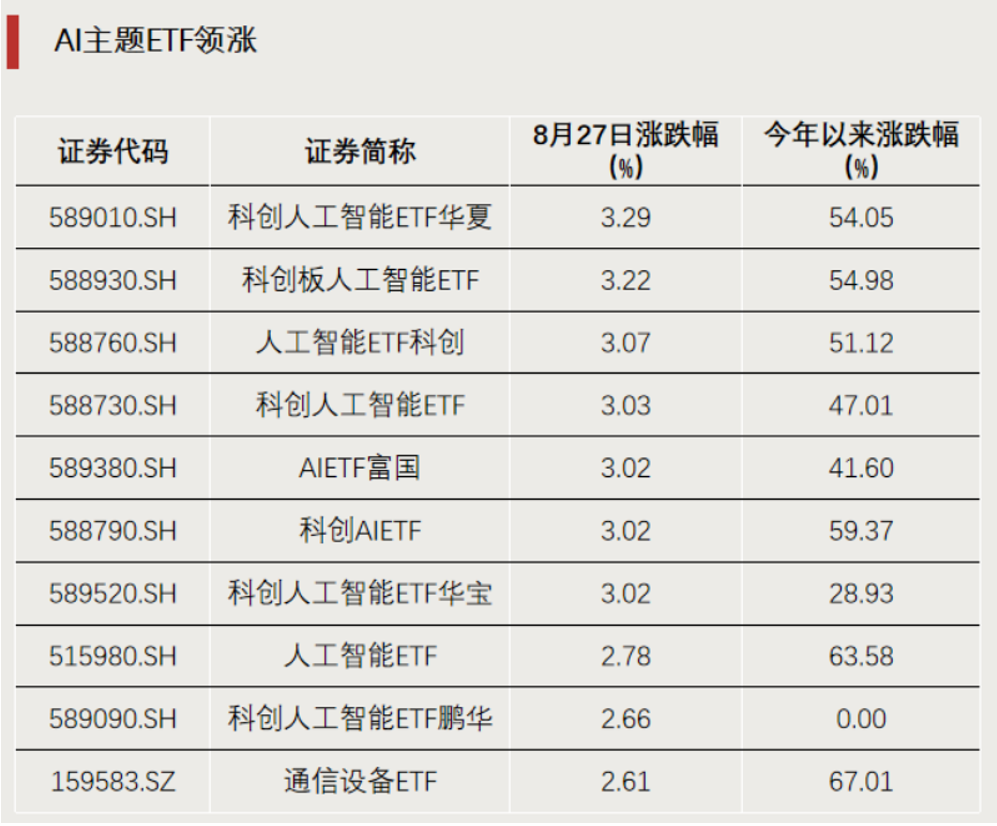
Market Overview - On August 27, A-shares saw a decline across the three major indices, with a market turnover of nearly 3.2 trillion yuan. Only 206 out of over 1200 ETFs in the market recorded gains [1] - The overall net inflow into the ETF market exceeded 12 billion yuan on August 26, marking the third consecutive day of net inflows exceeding 10 billion yuan [3][10] AI Theme ETFs Performance - AI-themed ETFs showed strong performance, with 9 products ranking among the top ten in terms of gains. The top performer, Huaxia's AI ETF, recorded a gain of 3.29%, while the overall gain for the fund exceeded 50% year-to-date [4][6] - The AI ETFs linked to the Shanghai Stock Exchange's AI index and the ChiNext AI index demonstrated significant gains, with some products seeing intraday increases of over 6% [5] Innovation Drug ETFs Performance - Conversely, the Hong Kong innovation drug-themed ETFs experienced notable declines, with eight out of the top ten ETFs by loss primarily focused on this sector. The Hong Kong Innovation Drug ETF saw a drop of 4.63% [7][9] - Morgan Stanley's analysis suggests that the innovation drug sector is currently facing short-term volatility due to profit-taking and external disturbances, although the long-term outlook remains positive [8] Fundraising Activities - On August 26, nearly 20 new funds were established, raising over 11 billion yuan in total. Notable new funds include Huaxia's National Index Hong Kong Technology ETF, which raised over 1.4 billion yuan [15] Investment Trends - Investment firms are focusing on sectors with low valuations and growth potential, such as AI computing and applications, innovation drugs, and Hong Kong internet stocks. The Hong Kong technology sector is expected to attract more attention due to its high growth potential [14]

高开低走!
Zhong Guo Ji Jin Bao· 2025-08-27 10:33
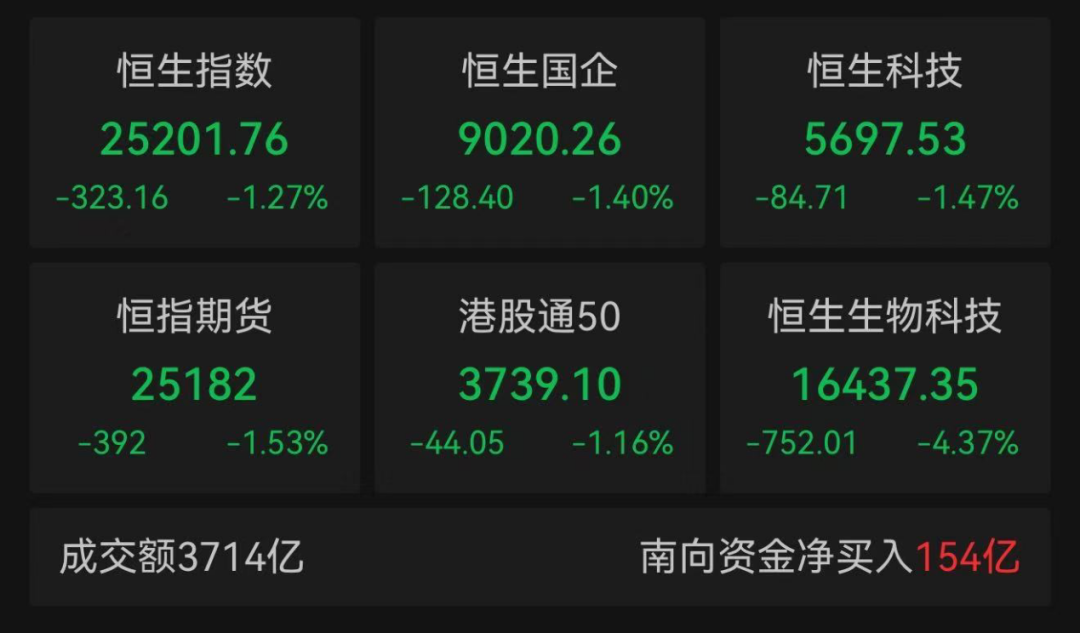
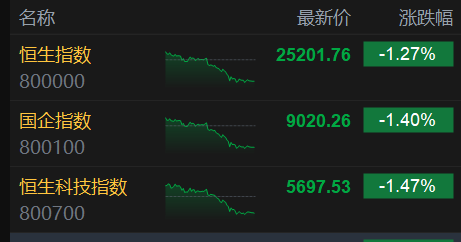
Market Overview - The Hong Kong stock market experienced a decline today, with the Hang Seng Index falling by 1.27% to close at 25,201.76 points, the Hang Seng Tech Index down by 1.47%, and the Hang Seng China Enterprises Index down by 1.40% [1][2] - Southbound funds recorded a net inflow of approximately 15.4 billion HKD [1] Major Stocks Performance - Alibaba had a trading volume of 13.972 billion HKD, up by 0.16%; SMIC had a trading volume of 12.950 billion HKD, up by 0.09%; Tencent Holdings had a trading volume of 12.842 billion HKD, down by 1.72% [3][2] - Meituan and Xiaomi also had significant trading volumes, with Meituan at 9.477 billion HKD, down by 3.08%, and Xiaomi at 7.678 billion HKD, down by 0.56% [3] Innovation Drug Sector - The innovation drug sector faced significant adjustments due to tariff disturbances, with notable declines in stocks such as CanSino, WuXi Biologics, and CStone Pharmaceuticals, which fell by 8.59%, 7.79%, and 7.75% respectively [5][6] - The potential implementation of a 250% tariff on imported drugs by the U.S. could have a substantial impact on the global pharmaceutical industry [6][7] Technology and Semiconductor Stocks - Despite the overall market decline, some semiconductor stocks showed resilience due to favorable policies, with companies like Shanghai Fudan and ZTE Corporation experiencing slight increases [4] - The Chinese government has issued opinions to promote the integration of artificial intelligence with various industries, which may benefit semiconductor companies in the long run [4] Brokerage and Real Estate Sector - Chinese brokerage stocks continued to decline, with notable drops in firms like Shenwan Hongyuan and Dongfang Securities, which fell by 6.02% and 5.78% respectively [9][10] - The real estate sector also faced challenges, with Country Garden dropping over 11% and other companies like China Jinmao and Sunshine 100 China experiencing declines of 8.23% and 7.69% respectively [10]

恒生指数连跌两日 部分半导体股逆势走强
Xin Lang Cai Jing· 2025-08-27 08:55
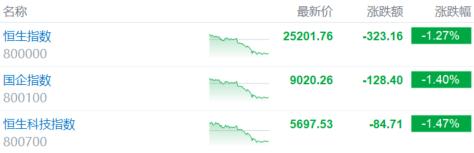
Market Performance - The Hong Kong stock market continues to show weakness, with the Hang Seng Index down 1.27% closing at 25,201.76 points, the Tech Index down 1.47% at 5,697.53 points, and the National Enterprises Index down 1.40% at 9,020.26 points [2][4]. Pharmaceutical Sector - Pharmaceutical stocks are under pressure due to U.S. President Trump's consideration of imposing tariffs up to 250% on imported drugs, which could create significant volatility in the global pharmaceutical industry. This presents both opportunities and challenges for Chinese biopharmaceutical companies [5]. - Notable declines in pharmaceutical stocks include Connoisseur-B (down 8.59%), King’s Ray Biotechnology (down 7.42%), and Kangfang Biologics (down 7.10%) [4]. Brokerage Sector - Brokerage stocks mostly declined, with notable drops in Shenwan Hongyuan (down 6.02%), Dongfang Securities (down 5.78%), and CICC (down 5.64%). However, there are indications of active trading and policy-driven valuation recovery, with increased market activity and record high margin trading balances [6]. Real Estate Sector - Real estate stocks continue to weaken, with China Jinmao down 8.23%, Vanke down 5.35%, and Sunac China down 5%. This follows the recent "Six Measures" policy adjustment in Shanghai, which has not positively impacted related stocks [7][8]. Beverage Sector - Beverage stocks faced declines despite positive earnings reports, with notable drops in Hu Shang Ayi (down 5.84%), Mixue Group (down 5.27%), and Gu Ming (down 3.75%) [9][10]. Technology Sector - Technology stocks also saw declines, with major companies like Beike-W down 6.82%, Kuaishou-W down 3.35%, and JD Health-W down 3.21%. Beike reported a net income of 49.339 billion RMB, a year-on-year increase of 24.13%, but a net profit decrease of 7.2% [11][12]. Semiconductor Sector - Semiconductor stocks performed well against the market trend, with Shanghai Fudan up 3.25%, Hard Egg Innovation up 0.41%, and SMIC up 0.09%. This is attributed to the recent government policy promoting the integration of artificial intelligence and economic sectors [13]. Individual Stock Movements - CSPC Pharmaceutical Group fell 6.36% due to second-quarter revenue and net profit missing expectations, despite management highlighting potential in their EGFR ADC product [14]. - Shuangdeng Co. saw a significant increase of 14.65% on its second day of trading, driven by strong demand during its IPO, with oversubscription rates of 3,876 times for public offerings and 18.75 times for international offerings [15][16].

港股收评:连跌两日!恒指收跌1.27%,科技、金融股继续下挫
Ge Long Hui· 2025-08-27 08:50
Market Overview - The Hong Kong stock market experienced a significant decline, with the Hang Seng Index dropping by 1.27%, closing at 25,201.76, down 323.16 points [1][2] - The Hang Seng Tech Index and the Hang Seng China Enterprises Index also fell by 1.47% and 1.4%, respectively, with the China Enterprises Index barely holding above the 9,000-point mark [1][2] Sector Performance - Major technology stocks saw a downturn, with companies like Kuaishou and Meituan falling over 3%, while JD.com dropped by 2.5% [5][6] - Financial sectors, including banks and insurance stocks, collectively underperformed, contributing to the overall market decline [2][5] - The biopharmaceutical sector faced significant losses, particularly after former President Trump announced plans to impose tariffs on drugs, leading to a broad sell-off in biotech stocks [2][5] Real Estate and Property Management - Property management stocks experienced sharp declines, with companies like Excellence Commercial Services dropping 16% and Country Garden Services falling over 11% [7] - Recent real estate policies in major cities like Beijing and Shanghai are expected to stabilize the market, with analysts optimistic about recovery in core cities [7] Brokerage Firms - Chinese brokerage stocks also fell, with Shenwan Hongyuan down over 6% and other major firms like Dongfang Securities and Huatai Securities declining more than 5% [8] - Despite the downturn, there is optimism regarding the brokerage sector's performance due to increased market activity and potential earnings growth [8] Biopharmaceutical Sector - The biopharmaceutical and innovative drug sectors saw significant declines, with stocks like CanSino Biologics and Innovent Biologics dropping over 7% [9] - Analysts suggest that recent changes in liquidity conditions may support a rebound in the Hong Kong stock market, narrowing the gap with the rapidly rising A-share market [9] Consumer Sector - New consumption concept stocks also faced declines, with companies like Nayuki's Tea and Bubble Mart dropping over 5% [10] - The Chinese Ministry of Commerce plans to introduce policies to boost service consumption, indicating a shift towards a balanced consumption model [10] Apple-Related Stocks - Apple-related stocks performed well, with Lens Technology rising nearly 8% ahead of the upcoming iPhone 17 launch event scheduled for September 9 [3][12] Capital Inflows - Southbound capital saw a net inflow of 15.371 billion HKD, indicating continued interest in Hong Kong stocks from mainland investors [12] Hedge Fund Activity - Recent reports indicate that global hedge funds have increased their bets on Chinese stocks, with significant inflows observed in consumer staples and industrial sectors [14]

港股收盘(08.27) | 恒指收跌1.27% 部分AI概念股走高 农夫山泉(09633)绩后大涨7%
智通财经网· 2025-08-27 08:48
Market Overview - The Hong Kong stock market experienced a decline for the second consecutive day, with all three major indices falling over 1%. The Hang Seng Index closed down 1.27% at 25,201.76 points, with a total turnover of HKD 371.376 billion [1] - The Hang Seng China Enterprises Index dropped 1.4% to 9,020.26 points, while the Hang Seng Tech Index fell 1.47% to 5,697.53 points [1] Blue Chip Performance - Nongfu Spring (09633) led the blue-chip stocks, rising 7.11% to HKD 50.3, contributing 10.53 points to the Hang Seng Index. The company reported a revenue of RMB 25.622 billion for the first half of 2025, a year-on-year increase of 15.56% [2] - Other notable blue-chip movements included Zhongsheng Holdings (00881) up 1.96%, China Hongqiao (01378) up 1.12%, while China Resources Mixc Lifestyle (01209) fell 9.08% and CSPC Pharmaceutical Group (01093) dropped 6.36% [2] Sector Highlights - Large tech stocks generally declined, with Tencent down 1.72% and Xiaomi down 0.56%. However, AI concept stocks surged following the State Council's release of the "Artificial Intelligence+" action plan, with SenseTime rising over 14% [3] - The AI action plan aims for over 70% application penetration of new intelligent terminals and intelligent entities by 2027, marking a shift towards deep integration with the real economy [3] Brokerage Stocks - Chinese brokerage stocks faced significant declines, with Shenwan Hongyuan (06806) down 6.02%, Dongfang Securities (03958) down 5.78%, and CITIC Securities (06030) down 4.11% [4] - The recent surge in the Shanghai Composite Index and trading volume indicates strong market sentiment, but there are signals of potential adjustments if volatility increases [4] Pharmaceutical Sector - The sentiment in the pharmaceutical sector remained low, with notable declines in stocks such as Connaught (02162) down 8.59% and King’s Flair International (01548) down 7.42% [4] Innovation Drug Sector - Guotou Securities reported that the current market capitalization of the innovative drug sector reflects a neutral expectation, with improvements in the domestic market expected to lead to profitability by 2026 [5] - The sector is anticipated to benefit from several catalysts in the second half of the year, including medical insurance negotiations and academic conferences [5] Notable Stock Movements - Lianyi Technology (09959) surged 23.21% to HKD 2.76 after announcing a share buyback plan [7] - Lens Technology (06613) reached a new high, rising 7.78% to HKD 27.98, driven by strong growth prospects and expected benefits from Apple's new products [8] - COSCO Shipping International (00517) reported a revenue of HKD 1.934 billion for the first half of 2025, a 10.3% year-on-year increase, with a profit attributable to shareholders of HKD 488 million, up 25.6% [9] - NIO (09866) rose 4.26% to HKD 51.65, supported by strong orders for new vehicle models [10] - Country Garden Services (06098) fell 11.11% after reporting a 30.8% decline in profit attributable to shareholders [11]

港股收盘 | 恒指收跌1.27% 部分AI概念股走高 农夫山泉绩后大涨7%
Zhi Tong Cai Jing· 2025-08-27 08:46
Market Overview - The Hong Kong stock market experienced a decline for the second consecutive day, with all three major indices falling over 1%. The Hang Seng Index closed down 1.27% at 25,201.76 points, with a total turnover of HKD 371.38 billion [1] - The short-term liquidity in the Hong Kong market is lagging, but it has structural advantages in the long term. Key characteristics of the market this year include stronger structure compared to indices and continuous rotation of leading sectors [1] Blue Chip Performance - Nongfu Spring (09633) led the blue-chip stocks, rising 7.11% to HKD 50.3, contributing 10.53 points to the Hang Seng Index. The company reported a revenue of RMB 25.622 billion for the first half of 2025, a year-on-year increase of 15.56% [2] - Other notable blue-chip movements included Zhongsheng Holdings (00881) up 1.96%, China Hongqiao (01378) up 1.12%, while China Resources Mixc Lifestyle (01209) fell 9.08%, and CSPC Pharmaceutical Group (01093) dropped 6.36% [2] Sector Highlights - Large technology stocks generally declined, with Tencent down 1.72% and Xiaomi down 0.56%. However, AI concept stocks surged following the State Council's release of the "Artificial Intelligence+" action plan, with SenseTime rising over 14% [3] - The AI action plan aims for over 70% application penetration of new intelligent terminals and entities by 2027, marking a shift towards deep integration with the real economy [3] - Chinese brokerage stocks faced significant declines, with Shenwan Hongyuan down 6.02% and Dongfang Securities down 5.78% [4] - The pharmaceutical sector showed low sentiment, with notable declines in stocks like Kangnuo Ya-B (02162) down 8.59% and King’s Flair International (01548) down 7.42% [4] Notable Stock Movements - Lianyi Technology-W (09959) saw a strong increase of 23.21% after announcing a share buyback plan of at least USD 80 million [7] - Lens Technology (06613) reached a new high, rising 7.78% due to strong growth prospects and expected benefits from Apple's upcoming foldable phone [7] - COSCO Shipping International (00517) reported a revenue of HKD 1.934 billion for the first half of 2025, a 10.3% year-on-year increase, with a profit attributable to shareholders of HKD 488 million, up 25.6% [8] - NIO-SW (09866) rose 4.26% as strong orders for new models are expected to drive stock price increases [9] - Country Garden Services (06098) fell 11.11% after reporting a 30.8% decline in profit attributable to shareholders despite a 10.2% increase in revenue [10]
港股收评:午后跳水恒指跌1.27%,科技股、金融股普遍弱势!蓝思科技涨8%,快手美团跌超3%,百度网易腾讯跌近2%
Ge Long Hui· 2025-08-27 08:40
Market Overview - The Hong Kong stock market experienced a significant decline in the afternoon, with the Hang Seng Index dropping by 1.27%, losing over 300 points. The Hang Seng China Enterprises Index and the Hang Seng Tech Index fell by 1.4% and 1.47% respectively, with the former barely holding above the 9000-point mark [2] - Major technology stocks, which serve as market indicators, continued to decline in the afternoon. Kuaishou and Meituan fell over 3%, while JD.com dropped by 2.5%. Baidu, NetEase, and Tencent saw declines close to 2%, and Xiaomi fell by 0.56%. Alibaba managed to stay slightly positive [3] Sector Performance - The financial sector, including banks, insurance companies, and Chinese brokerage firms, collectively underperformed, contributing to the overall market decline. The performance of individual stocks continued to be affected by ongoing earnings reports, with property management and real estate stocks experiencing significant drops [3] - Biopharmaceutical stocks faced a collective downturn, particularly in the innovative drug sector, following comments from Trump regarding the rapid imposition of tariffs on pharmaceuticals. This led to notable declines in various biopharma stocks [3] Specific Stock Movements - Several biopharmaceutical companies saw substantial declines, including Kanghao Ya-B (-8.59%), Qiansirui Biotechnology (-7.42%), and Kangfang Biotechnology (-7.10%). Other notable decliners included Xiansheng Pharmaceutical (-6.79%) and Shiyao Group (-6.36%) [3] - In contrast, the rare earth sector remained strong, benefiting from the implementation of supply reforms and multiple catalysts. Apple’s upcoming event on September 9, where the iPhone 17 series is expected to be launched, led to a rise in Apple-related stocks, with Lens Technology (300433) surging nearly 8% and reaching a new high since its listing [4]




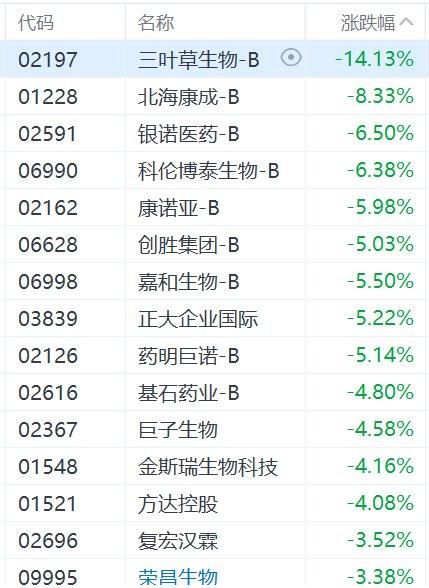
港股生物技术股普跌,科伦博泰生物跌超6%
Ge Long Hui A P P· 2025-08-27 05:41
Group 1 - The biotechnology sector in the Hong Kong stock market experienced a significant decline, with several companies reporting substantial drops in their stock prices [1] - Notable declines include Clover Biopharmaceuticals, which fell by 14.13%, and Beigene, which dropped by 8.33% [2] - Other companies such as Innovent Biologics and WuXi Biologics also saw declines exceeding 5%, indicating a broader trend of negative performance in the sector [1][2] Group 2 - The following companies reported specific percentage declines: Clover Biopharmaceuticals (-14.13%), Beigene (-8.33%), and Innovent Biologics (-6.50%) [2] - Additional companies with notable declines include Kintor Pharmaceutical (-6.38%), CanSino Biologics (-5.98%), and Zai Lab (-5.50%) [2] - The overall trend suggests a challenging environment for biotechnology stocks in the Hong Kong market [1]

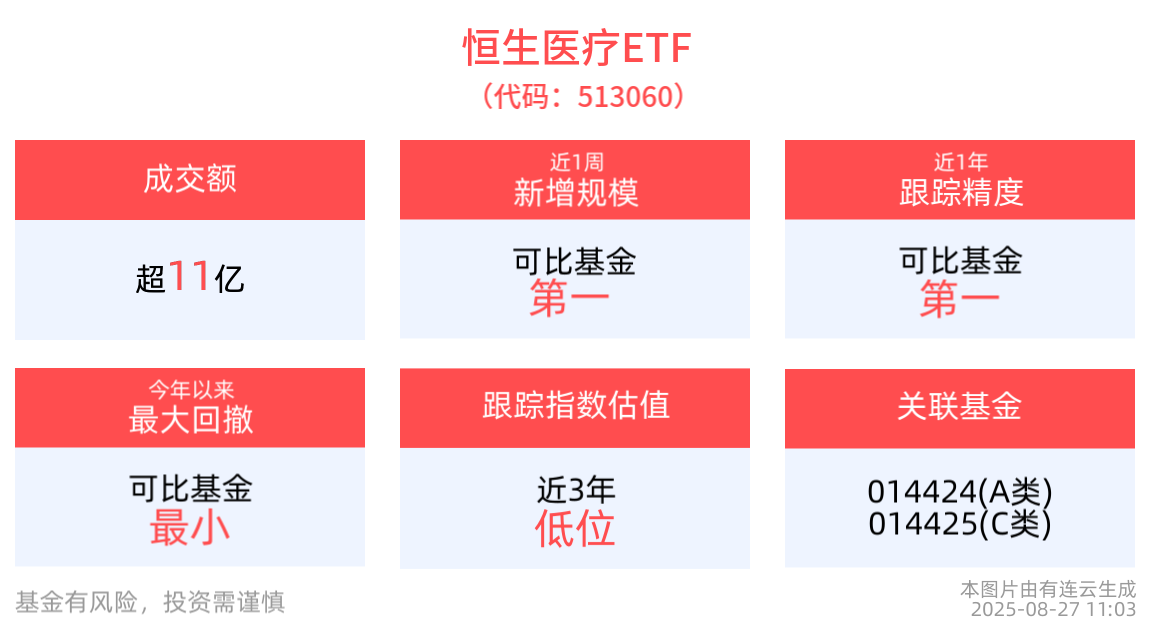
恒生医疗ETF(513060)近1周新增规模居可比基金首位,港股创新药精选ETF(520690)交投活跃,礼来orforglipron三期临床成功
Xin Lang Cai Jing· 2025-08-27 03:57
Core Viewpoint - The Hong Kong pharmaceutical sector is experiencing structural opportunities driven by innovative pipeline advancements, capital market recognition, and performance realization, particularly highlighted by the success of Eli Lilly's orforglipron in clinical trials, the inclusion of InnoCare Pharma in multiple indices, and the commercial growth of CanSino Biologics despite increased losses [7]. Group 1: Market Performance - As of August 27, 2025, the Hang Seng Healthcare Index (HSHCI) decreased by 1.96%, with mixed performances among constituent stocks [3] - The Hang Seng Medical ETF (513060) fell by 0.83%, with a latest price of 0.72 yuan, but showed a 0.28% increase over the past week, ranking 1/3 among comparable funds [3] - The Hang Seng Hong Kong Stock Connect Innovative Drug Selection Index (HSSCPB) declined by 2.04%, while the corresponding ETF (520690) dropped by 0.88% to 1.02 yuan, but had a 6.89% increase over the past two weeks, ranking 1/2 among comparable funds [5] Group 2: Company Developments - Eli Lilly's orforglipron achieved all primary and key secondary endpoints in the ATTAIN-2 Phase III trial, indicating potential to transform the treatment landscape for obesity in patients with type 2 diabetes [6] - InnoCare Pharma reported a revenue of 1.229 billion yuan in the first half of the year, with a research and development investment of 349 million yuan, and was recently included in major indices, reflecting strong market recognition [6] - CanSino Biologics achieved a revenue of 1.41 billion yuan in H1 2025, a year-on-year increase of 37.8%, but faced an expanded loss of 590 million yuan due to rising R&D and sales expenses [6] Group 3: ETF Insights - The Hang Seng Medical ETF (513060) has seen a significant increase in scale, with a growth of 182 million yuan over the past week, ranking 1/3 among comparable funds [8] - The ETF has a year-to-date Sharpe ratio of 2.41 and has outperformed its benchmark with a year-to-date relative drawdown of 0.63%, the lowest among comparable funds [9] - The latest price-to-earnings ratio (PE-TTM) for the Hang Seng Medical ETF is 32.1, indicating it is at a historical low compared to the past three years [9] Group 4: Index Composition - The top ten weighted stocks in the Hang Seng Healthcare Index account for 61.67% of the index, with major players including BeiGene, Innovent Biologics, and WuXi Biologics [9] - The top ten stocks in the Hang Seng Hong Kong Stock Connect Innovative Drug Selection Index represent 77.82% of the index, highlighting the concentration of investments in leading biotech firms [11]