舍得酒业

Search documents
舍得酒业20251225
2025-12-26 02:12
Summary of Shide Liquor Industry Conference Call Company Overview - **Company**: Shide Liquor Industry - **Industry**: Baijiu (Chinese liquor) Key Points Industry and Market Performance - The macroeconomic and consumer environment has led to weakened sales for some products, but Shide's banquet market strategy and the T68 product have performed well, with T68 showing particularly strong sales compared to other products [2][3] - The opening rate for the premium product "Pinwei Shide" is approximately 60%, with significant recovery in markets outside the province, especially in Shandong, Tianjin, and Dezhou [2][5] - Online sales have maintained growth through blind box promotions and other activities, accounting for 11% of total sales [2][8] Sales and Product Performance - In 2025, 85% of distributors are profitable due to strict price control and high-pressure regulation ensuring stable pricing [2][6] - Major products can be categorized into brand-up and channel-down strategies, with T68 outperforming other products [3][4] - The company expects a gradual recovery in the market, with a potential for a "front low, back high" trend in 2026 [4][10] Distributor and Inventory Management - The distributor structure remains stable, with over 75% being large distributors, which have strong risk resistance [2][6] - The number of distributors decreased by 100 to around 2,500, while inventory for "Pinwei Shide" has reduced to 3 months from 6-7 months last year [6][9] - The company emphasizes price control and distributor profitability, avoiding stockpiling to prepare for future industry recovery [6][7] Strategic Initiatives - Shide Liquor is focusing on long-term healthy development and strategy execution, with no immediate pressure from the group [11] - The company plans to increase prices for "Pinwei Shide" and upgrade T68's flavor profile, anticipating intensified competition in the mass market [4][12] - The company is exploring innovative internet sales models and aims for online revenue to reach over 20% in the next 2-3 years [14] Future Outlook - The overall performance of the baijiu industry is expected to improve during the 2026 Spring Festival, but full recovery may take about two years [10] - Shide anticipates maintaining growth in the mass market, leveraging its full price range product coverage and strong brand recognition in lower-tier cities [13][14] Organizational Structure - There are no plans for changes in the executive team or ownership structure, maintaining stability at the management level [15] Feedback and Payment Collection - The company has completed its payment collection for 2025, with inventory planning based on scientific targets rather than merely chasing report results [16]

加速锻造新质生产力 上市公司各显神通
Zhong Guo Zheng Quan Bao· 2025-12-25 21:10
Core Viewpoint - The technology theme is identified as the undisputed investment focus for 2025, with listed companies accelerating their development in both intrinsic and extrinsic ways to forge new productive forces [1] Group 1: Technological Advancements - Listed companies have made significant breakthroughs in key areas such as AI, semiconductors, biomedicine, high-end equipment, and communications this year [2] - Notable achievements include the world's first four-channel ultra-low noise semiconductor single-photon detector by GuoDun Quantum, and the approval of the world's first "rice-based" innovative drug by HeYuan Bio [2] - The trend of humanoid robots continues to gain momentum, with companies like Green Harmonic and Estun launching advanced components and robots for industrial applications [2] Group 2: Market Dynamics and Mergers - The total market capitalization of A-shares reached 107.32 trillion yuan, with the electronics sector leading at 12.42% of the market share, an increase of nearly 3 percentage points since the beginning of the year [3] - Companies are increasingly using mergers and acquisitions (M&A) as a strategy for resource reallocation and transformation, with significant activity in the semiconductor and information technology sectors [5] - In 2023, there were 1,104 new M&A disclosures in the Shenzhen market, totaling 553.7 billion yuan, marking a year-on-year increase of 54% [5] Group 3: Transition to New Productive Forces - Companies are focusing on transitioning to new productive forces, with examples like Wanlong Optoelectronics planning to acquire a leading infrastructure digital service provider [4] - The trend of cross-industry transformation is supported by policies, as seen with Songfa Co. transitioning from ceramics to shipbuilding and high-end equipment manufacturing [5] - The emphasis on high-quality development is evident as industries shift from "scale involution" to "quality upgrades," particularly in sectors like photovoltaics and new energy vehicles [6] Group 4: Innovation and Sustainability - Companies are investing heavily in R&D, with a total of 1.16 trillion yuan spent in the first three quarters of 2025, maintaining a scale above 1 trillion yuan for three consecutive years [2] - The ESG (Environmental, Social, and Governance) concept is gaining traction, with companies like Shede Liquor pioneering ecological brewing practices [6] - The government is promoting innovation and technology integration, with plans to support the establishment of innovation consortia and enhance the development of high-tech enterprises [7]
从“卖产品”到“卖文化”:营销变革下酒企出海新征程
Bei Jing Ri Bao Ke Hu Duan· 2025-12-25 16:28
Core Viewpoint - The Chinese liquor industry is increasingly focusing on international markets as domestic competition intensifies, with a significant number of companies expanding overseas to seek new growth opportunities [1][7]. Group 1: Market Expansion Strategies - A report indicates that by 2025, 63.9% of Chinese liquor companies will have established or are in the process of expanding into international markets, highlighting a collective shift towards seeking new growth avenues [1]. - Companies like Moutai and Wuliangye are launching products specifically designed for overseas markets, while others are exporting established domestic bestsellers [3][4]. - The export of Chinese liquor is experiencing a "volume and price increase," with total exports reaching $704 million in the first three quarters of the year, a 5.3% year-on-year increase [7]. Group 2: Cultural Integration - The industry recognizes that successful internationalization involves not just product export but also cultural integration, with many companies engaging in cultural activities to tell the story of Chinese liquor [5][6]. - Events like "He Mei Global Tour" by Wuliangye and "Chinese Banquet" by Yanghe are examples of how companies are using cultural narratives to enhance their international presence [5]. Group 3: Challenges and Opportunities - Despite the enthusiasm for international expansion, challenges remain, such as the need to adapt products to local tastes and cultural preferences, particularly in regions with significant Chinese populations like Southeast Asia [8][9]. - The industry is still in the early stages of internationalization, primarily serving Chinese consumers abroad, and must develop strategies to engage with local markets more effectively [8][9].

食品饮料行业 2026 年度投资策略报告(二):白酒:底部信号夯实,重视优质酒企配置机会-20251225
Guoxin Securities· 2025-12-25 13:59
Group 1 - The report indicates that the liquor industry is currently facing supply-demand imbalances, with companies reducing growth expectations and releasing channel pressures. The white liquor index has dropped by 12% since the beginning of 2025, underperforming the CSI 300 index by 33% [1][11] - The report highlights that the overall market demand for white liquor has shown slight recovery, but actual demand remains weak, with mainstream product prices in a downward trend. Companies like Wuliangye and Gujing Gongjiu are reducing growth expectations, leading to significant declines in Q3 performance [1][22] - The report suggests that the white liquor sector is entering a configuration phase, with leading companies like Kweichow Moutai improving their price-volume relationship and showcasing dividend asset attributes, with a projected dividend yield of 4% in 2026 [3][4] Group 2 - Looking ahead to 2026, the report anticipates that supply-side optimization and channel clearing will occur, with a focus on quality company configurations. The industry is expected to see gradual recovery in demand, particularly during the Spring Festival sales period [2][29] - The report notes that channel inventory has decreased since Q3 2025, and companies are focusing on maintaining dynamic profits for distributors. Leading companies are gradually relaxing channel policies, indicating a stabilization trend in product prices post-holiday [2][42] - The competitive landscape is shifting from price differentiation to brand and organizational capabilities, with companies that can establish pricing power in specific regions or demographics likely to emerge from the adjustment cycle first [2][29] Group 3 - Investment recommendations suggest that the white liquor sector is now in a configuration zone, with a focus on brands that can navigate through cycles, such as Kweichow Moutai and Shanxi Fenjiu, which are expected to see valuation improvements as market liquidity increases [3][4] - The report emphasizes the importance of companies that have established advantages in pricing and regional market share during the adjustment phase, such as Luzhou Laojiao, Gujing Gongjiu, and Jinhui Liquor [3][4] - The report also highlights companies with strong shareholder returns and cash flow safety margins, such as Wuliangye, as potential investment opportunities [3][4]





从“卖产品”到“卖文化” 酒企出海新征程
Bei Jing Shang Bao· 2025-12-25 13:52
Core Viewpoint - The Chinese liquor industry is increasingly focusing on international markets as domestic competition intensifies, with a significant number of companies expanding overseas to seek new growth opportunities [1][8]. Group 1: Market Expansion - As of December 25, 2023, 63.9% of Chinese liquor companies are either expanding or have already established a presence in overseas markets, indicating a collective shift towards internationalization [1]. - Major brands like Moutai, Wuliangye, and Luzhou Laojiao are actively entering global markets, while Huangjiu brands such as Guyue Longshan and Kuaijishan are also leveraging traditional culture alongside their products [1][3]. Group 2: Product Strategy - Companies are adopting two distinct strategies for internationalization: "cultural integration" with tailored products for foreign markets, and "value output" by exporting established domestic products [3]. - Moutai has launched a series of products specifically designed for international markets, while other brands like Luzhou Laojiao and Wuliangye are exporting their star products that have already gained traction in China [3][4]. Group 3: Cultural Integration - The cultural aspect of product export is becoming increasingly important, with companies recognizing that successful internationalization involves not just product sales but also cultural storytelling [6]. - Initiatives such as Wuliangye's "He Mei Global Tour" and various cultural exchange activities by other brands aim to promote Chinese liquor culture globally [6][7]. Group 4: Market Challenges - Despite the enthusiasm for international expansion, challenges remain, including the need for localization and the predominance of Chinese consumers in overseas markets [8][9]. - The Southeast Asian market is currently the primary focus for many companies, supported by a significant Chinese diaspora, but broader acceptance among local consumers is still a hurdle [8][9]. Group 5: Future Directions - To penetrate mainstream overseas markets, companies must innovate and adapt their products to local tastes, particularly through the integration of liquor with Chinese cuisine [9].



从“卖产品”到“卖文化” 营销变革下酒企出海新征程
Bei Jing Shang Bao· 2025-12-25 13:30
Core Viewpoint - The Chinese liquor industry is increasingly focusing on international markets as domestic competition intensifies, with a significant number of companies expanding overseas to seek new growth opportunities [1][7]. Group 1: Market Expansion - As of December 25, 2023, 63.9% of Chinese liquor companies are either expanding or have already established a presence in overseas markets [1]. - Major brands like Kweichow Moutai, Wuliangye, and Luzhou Laojiao are actively entering international markets, alongside traditional yellow wine brands like Guyue Longshan and Kuaijishan [1][2]. Group 2: Product Strategy - Companies are adopting two distinct strategies for internationalization: "cultural integration" with tailored products for foreign markets and "value output" by exporting established domestic products [2]. - Kweichow Moutai has launched a series of new products specifically designed for overseas markets, marking a significant expansion after six years [2]. - Luzhou Laojiao is innovating with products like ready-to-drink cocktails and oak barrel liquor to cater to international consumer preferences [3]. Group 3: Cultural Integration - The liquor industry recognizes that cultural storytelling is essential for successful international expansion, with many companies engaging in high-profile cultural activities to promote Chinese liquor [4][5]. - Initiatives like Wuliangye's "He Mei Global Tour" and the opening of tasting houses by Guyue Longshan in Paris highlight the industry's focus on cultural exchange [5][6]. Group 4: Market Challenges - Despite the enthusiasm for international markets, challenges remain, including a reliance on Chinese consumers abroad and the need for deeper localization to appeal to diverse international tastes [7][8]. - The Southeast Asian market is identified as a primary target for expansion, supported by a significant Chinese diaspora that influences local consumption patterns [7]. Group 5: Future Directions - Industry experts suggest that to penetrate mainstream markets, liquor companies must innovate and adapt products to local tastes, potentially developing lower-alcohol or pre-mixed beverages [8]. - There is a call for greater integration of liquor with Chinese cuisine to enhance market appeal and consumer acceptance [8].
白酒板块12月25日涨1.13%,水井坊领涨,主力资金净流入8.74亿元
Zheng Xing Xing Ye Ri Bao· 2025-12-25 09:07
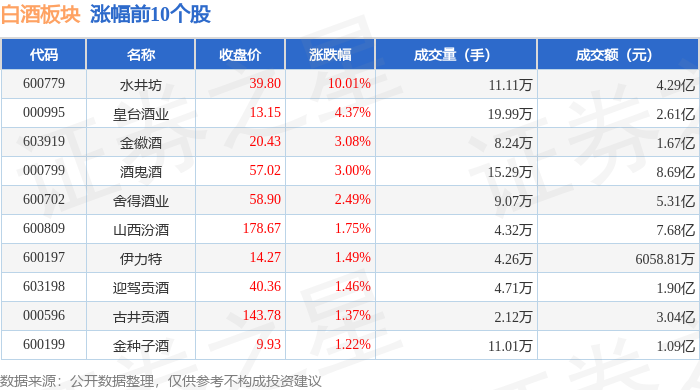
Core Viewpoint - The liquor sector experienced a rise of 1.13% on December 25, with Shui Jing Fang leading the gains, while the Shanghai Composite Index rose by 0.47% and the Shenzhen Component Index increased by 0.33% [1] Group 1: Liquor Sector Performance - Shui Jing Fang (600779) closed at 39.80, up 10.01% with a trading volume of 111,100 shares [1] - Other notable performers include Sanlong Jibei (000995) with a 4.37% increase, and Quan Wei Jiu (616809) rising by 3.08% [1] - The total net inflow of funds into the liquor sector was 874 million yuan, while retail investors saw a net outflow of 325 million yuan [1] Group 2: Fund Flow Analysis - Major net inflows were observed in Kweichow Moutai (600519) with 319 million yuan, accounting for 9.67% of the total [2] - Shui Jing Fang (600779) had a net inflow of 154 million yuan, representing 35.78% of its trading volume [2] - The retail investor net outflow for Shui Jing Fang was 93.49 million yuan, indicating a significant withdrawal from this stock [2]


海南封关开启,酒企南下“抢滩”
Xin Lang Cai Jing· 2025-12-25 08:24
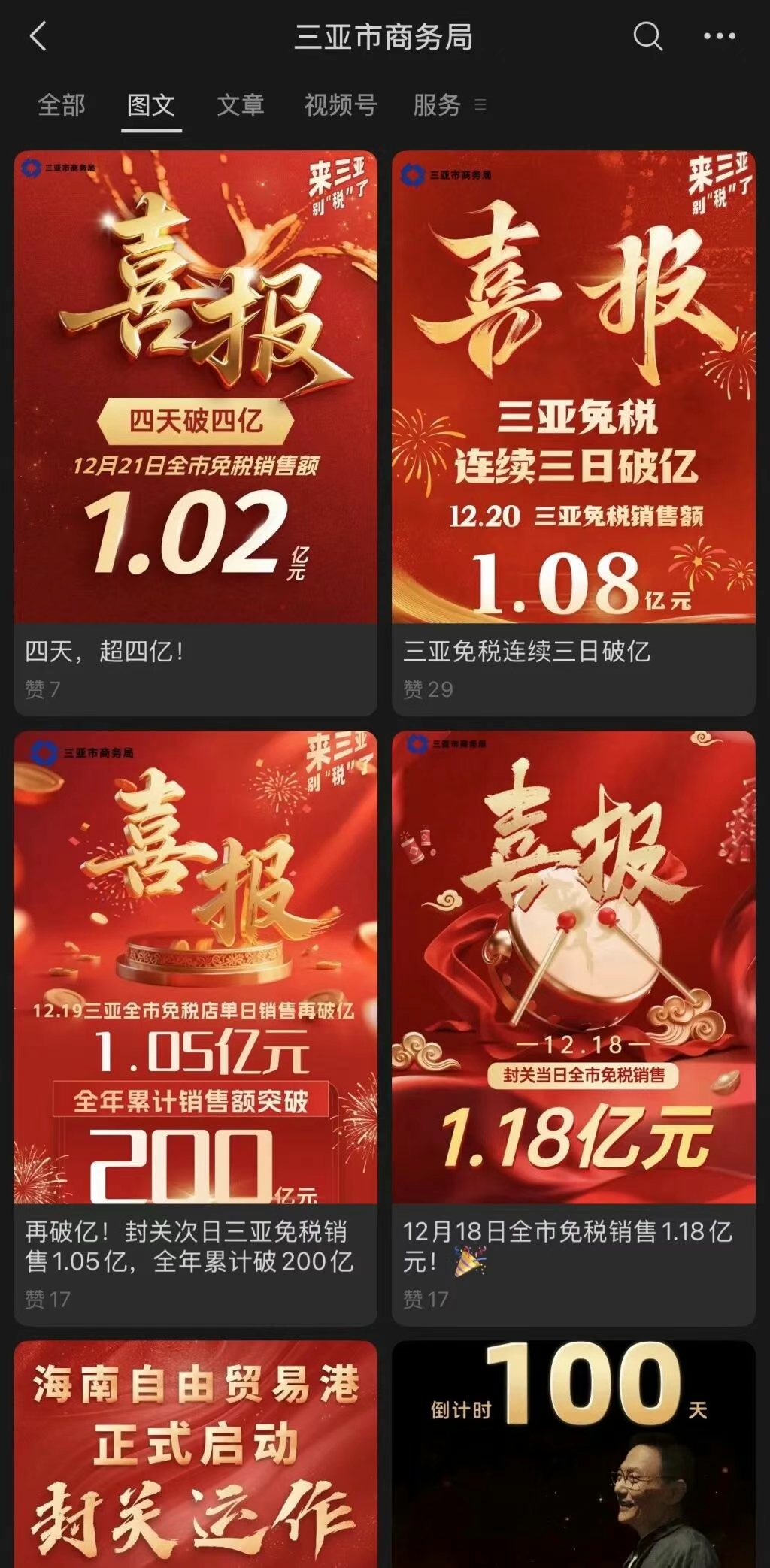
Core Viewpoint - The official launch of the Hainan Free Trade Port's full island closure operation on December 18 is expected to create significant policy advantages and institutional dividends for various industries, including the liquor industry, which is poised to leverage this opportunity for international expansion [1][4]. Group 1: Liquor Companies' Moves in Hainan - Major liquor companies such as Fenjiu, Wuliangye, and Langjiu have recently established operations in Hainan, indicating a trend of companies positioning themselves to capitalize on the new opportunities presented by the free trade port [4][5]. - The establishment of Fenjiu International Trade (Hainan) Co., Wuliangye's supply chain management company with a registered capital of 100 million yuan, and Langjiu's collaboration with Hainan Ecological Software Park exemplify proactive strategies by these companies [4][5]. - Other brands like Moutai and Luzhou Laojiao have also made significant investments in Hainan, with Moutai establishing a resort and Luzhou Laojiao setting up an international trade company [4][5]. Group 2: Supply Chain and Trade Dynamics - Hainan's closure policy is designed to enhance trade efficiency by allowing easier access for foreign goods and capital while maintaining regulatory controls for goods entering mainland China [1][5]. - The policy encourages the consolidation of processing activities within Hainan, reducing costs and improving logistics efficiency for liquor companies [5][6]. - The port of Yangpu is highlighted as a key hub for integrating scattered processing stages, which can significantly lower operational costs for liquor exporters [5][6]. Group 3: Hainan as a New Trade Hub - Hainan is positioned to potentially divert some trade flows from Singapore, which has historically been a significant hub for Chinese liquor exports [6][7]. - The region's capabilities are expected to evolve into a composite function that combines the roles of both Singapore and Hong Kong, facilitating not only trade but also production and brand showcasing for liquor companies [8][9]. - The zero-tariff policy in Hainan is anticipated to lower production costs for liquor companies, enhancing their competitiveness in international markets [8][9]. Group 4: Policy and Market Implications - The dual benefits of policy empowerment and innovative pathways provided by Hainan's closure are seen as advantageous for the liquor industry, simplifying processes and enhancing efficiency [9][10]. - The establishment of a trade network connecting Hainan, Southeast Asia, and the global market is expected to accelerate the penetration of Chinese liquor into ASEAN countries [9][10]. - The new institutional framework and shorter pathways for liquor exports from Hainan are viewed as revitalizing the long-standing topic of liquor internationalization [10].
白酒股,午后走高
Di Yi Cai Jing Zi Xun· 2025-12-25 05:59
Core Viewpoint - The liquor stocks experienced a significant upward trend in the afternoon of December 25, with notable gains in several companies, indicating a positive market sentiment in the sector [1]. Group 1: Stock Performance - Shuijingfang (水井坊) reached the daily limit with a gain of 10.01%, trading at 39.80 [2] - Huangtai Liquor (皇台酒业) increased by 5.00%, with a current price of 13.23 [2] - Jiugui Liquor (酒鬼酒) rose by 3.92%, priced at 57.53 [2] - Jinhui Liquor (金徽酒) saw a 3.23% increase, trading at 20.46 [2] - Shede Liquor (舍得酒业) gained 2.59%, with a price of 58.96 [2]


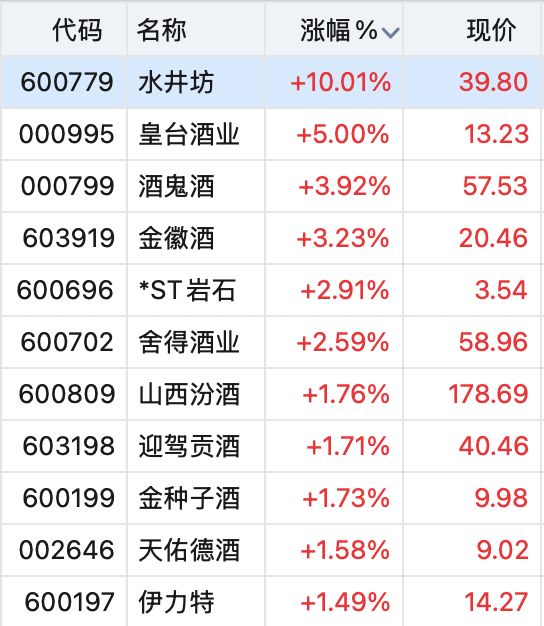
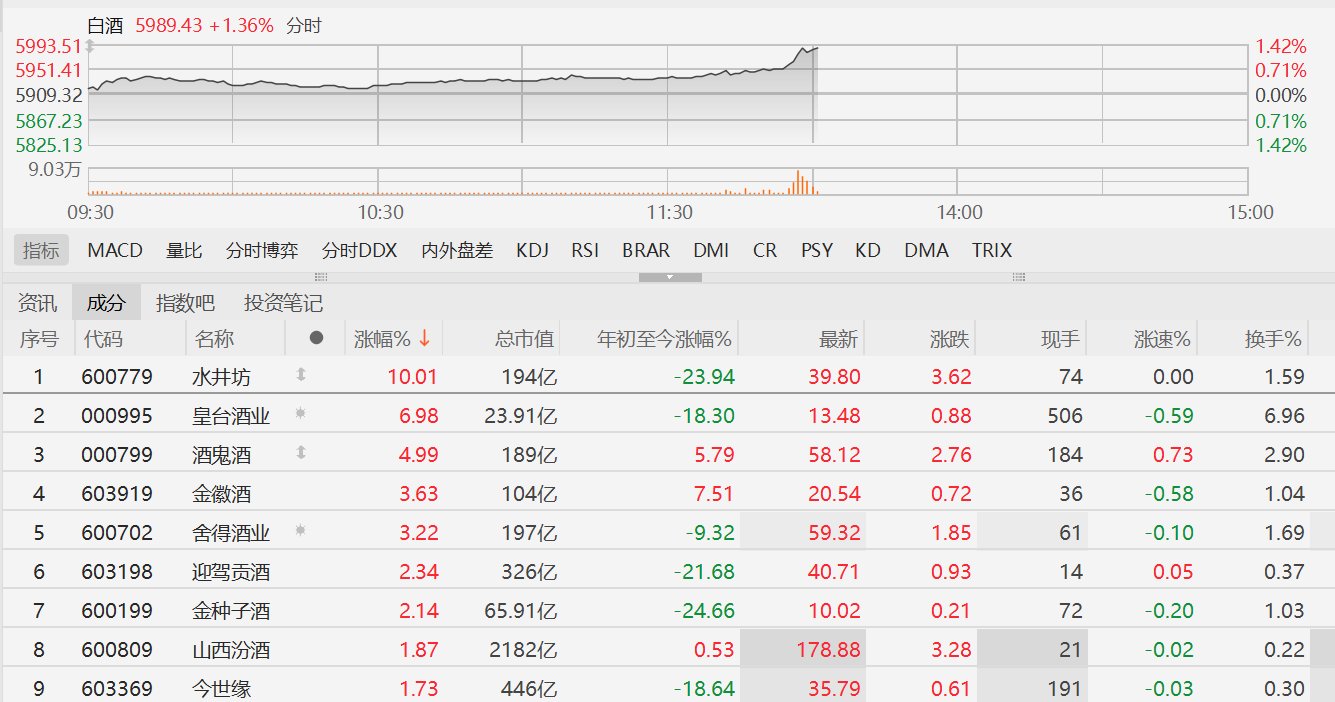
A股白酒股快速拉升,水井坊涨停
Ge Long Hui A P P· 2025-12-25 05:43
Group 1 - The A-share market saw a rapid increase in liquor stocks, with Shui Jing Fang hitting the daily limit, Huangtai Liquor rising over 6%, and Jiu Gui Jiu increasing nearly 5% [1] - Other notable performers included Jin Hui Jiu and She De Jiu Ye, both rising over 3% [1] Group 2 - The liquor index showed a gain of 1.36%, reaching 5989.43 points [2] - Shui Jing Fang had a significant increase of 10.01%, with a total market value of 194 billion [2] - Huangtai Liquor rose by 6.98%, with a market value of 23.91 billion [2] - Jiu Gui Jiu increased by 4.99%, with a market value of 189 million [2] - Jin Hui Jiu and She De Jiu Ye saw increases of 3.63% and 3.22%, respectively, with market values of 104 billion and 197 billion [2]