协鑫科技

Search documents
涨幅达12%!光伏硅片环节四巨头联合提价,释放了哪些信号?(附概念股)
Zhi Tong Cai Jing· 2025-12-25 23:48
Core Viewpoint - The solar photovoltaic industry is experiencing significant price increases for silicon wafers, driven by rising upstream silicon material costs and supply constraints, indicating a potential recovery in profitability for wafer manufacturers [1][2][3]. Group 1: Price Increases - Four leading silicon wafer companies have collectively raised prices, with 183N wafers priced at 1.4 yuan per piece, 210RN at 1.5 yuan, and 210N at 1.7 yuan, averaging a 12% increase [1]. - The average price increase for various silicon wafer models ranges from 3.3% to 9.8% this week, with expectations of further price hikes due to low shipping willingness among manufacturers [1][2]. Group 2: Cost Structure and Market Dynamics - The price of polysilicon, a key raw material for wafer production, has risen above 65,000 yuan per ton, reflecting over a 20% increase from previous transaction prices, significantly impacting wafer production costs [2]. - Polysilicon accounts for 48% of the production cost of silicon wafers, making it a critical factor in pricing and profitability for wafer manufacturers [2]. Group 3: Industry Trends and Policy Support - The solar industry is undergoing a "de-involution" process, with major polysilicon companies voluntarily reducing production, leading to a 29.6% year-on-year decline in output from January to October [2]. - A joint initiative by ten leading companies to establish a solar storage platform aims to stabilize prices and support the recovery of polysilicon and wafer prices through market-driven mechanisms [2][3]. Group 4: Company Insights - GCL-Poly Energy (03800) is highlighted for its competitive advantage in granular silicon and low energy consumption, with a target price of 1.54 HKD due to expected price increases [4]. - TCL Zhonghuan (002129.SZ), a leader in large-size wafers, is expected to benefit from price increases due to its strong price transmission capabilities [4]. - Jinyang New Energy (01121) is involved in upgrading production lines to enhance efficiency and competitiveness in the market [4].


涨幅达12%!光伏硅片环节四巨头联合提价 释放了哪些信号?(附概念股)
Zhi Tong Cai Jing· 2025-12-25 23:25
光伏产业链传来重磅消息。12月25日下午,市场消息称,四家头部硅片企业联合大幅上调报价,183N 硅片报1.4元/片、210RN报1.5元/片、210N报1.7元/片,平均涨幅达12%,有记者从多家硅片厂商人士已 证实该消息。业内普遍认为,上游硅料报价大幅上调(主流新单报价超6.5万元/吨)是本次涨价的核心驱 动力。 根据行业咨询机构InfoLink的数据,本周各型号硅片均价涨幅在3.3%—9.8%之间。该机构指出,在多数 硅片企业预期价格仍有进一步上调空间的情况下,现阶段发货意愿明显偏低,市场普遍采取控货策略。 整体而言,在自律议题持续延伸的情况下,短期内硅片价格不排除维持偏强走势。InfoLink数据暂未反 映12月25日的最新调价情况。 相关概念股: 协鑫科技(03800):12月,交银国际发布研报称,看好协鑫科技(03800)在颗粒硅盈利优势明显,低电耗 符合政策导向,行业"反内卷"推动多晶硅价格大涨,产能收储若能落地将推动价格进一步上涨,目标价 1.54港元。该行予内地新能源与公用事业行业领先评级,2025年在上半年政策推动一轮抢装后,该行预 期全年内地风/光的装机旺季将较往年温和,但维持全年装机总 ...
港股概念追踪 | 涨幅达12%!光伏硅片环节四巨头联合提价 释放了哪些信号?(附概念股)
智通财经网· 2025-12-25 23:23
光伏产业链传来重磅消息。12月25日下午,市场消息称,四家头部硅片企业联合大幅上调报价,183N 硅片报1.4元/片、210RN报1.5元/片、210N报1.7元/片,平均涨幅达12%,有记者从多家硅片厂商人士已 证实该消息。业内普遍认为,上游硅料报价大幅上调(主流新单报价超6.5万元/吨)是本次涨价的核心驱 动力。 根据行业咨询机构InfoLink的数据,本周各型号硅片均价涨幅在3.3%—9.8%之间。该机构指出,在多数 硅片企业预期价格仍有进一步上调空间的情况下,现阶段发货意愿明显偏低,市场普遍采取控货策略。 整体而言,在自律议题持续延伸的情况下,短期内硅片价格不排除维持偏强走势。InfoLink数据暂未反 映12月25日的最新调价情况。 此外,多晶硅作为硅片生产的核心原材料,其价格走向直接决定着硅片的生产成本。数据显示,当前多 数多晶硅企业已将新单报价上调至6.5万元/吨以上,较此前实际成交价涨幅超20%,尽管市场暂呈"有价 无市"的僵持状态,但硅料企业的挺价意愿极为强烈。从成本结构来看,硅料在硅片生产成本中的占比 高达48%,是影响硅片定价的最关键因素,上游原料价格的大幅波动直接牵动硅片企业的盈利空间 ...
硅片集体涨价12%,上游硅料驱动行业反转,龙头率先响应
Xuan Gu Bao· 2025-12-25 23:18
Group 1 - Major silicon wafer companies have significantly raised prices, with 183N wafers priced at 1.4 yuan/piece, 210RN at 1.5 yuan/piece, and 210N at 1.7 yuan/piece, averaging a 12% increase [1] - The price increase is primarily driven by substantial rises in upstream silicon material costs, indicating a potential recovery in profitability across the industry [1] - The establishment of a new company focused on multi-crystalline silicon capacity integration and mergers, backed by leading silicon material firms, aims to promote technological upgrades and optimize production capacity and costs [1] Group 2 - China Galaxy Securities highlights that the photovoltaic industry, as a key sector for "anti-involution," may see accelerated supply clearing due to policy support and technological advancements, with a potential industry turnaround by 2026 [2] - Guohai Securities notes that the newly formed silicon material storage platform is expected to enhance capital investment and establish reasonable pricing for multi-crystalline silicon, contributing to ongoing supply-side reforms and improved industry conditions [2] - The silicon material segment is anticipated to be the primary beneficiary of price increases, leading to early profitability improvements, while the battery and module sectors will gradually recover as price structures stabilize [2] Group 3 - Longi Green Energy, a leading company in the domestic photovoltaic industry, has raised silicon wafer prices in line with industry trends, leveraging its core advantages in high-efficiency battery technology [3] - JA Solar Technology operates as an integrated enterprise in the photovoltaic sector, focusing on the research, development, production, and sales of silicon wafers, batteries, and modules, as well as the development and operation of solar power plants [3]

光伏大变局:价格筑底 龙头盈利 跨界进退|2025中国经济年报
Hua Xia Shi Bao· 2025-12-25 02:25
Core Insights - The year 2025 marks a pivotal point for China's photovoltaic (PV) industry, transitioning from chaotic competition to rational collaboration, as stated by Wang Bohua, honorary chairman of the China Photovoltaic Industry Association [2] - The fixed electricity price era has ended, leading to a new market-oriented phase for the PV sector, with significant changes in pricing and production dynamics [2] Group 1: Market Dynamics - The price of polysilicon has rebounded, with futures prices soaring from over 30,000 yuan/ton to above 60,000 yuan/ton, nearly doubling [3] - Major upstream companies like Daqo Energy and Tongwei have reported profitability in Q3, indicating a recovery in the industry [3] - The profitability of 31 key companies in the PV main industry chain has improved, with Q3 losses narrowing to 64.22 billion yuan, a reduction of approximately 46.7% from Q2 [4] Group 2: Sector Challenges - Despite improvements, the industry still faces supply-demand imbalances, particularly in the equipment sector, where many leading companies reported declines in revenue and net profit [5] - The inverter sector shows a mixed performance, with some companies experiencing profit growth while others face declining profits [5] - The auxiliary materials sector is under pressure, with leading companies in quartz crucibles and glass reporting significant losses [5] Group 3: Industry Restructuring - The PV industry is witnessing a dual trend of cross-industry expansion and exits, with companies like Longi Green Energy entering the energy storage market [6] - Several companies have exited the PV sector through asset sales and project terminations, indicating a consolidation trend [6] - The restructuring signals are strengthening, with companies like Jingang Photovoltaic undergoing reorganization to focus on specific technologies [7] Group 4: Future Outlook - The competition in PV technology is entering a new phase, with BC technology products rapidly gaining market share, potentially reaching 100GW in production by next year [8] - The price of silicon is expected to regain its central role in the industry, with a projected recovery in silicon prices linked to upstream polysilicon prices [9] - The demand for auxiliary materials is anticipated to weaken further, but supportive policies may help stabilize the market [10]


光伏行业大会聚焦反内卷,特斯拉发布Optimus年度报告 | 投研报告
Zhong Guo Neng Yuan Wang· 2025-12-25 02:04
Core Viewpoint - The report highlights a significant slowdown in the growth of the photovoltaic (PV) industry in China for the first ten months of the year, with a notable decline in polysilicon production and a mixed performance in demand, indicating potential challenges ahead for the sector [1][2]. Manufacturing Sector Summary - Polysilicon production decreased by 29.6% year-on-year to 1.13 million tons - Wafer production fell by 6.7% year-on-year to 567 GW - Battery cell production increased by 9.8% year-on-year to 560 GW - Module production grew by 13.5% year-on-year to 514 GW [1][2][3]. Demand Sector Summary - The domestic PV installed capacity reached 252.87 GW, a year-on-year increase of 39.5% - From January to May, new installations totaled 198 GW, reflecting a 150% year-on-year growth - However, from June to October, new grid-connected installations saw a significant decline, dropping by 46.1% year-on-year [1][2]. Industry Developments - The 2025 China PV Industry Annual Conference focused on "anti-involution" strategies, aiming to address competitive pressures within the industry [1]. - The establishment of the polysilicon platform company, Guanghe Qiancheng, marks a significant step towards consolidating polysilicon production capacity, with major stakeholders including Tongwei Co., Ltd. holding a 30.35% share [3]. Future Outlook - The industry is expected to face a dual challenge of slowing new installations and a temporary supply-demand imbalance in the supply chain by 2026 - The "anti-involution" initiatives are anticipated to accelerate industry consolidation and reshape market dynamics [3]. Investment Recommendations - For the photovoltaic sector, it is advised to focus on leading companies such as Tongwei Co. and GCL-Poly Energy, as well as technology leaders in the BC technology space like LONGi Green Energy and Aiko Solar - In the robotics sector, attention is recommended for core companies with high supply chain certainty and significant value in the industry chain, including Topband, Sanhua Intelligent Controls, Zhaowei Electric, and Meihua Holdings [5].

港股市场2025年终盘点:IPO规模冠全球,多项指标创纪录
Sou Hu Cai Jing· 2025-12-25 01:44
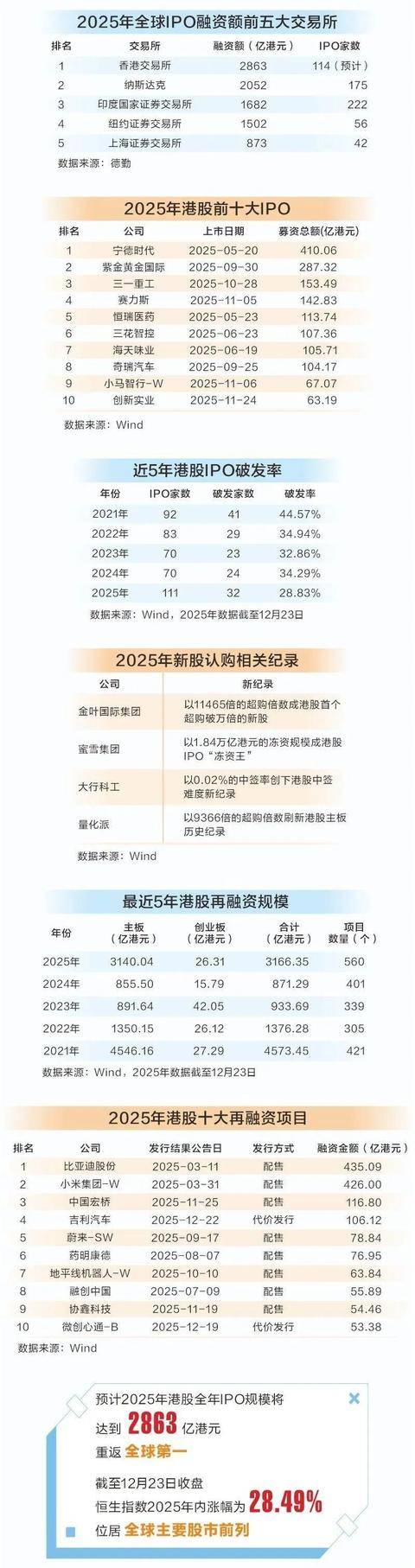
Core Viewpoint - The Hong Kong stock market is expected to fully recover in 2025 after experiencing a significant downturn from 2021 to 2024, with the Hang Seng Index dropping over 50% during that period. The market revival is driven by technological breakthroughs and a surge in IPO activities, establishing a solid foundation for a comprehensive rebound [1]. IPO Market Performance - In 2025, the Hong Kong Stock Exchange is projected to lead the global IPO market with a total financing amount of 286.3 billion HKD from approximately 114 IPOs [2]. - The top five exchanges for global IPO financing in 2025 are: Hong Kong Stock Exchange (286.3 billion HKD, 114 IPOs), Nasdaq (205.2 billion HKD, 175 IPOs), National Stock Exchange of India (168.2 billion HKD, 222 IPOs), New York Stock Exchange (150.2 billion HKD, 56 IPOs), and Shanghai Stock Exchange (87.3 billion HKD, 42 IPOs) [2]. - Eight companies in the top ten IPOs of 2025 raised over 10 billion HKD each, with notable contributions from companies like CATL and Zijin Mining [11]. IPO Quality and Market Sentiment - The IPO breakage rate in 2025 is reported at 28.83%, the lowest in five years, indicating a positive market sentiment and improved quality of IPOs [12]. - The new pricing mechanism implemented by the Hong Kong Stock Exchange has strengthened institutional investors' pricing power, contributing to the lower breakage rate [12]. Record-Breaking Subscription Metrics - The IPO market in Hong Kong has seen record-breaking subscription metrics, with companies like Jinye International Group achieving a subscription multiple of 11,465 times, setting a historical record [13]. - The "frozen capital" for the IPO of Mixue Group reached 1.84 trillion HKD, marking it as the "frozen capital king" in Hong Kong IPO history [13]. Secondary Financing Market - The total refinancing amount in Hong Kong for 2025 exceeded 316.6 billion HKD, surpassing the IPO scale and reaching a new high in project numbers with 560 projects [14]. - Major companies like BYD and Xiaomi led the top refinancing projects, raising significant amounts for business expansion and development [15]. Stock Market Performance - The Hang Seng Index recorded a year-to-date increase of 28.49%, ranking among the top global indices [16]. - Sectors such as innovative pharmaceuticals, non-ferrous metals, and semiconductors have shown significant growth, with stocks like Aijie Ankang experiencing a staggering increase of 950.95% [17]. Capital Inflows and Market Dynamics - Southbound capital inflows into the Hong Kong stock market reached a record high of approximately 1.41 trillion HKD in 2025, significantly enhancing market liquidity [18][19]. - The total buyback amount by listed companies in Hong Kong exceeded 175.9 billion HKD, indicating strong buyback enthusiasm amid market recovery [20][21]. Dividend Distribution - The total dividend distribution in the Hong Kong market for 2025 reached nearly 1.46 trillion HKD, surpassing the total for 2024 and reflecting a robust dividend environment [22]. Delisting Trends - The delisting process in Hong Kong accelerated in 2025, with 61 companies exiting the market, primarily due to privatization and forced delisting [23].
港股市场2025年终盘点:IPO规模冠全球 多项指标创纪录
证券时报· 2025-12-25 00:50
年终盘点。 2025年,是港股市场全面回暖的一年。回望2021年至2024年,港股市场堪称历经"寒冬",其间恒生指数一度下跌超50%,持续的"杀估 值"行情让市场悲观情绪蔓延。 经过2024年下半年的蓄势,"9·24"行情火爆启动,2025年初DeepSeek的横空出世更是瞬间激活了港股市场,让全球重新审视中国科技资 产的价值。这种由技术突破引发的产业景气预期,迅速传导至资本市场各环节,为港股的全面反攻奠定了坚实基础。这一轮反攻不仅推动港 股市场估值重构,更在IPO、再融资、二级市场、互联互通等多个维度创下历史纪录。 尤其是在香港交易所的交易大堂中,2025年以来锣声不断。香港交易所集团行政总裁陈翊庭评价称,2025年是全球投资者纷纷重返香港市 场的一年,中国内地和亚洲的创新发展为市场注入源源不绝的活力。一系列上市改革以及"科企专线"吸引了不少创新公司来港上市,互联互 通机制则继续为连接中国内地与国际资本市场发挥着独特的桥梁作用。 | 排名 | 交易所 | 融资额(亿港元) | IPO家数 | | --- | --- | --- | --- | | 1 | 香港交易所 | 2863 | 114(预计) | | ...

山西证券研究早观点-20251225
Shanxi Securities· 2025-12-25 00:22
Core Insights - The report highlights a price increase announced by a leading carbon fiber company, indicating a potential recovery in the industry's bottom line and overall market conditions [4][5] - The report emphasizes the growth potential in the label printing sector, particularly for Jiangtian Technology, which specializes in high-quality label printing services [6][7] Industry Summary Chemical Raw Materials - The new materials sector experienced a slight decline, with the new materials index down by 0.23%, although it outperformed the ChiNext index by 2.03% [4] - Key price movements in the amino acids and biodegradable materials were noted, with valine increasing by 4.98% to 13,700 CNY/ton, while other prices remained stable [4] Carbon Fiber Industry - The carbon fiber market is showing signs of recovery, with a significant increase in demand expected, particularly in wind power and aerospace applications. The actual consumption of carbon fiber in China is projected to reach 96,446 tons in 2025, a year-on-year increase of 71.89% [5] - Major companies like Toray and Jilin Chemical Fiber have announced price hikes for their carbon fiber products, indicating a strengthening market position for high-performance carbon fiber suppliers [5] Label Printing Sector - Jiangtian Technology is positioned as a leading service provider in the label printing industry, with a focus on non-dry adhesive labels used in various consumer sectors. The company has established stable partnerships with major brands like Unilever and Procter & Gamble [6] - The label printing market in China is expected to grow significantly, with a projected compound annual growth rate of 10.44% from 2023 to 2031, driven by rising disposable incomes and consumption upgrades [6][7] Solar Industry - The report notes stable pricing for polysilicon and an increase in silicon wafer prices, with the average price for 130um N-type silicon wafers rising by 5.9% to 1.25 CNY/piece [8] - Battery cell prices have also increased, with N-type battery cells seeing a 13.3% rise to 0.34 CNY/W, reflecting a tightening supply and increased production costs [9]
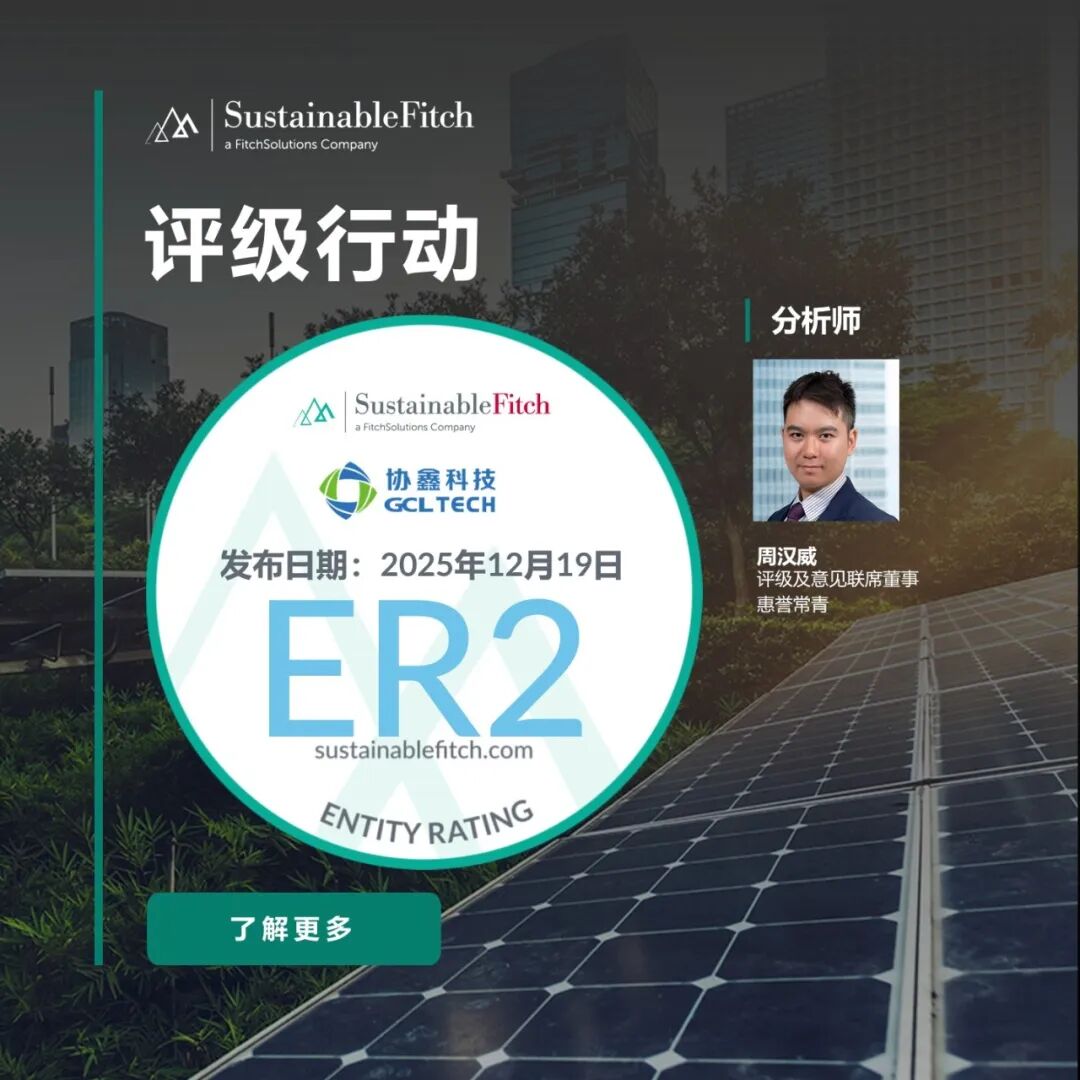
【惠誉常青】惠誉常青发布协鑫科技“2”的主体评级
Xin Lang Cai Jing· 2025-12-24 10:32
Core Viewpoint - Fitch Evergreen has assigned a "2" issuer rating to GCL-Poly Energy Holdings Limited (GCL-Poly), reflecting the company's environmental benefits in the solar materials sector, while noting an increase in absolute environmental metrics due to capacity expansion [2][8]. Group 1: Company Overview - GCL-Poly is a photovoltaic materials manufacturer operating 13 production bases in China and is listed on the Hong Kong Stock Exchange. The company primarily produces photovoltaic-grade polysilicon and wafers for downstream solar cell manufacturers. GCL-Poly's market share is projected to be 24% in the first half of 2025 [2][8]. Group 2: Environmental Impact - Fitch Evergreen believes that GCL-Poly's core business supports the expansion of solar power generation capacity, contributing to climate change mitigation. The company uses Fluidized Bed Reactor (FBR) technology to produce granular polysilicon, which has a lower "cradle-to-gate" carbon footprint compared to polysilicon produced by the Siemens process, thereby reducing the implicit carbon emissions of downstream solar components [2][8]. - GCL-Poly has established an environmental policy covering climate change and natural resource management at the group level, with all subsidiaries certified under ISO 14001:2015. The company discloses Scope 1 and Scope 2 greenhouse gas emissions and reports carbon intensity metrics for its main business lines. Despite an increase in absolute energy use and waste generation due to capacity expansion, carbon intensity has decreased year-on-year. The company aims to achieve Scope 1 and Scope 2 carbon neutrality by 2040 and value chain carbon neutrality by 2050 [2][8]. Group 3: Social and Governance Aspects - The social status of GCL-Poly is viewed neutrally. The company has established human rights and labor rights policies, along with an externally certified occupational safety management system, and has not reported any serious incidents in recent years. Customer satisfaction remains high. However, the gender ratio among employees and senior management is imbalanced, and the company has not disclosed gender pay gap metrics [3][9]. - The governance status of GCL-Poly is viewed positively. The company's financial statements have received unqualified audit opinions for the past three years. Risk management and internal audit functions are institutionalized. The overall independence and diversity of the board align with local listing company practices, though there remains a gap compared to international best practices [3][9].