通威股份

Search documents
工信部召开座谈会,强调以产能调控等手段破除光伏“内卷”
Di Yi Cai Jing· 2026-01-29 06:08
Core Viewpoint - The Chinese photovoltaic industry is undergoing a governance initiative to combat "involution" and promote rational competition, with the government emphasizing the need for coordinated efforts across various departments to address issues such as overcapacity, low-price competition, and quality control [1][3]. Group 1: Industry Governance and Regulation - The Ministry of Industry and Information Technology (MIIT) held a meeting on January 28, 2026, to discuss the "anti-involution" measures in the photovoltaic sector, highlighting the need for collaboration among departments to ensure a return to healthy competition [1]. - The MIIT aims to utilize market-oriented and legal methods to regulate the industry, including capacity control, standard setting, quality supervision, and intellectual property protection [1][3]. - The government has initiated multiple actions since the second half of 2025 to address the chaotic state of the photovoltaic industry, including a meeting on August 19, 2025, to emphasize capacity regulation and support industry self-discipline [3]. Group 2: Industry Performance and Financial Impact - The domestic photovoltaic manufacturing output value surged from 750 billion yuan in 2021 to 1.75 trillion yuan in 2023, with expectations to maintain over 1 trillion yuan in 2024 [1]. - However, the industry faces significant challenges, including a supply-demand mismatch and severe low-price competition, leading to widespread losses since the fourth quarter of 2023 [2]. - Major companies like Longi Green Energy, JinkoSolar, and Tongwei Co. are projected to incur substantial losses in 2025, with estimates ranging from 60 billion to 100 billion yuan [2]. Group 3: Quality and Compliance Issues - The photovoltaic industry has seen a decline in product quality, with the overall qualification rate of photovoltaic modules dropping from 100% in 2019 to 62.9% in 2024, indicating that over one-third of products have quality issues [2]. - In 2025, nearly 16% of the components tested from 36 companies were found to be non-compliant, with significant issues related to mechanical load and power misrepresentation [2]. Group 4: Market Recovery and Profitability - The ongoing "anti-involution" efforts are beginning to show positive effects, with the profitability of the main photovoltaic industry chain improving in the first three quarters of 2025, despite a total loss of 310.39 billion yuan among 31 companies [4]. - The gross profit margin for the main industry chain reached 5.61% in the third quarter of 2025, an increase from 3.64% in the previous quarters [4]. - By November 2025, the average prices of polysilicon, silicon wafers, battery cells, and modules had increased by 38.9%, 2.2%, 0.4%, and 2.3%, respectively, compared to the beginning of the year [4].



中国电力:2025 年风光装机超预期;电力需求增长符合预期-China – Power-2025 More Wind and Solar Installation Than Expected; Power Demand Growth In-line
2026-01-29 02:42
Summary of Key Points from the Conference Call Industry Overview - The report focuses on the **China Power** sector, specifically highlighting the growth in **wind and solar energy installations** in 2025, which exceeded expectations [1][5]. Core Insights and Arguments - **Power Demand Growth**: - National power consumption increased by **5.0% year-over-year (yoy)** in 2025, aligning with the China Electricity Council's (CEC) projections [8]. - Power demand by sector showed varied growth: - Primary: **9.9%** - Secondary: **3.7%** - Tertiary: **8.2%** - Residential: **6.3%** - This represents a moderation compared to 2024's growth rates [2]. - **Power Generation Statistics**: - Total power generation rose by **2.2% yoy** to **9,716 billion kWh** in 2025. - Solar and wind power generation increased significantly, with solar up **24.4%** and wind up **9.7%**, contributing **17%** of total generation (up from **14%** in 2024) [3]. - Thermal generation decreased by **1.0% yoy** to **6,295 billion kWh**, while hydro and nuclear generation rose by **2.8%** and **7.7%** respectively [3]. - **Capacity Additions**: - China added **543 GW** of power capacity in 2025, marking a **26.5% yoy** increase. This included: - **315 GW** of solar (up **13.7%**) - **119 GW** of wind (up **50.4%**) - **95 GW** of thermal, which accelerated from previous years [4]. - By the end of 2025, total installed power capacity reached **3,891 GW**, with solar and wind comprising **47.3%** of this total [4]. - **Sector-Specific Drivers**: - The major drivers for tertiary power consumption were identified as **electric vehicle (EV) charging** and **software & IT services**, which grew by **48.8%** and **17.0% yoy** respectively [8]. Additional Important Insights - The report indicates that the growth in renewable energy installations was higher than previously forecasted, with cumulative solar and wind capacity reaching **1,202 GW** and **640 GW** respectively by the end of 2025 [8]. - The thermal power installation for 2025 was below the CEC's forecast of **106 GW**, indicating a potential area of concern for future thermal energy investments [8]. This summary encapsulates the key findings and insights from the conference call regarding the state of the power sector in China, particularly focusing on the growth of renewable energy sources and the overall demand for power.
研判2026!中国光伏储能行业政策、产业链、装机规模、产值、市场规模、企业布局情况及发展趋势:未来十年光伏储能市场规模有望迎来爆发式增长[图]
Chan Ye Xin Xi Wang· 2026-01-29 01:28
Core Viewpoint - The photovoltaic energy storage industry is experiencing rapid growth, with significant advancements in technology and market potential, projected to become a core sector in the new energy revolution over the next decade [1][2]. Industry Definition and Classification - Photovoltaic energy storage systems combine solar power generation with storage technology, enhancing energy efficiency and grid stability [2]. - The main components include photovoltaic arrays, storage devices, inverters, and control systems [2]. Current Development Status - The supply of core hardware for photovoltaic energy storage systems is now capable of large-scale production, with a compound annual growth rate of 51.25% in industry output value from 2020 to 2024 [2][3]. - By the end of 2024, the cumulative installed capacity of photovoltaic energy storage projects in China is expected to reach 15.55 GW/36.60 GWh, with new installations of 7.31 GW/18.42 GWh [3]. Market Size and Fluctuations - The market size for photovoltaic energy storage in China is projected to grow from 22.30 billion yuan in 2020 to 115.68 billion yuan in 2024, indicating significant volatility influenced by installation numbers and system price changes [4]. Industry Chain - The upstream of the photovoltaic energy storage industry includes key materials like polysilicon and silicon wafers, while the midstream consists of system integrators responsible for design and assembly [4][6]. Policy Environment - Various policies have been introduced to promote the development of new energy storage technologies, including support for virtual power plants and smart microgrids [6]. Competitive Landscape - As of the end of 2025, there are 10,357 manufacturing enterprises in the photovoltaic energy storage sector in China, with 1,813 new companies added in 2025 [8]. - Major players in the industry include Trina Solar, Canadian Solar, and JinkoSolar, with a trend towards vertical integration in production [8]. Development Trends - The integration of photovoltaic and storage technologies is leading to optimized energy utilization and system stability [9]. - Accelerated technological advancements are evident, with breakthroughs in high-efficiency batteries and new storage technologies like sodium-ion and flow batteries [9]. - The market mechanisms are maturing, allowing energy storage to participate as an independent market entity [10]. - The industry is witnessing increased concentration, with leading companies expanding their market share through mergers and acquisitions [11]. - Chinese companies are actively expanding into international markets, enhancing their global influence in the photovoltaic energy storage sector [12].





光伏行业月报:全年新增装机超300GW,关注太空光伏商业化进展
Zhongyuan Securities· 2026-01-28 13:25
Investment Rating - The report maintains an "Outperform" rating for the power equipment and new energy sector [1] Core Insights - The photovoltaic industry index rebounded strongly in January, influenced by space photovoltaic themes, with an increase of 15.65%, significantly outperforming the CSI 300 index, which had a return of -0.26% during the same period [3][10] - The total newly installed photovoltaic capacity exceeded 300GW in 2025, with a year-on-year growth of 13.67% [4][20] - The cancellation of the export VAT rebate for photovoltaic products is expected to accelerate the exit of high-cost production capacity [7][19] - The rise in silver prices has significantly increased the production costs of photovoltaic cells, leading to price hikes in battery and component prices [7][40] Industry Performance Review - The photovoltaic industry index showed a strong performance in January, with a daily average transaction amount of 89.662 billion yuan, a significant increase compared to previous months [10] - All sub-sectors within the photovoltaic industry experienced growth, with conductive silver paste and photovoltaic equipment leading the gains [13] - Notable stock performances included companies like Aotewi, Dike, and Maiwei, which saw substantial increases in their stock prices [16][18] Industry and Company Dynamics - The cancellation of the export VAT rebate for photovoltaic products is set to take effect on April 1, 2026, which may lead to accelerated exports before the policy change [7][19] - SpaceX plans to build 200GW of photovoltaic capacity in the U.S. over the next three years, primarily for powering satellites and data centers [19] - The domestic photovoltaic market saw a total export volume of approximately 246.2GW in 2025, with a slight decrease in December [22] Key Segment Data - In December 2025, the newly installed photovoltaic capacity reached 40.18GW, a month-on-month increase of 82.47%, although it showed a year-on-year decline of 43.30% [20] - The average price of polysilicon increased to 54 yuan/kg, reflecting a slight upward trend in the market [39] - The price of N-type solar cells has significantly increased, with prices reaching 0.42 yuan/W, driven by rising silver prices [40][43] New Technology Iteration and Commercialization Progress - A new solid-state molecular imprint annealing strategy has been proposed to enhance the stability of perovskite solar cells, achieving efficiencies of up to 26.6% in small devices [53] - The launch of the world's first rollable photovoltaic curtains at CES 2026 represents a significant technological breakthrough in flexible photovoltaic products [53]
光伏行业月报:全年新增装机超300GW,关注太空光伏商业化进展-20260128
Zhongyuan Securities· 2026-01-28 12:40
Investment Rating - The report maintains an "Outperform" rating for the power equipment and new energy sector [1] Core Insights - The photovoltaic industry index rebounded strongly in January, influenced by space photovoltaic themes, with an increase of 15.65%, significantly outperforming the CSI 300 index, which had a return of -0.26% during the same period [3][10] - The total newly installed photovoltaic capacity exceeded 300GW in 2025, with a year-on-year growth of 13.67% [4][20] - The cancellation of the export VAT rebate for photovoltaic products is expected to accelerate the exit of high-cost production capacity [7][19] - The rise in silver prices has significantly increased the production costs of photovoltaic cells, leading to price hikes in battery and component prices [7][40] Industry Performance Review - The photovoltaic industry index showed a strong performance in January, with a daily average transaction amount of 89.662 billion yuan, a significant increase compared to previous months [10] - All sub-sectors within the photovoltaic industry experienced growth, with conductive silver paste and photovoltaic equipment leading the gains [13] - Notable stock performances included companies like Aotewi, Dike Co., and Jun Da Co., which saw substantial increases in their stock prices [16][18] Industry and Company Dynamics - The cancellation of the export VAT rebate for photovoltaic products is set to take effect on April 1, 2026, which may lead to accelerated exports before the policy change [7][19] - SpaceX plans to build a significant amount of photovoltaic capacity for space satellites and data centers, aiming for 200GW within three years [19] - The domestic photovoltaic market saw a total of 315.07GW of new installations in 2025, with December alone contributing 40.18GW, marking an 82.47% month-on-month increase [20][22] Key Segment Data - The domestic photovoltaic market is experiencing a supply-side contraction, with a reduction in production capacity for polysilicon and silicon wafers due to seasonal demand fluctuations [33][35] - The average price of polysilicon has slightly increased to 54 yuan per kilogram, while N-type solar cell prices have risen significantly due to increased production costs [39][40] - The price of photovoltaic glass has shown a downward trend, reflecting weak demand and increased inventory levels [43]
马斯克的“太空光伏梦”,离不开中国供应链
3 6 Ke· 2026-01-28 11:06
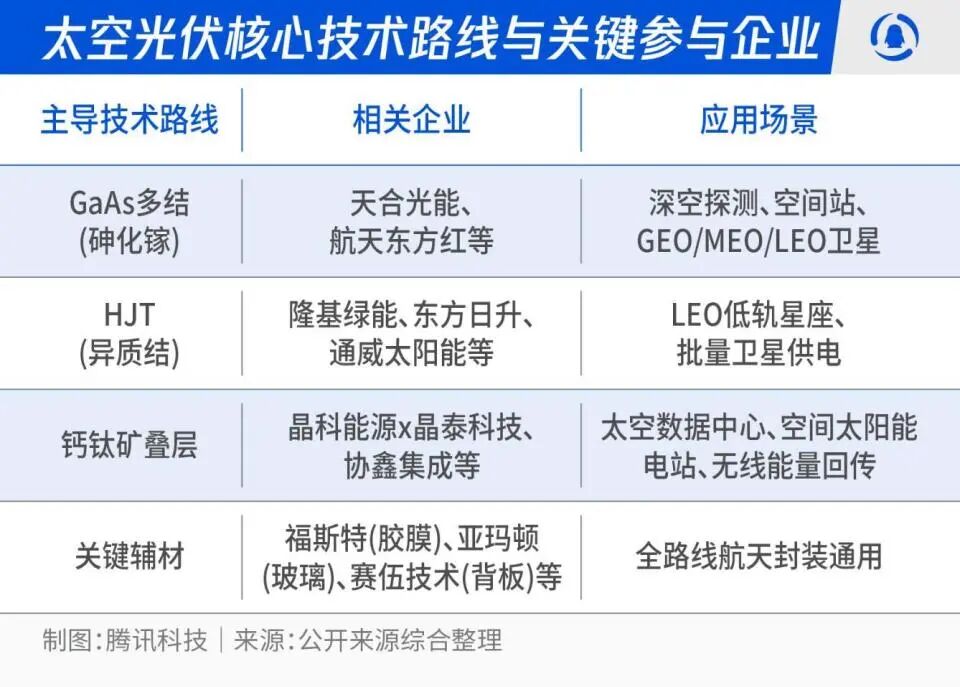
Core Viewpoint - The emergence of "space photovoltaics" is reshaping the value proposition for Chinese solar companies, positioning them as essential players in Elon Musk's space energy vision [1][4]. Group 1: Market Dynamics - The recent surge in the A-share market for solar stocks is driven by Musk's announcement at the Davos Forum about SpaceX and Tesla's plan to establish a solar production base with an annual capacity of 200GW, which is projected to meet nearly a quarter of the U.S. electricity demand [1][3]. - The excitement in the capital market is not merely speculative; it reflects a structural shift in the global energy landscape, with China having a significant role due to its established solar manufacturing capabilities [4][6]. Group 2: Industry Challenges and Opportunities - The solar industry has faced significant challenges over the past two years, including overcapacity and price wars, leading to widespread losses among companies, with projected losses totaling around 400 billion yuan [7]. - Musk's focus on space photovoltaics offers a new growth narrative for the industry, potentially alleviating some of the pressures from the current overcapacity situation [7][8]. Group 3: Technological Advancements - The global space photovoltaic market is expected to reach between $500 billion and $1 trillion by 2030, driven by the removal of traditional constraints faced by ground-based solar [3]. - The technology roadmap for space photovoltaics is anticipated to evolve through three phases, starting with GaAs cells for high-value applications, followed by HJT technology for low Earth orbit satellites, and eventually transitioning to perovskite tandem cells for large-scale deployments [9][10]. Group 4: Chinese Supply Chain Advantage - Chinese companies dominate over 70% of the global solar manufacturing supply chain, making them indispensable for any large-scale space photovoltaic initiatives, regardless of where the production is localized [5][11]. - The integration of space photovoltaics into China's existing energy infrastructure and policy frameworks positions the country favorably for future developments in this sector [5][12]. Group 5: Competitive Landscape - Various companies are exploring different technological pathways in the space photovoltaic sector, with some focusing on efficiency breakthroughs and others leveraging existing aerospace supply chain experience [11][12]. - The competition in space photovoltaics will involve not only technological advancements but also the ability to meet stringent aerospace certification requirements, which can create significant barriers to entry for new players [11][12].



安泰科:本周多晶硅报价松动难引成交 供需弱平衡持续巩固
智通财经网· 2026-01-28 06:01
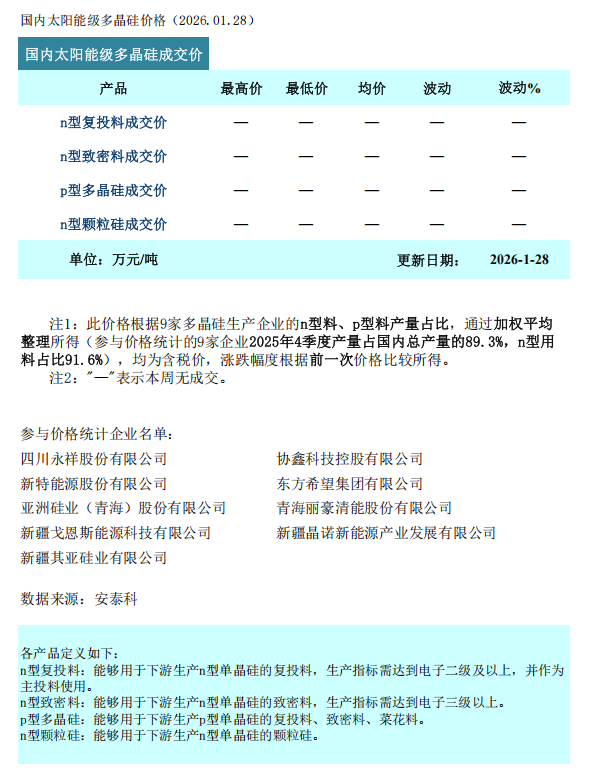
Group 1 - The core viewpoint of the articles indicates that the polysilicon market is currently in a stalemate, with almost no significant transactions occurring this week due to prevailing market sentiment and low purchasing willingness from downstream buyers [1][2] - The demand side is constrained by high prices of key auxiliary materials like silver paste, which keeps battery production costs elevated, and insufficient overseas orders for modules, leading to a lack of purchasing intent [1][2] - On the supply side, major companies have significantly reduced or halted production, which has led to a continuous contraction in polysilicon supply, somewhat alleviating supply-demand conflicts and reducing the willingness of companies to lower prices [1][2] Group 2 - As of this week, one major company has completely halted production, and two others have implemented production cuts, resulting in an expected 15% month-on-month decrease in polysilicon output for January, aligning with the production schedules of silicon wafer companies [1] - The production plan for February indicates a further reduction in polysilicon output to 82,000 to 85,000 tons, continuing the trend of supply contraction [1] - The upcoming Chinese New Year and the traditional off-season in the first quarter are expected to weaken domestic terminal demand and overseas module orders, while high prices of auxiliary materials will maintain cost pressures on battery cells [2]
银河期货每日早盘观察-20260128
Yin He Qi Huo· 2026-01-28 04:34
银河期货研究所 2026 年 1 月 28 日 0 / 49 期 货 眼 ·日 迹 每日早盘观察 研究所 期货眼·日迹 | 股指期货:压力有所减轻 4 | | --- | | 国债期货:股债跷跷板 5 | | 蛋白粕:供应仍有压力 | 盘面走势偏强 6 | | --- | --- | | 白糖:外盘走势现分歧,郑糖底部震荡 6 | | | 油脂板块:油脂有所分化 7 | | | 玉米/玉米淀粉:北港现货稳定,盘面偏弱震荡 8 | | | 生猪:出栏压力增加 | 现货震荡运行 9 | | 花生:花生现货稳定,花生盘面底部震荡 10 | | | 鸡蛋:临近节前备货,蛋价有所上涨 10 | | | 苹果:节前走货尚可,苹果价格坚挺 11 | | | 棉花-棉纱:整体变化不大 | 棉价有所支撑 12 | | 钢材:需求边际转弱,钢价延续震荡 14 | | --- | | 双焦:基本面乏善可陈,关注资金扰动 14 | | 铁矿:终端需求低位,矿价震荡运行 15 | | 铁合金:估值偏低存在修复需求,短期震荡偏强 16 | | 金银:特朗普"暗示"弱美元,金银维持强势 17 | | --- | | 铂钯:美元信任危机 贵 ...
A股超500家公司年报预亏
Xin Lang Cai Jing· 2026-01-28 04:02
Group 1 - A significant number of A-share companies are reporting losses, with over 500 companies expected to post losses for 2025, reflecting a shift in the market where loss-making companies are disclosing their financials earlier than usual [1][3][22] - The real estate and construction sectors are particularly affected, with companies like Huaxia Happiness expected to report losses between 16 billion to 24 billion yuan, making it the "loss king" [4][24] - The overall performance of A-share companies is under pressure, with 709 out of 1165 companies reporting declining performance, which is approximately 60% [1][22] Group 2 - The trend of loss-making companies disclosing their financials is seen as a sign of market rationalization, with companies aiming to manage expectations and release financial pressures [2][21] - The solar energy sector is facing significant challenges, with leading companies like Tongwei Co. and Longi Green Energy expected to report substantial losses due to overcapacity and price competition [6][24] - The real estate sector is also experiencing widespread losses, with over 30 A-share real estate companies reporting poor performance, and only a few showing positive results [7][25] Group 3 - Companies like Zhichun Technology and Siyuanjie are facing severe stock price declines following their loss announcements, indicating investor reactions to poor financial forecasts [12][30] - The overall market sentiment is expected to be negatively impacted in the short term due to the concentration of negative financial disclosures, but this could lead to improved market pricing efficiency in the long run [15][32] - The performance of A-share companies is anticipated to show a "total pressure, structural brilliance" pattern, with traditional industries like real estate and solar energy under significant strain [16][33][34]






A股超500家公司年报预亏
第一财经· 2026-01-28 04:01
2026.01. 28 本文字数:2709,阅读时长大约4.5分钟 作者 | 第一财经 周楠 当前正值上市公司年报预告披露期,不同于以往的绩优股抢先发布业绩,今年财报季里,一批亏损公司正在 密集"交卷"。 1 月 26 日 晚 间 , 百 余 家 A 股 公 司 披 露 了 2025 年 业 绩 预 告 , 多 家 亏 损 公 司 在 列 。 其 中 , 大 禹 生 物 (920970.BJ)、ST英飞拓(002528.SZ)等续亏;二六三(002467.SZ)、恒基达鑫(002492.SZ)等首 亏。 另据Wind统计,截至1月26日,共计1165家A股公司已披露2025年业绩预告,业绩下滑的有709家,占比约 六成,当期预计亏损的有500多家。从行业来看,预亏幅度较大的企业扎堆房地产、建筑行业,涉及华夏幸 福(600340.SH)、绿地控股(600606.SH)等。华夏幸福预计去年亏损160亿元至240亿元,暂时成为"亏 损王"。 一些业绩"滑坡"的公司,遭遇投资者"用脚投票"。至纯科技(603690.SH)预计去年亏损3亿元至4.5亿元, 或出现上市以来的首次归母净利润亏损,消息披露后公司股票一度跌停。 ...