
中石油

Search documents
科网股分化,快手涨超11%,汽车股下挫,蔚来跌近6%
2 1 Shi Ji Jing Ji Bao Dao· 2026-01-05 09:28
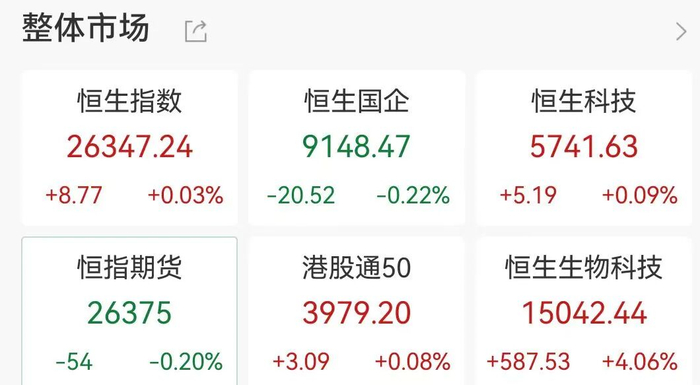
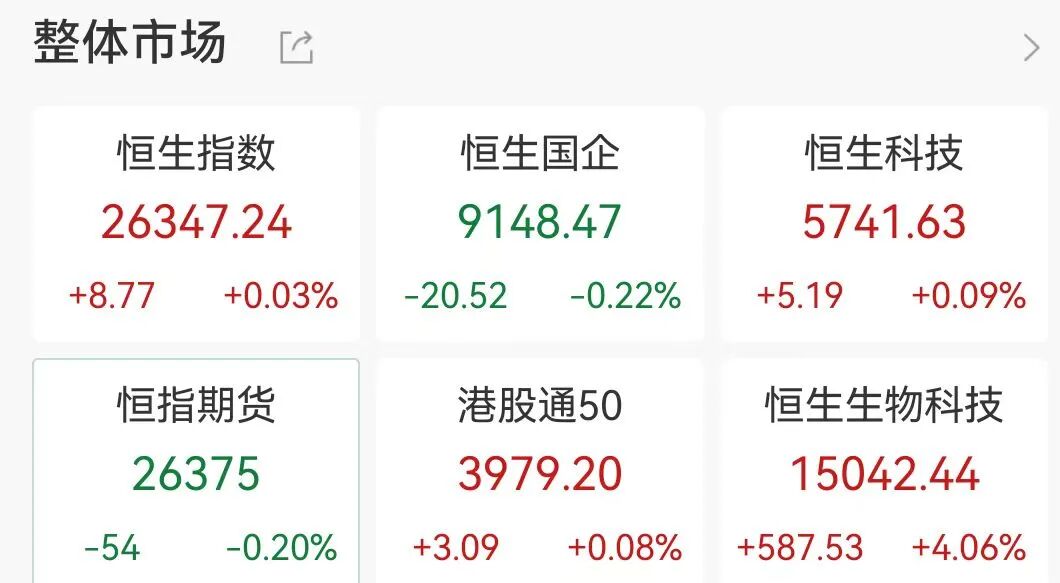
Market Overview - The Hong Kong stock market showed a narrow fluctuation today, with the Hang Seng Index slightly up by 0.03% to close at 26,347.24, while the Hang Seng China Enterprises Index fell by 0.22% to 9,148.47, and the Hang Seng Tech Index increased by 0.09% to 5,741.63 [1][2]. Technology Sector - The technology sector exhibited mixed performance, with Kuaishou rising over 11%, Bilibili increasing by over 4%, Alibaba up by over 2%, while NetEase and Xiaomi both dropped by over 2% [2]. Automotive Sector - The automotive stocks faced significant declines, with NIO down nearly 6%, XPeng Motors falling over 4%, and Li Auto dropping over 3%. Great Wall Motors also saw a decline of over 6% [4]. Biopharmaceutical Sector - The biopharmaceutical sector saw gains, with Rongchang Biopharmaceutical rising over 7%. The China Drug Evaluation Center (CDE) indicated that by December 31, 2025, 76 innovative drugs are expected to be approved, surpassing the 48 approved in 2024, marking a historical high [4]. Real Estate Sector - The real estate sector showed strength, with China Rongxin rising over 6% [5]. Brain-Computer Interface Sector - The brain-computer interface concept surged, with Nanjing Panda Electronics rising over 39%. Elon Musk announced that his company Neuralink plans to begin large-scale production of brain-computer interface devices in 2026 [5]. Oil Sector - The oil sector weakened, with PetroChina declining by over 3%. This follows reports of U.S. military actions against Venezuela, with plans for U.S. oil companies to invest billions in repairing Venezuela's oil infrastructure while maintaining an oil embargo [5].


科网股分化,快手涨超11%,汽车股下挫,蔚来跌近6%,小鹏跌超4%
2 1 Shi Ji Jing Ji Bao Dao· 2026-01-05 09:00
港股汽车股跌幅居前,蔚来跌近6%,小鹏汽车跌超4%、零跑汽车跌超3%,长城汽车(601633)跌超6%。 | 名称 | 现价 | 涨跌幅 -- | | --- | --- | --- | | 蔚来-SW | 38.860 | -5.95% | | 9866.HK | | | | 小鹏汽车-W | 76.650 | -4.60% | | 9868.HK | | | | 零跑汽车 | 47.880 | -3.39% | | 9863.HK | | | | 比亚迪股份 | 95.800 | -2.99% | | 1211.HK | | | | 长城汽车 | 14.190 | -6.15% | | 2333.HK | | | | 吉利汽车 | 17.600 | -3.30% | | 0175.HK | | | 生物医药股涨幅居前,荣昌生物涨超7%。2025年12月31日,CDE官网显示,荣昌生物维迪西妥单抗新适应症拟纳入突破性治疗品种。此外,1月3日晚 间,国家药监局官方微信公号发文称,2025年我国已批准上市的创新药达76个,大幅超过2024年全年48个,创历史新高。此外,2025年我国创新药对外 授权交易总金额超 ...
科网股分化,快手涨超11%,汽车股下挫,蔚来跌近6%,小鹏跌超4%
21世纪经济报道· 2026-01-05 08:55
| 名称 | 现价 | 涨跌幅 -- | | --- | --- | --- | | 快手-W | 73.600 | 11.09% | | 1024.HK | | | | 毕 哩 哔 里-W | 209.800 | 5.06% | | 9626.HK | | | | 华虹半导体 | 84.000 | 3.32% | | 1347.HK | | | | 京东健康 | 58.200 | 3.28% | | 6618.HK | | | | 阿里巴巴-W | 152.800 | 2.55% | | 9988.HK | | | | 阿里健康 | 5.320 | 2.11% | | 0241.HK | | | | 中芯国际 | 76.500 | 1.86% | | 0981.HK | | | | 金山软件 | 29.700 | 1.78% | | 3888 HK | | | 港股汽车股跌幅居前,蔚来跌近6%,小鹏汽车跌超4%、零跑汽车跌超3%,长城汽车跌超 6%。 | 名称 | 现价 | 涨跌幅 -- | | --- | --- | --- | | 蔚来-SW | 38.860 | -5.95% | | 9866.HK ...

收评:港股恒指涨0.03% 科指涨0.09% 石油股走弱 生物医药股走强 快手涨超11%
Xin Lang Cai Jing· 2026-01-05 08:13
Market Overview - The Hong Kong stock market showed mixed results, with the Hang Seng Index up 0.03% to 26,347.24 points, the Hang Seng Tech Index up 0.09%, and the State-Owned Enterprises Index down 0.22% [1][7] Technology Sector - Internet stocks had varied performances, with Kuaishou rising over 11%, Bilibili up over 4%, Alibaba increasing over 2%, while NetEase and Xiaomi fell over 2% [1][7] Biopharmaceutical Sector - Biopharmaceutical stocks led the gains, with Rongchang Biopharmaceutical rising over 7%. The CDE announced that Rongchang's new indication for Vidi Xi Tuo monoclonal antibody is set to be included as a breakthrough therapy [3][9] - In 2025, China approved 76 innovative drugs for market entry, significantly surpassing the 48 approved in 2024, marking a historical high. The total value of innovative drug licensing transactions exceeded $130 billion, with over 150 transactions, also a record [3][9] Real Estate Sector - Real estate stocks strengthened, with Ronxin China rising over 6%. A recent article in the Communist Party's publication "Qiushi" has raised investor hopes for a policy shift, suggesting a more substantial approach to real estate policy this year [3][11] - Morgan Stanley noted that the commentary indicates a potential change in the official stance towards the real estate market, with the next policy windows being the March "Two Sessions" and the April Politburo meeting [11] Brain-Computer Interface Sector - The brain-computer interface sector saw significant gains, with Nanjing Panda Electronics rising over 39%. Elon Musk announced that his company Neuralink plans to begin large-scale production of brain-computer interface devices in 2026 [4][11] - According to Precedence Research, the global brain-computer interface market is expected to grow to approximately $12.4 billion by 2034, with a CAGR of 17% from 2025 to 2034 [4][11] Oil Sector - Oil stocks weakened, with PetroChina falling over 3%. The U.S. has launched military actions against Venezuela, with President Trump stating that U.S. oil companies will invest billions to repair Venezuela's oil infrastructure while maintaining a complete oil embargo [6][12] Automotive Sector - Automotive stocks faced declines, with Great Wall Motors dropping over 6%. CICC reported that the domestic automotive industry may face challenges under continued policy conditions, while overseas sales remain stable [6][12] - The investment strategy suggests focusing on auto parts over complete vehicles, with attention to opportunities in robotics, smart driving, and AI-related developments [12]
港股午评:恒指跌0.08%,科指跌0.18%,创新药概念股普涨,脑机接口概念股大涨
Jin Rong Jie· 2026-01-05 04:29
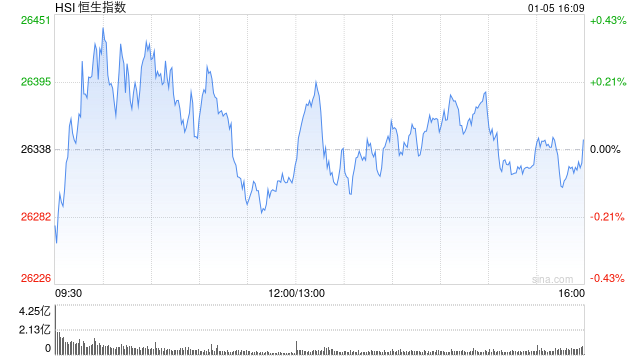
Market Overview - The Hang Seng Index closed down 0.08% at 26,316.55 points, while the Hang Seng Tech Index fell 0.18% to 5,726.11 points. The National Enterprises Index decreased by 0.19% to 9,151.59 points, and the Red Chip Index rose by 0.38% to 4,099.43 points [1] Technology Sector - Alibaba-W increased by 2.28%, Tencent Holdings rose by 0.08%, while JD Group-SW fell by 1.13%, Xiaomi Group-W dropped by 2.53%, NetEase-S decreased by 2.71%, Meituan-W fell by 0.19%, Kuaishou-W surged by 9.66%, and Bilibili-W rose by 5.56% [1] Biopharmaceutical Sector - The biopharmaceutical sector saw significant gains, with Fuhong Hanlin rising by 7%. The National Medical Products Administration announced that by 2025, 76 innovative drugs will be approved for market, significantly exceeding the 48 approved in 2024, marking a historical high. Additionally, the total amount of authorized transactions for innovative drugs will exceed $130 billion, with over 150 transactions, also a historical high [1] Real Estate Sector - Domestic real estate stocks strengthened, with Shimao Group rising over 9%. An article in "Qiushi" magazine emphasized the critical role of real estate in national economic development, advocating for proactive measures to stabilize market expectations and reduce adjustment times. It highlighted the need for consistent policy strength that aligns with market expectations, avoiding piecemeal approaches that could lead to market-policy conflicts [1] Brain-Computer Interface Sector - The brain-computer interface concept surged, with Nanjing Panda Electronics rising over 44%. Elon Musk announced that his company Neuralink plans to begin large-scale production of brain-computer interface devices in 2026, with a streamlined and automated surgical process. A key breakthrough involves electrodes passing through the dura mater without removal, potentially reducing the invasiveness of traditional devices and optimizing efficiency and costs through automation [2] Oil Sector - Oil stocks weakened, with PetroChina falling over 4%. The U.S. launched military actions against Venezuela, capturing President Maduro. Trump stated that U.S. oil companies would invest billions to repair Venezuela's damaged oil infrastructure, aiding in capacity recovery and revenue generation, while maintaining a complete oil embargo against Venezuela [2]
高硫稳定弱势,低硫供应回升
Yin He Qi Huo· 2025-12-31 03:19
高硫稳定弱势,低硫供应回升 研究员:吴晓蓉 期货从业证号:F03108405 投资咨询证号:Z0021537 目录 | 第一章 | 综合分析与交易策略 | 2 | | --- | --- | --- | | 第二章 | 核心逻辑分析 | 4 | | 第三章 | 周度数据追踪 | 9 | GALAXY FUTURES 1 227/82/4 228/210/172 181/181/181 87/87/87 文 字 色 基 础 色 辅 助 色 137/137/137 246/206/207 68/84/105 210/10/16 221/221/221 208/218/234 综合分析与交易策略 【综合分析】 低硫近端供应环比增长,各主要供应地区供应均有回升预期。Al-Zour炼厂一套CDU确定回归,另一套CDU及渣油脱硫装置预期于12 月底回归,低硫供应初步恢复。Dangote炼厂Dangote炼厂汽油装置检修计划启动,近端低硫出口已开始回升,新招标流出。南苏丹 接管赫格利格油田的主要安全控制权,能源供应预期逐步恢复,Senning1月新低硫原油招标发布。 高硫现货窗口现货贴水低位维持。高硫四季度预期稳定弱势维持 ...
摩尔的爆炒 | 谈股论金
水皮More· 2025-12-11 10:46
水皮杂谈 一家之言 兼听则明 偏听则暗 功败垂成 盘面消息 今天 摩尔线程再度暴涨,收盘报 941.08 元 /股 ,创全天最高价,涨幅达 28.04%,总市 值已升至 4423 亿元。相较于上市后556 元 /股 的最低价,当前股价近乎翻倍;若对比 114 元 /股 的发行价,涨幅更为惊人。 作为仍处于亏损状态的个股,摩尔线程为何能遭到爆炒?核心原因有三: 其一, 2025 年科技股炒作中涌现 "市标率" 新概念。所谓 " 市标率 " ,是将国内相关科技 股与美国同类标的对标,核心并非比较估值,而是 比较市值 , 所以出现了 "市标率" 这一概 念 。 既然寒武纪可与英伟达对标, 为什么 摩尔线程与寒武纪 不能做对比呢?所以,这实际 是 "市标率" 在国内同类股票之中的一个应用。 今天 寒武纪下跌 2.73%,收盘价 1382 元 /股 ,市值 5828 亿元,摩尔线程与寒武纪的市 值差距并非遥不可及,甚至存在超越可能。 其二,国产 GPU "四小龙" 相关标的上市进程持续推进。其中,沐曦股份预计下周上市,有 望吸引炒新资金聚焦;后续还有燧原科技、璧仞科技等公司排队上市,意味着相关概念题材的 炒作尚未进入尾 ...

还是女人钱好挣!林清轩卖“贵妇油”,毛利率直追茅台
Sou Hu Cai Jing· 2025-12-05 00:43
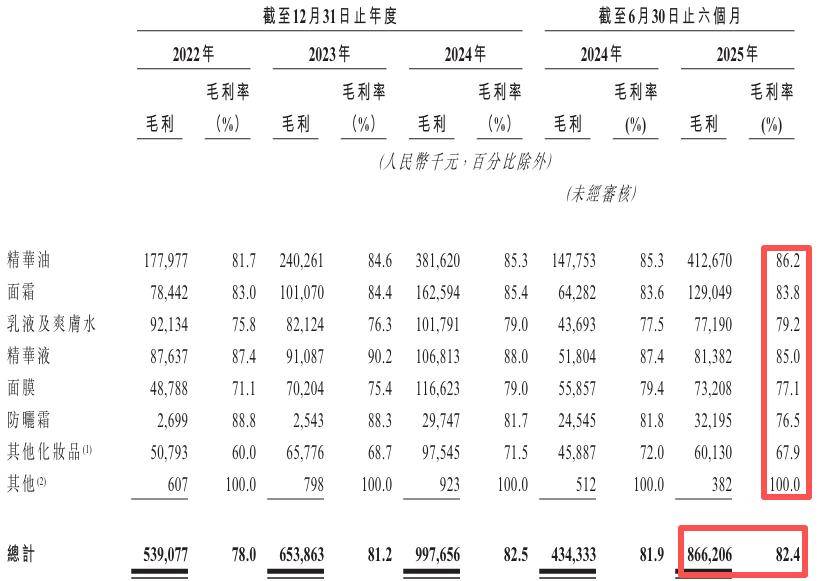
还是中国女人的钱好挣啊! 这不,"贵妇级护肤品",又又递交招股书了! 没错,此前招股书失效后,林清轩立马重新递表,更新了很多内容。 甚至,连公司名字都改了! 招股书显示,林清轩将此前的"生物科技"字眼,换成了"化妆品集团"。 除了名字变更外,林清轩还更新了财报数据。 好家伙,这"卖面油"的公司,简直比"卖石油"还赚钱。 毛利率更是高得离谱,超过一众白酒企业。 | | | | 截至12月31日止年度 | | | | | 截至6月30日止六個月 | | | | --- | --- | --- | --- | --- | --- | --- | --- | --- | --- | --- | | | 2022年 | | 2023年 | | 2024年 | | 2024年 | | 2025年 | | | | | 毛利率 | | 毛利率 | | 毛利率 | | 毛利率 | | 毛利率 | | | 毛利 | (%) | 毛利 | (%) | 毛利 | (%) | 毛利 | (%) | 毛利 | (%) | | | | | | | (人民幣千元,百分比除外) | | | | | | | | | | | | | | (未經審 ...
高硫稳定弱势,低硫供应较预期增长
Yin He Qi Huo· 2025-11-28 05:34
1. Report's Investment Rating for the Industry - There is no information provided regarding the report's industry investment rating. 2. Core Viewpoints of the Report - Low-sulfur fuel oil supply has increased more than expected, and attention should be paid to the impact of refinery device changes on supply. The low-sulfur supply gap disturbance has subsided, and the expected low-sulfur output has significantly increased. The low-sulfur winter power generation demand currently has no driving force [4]. - High-sulfur fuel oil is expected to remain stable and weak in the fourth quarter. Although Russian energy facilities have been attacked, the overall high-sulfur export volume has not been significantly affected. The near - term high - sulfur export from Mexico has significantly rebounded. The fuel feed demand has weakened month - on - month [4]. - For trading strategies, both high - and low - sulfur fuel oils are in a weak and volatile state. It is not recommended to go long for now. The low - sulfur cracking has weakened, and the high - sulfur cracking remains stable at a low level. It is advisable to take a wait - and - see approach for options [5]. 3. Summary by Relevant Catalogs 3.1 Comprehensive Analysis and Trading Strategies 3.1.1 Comprehensive Analysis - Low - sulfur fuel oil: Supply has increased more than expected. The resumption of oilfield operations and exports in South Sudan has eliminated the supply gap disturbance. Refinery device changes in various regions, such as the early and extended maintenance of Dangote refinery's RFCC device and the delay of primary processing device maintenance, are affecting supply. The low - sulfur winter power generation demand lacks driving force [4]. - High - sulfur fuel oil: It is expected to remain stable and weak in the fourth quarter. Russian high - sulfur exports are slightly affected by the attacks, and Mexican high - sulfur exports have rebounded. The fuel feed demand has weakened due to the expected early issuance of crude oil quotas in 2026 [4]. 3.1.2 Strategies - Unilateral trading: Both high - and low - sulfur fuel oils are in a weak and volatile state, and it is not recommended to go long [5]. - Arbitrage: Low - sulfur cracking has weakened, and high - sulfur cracking remains stable at a low level [5]. - Options: Take a wait - and - see approach [5]. 3.2 Core Logic Analysis 3.2.1 High - Sulfur Fuel Oil Supply - Russia: Energy facilities have been continuously attacked, but the overall high - sulfur export volume has not been significantly affected. Some refineries have been damaged, and the export volume has slightly decreased month - on - month. The EU is planning the 20th round of sanctions against Russia [8][9]. - Mexico: The near - term high - sulfur export has significantly rebounded. The Tula coking unit has been put into operation, and the Olmeca refinery has frequently adjusted its maintenance plan. The high - sulfur output is expected to gradually decrease [13]. - Middle East: The US sanctions against Iran continue. After the demand subsides, the high - sulfur export has increased. Iraq plans to supply more than 6 million tons of high - sulfur fuel oil from January to June 2026 [18][19]. 3.2.2 High - Sulfur Fuel Oil Demand - Feed demand: The expected early issuance of crude oil quotas in 2026 has weakened the high - sulfur feed demand. The actual logistics arrival volume has not increased significantly in the context of the fourth - quarter crude oil quota gap [23][24]. - Marine fuel demand: It provides stable support, and the marginal increase comes from the stable growth of the number of ships equipped with desulfurization towers [28]. - Power generation demand: It has completely subsided, especially in Egypt and Saudi Arabia [31]. 3.2.3 Low - Sulfur Fuel Oil Supply - Pan - Singapore region: The expected excess supply is gradually decreasing with the increase in RFCC device operation rates. The return of the Malaysian Rapid refinery's RFCC device has been delayed, and the Indonesian Balikpapan refinery is planning to expand its gasoline production [34][36]. - Sudan: The low - sulfur crude oil supply was briefly interrupted and then resumed. The low - sulfur crude oil has been redirected to the Pan - Singapore region [37][38]. - Nigeria: The low - sulfur export supply has increased more than expected. The Dangote refinery has adjusted its device maintenance plan, and the low - sulfur export is expected to increase significantly in December [39][41]. - Middle East: The return of the Al - Zour refinery's devices has been delayed, and there is still a short - term supply gap [42][44]. 3.2.4 Low - Sulfur Fuel Oil Demand - There is no specific driver. The marine fuel demand is stable, and the power generation economy is inferior to that of natural gas [45]. 3.2.5 China's Low - Sulfur Fuel Oil Market - The bonded low - sulfur export quota in the fourth quarter has tightened. The overall quota in 2025 has slightly decreased compared to 2024. The quota usage rate as of October is about 81%, and the remaining quota in the fourth quarter is expected to be tight but still sufficient [50]. 3.3 Weekly Data Tracking 3.3.1 Fuel Oil Spot - There are charts showing the price trends of Brent crude oil, HSFO380, LSFO, and their spreads with Brent crude oil [54][55][57]. 3.3.2 High - Sulfur Fuel Oil Cross - Region and Cross - Period Spreads - There are charts showing spreads such as ARA Brent Crack, Singapore high - sulfur M1 - M2, and HSFO380 spot discounts [60][61][63]. 3.3.3 Low - Sulfur Fuel Oil Cross - Region and Cross - Variety Spreads - There are charts showing spreads such as Singapore LSFO - GO, LSFO M1 - M2, and Singapore low - sulfur spot discounts [67][68]. 3.3.4 Natural Gas - Fuel Oil Price Ratio - The report provides data on the equal - calorific - value price ratio of various fuels, including Singapore 380, Singapore 180, Singapore 0.5%, JKM, GO10ppm ARA, and TTF [70][71]. 3.3.5 Cross - Region Freight Reference - There are charts showing freight rates from Russia to Singapore, Rotterdam to Singapore, etc. [73][74]. 3.3.6 Singapore Bunkering Spreads - There are charts showing spreads such as Singapore HSFO Exwharf - MOPS and Singapore LSFO Exwharf - MOPS [76][77]. 3.3.7 Fuel Oil Inventory Structure - There are charts showing the inventory trends of fuel oil in Singapore, ARA, Fujairah, Japan, and the US [79][80][81]. 3.3.8 Northwest Europe Inventory Structure - There are charts showing the inventory trends of gasoline, diesel, and refined oil in ARA [86][87]. 3.3.9 US Gulf Inventory Structure - There are charts showing the inventory trends of gasoline, diesel, Cushing crude oil, and commercial crude oil in the US [89][90].
恒指0.07%微涨VS恒生科技0.36%微跌:港股分化迷局,转机藏在哪?
Sou Hu Cai Jing· 2025-11-27 10:17
Core Viewpoint - The Hong Kong stock market is experiencing a divergence between traditional heavyweight stocks supporting the index and technology growth stocks facing pressure, reflecting a complex market environment influenced by the Federal Reserve's policies and the slowing economic recovery in mainland China [1][2]. Group 1: Market Performance - The Hang Seng Index rose slightly by 0.07% to close at 17,825.43 points, primarily driven by the financial and energy sectors, with financial stocks contributing nearly 60% of the index's gains [1]. - HSBC Holdings saw a 1.2% increase due to better-than-expected quarterly results, while PetroChina and CNOOC also posted gains of 0.8% and 1.5%, respectively [1]. - In contrast, the Hang Seng Tech Index fell by 0.36% to 3,852.19 points, indicating a collective downturn in technology stocks, with Tencent, SMIC, and Alibaba all experiencing declines [2]. Group 2: Investor Sentiment - The divergence in stock performance reflects a layered market risk appetite, with investors prioritizing defensive positions in low-valuation, high-dividend sectors like financials and energy [2]. - There has been a net inflow of 23 billion HKD into the financial sector through the Stock Connect program in November, while the technology sector saw a net outflow of 12 billion HKD [2]. Group 3: Key Variables Influencing Future Trends - The future trajectory of the Hong Kong stock market hinges on three critical variables: the direction of the Federal Reserve's monetary policy, the strength of the economic recovery in mainland China, and the performance of the technology sector [3][4]. - Market expectations suggest that if the Fed signals a rate cut in December, the Hang Seng Tech Index could rebound by 10%-15% [3]. - The performance of the mainland economy, particularly manufacturing PMI data, will directly impact core sectors like real estate and consumption [3]. Group 4: Investment Outlook - Despite the current market volatility, there is a consensus among institutions that the Hang Seng Index is undervalued, with a price-to-earnings ratio of 8.5, indicating a high margin of safety [5]. - Three main investment themes have emerged: defensive sectors like banking and energy, cyclical sectors benefiting from economic recovery, and leading companies in emerging technology fields such as AI and cloud computing [5].