
华泰柏瑞

Search documents
ETF业绩跟踪及资金流动周报-20260211
SINOLINK SECURITIES· 2026-02-11 02:39
Report Overview - The report is titled "ETF Performance Tracking and Fund Flow Weekly Report (2026.1.26 - 2026.1.30)" and was released on February 2, 2026 [1] Core Viewpoints - Overseas ETF funds showed a continuous return trend, with a net inflow of 2.055 billion yuan in the past week, which was lower than the previous week. Large - cap style targets such as CSI 300 and CSI A500 received significant capital inflows, and the electronics industry had the most concentrated capital inflow at the industry level. Overseas funds continued to be positive about the allocation of relevant ETFs, focusing on core assets at the industry level and being relatively balanced at the individual stock level [16] Key Points by Category 1. Broad - based ETFs Average Weekly Returns and Fund Flows - The report presents the average weekly returns and fund inflows/outflows of broad - based ETFs [1][2] Top 10 Funds with Inflows - Funds like LIELEAS NEASOOETF (fund code: 563360.OF) had a net inflow of 1.126 billion yuan, Tianhong CSI Science and Technology Innovation and Entrepreneurship 50 ETF (fund code: 159603.OF) had a net inflow of 928 million yuan, etc [4] Top 10 Funds with Outflows - E Fund CSI 300 ETF (fund code: 510310.OF) had a net outflow of 7.4857 billion yuan, Huatai - Peregrine CSI 300 ETF (fund code: 510300.OF) had a net outflow of 7.4319 billion yuan, etc [6] 2. Industry - themed, Smart Beta, and Hong Kong Stock Connect ETFs Average Weekly Returns and Fund Flows - It includes the average weekly returns and fund inflows/outflows of industry - themed, Smart Beta, and Hong Kong Stock Connect ETFs. For example, in the Smart Beta ETF, different categories such as cycle, green/ESG, etc., had different fund inflow/outflow situations [7][8] Hong Kong Stock Connect ETFs - The average weekly returns and fund inflows/outflows of Hong Kong Stock Connect ETFs in different categories like technology, finance, etc., are presented. For instance, the technology - themed Hong Kong Stock Connect ETF had a net inflow of 1.76 billion yuan [9][12] 3. Equity ETFs - The report provides statistics on the number, scale, and trading volume of equity ETFs, including different index - corresponding funds, their scale, scale proportion, trading volume, and trading volume proportion [13][14] 4. Overseas ETFs Weekly Fund Flows - Overseas ETF funds had a net inflow of 2.055 billion yuan in the past week. Large - cap style targets like CSI 300 and CSI A500 had significant capital inflows, with 1.562 billion yuan and 1.51 billion yuan respectively. The electronics industry had the most concentrated capital inflow of 384 million yuan [16][23] Individual Stock Capital Inflows - Among individual stocks, Kweichow Moutai had the largest capital inflow of 65 million yuan, followed by Contemporary Amperex Technology Co., Limited with 44 million yuan [16][17]
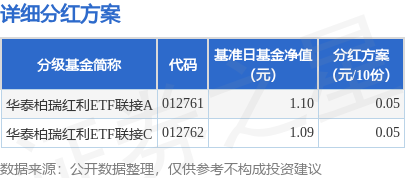
基金分红:华泰柏瑞红利ETF联接基金2月13日分红
Sou Hu Cai Jing· 2026-02-11 01:37
本次分红对象为权益登记日在本基金注册登记机构登记在册的本基金全体基金份额持有人,权益登记日 为2月12日,现金红利发放日为2月13日。选择现金红利再投资的投资者将其现金红利转基金份额的基金 份额净值确定日为:2026年2月12日,红利再投资所得份额的持有期限自份额确认日开始计算。选择现 金红利再投资方式的投资者其红利再投资的基金份额将于2026年2月13日直接计入其基金账户,2026年2 月24日起可以查询、赎回。根据财政部、国家税务总局的相关规定,基金向投资者分配的基金收益暂免 征收所得税。本次分红免收分红手续费;选择现金红利再投资方式的投资者其现金红利再投资的基金份 额免收申购费用。 以上内容为证券之星据公开信息整理,由AI算法生成(网信算备310104345710301240019号),不构成 投资建议。 证券之星消息,2月11日发布《华泰柏瑞上证红利交易型开放式指数证券投资基金联接基金分红公 告》。2026年度第二次分红。公告显示,本次分红的收益分配基准日为1月1日,详细分红方案如下: | 分级基金简称 代码 | 墓准日墓会净值 (元) | | 分红方案 (元/10份) | | | --- | --- ...

盘前资讯|影视主题ETF大涨 吸引超13亿元资金布局
Sou Hu Cai Jing· 2026-02-11 01:31
Group 1 - The AI application-related sectors experienced a significant surge on February 10, with the film ETFs (159855) hitting the daily limit and another film ETF (516620) rising over 9%, collectively attracting more than 1.3 billion yuan in net inflows [1] - In addition to film-themed ETFs, various other thematic ETFs, including those focused on gold, robotics, media, satellites, chemicals, and rare earths, also saw substantial capital allocation, while leading broad-based ETFs like the HuShen 300 ETF (510300) and the CSI 500 ETF (510500) experienced net outflows exceeding 1.4 billion yuan each [1] - The People's Bank of China released its monetary policy execution report for the fourth quarter of 2025, emphasizing the continuation of a moderately accommodative monetary policy aimed at stabilizing economic growth and ensuring reasonable price recovery, while carefully managing the implementation of policies based on domestic and international economic conditions [1]
2025登顶亚洲,中国ETF市场的“奇点之年”
2 1 Shi Ji Jing Ji Bao Dao· 2026-02-10 13:16
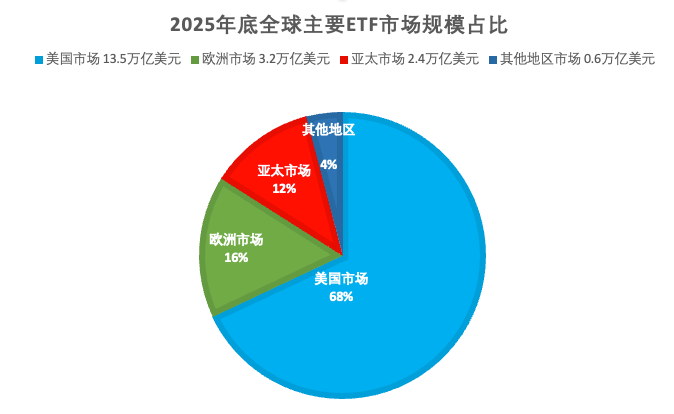
Core Insights - In 2025, China's ETF market reached a historic milestone, surpassing 6 trillion yuan, making it the largest in Asia, overtaking Japan [1][7][13] - The growth was driven by significant net inflows, particularly in bond ETFs, and a shift towards institutional investors dominating the market [2][12][28] Market Growth - By the end of 2025, the total size of the ETF market in China was 6.02 trillion yuan, with the Shanghai Stock Exchange (SSE) contributing approximately 4.22 trillion yuan and the Shenzhen Stock Exchange (SZSE) about 1.79 trillion yuan [1][8] - The SSE recorded a trading volume of 61 trillion yuan, ranking first in Asia and third globally, while the SZSE's trading volume grew by 189% to 23.17 trillion yuan [11][12] Investor Dynamics - The net inflow into the domestic ETF market exceeded 1.16 trillion yuan, with bond ETFs leading at 552.7 billion yuan [2][12] - Institutional ownership of ETFs increased significantly, with the SSE reaching 65% and the SZSE 58%, indicating a shift towards a more institutional-driven market [2][28] Product Innovation - The ETF market saw a transformation from broad-based products to more targeted offerings, including thematic ETFs focused on technology and innovation [15][16] - Bond ETFs experienced explosive growth, with their total size increasing from 173.9 billion yuan to 829 billion yuan, marking a 376% increase [18][20] Market Structure - By the end of 2025, the structure of the ETF market included 1,381 products, with stock ETFs making up 63.6% of the total size, followed by cross-border ETFs at 15.6% and bond ETFs at 13.8% [7][8] - The market's evolution reflects a growing demand for diversified investment strategies and a focus on long-term asset allocation [2][12] Regulatory and Institutional Framework - The regulatory environment has evolved to support the rapid growth of the ETF market, with new rules and mechanisms introduced to enhance liquidity and investor protection [29][30] - The market is transitioning towards a more institutionalized structure, with a focus on long-term capital and risk management [28][29] Future Outlook - The future of the ETF market in China is expected to focus on building a sustainable ecosystem that attracts long-term capital, emphasizing product innovation and regulatory balance [33]
景顺长城:麦高证券麦高金工团队
Mai Gao Zheng Quan· 2026-02-10 11:26
- The report introduces the **RSI (Relative Strength Index)** as a quantitative factor. The construction idea is to measure the relative strength of price movements over a specific period to identify overbought or oversold conditions. The formula is: $ RSI = 100 - \frac{100}{1 + RS} $, where $ RS $ is the ratio of the average gain to the average loss over a 12-day period. $ RSI > 70 $ indicates an overbought market, while $ RSI < 30 $ indicates an oversold market[2] - Another quantitative factor mentioned is **Net Subscription (NETBUY)**, which measures the net inflow or outflow of funds in ETFs. The formula is: $ NETBUY(T) = NAV(T) - NAV(T-1) \times (1 + R(T)) $, where $ NAV(T) $ is the net asset value on day $ T $, $ NAV(T-1) $ is the net asset value on the previous day, and $ R(T) $ is the return on day $ T $[2] - The report also highlights **Intraday Trend Analysis**, which uses 5-minute interval transaction prices to construct intraday price trends. Red dots mark the highest and lowest prices of the day. However, due to data limitations, some intraday data may be incomplete[2] - The **Institutional Holding Ratio** is another factor, calculated based on the latest annual or semi-annual reports of ETFs, excluding holdings by linked funds. The data is an estimate and may have deviations[3] - The report provides detailed tracking of various ETFs categorized into "broad-based" and "thematic" indices, such as CSI 300, CSI 500, and sector-specific indices like non-bank financials and dividends. These indices serve as benchmarks for ETF performance evaluation[2][4] - The report includes a comprehensive table of ETF performance metrics, such as RSI values, net subscription amounts, and institutional holding ratios, for various ETFs tracking indices like CSI 300, CSI 500, CSI 1000, and others. For example, the RSI for CSI 300 ETFs ranges from 50.04 to 54.02, while net subscription values vary significantly across ETFs[4] - The report also tracks thematic ETFs, such as those focused on semiconductors, artificial intelligence, and renewable energy, providing performance metrics like RSI, net subscription, and institutional holding ratios. For instance, the RSI for semiconductor ETFs ranges from 49.16 to 50.40, while net subscription values show significant variation[7]
港股通红利低波ETF华泰柏瑞(520890)涨0.67%,成交额4135.03万元
Xin Lang Cai Jing· 2026-02-09 07:09
Core Viewpoint - The Hong Kong Dividend Low Volatility ETF managed by Huatai-PB has experienced a decrease in both share count and total assets since the beginning of the year, indicating potential challenges in attracting investment [1][2]. Group 1: Fund Performance - The Hong Kong Dividend Low Volatility ETF (520890) closed at a 0.67% increase with a trading volume of 41.35 million yuan on February 9 [1]. - The fund's management fee is set at 0.50% annually, while the custody fee is 0.10% annually [1]. - As of February 6, the fund's latest share count was 83.08 million, with a total asset size of 126 million yuan, reflecting a 12.63% decrease in shares and a 7.15% decrease in total assets since December 31, 2025 [1]. Group 2: Liquidity and Trading Activity - Over the past 20 trading days, the cumulative trading amount for the fund reached 569 million yuan, with an average daily trading amount of 28.44 million yuan [1]. - Since the beginning of the year, the fund has recorded a cumulative trading amount of 714 million yuan over 26 trading days, averaging 27.45 million yuan per day [1]. Group 3: Fund Holdings - The current fund manager, Li Qian, has managed the fund since September 4, 2024, achieving a return of 49.36% during her tenure [2]. - Major holdings in the fund include Shougang Resources (3.77%), Yanzhou Coal Mining (2.70%), and Hang Seng Bank (2.63%), among others, with the total holdings reflecting a diversified portfolio [2].


节前资金接力进场!沪深300ETF华泰柏瑞(510300)、A500ETF华泰柏瑞(563360)连续2个交易日转为资金净流入
Xin Lang Cai Jing· 2026-02-09 05:46
Core Viewpoint - In early February, investors shifted from high-volatility growth sectors to more defensive sectors with stronger earnings certainty, leading to renewed interest in major broad-based indices like the CSI 300 and the CSI A500, which represent core Chinese assets [1][4]. Group 1: Fund Performance and Inflows - The CSI 300 ETF by Huatai-PB (510300) and the A500 ETF by Huatai-PB (563360) have seen net inflows of 2.209 billion yuan and 833 million yuan respectively over two consecutive trading days since February 5, 2026 [1][4]. - The CSI 300 ETF is one of the only equity ETFs in the market with net subscriptions exceeding 2 billion yuan during the same period [1][4]. - Despite increased counter-cyclical adjustments since the beginning of the year, broad-based ETFs are attracting capital due to favorable policies and enhanced market stability, indicating their long-term investment value [1][4]. Group 2: Cost Efficiency and Management - The annual management fee and custody fee for the CSI 300 ETF and A500 ETF are 0.15% and 0.05% respectively, making them among the lowest fee levels for equity index products in the A-share market, which may help investors capture long-term opportunities in core A-share assets at a low cost [2][5]. - As of the end of 2025, the CSI 300 ETF has generated a cumulative profit of 143.5 billion yuan for its holders, while the A500 ETF has achieved a profit of 4.642 billion yuan, with the former being the only equity fund in the A-share market to exceed 100 billion yuan in cumulative profits [6]. Group 3: Management Experience and Product Range - Huatai-PB, the fund manager for the CSI 300 ETF and A500 ETF, is one of the first ETF managers in China, with over 19 years of experience in managing dividend-themed index investments, creating a diverse range of products across the Shanghai, Hong Kong, and Shenzhen markets [3][6]. - The Huatai-PB Dividend ETF (510880) is the first dividend-themed index fund in the A-share market, having distributed a total of 5.18 billion yuan in dividends over its 19-year history [7].
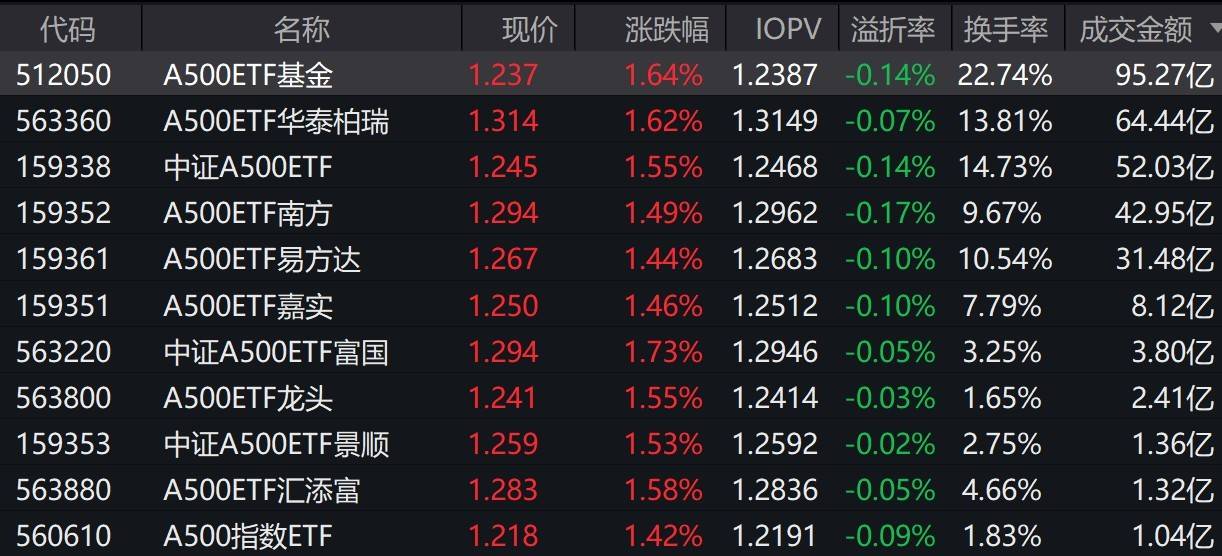
市场早盘高开高走,中证A500指数上涨1.63%,2只中证A500相关ETF成交额超64亿元
Sou Hu Cai Jing· 2026-02-09 03:59
Market Performance - The market opened higher with the Shanghai Composite Index rising over 1% and the CSI 500 Index increasing by 1.63% [1] - The photovoltaic sector experienced a significant surge, while computing hardware concepts collectively strengthened, and AI applications and the chemical sector showed active performance [1] - Conversely, oil and gas stocks exhibited weaker performance [1] ETF Trading Activity - Multiple ETFs tracking the CSI 500 Index saw gains of over 1%, with 11 ETFs having transaction volumes exceeding 100 million yuan, and 2 surpassing 6.4 billion yuan [1] - The A500 ETF Fund and A500 ETF Huatai Baichuan recorded transaction volumes of 9.527 billion yuan and 6.444 billion yuan, respectively [1] Market Sentiment and Outlook - Some brokerages indicated that external disturbances have not substantially impacted the fundamentals of Chinese industries, and the concentrated cooling operations have concluded [1] - Market sentiment has been fully released, and adjustments are considered adequate, suggesting that the A-share spring market rally may continue after the Spring Festival [1]
“巨无霸”缩水!宽基ETF开年大赎回 什么信号?
Sou Hu Cai Jing· 2026-02-09 00:49
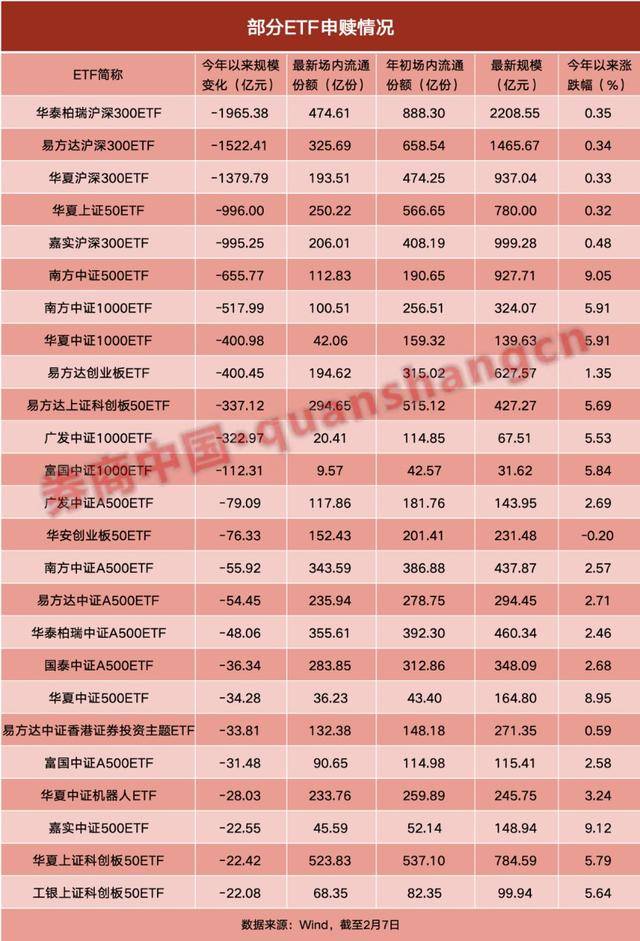
Core Viewpoint - The stock ETF market has experienced significant net outflows since the beginning of the year, with a total reduction of nearly 700 billion yuan in scale, primarily due to a decrease in shares rather than market declines [1][2][4] Group 1: ETF Market Overview - As of February 6, the total scale of stock ETFs is approximately 3.14 trillion yuan, down nearly 700 billion yuan since the beginning of the year [2] - There have been 17 trading days with net outflows out of 25 since the start of the year, with a peak single-day net outflow exceeding 130 billion yuan [2] - The largest contributors to the outflows include the Huatai-PB CSI 300 ETF, which saw a net outflow of 196.54 billion yuan, and both the E Fund and Huaxia CSI 300 ETFs, each with net outflows exceeding 100 billion yuan [3][4] Group 2: Specific ETF Performance - The Huatai-PB CSI 300 ETF's scale has dropped from 420 billion yuan to around 220 billion yuan, a decrease of over 50% [4] - The E Fund CSI 300 ETF has also seen a significant decline, with its scale dropping from over 300 billion yuan to 146.57 billion yuan [4] - The South China CSI 1000 ETF's shares decreased from 256.51 billion to 100.51 billion, marking a decline of 60.82% [4] Group 3: Market Sentiment and Future Outlook - Institutional investors are currently exhibiting a cautious risk preference, which is reflected in the outflows from broad-based ETFs despite positive average returns [6][7] - Analysts believe that the market is transitioning from liquidity-driven to earnings-driven dynamics, with a focus on performance validation in 2026 [8][9] - The outlook for 2026 remains optimistic, with expectations of continued growth in emerging industries and a resilient A-share and Hong Kong market [8][9]
资金加仓恒生科技等赛道宽基核心资产受关注
Zhong Guo Zheng Quan Bao· 2026-02-08 20:22
Group 1 - The consumer and photovoltaic sectors saw significant gains, with several related ETFs rising over 3% last week, while gold and artificial intelligence sectors experienced declines, with some ETFs dropping over 9% [1][2] - A-shares market showed active trading in broad-based products, with ETFs tracking the CSI 500 index exceeding a total trading volume of 250 billion yuan, and those tracking the Sci-Tech 50 index surpassing 30 billion yuan [1][2] - The market outlook for February suggests a continuation of the upward trend, driven by concentrated earnings forecasts and the recovery of leading companies' performance, benefiting core assets [1][4] Group 2 - The Hong Kong consumer sector performed strongly, with ETFs such as the Hang Seng Consumer ETF leading the gains, while the photovoltaic sector also showed positive performance [1] - The gold sector underperformed, with commodity gold ETFs declining over 5%, and gold stock ETFs experiencing even greater declines, with some dropping over 13% [2] - The technology sector attracted significant capital inflow, with the Hang Seng Technology ETFs seeing substantial net inflows, particularly the Huatai-PineBridge Hang Seng Technology ETF, which had a net inflow of over 3.8 billion yuan last week [2] Group 3 - The satellite communication sector also experienced notable capital inflow, with the Yongying National Commercial Satellite Communication Industry ETF seeing a net inflow of over 1.8 billion yuan [3] - Several ETFs, including the Huazhong Gold ETF and the Southern CSI Nonferrous Metals ETF, reported net inflows exceeding 10 billion yuan this year [3] - Investment firms are focusing on five key areas for the Chinese equity market by 2026: technology, manufacturing, renewable energy, healthcare, and emerging experiential consumption [3] Group 4 - The market is expected to stabilize in February, with a shift in focus from January's credit and liquidity performance to macro and industry clues [4] - The "14th Five-Year Plan" is anticipated to provide a clearer framework for high-quality development and new growth drivers, stabilizing market perceptions of future growth [4] - Core assets are recommended for continued attention, as their valuations are at historical median levels, with stable profit expectations and increasing foreign capital inflow [4]