
航天科技集团

Search documents
"太空光伏"狂欢: 万亿叙事焦虑与泡沫预警
2 1 Shi Ji Jing Ji Bao Dao· 2026-01-14 07:32
Core Viewpoint - The concept of "space photovoltaic" has gained renewed attention due to Elon Musk's ambitious plans for deploying solar energy satellites in space, aiming for significant advancements in solar energy capture and utilization [1][3][4] Industry Overview - Space photovoltaic technology has two levels: narrowly, it refers to solar components on spacecraft for self-powering; broadly, it involves deploying large solar arrays in space to transmit energy back to Earth [4][5] - The technology has historical applications dating back to the 1950s, with significant advancements in satellite energy supply [5][6] - Current market enthusiasm for space photovoltaic technology has shifted from traditional applications to a full-chain energy solution involving space power generation, wireless transmission, and ground reception [6][8] Market Dynamics - The surge in interest is driven by two main factors: the explosive growth of commercial space and the energy demands of AI computing centers [7][8] - The deployment of low Earth orbit satellites is creating a rigid energy demand, with projections indicating a market space of nearly 200 billion for solar wings if 10,000 satellites are launched annually [7] - The AI computing sector's energy needs are pushing infrastructure towards space, with potential market sizes reaching $500 billion if space data centers are deployed at scale [8][9] Competitive Landscape - The space photovoltaic sector is characterized by a competitive landscape where state-owned enterprises lead core space missions while private companies target commercial applications [9][10] - Major players in the domestic market include state-owned enterprises like the China Aerospace Science and Technology Corporation, which focus on high-end space equipment energy supply [9][10] - Private solar companies are entering the space photovoltaic market, aiming to capitalize on commercial space and AI energy needs [10][11] Technological Competition - The competition in space photovoltaic technology revolves around three main routes: gallium arsenide, crystalline silicon, and perovskite, each with its advantages and challenges [13][14] - Gallium arsenide is currently the dominant technology with high efficiency but faces cost challenges; crystalline silicon is cost-effective but has performance limitations in space; perovskite is seen as a potential long-term solution but requires stability improvements [13][14] Investment Sentiment - The capital market's enthusiasm for space photovoltaic technology is driven by narratives of vast market potential, with projections suggesting a market size of 295 billion by 2030 for low Earth orbit satellites [15][19] - The stock prices of companies involved in space photovoltaic have surged, reflecting speculative interest rather than fundamental performance [15][19] - The current market dynamics exhibit signs of a bubble, with stock price increases not aligned with actual revenue from space photovoltaic projects [19]

“太空光伏”狂欢:万亿叙事焦虑与泡沫预警
2 1 Shi Ji Jing Ji Bao Dao· 2026-01-13 11:22
Core Insights - Tesla CEO Elon Musk has ambitious plans for "space solar power," aiming to launch solar AI satellites to maximize solar energy utilization from space, with projections of 8,000 launches per year for deployment [1][2] - The concept of "space solar power" has gained significant attention in the Chinese A-share market, with predictions of a trillion-dollar market, despite the technology still facing commercialization challenges [2][3] Concept Clarification - "Space solar power" refers to two levels: narrowly, it involves solar components on spacecraft for self-power; broadly, it includes deploying large solar arrays in space to transmit energy to Earth [3][4] - The core advantage of space solar power is its ability to generate energy continuously without atmospheric interference, achieving 5-10 times the sunlight intensity compared to ground-based solar [4][5] Market Dynamics - The surge in interest is driven by the explosive growth of commercial space and the energy demands of AI computing centers, creating a rigid energy demand for low Earth orbit satellites [6][7] - The global market for space solar power is projected to reach approximately 29.5 billion RMB by 2030, ten times the current size, driven by the deployment of low Earth orbit satellites [6][7] Competitive Landscape - The space solar power sector is characterized by a competitive landscape where state-owned enterprises lead core space missions, while private companies target commercial applications [8][9] - Major Chinese solar companies like Trina Solar and LONGi Green Energy are advancing from technology development to engineering validation, with significant investments in various solar technologies [9][10] Technological Challenges - The current technology competition in space solar power revolves around three main routes: gallium arsenide, crystalline silicon, and perovskite, each with its advantages and limitations [12][13] - Gallium arsenide batteries are efficient but costly, while crystalline silicon is cheaper but less effective in space; perovskite is seen as a potential long-term solution but faces stability issues [12][13] Investment Sentiment - The capital market's enthusiasm for space solar power is fueled by narratives of vast market potential, with predictions suggesting a market size reaching trillions by 2030 [14][18] - However, the current excitement may be speculative, as many companies lack substantial revenue from space solar power, indicating a potential disconnect between stock prices and fundamental performance [18]
从深化提升行动“成绩单”看国企改革攻坚新成效
Xin Lang Cai Jing· 2026-01-10 02:59
Group 1 - The core viewpoint of the news is that the latest round of state-owned enterprise (SOE) reforms has significantly enhanced the core functions and competitiveness of these enterprises, with the main tasks of the reform action being largely completed [1] - The average annual growth of R&D expenditure for central enterprises has been 6.5% since the 14th Five-Year Plan, with R&D spending exceeding 1 trillion yuan for three consecutive years from 2022 to 2024, and basic research investment growing at an average rate of 19% [2] - The establishment of a modern enterprise system with Chinese characteristics is being continuously improved, with a more scientific and efficient operation of boards of directors and a deepening of market-oriented management mechanisms [3] Group 2 - The optimization of the state-owned asset structure is a key focus of the reform, aimed at accelerating the transformation of momentum and enhancing the strategic support role of the state-owned economy [4] - New central enterprises such as China Chang'an Automobile Group have been established, and 116 strategic reorganizations have been carried out to support pillar industries [4] - The China National Offshore Oil Corporation is advancing the development of strategic emerging industries, with revenue from these industries expected to exceed 15% by 2025 [4] Group 3 - The effectiveness of state-owned asset supervision is being continuously improved, with a focus on a matrix-style regulatory model that balances object and behavior supervision [6] - The integration of smart technology and penetrating supervision has become a trend in regulatory reforms, with platforms being developed to enhance oversight capabilities [7] - Despite the completion of the reform action, there is a commitment to continue deepening reforms and solidifying their outcomes [7]
公司问答丨科德数控:公司产品已在航天科工、航天科技集团项下数十家用户单位获得广泛应用
Ge Long Hui A P P· 2026-01-07 08:51
Core Viewpoint - The company is well-positioned to capitalize on the growth opportunities in the civil aerospace sector, leveraging its existing technology and customer base in the aerospace manufacturing field [1] Group 1: Company Capabilities - The company has a strong technical foundation in aerospace manufacturing, with products widely used across numerous user units under the Aerospace Science and Industry Corporation and the China Aerospace Science and Technology Corporation [1] - The company has participated in the manufacturing of various aerospace vehicles and their supporting systems, including launch vehicles and satellites [1] Group 2: Market Opportunities - The company is actively expanding its product and customer coverage in the civil aerospace sector, responding to the explosive growth in this market [1] - The company is committed to continuous research and development of more advanced CNC technologies and products to provide robust equipment support for the development of the aerospace industry [1]

科德数控(688305.SH):产品已在航天科工、航天科技集团项下数十家用户单位获得广泛应用
Ge Long Hui· 2026-01-07 07:40
Core Viewpoint - The company, Kede CNC (688305.SH), has a strong technical foundation in aerospace manufacturing and is expanding its product offerings and customer base in the civil aerospace sector [1] Group 1: Company Overview - Kede CNC has extensive technical expertise in the aerospace manufacturing field, with products widely used by numerous clients under the Aerospace Science and Industry Corporation and the China Aerospace Corporation [1] - The company has participated in the manufacturing of various aerospace vehicles and their supporting systems, including launch vehicles and satellites [1] Group 2: Industry Development - The company is actively expanding its product range and customer coverage in response to opportunities in the civil aerospace sector [1] - Continuous research and development of advanced CNC technologies and products are being pursued to provide robust equipment support for the development of the aerospace industry [1]
爱建电子深度报告:卫星通信加速进入发展元年
Shanghai Aijian Securities· 2026-01-05 09:46
Investment Rating - The report rates the electronic industry as "Outperform" compared to the market [1] Core Insights - Satellite communication is accelerating into a development year, complementing traditional networks and addressing the connectivity gap for over 2 billion people globally [2][21] - Low Earth Orbit (LEO) satellites are expected to play a crucial role in the future 6G non-terrestrial networks, enhancing global internet coverage [2][20] - The global satellite communication industry is entering a launch-intensive period, with significant investments and advancements expected in 2026 [23][24] Summary by Sections Industry Overview - As of 2025, 73.6% of the global population has internet access, leaving 26.4% offline, particularly in rural areas where traditional network expansion faces challenges [6][11] - The cost and technical difficulties of expanding high-speed infrastructure in rural areas hinder internet penetration, making satellite communication a viable alternative [2][11] Satellite Communication Development - The number of small satellite launches is projected to reach approximately 2,790 in 2024, indicating rapid growth in the sector [2] - The global government support for space initiatives has increased from $4.2 billion in 2014 to $13.5 billion in 2024, with China being a significant contributor [2] Market Dynamics - The satellite communication market is expected to grow significantly, with the global space industry revenue potentially exceeding $1 trillion by 2040, driven largely by satellite broadband [46][49] - The satellite service sector, including satellite TV, broadband, and fixed communication, is projected to dominate the market, with personal consumption accounting for a substantial share [52][57] Cost and Coverage Advantages - Satellite communication offers significant advantages over traditional cellular networks, including wide coverage and lower costs in sparsely populated areas [26][62] - The cost of deploying LEO satellites is decreasing due to advancements in manufacturing and launch technologies, making satellite communication more economically viable [34][36] Industry Chain - The satellite communication industry chain includes satellite manufacturing, launching, and ground equipment, with key players in each segment contributing to the overall ecosystem [79][80] - The development of satellite communication is critical, as limited frequency resources and orbital slots necessitate rapid deployment to secure these assets [84][87]
从0到1迈入黄金发展期:中国商业火箭产业链全景拆解
Hua Er Jie Jian Wen· 2026-01-05 08:34
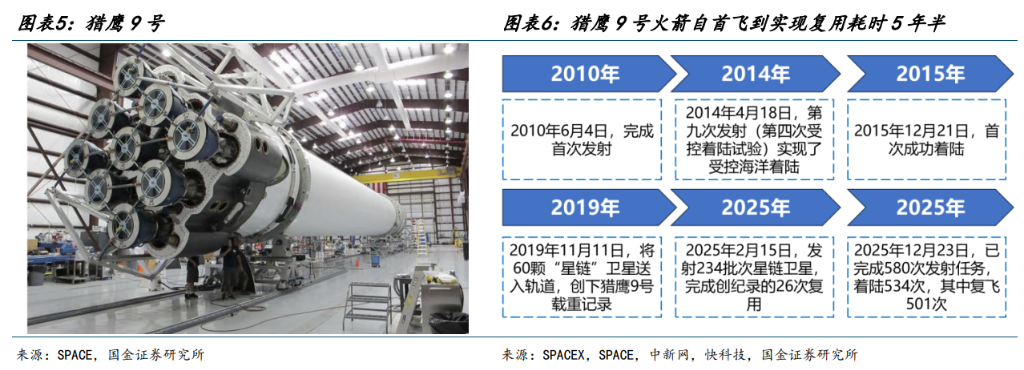
Core Insights - China's commercial space industry is at a critical turning point similar to SpaceX in 2015, with the recent test flights of Zhuque-3 and Long March 12A marking the transition of reusable rocket technology from experimental to engineering implementation [1][2] - The opening of the fifth set of standards for the Sci-Tech Innovation Board has cleared obstacles for IPOs of rocket companies, indicating a significant market opportunity driven by the rigid demand for satellite internet and the cost revolution brought by reusable technology [1][10][13] Market Opportunity - The satellite internet construction is expected to create a trillion-dollar market, driven by the rapid deployment of satellite constellations such as GW and G60, which plan to deploy up to 44,816 satellites [1][7][9] - The annual replacement demand for nearly 9,000 satellites will create a substantial capacity gap, further fueling the demand for commercial launches [1][7] Technological Development - Reusable rocket technology is identified as the key to breaking the cost bottleneck in space transportation, with China currently in a phase similar to SpaceX's early technical ramp-up [2][18] - The recent test flights of Zhuque-3 and Long March 12A, despite not achieving complete recovery, signify the start of a concentrated exploration period for reusable rockets in China [2] Cost Advantages - The cost advantages of high-frequency reuse are significant, as demonstrated by SpaceX's Falcon 9, which has achieved a marginal reuse cost of $15 million per launch, compared to the average cost of $110 million to $180 million for expendable rockets [5] - If China's commercial rockets can achieve similar breakthroughs, launch costs could be drastically reduced, supporting the large-scale deployment of satellite internet [5] Investment Focus - Analysts suggest that investment should focus on the most valuable segments of the supply chain, particularly engine manufacturing and rocket structure, which will benefit first from high consumption before reusable technology matures [1][18] - The core components of a typical liquid rocket, such as engines and structures, account for a significant portion of hardware costs, with the first-stage engine and structure comprising 77.8% of the total [14][18] Policy and Capital Market - The improvement of policy frameworks and the opening of capital market exit channels are accelerating the transition of commercial space from a storytelling phase to a performance-driven phase [10][17] - The new IPO guidelines for the Sci-Tech Innovation Board directly pave the way for leading commercial rocket companies like Blue Arrow Aerospace and Interstellar Glory [10][13]
成都华微:产品已应用于航天科技集团、航天科工集团等客户
Ge Long Hui· 2026-01-05 08:13
Core Viewpoint - Chengdu Huami (688709.SH) has signed a strategic cooperation agreement with Suiruan Technology to collaborate in the fields of large models and high-performance GPU technology [1] Group 1: Strategic Cooperation - The partnership aims to leverage high computing power for applications in model training, space computing, and edge inference [1] - The company emphasizes strict adherence to information disclosure regulations regarding business progress [1] Group 2: Product Applications - The company's products are already utilized by clients such as the Aerospace Science and Technology Group and the Aerospace Industry Group [1] - Core products including FPGA, ADC/DAC, and TSN have potential applications in the commercial aerospace industry chain [1] Group 3: Technical Development - The company’s team has been invited as core experts to participate in the formulation of the "Arrowborne Time-Sensitive Network (TSN) Technical Specifications" [1] - The company is committed to advancing TSN technology in high-end equipment and is focused on technology research and market expansion [1] - The company is closely monitoring trends in cutting-edge technology and customer demands to explore potential application scenarios and develop forward-looking strategies [1]
成都华微(688709.SH):产品已应用于航天科技集团、航天科工集团等客户
Ge Long Hui· 2026-01-05 07:51
Core Viewpoint - Chengdu Huami (688709.SH) has signed a strategic cooperation agreement with Suiruan Technology to collaborate in the fields of large models and high-performance GPU technology, which can be widely applied in model training, space computing, and edge inference [1] Group 1: Strategic Cooperation - The partnership with Suiruan Technology aims to leverage high computing power for various applications [1] - The company emphasizes strict adherence to information disclosure regulations regarding business progress [1] Group 2: Product Applications - The company's products have been applied in clients such as the Aerospace Science and Technology Group and the Aerospace Industry Group [1] - Core products including FPGA, ADC/DAC, and TSN have potential applications in the commercial aerospace industry chain [1] Group 3: Technical Development - The company is actively involved as core experts in the formulation of the "Arrowborne Time-Sensitive Network (TSN) Technical Specification" for commercial aerospace [1] - The company is committed to advancing technology research and market expansion while closely monitoring trends in cutting-edge technology and customer demands [1]
2025中国航天战报:全年92次发射创下新高,民营火箭亮出成绩单
Xin Lang Cai Jing· 2026-01-05 05:19
Core Insights - In 2025, global launch frequency reached 329 times, with China's share nearing 30%, indicating that approximately 1 in every 3 rockets launched globally originated from China [1] - China's total launches for the year amounted to 92, representing a 35.3% increase from 68 launches in 2024, with a high success rate of 97.8% [1] Launch Contributions - Multiple commercial rockets achieved significant launch results in 2025, contributing to the overall increase in launch volume [1] - Zhongke Aerospace's Lijian-1 completed 5 launches, placing 27 satellites into orbit with a total payload of about 6 tons, handling all external orders for commercial rockets [1] - Xinghe Power's Gushenxing-1 had 6 launches, successfully placing 27 satellites into orbit with a total payload of approximately 1 ton [1] - Blue Arrow Aerospace's improved Zhuque-2 had 2 launches, placing 6 satellites into orbit with nearly 1 ton of payload, while Zhuque-3 had its maiden flight without carrying any satellites [1] - Interstellar Glory's Hyperbola-1 completed 1 launch, placing 1 satellite into orbit with a payload of nearly 100 kilograms [1] - Dongfang Space's Gravitational-1 had 1 launch, successfully placing 3 satellites into orbit with a total payload of about 500 kilograms [1] Broader Achievements - Beyond rocket launches, China's aerospace sector made significant advancements in satellite constellation networking, commercial space investment and financing, rocket technology, and supporting infrastructure [1]