vivo

Search documents
8点1氪丨错版“马年茅台”二手价格被炒至2800元;vivo叫停AI眼镜项目;兰博基尼2025销量创历史新高,卖出10747辆
3 6 Ke· 2026-01-22 23:57
Group 1 - The "Year of the Horse" edition of Moutai has a printing error, leading to a surge in second-hand prices, with listings ranging from 2300 to 2800 yuan, up from the original price of 1899 yuan [2] - Vivo has halted its AI glasses project after six months of development, citing difficulties in differentiation as the reason for the decision [2] - Lamborghini announced a record delivery of 10,747 vehicles in 2025, marking a 60-unit increase from 2024 and achieving over 10,000 deliveries for the second consecutive year [3] Group 2 - Yonghui Supermarket expects a net loss of 2.14 billion yuan for 2025 due to significant strategic adjustments, including store renovations and asset write-offs [4] - The company has a high debt ratio of 88.96% and a current ratio of 0.63, indicating financial strain [6] - The company plans to complete its strategic adjustments by 2026 [6] Group 3 - Goldman Sachs raised its gold price target for December 2026 from 4900 to 5400 dollars per ounce, driven by increased diversification in gold holdings amid global uncertainties [11] - Nvidia has overtaken Apple as TSMC's largest customer, accounting for approximately 13% of TSMC's total revenue [11] - China has implemented a nationwide subsidy program for elderly individuals with moderate to severe disabilities, providing up to 800 yuan per month for various elder care services [12] Group 4 - Intel reported a 4.1% year-over-year decline in Q4 revenue, totaling 13.67 billion dollars, while adjusted EPS rose to 0.15 dollars [23] - The company expects Q1 revenue to be between 11.7 billion and 12.7 billion dollars, with adjusted EPS projected at 0.0 dollars [23] - The company "Raising a Cow" achieved over 7 billion yuan in revenue for 2025, reflecting steady growth from the previous year [23]



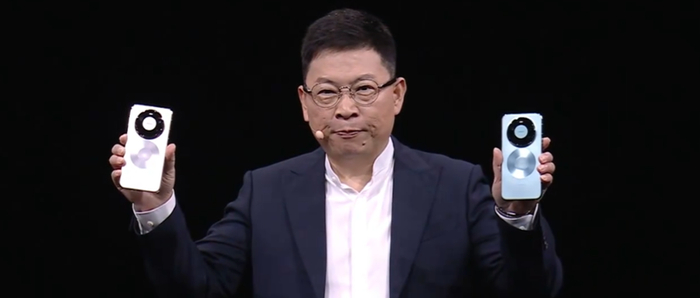
华为登顶,吃了谁的蛋糕?
Xin Lang Cai Jing· 2026-01-22 20:13
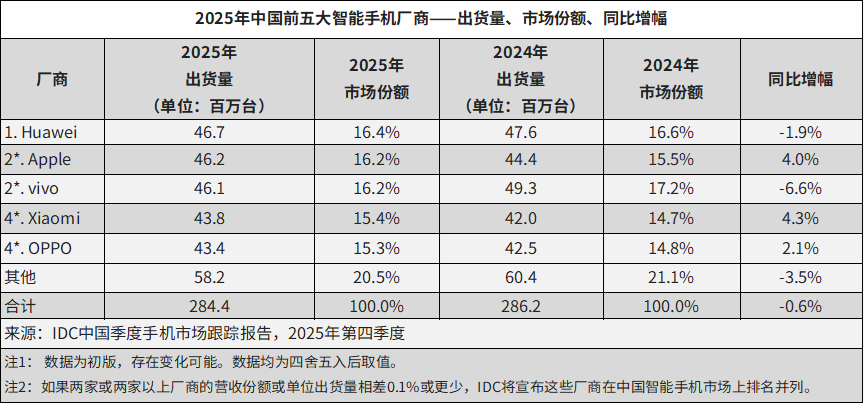
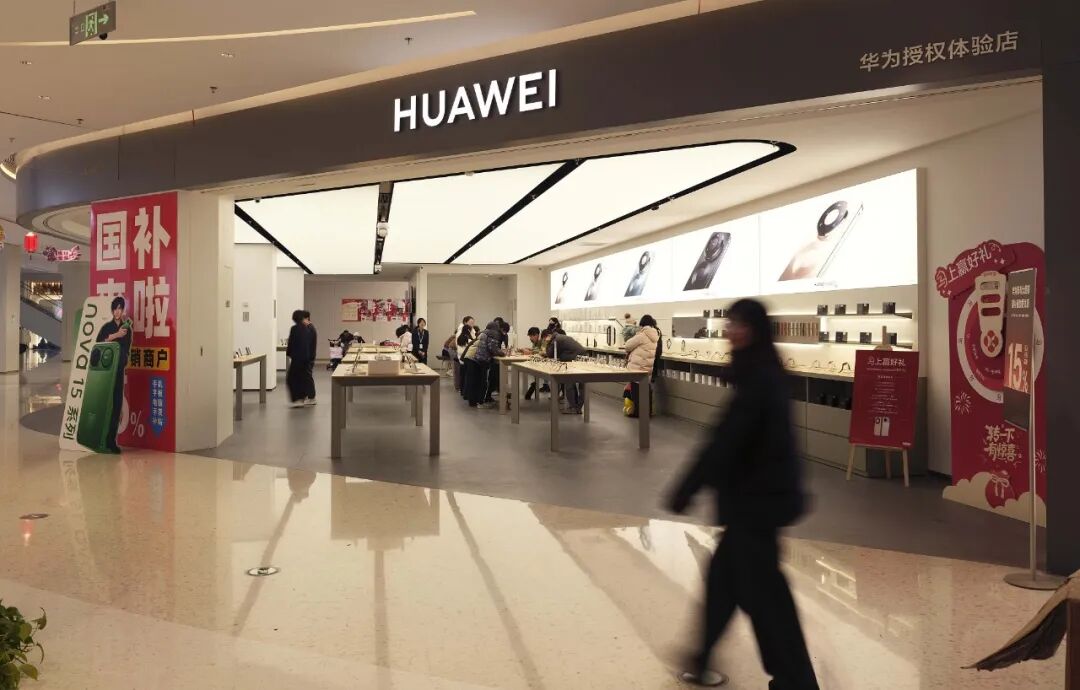
Core Insights - Huawei has regained the top position in the Chinese smartphone market with a shipment of 46.7 million units and a market share of 16.4% in 2025, although this is significantly lower than its peak of 124.9 million units and 38.3% market share in 2020 [2][3][6] - The competition among the top three manufacturers—Huawei, Apple, and Vivo—is intense, with their shipment volumes closely aligned, indicating a highly competitive market landscape [4][7] - Despite Huawei's return to the top, its shipment volume has decreased by approximately 2% year-on-year, reflecting a broader market decline [5][6] Shipment and Market Share - In 2025, the top five smartphone manufacturers in China by shipment volume are: 1. Huawei: 46.7 million units (16.4%) 2. Apple: 46.2 million units (16.2%) 3. Vivo: 46.1 million units (16.2%) 4. Xiaomi: 43.8 million units (15.4%) 5. OPPO: 43.4 million units (15.3%) [3][6] - The overall smartphone market in China saw a slight decline, with total shipments of 284.4 million units in 2025, down 0.6% from 2024 [6] Activation vs. Shipment - Huawei's activation volume ranks fifth, significantly lower than its shipment volume, indicating potential inventory issues with a gap of over 3 million units between shipments and activations [10][12] - In contrast, other brands like Vivo, Apple, and OPPO have activation volumes closely matching their shipment volumes, suggesting healthier inventory management [12][10] Competitive Landscape - The competition is not only between Huawei and Apple but also includes Vivo, which has maintained a strong presence in the market, and Xiaomi, which has shown positive growth [30][34] - OPPO has also demonstrated resilience, achieving a year-on-year shipment growth of nearly 30% in 2025, indicating a robust competitive strategy [34] Product Strategy and Pricing - Huawei's successful return is attributed to its strong product lineup, including the Mate 70 and Pura 80 series, which have seen significant sales despite the absence of advanced 3nm chips [21][24] - The company has strategically reduced prices on key models, with reductions exceeding 800 yuan, making its products more competitive in a market where other brands have raised prices [27][29] Future Outlook - The smartphone market in 2026 is expected to face challenges, including rising storage costs and a potential decline in overall shipments, which could reshape the competitive dynamics [36][38] - The ability of manufacturers to adapt to these changes and maintain product appeal will be crucial for sustaining market positions in the coming years [38]


广告“大字吸睛、小字免责”游戏,终于玩到头了?
Sou Hu Cai Jing· 2026-01-22 16:22
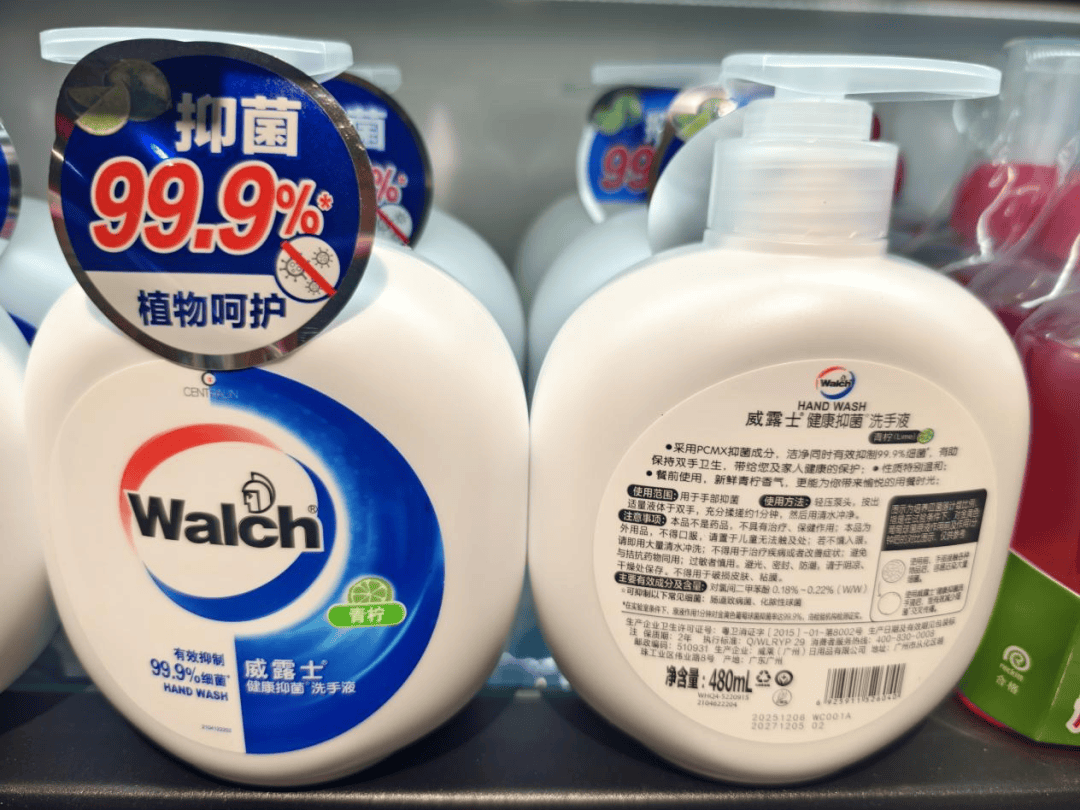
Core Viewpoint - The article highlights the deceptive advertising practice of using prominent claims while burying critical limitations in small print, which misleads consumers and has drawn regulatory scrutiny [1][2][10]. Group 1: Advertising Practices - The "big letters attract attention, small letters disclaim" strategy is prevalent across various consumer sectors, including digital, financial, food, and beauty products [1][10]. - In the personal care sector, products like a hand sanitizer claim to "effectively inhibit 99.9% of bacteria," but the fine print specifies that this is under laboratory conditions against a specific strain [2][4]. - Similar tactics are observed in electronics, where a sports camera advertises "200 minutes of battery life," but the conditions for this claim are hidden in small print [4][8]. Group 2: Legal and Regulatory Context - Legal experts argue that such advertising practices may violate consumer protection laws by failing to provide "true and comprehensive" information [4][11]. - The market regulatory authority has begun addressing these misleading practices, emphasizing that advertising must present information clearly and accurately [10][15]. - New guidelines have been proposed to ensure that font size and color do not obscure critical product information, aiming to reduce consumer confusion and false advertising risks [15][16]. Group 3: Industry Implications - The prevalence of misleading advertising can distort competition, erode consumer trust, and increase compliance costs for businesses [12][13]. - Experts suggest that the focus on attention-grabbing marketing tactics detracts from genuine product quality and brand integrity [13][14]. - The rise of such practices has prompted calls for stricter regulations and better enforcement to protect consumer rights and ensure fair competition [16].

FINE2026丨智能终端×新材料:六大主题展集结,洞见未来产业新机遇
DT新材料· 2026-01-22 16:11
Core Viewpoint - The 2026 Future Industries New Materials Expo (FINE 2026) aims to lead global innovation in new materials, emphasizing their critical role in the transformation of high-tech industries and the future economy [1][2]. Group 1: Event Overview - FINE 2026 will take place from June 10 to 12, 2026, at the Shanghai New International Expo Center, featuring a total exhibition area of 50,000 square meters and over 800 exhibitors [12][34]. - The expo will include more than 300 strategic and cutting-edge technology reports, showcasing innovations applicable to various industries such as AI, aerospace, smart vehicles, and renewable energy [2][20]. Group 2: Focus Areas - The event will concentrate on five common demands of future industries: advanced semiconductors, advanced batteries, lightweight functional materials, low-carbon sustainability, and thermal management [2][10]. - Six thematic exhibition areas will be established, including advanced semiconductors, advanced batteries and energy materials, thermal management, lightweight and sustainable materials, new materials technology innovation, and future smart terminals [12][15]. Group 3: Participation and Audience - FINE 2026 is expected to attract over 100,000 professional visitors, including industry leaders and investors, facilitating precise connections between enterprises and industry resources [34][35]. - The event will invite over 5,000 industry investors to support quality startups and enhance collaboration opportunities [10][35]. Group 4: Supporting Organizations - The expo is organized by DT New Materials, in collaboration with various associations and institutions, including the China Productivity Promotion Center and the Ningbo New Materials Industry Association [4][5]. - The event will leverage the extensive network of DT New Materials, which has established connections with over 200,000 professionals across various sectors [10]. Group 5: Historical Context and Expectations - FINE 2026 builds on the success of previous events, including the 2025 International Carbon Materials Expo and the 2025 Thermal Management Expo, which collectively attracted over 35,000 professional visitors from 27 countries [7][34]. - The expo is positioned as a pivotal opportunity for businesses to engage in technology transfer and innovation integration, aiming to solidify the foundation for new productivity in the materials sector [2][10].

存储等核心元器件成本上涨 手机行业竞争格局重构
Mei Ri Jing Ji Xin Wen· 2026-01-22 15:28
Core Insights - Honor has launched three new smartphone models targeting different consumer segments, indicating a strategic shift to attract younger and female users under new management [1] - The global smartphone market is facing dual pressures from rising component costs and limited domestic market growth, necessitating a search for new growth opportunities [1] - Omdia predicts that by 2026, the smartphone market will enter a new phase dominated by "cost pressure" and "value creation," with a clear trend of market differentiation [2] Industry Overview - The global smartphone shipment is expected to reach 1.26 billion units in 2025, with a year-on-year growth of 1.9%, primarily driven by mid-to-high-end models [3] - Apple and Samsung are projected to be the strongest performers among the top five smartphone manufacturers, with growth rates of 6.3% and 7.9% respectively, increasing their combined market share to 39% [3] - Other manufacturers like Xiaomi and OPPO are experiencing market share declines, with Xiaomi's shipments dropping significantly in Q4 2025 due to competitive pressures and a shift towards high-end products [3] Market Dynamics - The entry-level smartphone segment, once a stronghold for Chinese manufacturers in overseas markets, is now under pressure due to rising component costs, prompting a shift towards the mid-to-high-end market [4] - Honor's overseas smartphone shipments grew by approximately 55% in the first three quarters of 2025, with Europe being a key market for its high-end strategy [4] - OPPO's shipments of mid-to-high-end smartphones increased from 2.7 million units in Q2 2024 to 4 million units in Q2 2025, reflecting a similar strategic shift [5] Supply Chain Challenges - Rising prices of core components, particularly storage, are significantly impacting the smartphone market, with Omdia highlighting this as a key variable for 2026 [7] - The supply of LPDDR4 and LPDDR5 memory is constrained, leading to intense competition among manufacturers to manage costs and secure supply [7] - The price of DRAM and NAND memory surged by 386% and 207% respectively in 2025, with further increases expected in early 2026 [8] Strategic Adjustments - Manufacturers are adjusting their product strategies in response to rising costs, with many shifting focus from entry-level to mid-range products to maintain profitability [4][9] - The industry is expected to face challenges in maintaining healthy inventory levels, with a recommended storage inventory of 8 to 10 weeks [9]
传vivo叫停AI眼镜项目,官方暂无回应
Xin Lang Cai Jing· 2026-01-22 14:48
Core Viewpoint - Vivo has recently halted its AI glasses project, which had been in secret preparation for six months, due to concerns about differentiation in the current market [1][2]. Group 1: Project Details - The AI glasses project had previously collaborated with several ODM manufacturers, including GoerTek and Zhongke Chuangda, to develop demos [1][2]. - Vivo's executives, including Vice President Hu Baishan, determined that the AI glasses would struggle to stand out in the current market landscape [1][2]. Group 2: Previous Product Launch - In August 2025, Vivo launched its first MR glasses, the Vivo Vision Exploration Edition, but did not disclose a specific price or initiate public sales [1][2]. - The product was made available for user experience appointments at authorized Vivo experience stores in select cities, aiming to improve the product based on user feedback and word-of-mouth [1][2].
2025年中国智能手机市场再洗牌:华为重返榜首,苹果、vivo并列第二
Guo Ji Jin Rong Bao· 2026-01-22 10:15
智能手机赛道早已进入"存量搏杀"时代。 近日,国际数据公司(IDC)发布的最新手机市场跟踪报告显示,2025年全年,中国智能手机市场出货量约2.84亿台,同比 下降0.6%。 IDC数据指出,上半年伊始,"国补"叠加春节销售旺季推动市场增长明显,但后继乏力。下半年随着部分市场需求提前释 放,多地"国补"资金提前用尽以及成本持续上升等因素影响,市场继续保持同比下滑趋势。面对存储价格预计仍将大幅上 涨的态势,手机厂商的成本压力将进一步加剧,IDC预计,2026年中国智能手机市场出货量或将出现较明显回落。 然而,排位的更迭难以掩盖整体市场的寒意。2025年,尽管华为凭借4670万台出货量重回第一,但同比仍下滑1.9%;而昔 日冠军vivo则遭遇重创,出货量同比下降6.6%,在头部阵营中表现垫底。 相比之下,小米、苹果及OPPO实现了出货量的小幅增长。IDC指出,从全年来看,苹果以并列第二的市场份额,终结了此 前连续三年的出货量下滑趋势,实现触底回升。其中,iPhone 17 Pro Max仍是最畅销机型,进一步扩大了苹果在800美元以 上高端市场的优势。全面升级的iPhone 17系列显著提升了产品吸引力,获得消费 ...
王石,怎么了
盐财经· 2026-01-22 10:14
Core Viewpoint - The article discusses the contrasting trajectories of Wang Shi and Yao Zhenhua, highlighting Wang's existential crisis and the decline of his influence in the real estate industry, while Yao's aggressive capital strategies have led to his rise in the market [5][20][32]. Group 1: Wang Shi's Current Situation - Wang Shi expressed feelings of inadequacy, stating, "I should be very unsuccessful compared to you," indicating a deep self-reflection on his current status [3][5]. - The public perception of Wang Shi has shifted, with rumors of marital issues and a decline in his business influence becoming hot topics on social media [5][6]. - Wang Shi's past principles, such as rejecting bribery and excessive profits, seem to have lost relevance in the current market environment, leading to a sense of disconnection from his previous ideals [7][10][15]. Group 2: Yao Zhenhua's Rise - Yao Zhenhua's journey from humble beginnings in the agricultural trade to becoming a significant player in the real estate market illustrates a contrasting narrative to Wang Shi's [23][24]. - Yao's strategic moves, including leveraging insurance products for capital growth, have positioned him as a formidable force in the industry, especially during the "Baowan War" against Wang Shi [24][27]. - The article notes that Yao's approach has evolved from being seen as a "barbarian" to a figure seeking to prove his value as a creator rather than a destroyer [30][32]. Group 3: Industry Reflections - The article reflects on the broader implications of Wang Shi's and Yao Zhenhua's experiences, suggesting that they represent two extremes shaped by the same market forces [22][32]. - Wang Shi's legacy and the challenges faced by Vanke post his departure highlight the vulnerabilities in corporate governance and the impact of leadership transitions [15][28]. - The contrasting paths of these two figures serve as a commentary on the shifting dynamics within the Chinese business landscape, where traditional values are increasingly challenged by aggressive capital strategies [42][43].


2025手机销量迷局:华为到底是第一还是第五? | 深网
Xin Lang Cai Jing· 2026-01-22 10:08
Core Viewpoint - The competition in the Chinese smartphone market is extremely fierce, with slight differences in market positions among leading brands, as highlighted by the activation volume rankings for 2025 [2][4]. Market Rankings - The top five brands in terms of activation volume for 2025 are: 1. Vivo (including IQOO) with 46.36 million units and a market share of 16.77%, showing a decrease of 2.58% from 2024 2. Xiaomi (including REDMI) with 45.88 million units and a market share of 16.60%, increasing by 5.41% from 2024 3. Apple with 45.21 million units and a market share of 16.35%, increasing by 9.34% from 2024 4. OPPO (including OnePlus and realme) with 43.99 million units and a market share of 15.91%, increasing by 7.63% from 2024 5. Huawei with 43.40 million units and a market share of 15.70%, decreasing by 0.96% from 2024 [3][15]. Discrepancies in Data - There is a notable discrepancy between the activation volume and shipment data, with Huawei ranking first in shipment volume according to major research firms, while it ranks fifth in activation volume [5][17]. - The difference in rankings has raised questions about the accuracy of the data, particularly why Huawei's shipment figures exceed its activation numbers by over 300,000 units [20]. Sales Channels - The majority of smartphone sales in China occur through offline channels, which account for approximately 70% of total sales, while Xiaomi has historically leaned towards online sales [6][18]. - The sales process involves multiple stages: Sell In (SI), Sell Through (ST), and Sell Out (SO), with most research firms reporting on SI data, while actual user activation (SO) remains confidential [19]. Xiaomi's Strategy - Xiaomi's activation volume surpasses its reported shipment volume by approximately 200,000 units, attributed to its direct online sales model, which shortens the time from shipment to activation [10][21]. - During the 2025 Double Eleven shopping festival, Xiaomi reported total sales exceeding 29 billion yuan, highlighting the effectiveness of its online sales strategy [22]. High-End Market Focus - Xiaomi has been focusing on high-end market penetration since implementing its dual-brand strategy in 2019, investing around 105 billion yuan in R&D over the past five years [11][22]. - The company aims to compete directly with Apple and Huawei in the high-end segment, where it currently holds a market share of only 7.4% compared to Apple's 48% and Huawei's 33.4% [12][22]. Technological Investments - Xiaomi is investing in self-developed SoC chips to enhance its competitive edge in the high-end smartphone market, indicating a long-term commitment to building a strong brand presence [23].
苹果官宣限时促销,官网最高降价1000元
Xin Lang Cai Jing· 2026-01-22 09:57
Group 1 - Apple has launched a limited-time Spring Festival promotion on its Chinese website, allowing users to save up to 1,000 yuan on selected products from January 24 to January 27, 2026 [1] - The iPhone 16 series models enjoy various discounts, with the iPhone 16 and iPhone 16 Plus saving 300 yuan, and the iPhone 16e saving 200 yuan. The MacBook Pro has a maximum discount of 1,000 yuan, while the MacBook Air discounts range from 700 to 800 yuan. The iPhone 17 series is not included in the promotion [3] - Apple has consistently launched limited-time promotions around the Lunar New Year in recent years, becoming a regular marketing strategy [3] Group 2 - According to Omdia, the smartphone shipment in mainland China for 2025 is approximately 282.3 million units, a slight decrease of 1% year-on-year. Huawei leads the market with 46.8 million units shipped, holding a 17% market share, followed by Vivo with 46 million units. Apple ranks third with 45.9 million units shipped [3] - In Q4 2025, driven by year-end promotions and continued "national subsidies," the Chinese market's year-on-year decline narrowed to 1%, with quarterly shipments reaching 76.4 million units. Apple shipped 16.5 million units in this quarter, increasing its market share to 22%, ranking first in the domestic market [4] - Globally, smartphone shipments grew by 4% year-on-year in Q4 2025, with Apple achieving a record high in shipments due to strong demand for the iPhone 17 series, leading with a 25% global market share and maintaining its position as the top smartphone manufacturer for three consecutive years, slightly ahead of Samsung [4] Group 3 - Several Wall Street firms have expressed optimism about Apple's prospects for 2026. Morgan Stanley raised its target price for Apple to $315 in December 2025, citing benefits from an extended replacement cycle, feature upgrades, and optimized carrier subsidies for the iPhone 17 series. Goldman Sachs also raised its target price to $320 in November 2025, providing a positive outlook for Apple's future performance [4]