中国东航

Search documents
大消费板块拉升!免税概念领涨
Zheng Quan Ri Bao Zhi Sheng· 2026-01-19 07:57
Group 1: Market Performance - The A-share market showed mixed performance on January 19, with major indices fluctuating, while sectors like electric grid and precious metals remained strong, and other popular sectors continued to pull back [1] - The consumer sector saw a boost due to positive consumption data and policy support, particularly in retail and tourism, with notable performances from duty-free and airline stocks [1] Group 2: Consumer Data Insights - Recent consumer data highlights include a projected growth in service retail sales by 5.5% year-on-year for 2025, with significant increases in categories such as cultural and recreational services, telecommunications, and travel services [2] - In Hainan, the first month of duty-free sales from December 18, 2025, to January 18, 2026, reached 4.86 billion yuan, marking a 46.8% year-on-year increase, with shopping participation and item counts also showing substantial growth [2] Group 3: Airline Industry Performance - Airlines reported strong operational data for December 2025, with China Eastern Airlines showing a 4.93% increase in passenger capacity and a 7.61% rise in passenger turnover [3] - China Southern Airlines reported an 11.89% increase in passenger capacity and an 11.20% rise in passenger turnover for the same period, indicating a robust recovery in the aviation sector [3] Group 4: Policy Support for Consumption - The State Council's recent meeting emphasized the need to accelerate the cultivation of new growth points in service consumption and to enhance the quality of service supply, aiming to stimulate consumer spending [4] - Analysts noted that the recent consumer data reflects a structural recovery, with growth shifting from traditional goods to services and duty-free markets, supported by improving airline and freight data [4] Group 5: Investment Opportunities - The consumer sector is currently in a phase of "policy catalysis + seasonal drive," with expectations for recovery in essential and discretionary consumption sectors, particularly in areas like liquor, food and beverage, tourism, and airlines [5] - Investment strategies should focus on high-quality stocks that demonstrate supply innovation, policy support, or brand upgrades, as the market shifts towards structural and thematic opportunities [5]




资金高切低!大消费走强,大连圣亚涨停,安井食品涨超5%
Mei Ri Jing Ji Xin Wen· 2026-01-19 04:41
Group 1 - The Shanghai Composite Index experienced a rebound, rising 0.13% to close at 4107 points, with significant activity in the consumer sector, particularly in tourism and dining [1] - The State Council meeting on January 16 emphasized the need to accelerate the cultivation of new growth points in service consumption, highlighting the potential for growth as China's household consumption accounts for only about 40% of GDP, significantly lower than the average in developed countries [1] - The new round of government subsidies amounting to 62.5 billion yuan for "old-for-new" initiatives is expected to stimulate domestic demand and improve people's livelihoods [1] Group 2 - The Tourism ETF (562510.SH) tracks the CSI segmented tourism index, covering leading stocks in sectors such as duty-free, airlines, hotels, and attractions, including China Duty Free Group and China Eastern Airlines [1] - The Food ETF Huaxia (159151.SZ) tracks the CSI All Food Index, which includes leading stocks in seasoning, dairy, meat products, and snacks, and is designed to better reflect daily consumer needs by excluding traditional alcoholic beverages [1]

旅游概念股走强,旅游ETF涨约3%
Mei Ri Jing Ji Xin Wen· 2026-01-19 03:09
Group 1 - The tourism sector is experiencing a strong rally, with China Eastern Airlines rising over 5%, and China Southern Airlines, Jin Jiang Hotels, and ShouLve Hotels increasing by more than 4% [1] - The tourism ETF has seen an approximate increase of 3% due to market influences [1] Group 2 - Various segments of the tourism industry, including scenic spots, hotels, travel agencies, and retail, are showing comprehensive recovery from a supply perspective [2] - The government continues to implement industry policies to support high-quality development in tourism, focusing on regulating industry growth, enhancing quality tourism products and services, improving infrastructure investment, optimizing transportation services, and broadening financing channels [2] - The recent increase in tourism activity is attributed to the extended Spring Festival holiday, heightened interest in ice and snow tourism, and the introduction of duty-free and visa-free policies [2]



周期大宗品的投资机会推荐
2026-01-19 02:29
Summary of Key Points from Conference Call Records Industry Overview - The conference call discusses the investment opportunities in the Chinese capital market, particularly focusing on the recovery and growth potential in various sectors, including technology, chemicals, and energy metals [1][2][3]. Core Insights and Arguments - **Market Recovery**: The Chinese capital market is expected to rise significantly, with predictions of reaching 4,200 points before the Spring Festival and a target of 5,200 points for the year 2026. This recovery is attributed to reduced internal and external concerns, leading to increased investor confidence [1][2][10]. - **Sector Focus**: Key sectors identified for investment include: - **Technology**: Emphasis on leading companies in the internet, electronic semiconductors, telecommunications, and military industries. Notable mentions include storage chip suppliers and platform companies [1][9][14]. - **Chemicals**: Growth stocks in the chemical industry are expected to benefit from increased downstream demand, with specific recommendations for companies like 雅克科技 (Yake Technology) and 国瓷材料 (Guoci Materials) [1][14]. - **Energy Metals**: Positive outlook on industrial metals like copper and aluminum, with expectations of price stability and growth due to demand from AI and infrastructure investments [3][20][21]. - **Aviation Sector**: The aviation sector is projected to see continued improvement in supply and demand, with recommendations for companies like 中国航 (China Airlines) and 吉祥航空 (Lucky Air) [12]. - **Oil Shipping**: The oil shipping sector has shown significant price recovery, with daily rates increasing from $20,000 to $116,000, indicating strong demand and limited supply growth [13]. Additional Important Insights - **Regulatory Environment**: The importance of a stable regulatory environment is emphasized, as it fosters long-term market growth and investor confidence. Strict regulations against stock price manipulation are seen as beneficial for the majority of investors [6][7]. - **Economic Indicators**: The overall economic stability and liquidity expansion are expected to support market growth, with specific attention to the A500 index representing leading companies in various sectors [1][8]. - **Coal Demand**: Coal demand is projected to grow significantly due to increased electricity consumption, particularly in the service sector, which is expected to contribute over 50% to the total electricity demand growth [29]. - **Geopolitical Factors**: Geopolitical events are influencing oil prices, with expectations of a return to fundamental supply-demand dynamics in the medium to long term [26]. Conclusion - The conference call highlights a positive outlook for the Chinese capital market in 2026, driven by sector-specific growth opportunities and a stable regulatory environment. Key sectors such as technology, chemicals, and energy metals are poised for significant investment, while the aviation and oil shipping sectors are also expected to perform well.
机器人“纯度”提高!热门基金,最新调仓曝光
券商中国· 2026-01-18 03:40
Group 1 - The core viewpoint of the article is that the 2025 market will be dominated by a "technology bull market," with humanoid robots and AI-driven energy sectors performing exceptionally well [1] Group 2 - The "purity" of robot-themed funds has increased, as evidenced by the significant growth in the Huafu Technology Momentum Fund's shares from 1.08 billion at the end of 2024 to 23.97 billion by the end of Q4 2025 [2] - The fund maintained a high stock position of 87.34% and continued to focus on the robot sector, with the manager expressing optimism about the domestic humanoid robot industry's ongoing development [2] - The top holdings of the fund shifted, with Zhejiang Rongtai becoming the largest holding and Xinquan shares moving up to the second position, while previous top holdings like Sanhua Intelligent Control and Top Group exited the top ten [2] Group 3 - The Huafu New Energy Fund also saw a significant increase in size, rising from 13.1 billion shares in Q3 to 35.45 billion by the end of Q4 [3] - The fund adjusted its holdings, increasing exposure to lithium battery materials and photovoltaic sectors while reducing positions in wind power and humanoid robots [3] - The fund manager highlighted the investment opportunities in the energy sector driven by AI, noting that large-scale energy storage is expected to experience explosive growth starting in 2024 [3] Group 4 - The Jin Xin Fund reported that while the consumer sector, represented by liquor, performed generally, the Jin Xin Consumer Upgrade Fund saw an increase of over 20% for the year, with a Q4 rise of approximately 13.36% [4] - The fund focused on service consumption sectors such as aviation, scenic spots, hotels, and tourism, rather than traditional consumer stocks [4] - The top holdings included major airlines and tourism companies, with favorable conditions in Q4 contributing to the aviation sector's strong performance [5]

江苏旅游市场持续升温 航空公司运力扩容保障出行需求
Sou Hu Cai Jing· 2026-01-17 10:51
Group 1 - The tourism market is experiencing significant growth as the Spring Festival approaches, with increased bookings for both domestic and outbound travel compared to previous years, particularly for long-distance trips [1] - In Nanjing, travel agencies report a surge in consumer inquiries, with limited availability for group tours to Southeast Asia destinations like Bangkok and Phuket, as well as winter destinations such as Changbai Mountain and Harbin [3] - To accommodate the rising travel demand during the Spring Festival and the entire Spring Transport period, airlines are expanding their capacity by launching, restoring, and increasing the frequency of multiple routes [5] Group 2 - Eastern Airlines Jiangsu Company announced new flights from Nanjing to Bangkok and Kuala Lumpur during the Spring Festival period, with one flight daily, and the resumption of daily flights to Phuket [5] - Domestic routes will also see new flights, including direct flights from Nanjing to Ulanhot and new connections to Chongqing, as well as additional routes from Wuxi to Dalian and Xishuangbanna, and from Changzhou to Jinzhou [5]

航空行业2025年12月数据点评:上市航司国内客座率同比持续提升,春秋国内92.2%领跑,国航同比提升幅度最高
Huachuang Securities· 2026-01-17 09:24
Investment Rating - The report maintains a "Recommendation" rating for the aviation industry, expecting the industry index to outperform the benchmark index by over 5% in the next 3-6 months [61]. Core Insights - The domestic passenger load factor for listed airlines continues to improve, with Spring Airlines leading at 92.2% in December, and Air China showing the highest year-on-year increase [1]. - The report highlights a structural improvement in demand for the aviation industry, with a notable recovery in cross-border travel demand outpacing domestic demand [9]. - The report emphasizes the high elasticity of prices under high load factors, indicating potential for price increases as the industry recovers [9]. Summary by Sections 1) Domestic Routes - In December, the ASK (Available Seat Kilometers) growth was led by Spring Airlines at 16.4%, followed by China Southern Airlines at 6.8% and Air China at 4.2% [2]. - The RPK (Revenue Passenger Kilometers) growth for December was also led by Spring Airlines at 17.7%, with Air China at 10.6% and China Southern Airlines at 6.9% [2]. - For the cumulative data from January to December, East China Airlines had the highest ASK growth at 10.7%, while Spring Airlines and East China Airlines both had RPK growth of 9.1% [2]. 2) International Routes - In December, China Southern Airlines led with an ASK growth of 25.8%, followed by East China Airlines at 9.4% and Air China at 4.1% [3]. - The RPK growth for December was also led by China Southern Airlines at 22.8%, with East China Airlines at 11.0% and Air China at 9.1% [3]. - For the cumulative data from January to December, 吉祥航空 (Juneyao Airlines) showed the highest ASK growth at 37.6% and RPK growth at 43.5% [3]. 3) Regional Routes - In December, Spring Airlines had the highest ASK growth at 92.0%, while 吉祥航空 (Juneyao Airlines) experienced a decline of 20.2% [4]. - The RPK growth for December was again led by Spring Airlines at 97.5%, with 吉祥航空 (Juneyao Airlines) showing a decline of 15.9% [4]. - For the cumulative data from January to December, China Southern Airlines had the highest ASK growth at 3.1%, while Spring Airlines and 吉祥航空 (Juneyao Airlines) both showed significant declines [4]. 4) Passenger Load Factor - In December, Spring Airlines had a load factor of 91.5%, with a year-on-year increase of 0.7% [5]. - For the cumulative data from January to December, Spring Airlines maintained a load factor of 91.5%, with Air China at 81.9% showing a year-on-year increase of 2.0% [5]. - The total fleet of the five listed airlines increased by 15 aircraft by December 2025, with a year-on-year fleet growth of 4% [5].


航空机场2025年12月数据点评:国内线表现明显优于24年,国际线供给略有过剩
Dongxing Securities· 2026-01-16 11:59
Investment Rating - The industry investment rating is "Positive" for the transportation sector, indicating an expectation of performance that exceeds the market benchmark by more than 5% [6]. Core Insights - Domestic routes show significant improvement compared to 2024, with a 4.2% year-on-year increase in capacity and a 2.4 percentage point increase in passenger load factor [2][34]. - International routes are experiencing a short-term oversupply, with a 12.8% year-on-year increase in capacity but only a 1.0 percentage point increase in load factor, indicating weaker-than-expected demand [3][52]. - The cancellation of Japanese flights has a more pronounced impact on airports than on airlines, as airport revenues are closely tied to passenger volume and flight operations [4][66]. - The introduction of the "Self-Discipline Convention for Air Passenger Transport" in August 2025 is seen as a foundational step towards reducing market competition pressures and improving profitability in the industry [5]. Summary by Sections Domestic Routes - In December 2025, listed companies increased domestic route capacity by approximately 4.2% year-on-year and 1.9% month-on-month, reflecting a gradual recovery in supply-demand dynamics compared to the previous year [2][14]. - The overall passenger load factor for domestic routes improved by about 2.4 percentage points year-on-year, although it saw a seasonal decline of 1.0 percentage point compared to November [34][41]. International Routes - For international routes, capacity increased by approximately 12.8% year-on-year and 9.3% month-on-month in December 2025, but the load factor only increased by 1.0 percentage point year-on-year, with a significant month-on-month decline of 3.1 percentage points [3][52]. - The low year-on-year increase in load factor is attributed to a low base in 2024, and the demand for international routes is not meeting expectations, leading to oversupply [12][57]. Airport Sector - Major airports such as Shanghai, Beijing, Baiyun, and Shenzhen saw international passenger throughput growth of 4%, 9%, 22%, and 9% respectively in December, but the growth rates were significantly lower than in November due to the cancellation of Japanese flights [4][66]. - The impact of flight cancellations on airport revenues is more significant than on airlines, as airport income is based on passenger volume and flight operations [4][66].
【16日资金路线图】两市主力资金净流出近240亿元 电子等行业实现净流入
证券时报· 2026-01-16 10:33
1月16日,A股市场整体下跌。截至收盘,上证指数收报4101.91点,下跌0.26%;深证成指收报14281.08 点,下跌0.18%;创业板指收报3361.02点,下跌0.2%。两市合计成交30262.32亿元,较上一交易日增加 1207.36亿元。 1. 两市主力资金净流出近240亿元 今日沪深两市主力资金开盘净流出106.45亿元,尾盘净流出38.37亿元,全天净流出238.85亿元。 | | | 沪深两市最近五个交易日主力资金流向情况(亿元) | | | | --- | --- | --- | --- | --- | | 日期 | | 净流入金额 开盘净流入 | 尾盘净流入 | 超大单净买入 | | 2026-1-16 | -238.85 | -106. 45 | -38. 37 | -133. 83 | | 2026-1-15 | -509.20 | -225. 52 | 49.73 | -265. 38 | | 2026-1-14 | -504.74 | -71.84 | -54. 14 | -90. 16 | | 2026-1-13 | -1286.54 | -530. 96 | -183. 9 ...

航空机场板块1月16日跌0.78%,中信海直领跌,主力资金净流出4.77亿元
Zheng Xing Xing Ye Ri Bao· 2026-01-16 08:56
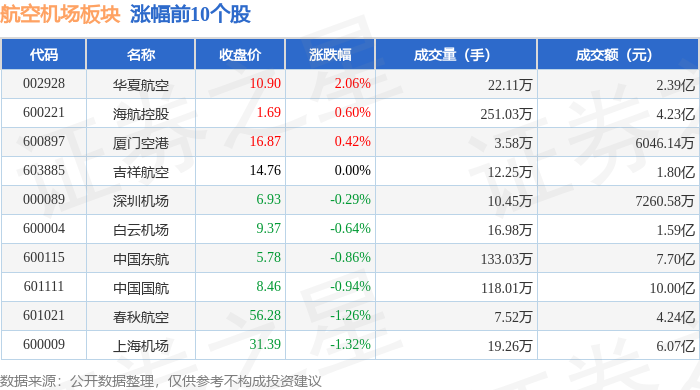
Market Overview - The aviation and airport sector declined by 0.78% on January 16, with CITIC Hainan Airlines leading the drop [1] - The Shanghai Composite Index closed at 4101.91, down 0.26%, while the Shenzhen Component Index closed at 14281.08, down 0.18% [1] Stock Performance - Notable stock performances included: - Huaxia Airlines (002928) increased by 2.06% to close at 10.90 with a trading volume of 221,100 shares and a turnover of 239 million yuan [1] - Hainan Airlines (600221) rose by 0.60% to 69.1 with a trading volume of 2.51 million shares and a turnover of 423 million yuan [1] - Xiamen Airport (600897) increased by 0.42% to 16.87 with a trading volume of 35,800 shares and a turnover of 60.46 million yuan [1] - China Eastern Airlines (600115) decreased by 0.86% to 5.78 with a trading volume of 1.33 million shares and a turnover of 770 million yuan [1] - China Southern Airlines (600029) fell by 1.46% to 7.43 with a trading volume of 795,100 shares and a turnover of 594 million yuan [2] Capital Flow - The aviation and airport sector experienced a net outflow of 477 million yuan from institutional investors, while retail investors saw a net inflow of 257 million yuan [2] - The capital flow for individual stocks showed: - Xiamen Airport had a net inflow of 121.82 million yuan from retail investors, despite a net outflow of 341.39 million yuan from institutional investors [3] - CITIC Hainan Airlines faced a significant net outflow of 75.42 million yuan from institutional investors, while retail investors contributed a net inflow of 57.25 million yuan [3] - China Eastern Airlines had a net outflow of 73.70 million yuan from institutional investors, with retail investors contributing a net inflow of 45.21 million yuan [3]