舍得酒业

Search documents
国信证券晨会纪要-20251209
Guoxin Securities· 2025-12-09 01:01
Macro and Strategy - The Federal Open Market Committee (FOMC) is facing a personnel change that will influence future policy direction and independence boundaries, with a key focus on the upcoming 2026 board member replacements [7][8] - The current structure of the FOMC, with a mix of "core dependent" and "institutional defense" members, will determine the continuation of its independence, with potential shifts in policy power dynamics anticipated [8] - The report predicts that the Federal Reserve is likely to enter a phase of "political rate cuts," with increased uncertainty in decision-making frameworks [9] Industry and Company Agriculture, Forestry, Animal Husbandry, and Fishery - The investment strategy for December 2025 highlights an expected reversal in the livestock cycle, recommending key stocks in the dairy farming sector such as Yuran Agriculture and Modern Farming [13] - The report emphasizes the potential for a rebound in meat and milk prices, driven by a synchronized recovery in the livestock sector, with leading companies expected to experience significant earnings recovery [13][14] - Recommendations include leading companies in various segments: livestock (Yuran Agriculture, Modern Farming), pork (Hua Tong, De Kang), and pet food (Guaibao Pet) [15][17] Food and Beverage - The food and beverage sector has seen a decline of 1.80% recently, with A-share food and beverage indices underperforming the broader market [18][19] - The report identifies a divergence in performance across categories, with alcoholic beverages facing supply-demand imbalances, while dairy products are expected to see gradual recovery [19][20] - Investment recommendations focus on high-potential companies in the beverage sector, such as Nongfu Spring and East Peak Beverage, as well as premium liquor brands like Luzhou Laojiao and Moutai [19][20] Real Estate - The real estate market is experiencing significant pressure, with a 9.6% year-on-year decline in sales volume and a 6.8% drop in sales area from January to October 2025 [25][26] - The report notes that while non-popular cities are seeing population outflows, local residents still have improvement-driven housing demands, which could stabilize the market [26][28] - Recommendations include focusing on companies that are well-positioned in non-popular cities, such as China Overseas Land & Investment, which can leverage local demand for housing improvements [28] Internet and AI - The report highlights advancements in AI technology, with significant product launches from companies like OpenAI and Tencent, indicating a growing trend in AI applications across various sectors [29][30] - Investment strategies suggest focusing on internet giants that are leveraging AI for growth, with recommendations for Alibaba and Tencent as key players benefiting from AI integration [30] - The report also notes the potential for AI to enhance advertising and cloud service revenues for these companies, suggesting a positive outlook for their financial performance [30]
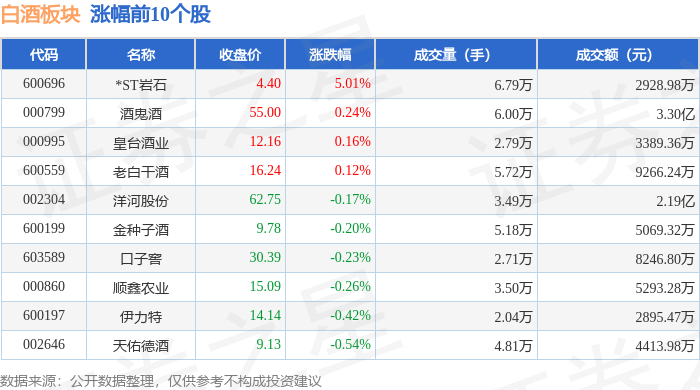
白酒板块12月8日跌1%,泸州老窖领跌,主力资金净流出17.88亿元
Zheng Xing Xing Ye Ri Bao· 2025-12-08 09:04
Core Insights - The liquor sector experienced a decline of 1.0% on December 8, with Luzhou Laojiao leading the drop [1][2] - The Shanghai Composite Index closed at 3924.08, up 0.54%, while the Shenzhen Component Index closed at 13329.99, up 1.39% [1] Liquor Sector Performance - Luzhou Laojiao's stock price fell by 2.31% to 125.38, with a trading volume of 117,400 shares and a transaction value of 1.482 billion yuan [2] - Wuliangye and Gujing Gongjiu also saw declines of 1.47% and 1.35%, respectively, with transaction values of 3.157 billion yuan and 279 million yuan [2] - The overall net outflow of main funds from the liquor sector was 1.788 billion yuan, while retail investors saw a net inflow of 926 million yuan [2][3] Fund Flow Analysis - Main funds showed a negative net inflow for several companies, including ST Yanshi and Jinhui Liquor, with net outflows of 1.29 million yuan and 3.21 million yuan, respectively [3] - Retail investors contributed positively to the net inflow for companies like Yilite and Tianyoude Liquor, with net inflows of 3.97 million yuan and 3.42 million yuan, respectively [3] - The overall trend indicates a shift in investor sentiment, with retail investors more active in the market compared to institutional investors [2][3]




600元价格带,会不会成为攻防据点?
Sou Hu Cai Jing· 2025-12-08 05:55
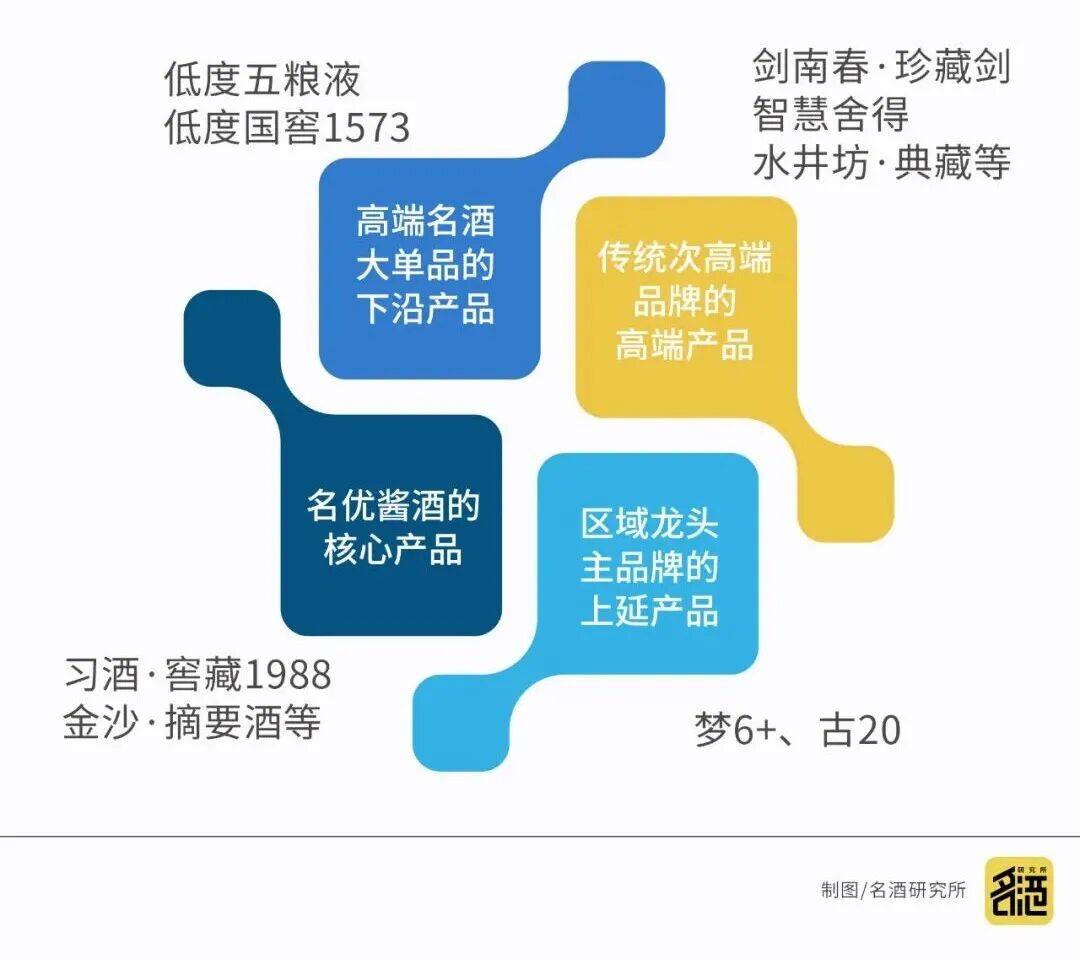
Core Viewpoint - The 600 yuan price segment in the high-end liquor market is experiencing complex dynamics due to both proactive expansion and passive competition, leading to increased uncertainty and variability in market conditions [1]. Group 1: Market Dynamics - The high-end market is under pressure, but the next high-end price range has not contracted as expected, instead forming a solid support at the 600 yuan level [1]. - Moutai 1935 has seen significant sales growth in September and October after increasing distribution, while lower-alcohol products like Guojiao 1573 and Wuliangye have capitalized on the trend towards lower alcohol consumption [1]. - The competition is intensifying among high-end liquor brands, with new entrants like Dazhen Zhenjiu leveraging innovative strategies to capture market share [1]. Group 2: Historical Context - The 600 yuan price segment began to take shape around 2019, when high-end liquor prices surged, breaking previous price ceilings and leading to significant market growth [2][3]. - The traditional next high-end price range of 300-400 yuan has been pushed upwards due to pricing strategies, reflecting a broader trend of market expansion [3]. Group 3: Competitive Landscape - Major liquor companies have targeted the 600 yuan segment, with brands like Shede and Gujing Gongjiu launching products aimed at this price point, achieving significant sales [4][5]. - By 2020, the 600 yuan price segment had attracted various strong brands, including low-alcohol versions of established products and new offerings from regional leaders, creating a market with over 100 billion yuan in scale [5]. Group 4: Current Market Position - The 600 yuan price segment is now seen as a critical battleground, with brands like Moutai 1935 and Guojiao 1573 demonstrating resilience against market pressures [11][14]. - The segment has shown remarkable stability and potential for growth, with a market size estimated at 500 billion yuan, making it a focal point for both offensive and defensive strategies in the industry [11][14]. Group 5: Future Outlook - The 600 yuan price segment is expected to remain a key area of focus for brands looking to navigate the current market challenges, with opportunities for both expansion and defense against high-end market pressures [15].
多家A股公司,“花式”宠股东!
Zhong Guo Zheng Quan Bao· 2025-12-08 04:41
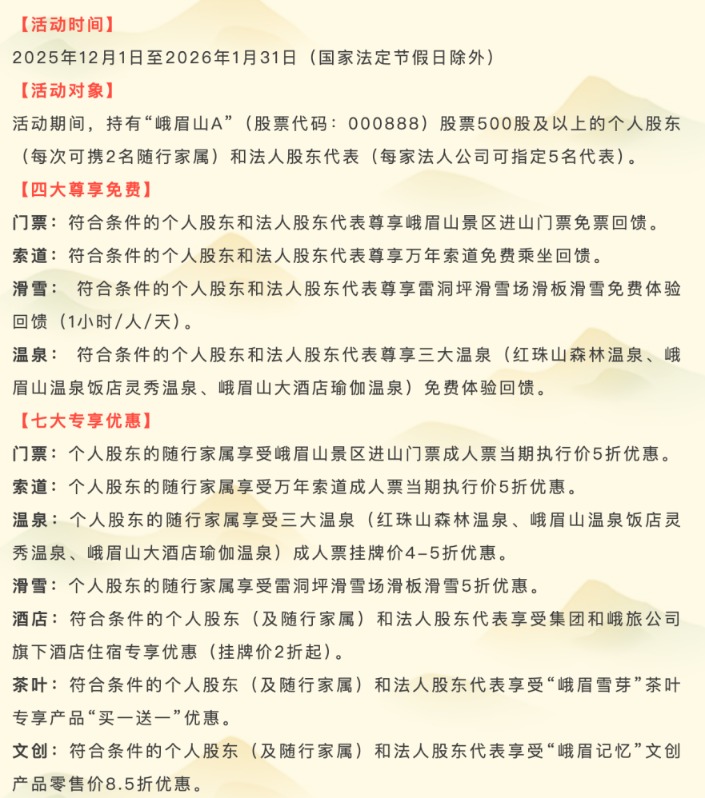
Core Viewpoint - The trend of companies offering "physical dividends" to shareholders is increasing, with over 30 listed companies implementing various shareholder reward activities this year, particularly in the tourism and food sectors [1][3][10]. Group 1: Company Initiatives - Qianwei Yangchu announced a shareholder reward activity where shareholders holding 100 shares or more can receive a product gift package worth 200 yuan, while corporate shareholders can receive three packages [3]. - Emei Mountain A has launched a shareholder reward program allowing shareholders holding 500 shares or more to enjoy free admission to the scenic area and other benefits from December 1 to January 31, 2026 [5]. - Xiangyuan Cultural Tourism initiated the "Xiangyuan Cultural Tourism 2025 Shareholder Reward" program, offering multiple benefits including free access to key scenic spots and hotel stay discounts [6][8]. Group 2: Market Analysis - Market analysts suggest that these shareholder benefits serve as a marketing and communication innovation, emphasizing the importance of focusing on the company's long-term value rather than short-term rewards [10]. - The nature of these physical or rights-based rewards differs fundamentally from the ongoing cash dividends advocated by regulators, often leading to short-term stimulation effects [10]. - Investors are advised to maintain a rational perspective on these activities, as they may create emotional trading opportunities but lack sustainability in driving long-term company performance [10].


白酒渠道跟踪
2025-12-08 00:41
Summary of the Conference Call on the Baijiu Industry Industry Overview - The Baijiu market in 2025 is facing challenges such as declining sales and inventory buildup, with high-end brands like Moutai and Wuliangye experiencing price adjustments and increased inventory pressure [2][18] - The overall sales in the Henan region decreased by approximately 20% compared to 2024, with some manufacturers issuing reduction directives due to unfulfilled sales tasks [7][18] Key Points and Arguments Sales Performance - Moutai's sales have been stable, with all goods delivered by November 2025 and a 10% increase in December. However, online platforms have reported prices as low as 1,300 RMB, below cost [4][18] - Wuliangye expects a 10% sales growth in 2026, driven by new leadership and compensation for reduced output in 2025, but faces challenges with margins and potential negative profits [2][6][20] - Fenjiu has shown relative stability in Shandong, with a planned 10% growth for 2026, although it has faced historical low prices and reliance on rebates for profits [2][10] - The Jiangsu market has seen a 25%-30% decline in high-end Baijiu demand, with increased inventory levels and reduced enthusiasm from distributors [2][18] Inventory and Pricing - Moutai's current inventory is approximately 40 days, while Wuliangye's is about 10 days, with some stores facing up to two months of inventory due to wholesale restrictions [4][18] - Fenjiu's pricing has dropped to historical lows, with some products priced at around 350 RMB, impacting distributor profits [4][10] - The overall inventory levels in the Shandong region are high, with significant pressure on brands like Water Well and Shede, which have seen declines of 10% and 15% respectively [11][12] Future Outlook - Wuliangye's growth expectations for 2026 are contingent on pricing and subsidy negotiations, with no specific plans communicated yet [8][20] - Fenjiu has adjusted its product structure, increasing high-end offerings while facing challenges in profit generation due to low prices [10][20] - The overall sentiment in the Baijiu market indicates a cautious outlook, with expectations for improvement in 2026 if economic conditions stabilize and inventory is effectively managed [23][24] Additional Important Insights - Consumer behavior has shifted towards immediate consumption rather than stockpiling, leading to stable but non-explosive sales growth [3][18] - The competitive landscape shows that while high-end brands are under pressure, some mid-tier brands like Yanghe and Jinshiyuan are also struggling with high inventory and low prices [22][23] - The overall market dynamics suggest that brands need to adapt to changing consumer preferences and economic conditions to navigate the current challenges effectively [24][46]

五粮液回应“10年来首次降价”:是补贴,不是调低出厂价
Sou Hu Cai Jing· 2025-12-07 13:54
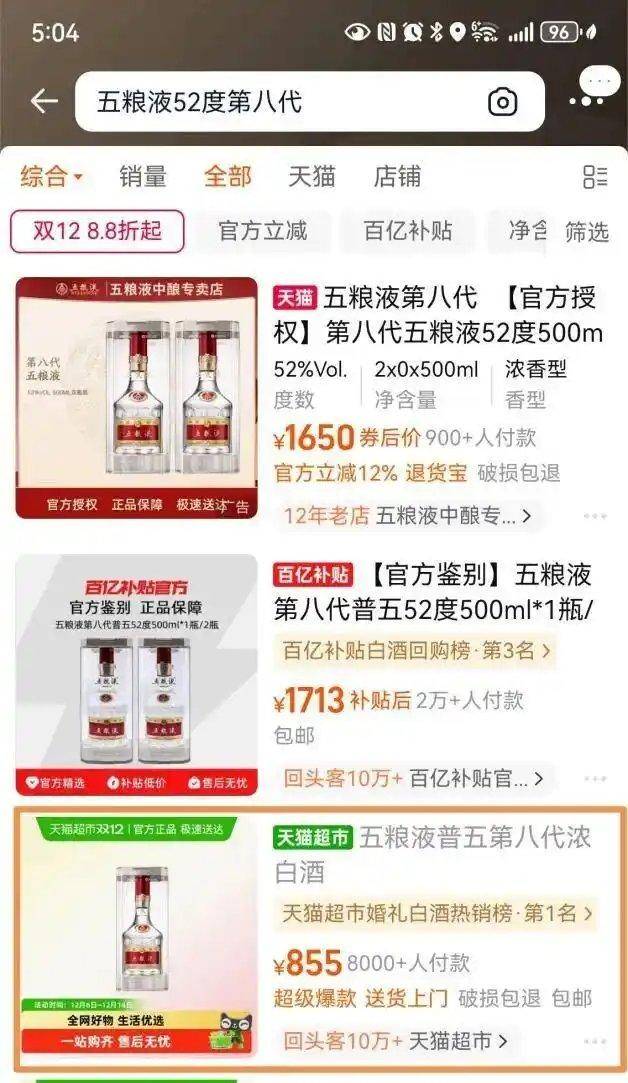
Core Viewpoint - The major price adjustment of the core product, the 52-degree Eighth Generation Wuliangye, has sparked significant market attention, with reports suggesting a price drop to 900 yuan per bottle, although the company clarifies that the factory price remains unchanged at 1019 yuan per bottle, and the perceived price drop is due to subsidy policies [1][3][9]. Price Adjustment Details - Reports indicate that the Eighth Generation Wuliangye's invoice price may drop to 900 yuan per bottle, with potential costs for distributors falling to around 800 yuan per bottle when including various support and rebate policies [1][2][4]. - The company maintains that the factory price of the Eighth Generation Wuliangye has not been adjusted, and the market's perception of a price drop is linked to the implementation of subsidy support policies [3][9]. Market Context - The white liquor industry has experienced a price increase trend from the second half of 2023 to the first half of 2024, with several major brands raising their factory prices, including a notable increase for Wuliangye's Eighth Generation product from 969 yuan to 1019 yuan [8][9]. - The current price drop is viewed as a "structural concession" aimed at alleviating financial and inventory pressures on distributors, allowing them to focus on genuine consumer engagement rather than speculative trading [9][10]. Industry Implications - The adjustment is seen as a strategic move to reward distributors who actively engage with consumers, thereby enhancing the overall consumer experience and driving sales [10]. - Experts in the industry have positively evaluated the decision, suggesting that it could help mitigate financial pressures and redirect resources towards actual consumption [10].
周观点:年底关注渠道反馈,餐供龙头率先复苏-20251207
GOLDEN SUN SECURITIES· 2025-12-07 08:24
Investment Rating - The report maintains an "Increase" rating for the food and beverage industry, indicating a positive outlook for selected stocks and sectors within the industry [4]. Core Insights - The white liquor sector is showing signs of recovery, with Shanxi Fenjiu focusing on national expansion, youth engagement, and internationalization strategies for 2026. The company is optimizing inventory and enhancing market capacity, which is expected to support growth [2]. - In the beverage sector, companies like Nongfu Spring are planning to strengthen their water and tea product lines while introducing new products. The beer segment is diversifying with new flavors to cater to changing consumer preferences [3]. - The report highlights the potential for growth in consumer staples, with companies like Three Squirrels expanding into a full-category strategy and Mengniu Dairy leading in deep processing innovations [7]. Summary by Sections White Liquor - Shanxi Fenjiu's 2026 marketing strategy focuses on nationalization, youth engagement, and precise consumer service. The company is targeting key markets and optimizing inventory to enhance growth potential [2]. - The white liquor industry is characterized by bottoming out in sales, clearing financial reports, and low expectations, suggesting a favorable environment for quality asset allocation [2]. Beer and Beverage - The beer sector is witnessing the launch of new products like Jin Xing Beer’s winter flavor, reflecting a shift in consumption patterns towards home and outdoor settings [3]. - Nongfu Spring's strategy for 2026 includes strengthening its core water products and expanding its tea offerings, indicating a focus on product diversification and market penetration [3]. Consumer Staples - Three Squirrels is advancing its full-category strategy with the opening of flagship stores, emphasizing community engagement and a wide range of products [7]. - Mengniu Dairy is enhancing its product line with deep processing innovations, which are expected to drive demand and improve the utilization of raw milk [7]. - The frozen food sector is recovering, with companies like Anjuke benefiting from new product launches and channel optimizations, indicating a positive market response [7].

第八代五粮液突然降到800多元?公司回应了:是补贴,不是调低出厂价!有酒商称“让消费者喝掉,才是最终目的”
Mei Ri Jing Ji Xin Wen· 2025-12-07 06:32
Core Viewpoint - The major price adjustment of Wuliangye's core product, the 52-degree Eighth Generation Wuliangye, has sparked significant market attention, with reports suggesting a price drop to 900 yuan per bottle, although the company clarifies that the factory price remains unchanged at 1019 yuan per bottle, and the perceived price drop is due to subsidy policies [1][4][10] Pricing and Policy Changes - Wuliangye is reportedly offering a discount of 119 yuan on the factory price, leading to a potential dealer cost as low as 800 yuan per bottle when factoring in additional support and rebates [1][3][5] - The current market prices for the Eighth Generation Wuliangye on platforms like Tmall and JD are between 820 yuan and 850 yuan per bottle, indicating a price inversion phenomenon in the industry [5] Industry Context - The white liquor industry is undergoing structural adjustments, and the pricing strategies of leading companies like Wuliangye can significantly influence the entire sector [3][8] - Other major liquor companies have recently raised their product prices, indicating a trend of price increases across the industry, contrasting with Wuliangye's current strategy [8] Strategic Implications - The pricing and subsidy strategy is viewed as a "structural benefit" aimed at supporting dealers who effectively serve consumers, thereby enhancing the overall consumer experience [8][10] - Historical context shows that previous price adjustments by Wuliangye led to significant revenue declines, but the current market dynamics and company fundamentals differ from a decade ago [9][10]
第八代五粮液开票价被指降至900元/瓶,公司:所谓“降价”为补贴后价格变化;有酒商称“政策设计鼓励喝掉拿全奖,倒手卖的可能没有”
Sou Hu Cai Jing· 2025-12-07 06:21
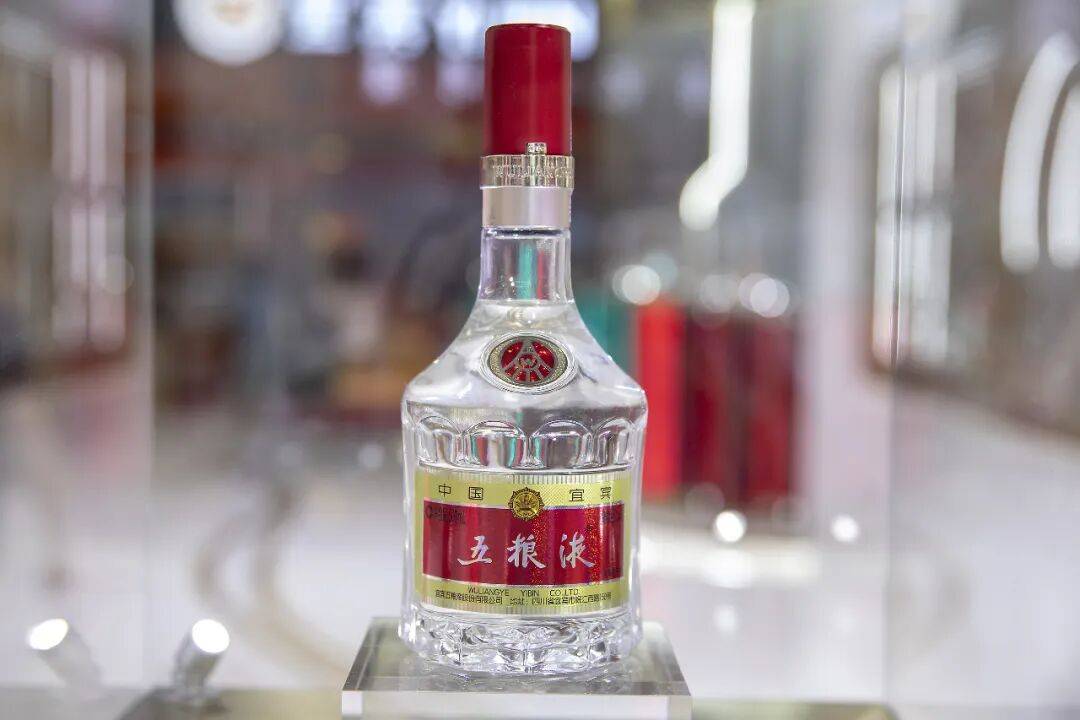
Group 1 - The core point of the article is that Wuliangye (000858.SZ) will adjust the pricing strategy for its eighth-generation product starting next year, maintaining the factory price at 1019 yuan per bottle while offering a discount that brings the effective price down to around 900 yuan per bottle, potentially as low as 800 yuan with additional support policies [1][3][4] - The current phenomenon of price inversion is prevalent in the liquor industry, with online prices for the eighth-generation Wuliangye ranging from 820 to 850 yuan per bottle, including platform subsidies [3] - The liquor industry has experienced a price increase trend from the second half of 2023 to the first half of 2024, with several major brands raising their factory prices, including Moutai and Luzhou Laojiao [3][4] Group 2 - Wuliangye's pricing policy is seen as a practical decision to alleviate financial and inventory pressures on distributors, allowing them to focus on enhancing consumer experiences rather than engaging in price manipulation [4] - Analysts suggest that the liquor industry is at a critical juncture, transitioning into a "cycle bottom" phase, with market sentiment shifting from pessimism to a focus on underlying value [4][5] - Forecasts indicate that the second quarter of 2026 may see stabilization in sales, with a potential turning point in the industry's fundamentals by the third quarter [6]
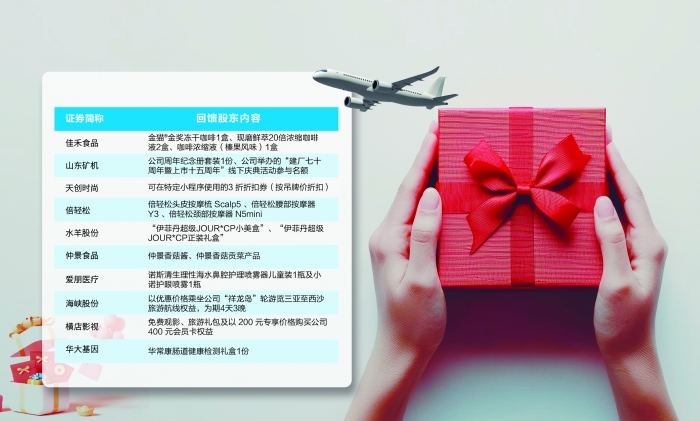
30多家A股公司今年向股东发过产品
Shang Hai Zheng Quan Bao· 2025-12-05 19:08
Core Insights - The trend of "shareholder rewards" has significantly increased in 2025, with over 30 A-share companies participating, marking a nearly 90% growth compared to 18 companies in 2024 [2][3] - The primary sectors driving this trend are food and beverage, tourism services, and other consumer-facing industries, which aim to enhance investor relations and brand influence [2][3][6] Company Activities - Companies like Jiahua Food and Emei Mountain A have initiated various shareholder reward activities, including free product giveaways and exclusive access to services [4][5] - Jiahua Food, for instance, offered free coffee products to shareholders to enhance their understanding of the brand and gather feedback [4] - Emei Mountain A provided free access to scenic spots and discounts at hotels for shareholders, aiming to deepen their connection with the company's offerings [5] Market Reactions - Announcements of shareholder rewards often attract market attention and can lead to short-term stock price increases, as seen with Emei Mountain A and Qianwei Central Kitchen [6][7] - While these events can create temporary trading opportunities, they are not expected to have a lasting impact on the company's overall performance [6][7] Strategic Implications - The shareholder reward activities serve as a novel communication method between companies and shareholders, transforming shareholders into product "experience officers" [6] - Companies aim to strengthen brand recognition and gather genuine user feedback through these initiatives, fostering a more robust investor relationship [6][7]