三生制药

Search documents
年度行情今日收官 十家券商金股组合收益率超百分之五十
Zheng Quan Shi Bao· 2025-12-30 18:19
Core Insights - The article highlights the performance of brokerage firms' recommended stocks, known as "golden stocks," which have achieved over 50% returns in 2025, with some firms excelling by identifying and recommending stocks early in their upward trends [1][3]. Group 1: Performance of Golden Stocks - As of December 29, 2025, 10 brokerage firms' golden stock portfolios recorded returns exceeding 50%, with the highest being 83.73% from Guoyuan Securities [3]. - Other notable performers include Northeast Securities and Kaiyuan Securities, with returns of 67.47% and 67%, respectively [3]. - The golden stock strategy has become a mature business for many brokerage firms, showcasing their research capabilities and market insights [3]. Group 2: Strategies for Success - Early identification of stocks at low prices and consistent recommendations have been key strategies for achieving high returns [4]. - For instance, Kaiyuan Securities recommended Xinyisheng for four consecutive months, resulting in a total increase of 440% from May to August [5]. - Guoyuan Securities focused on sectors like media, pharmaceuticals, and machinery, with significant monthly gains from stocks like Giant Network and JiBit [4]. Group 3: Popularity of Tencent - Tencent Holdings emerged as the most recommended stock, being favored by around seven brokerage firms monthly, making it the top "golden stock" of the year [2][6]. - The popularity of stocks varies by quarter, with technology stocks dominating in the first quarter, consumer stocks in the second, financial stocks in the third, and a return to technology stocks in the fourth quarter [6]. Group 4: Market Trends and Recommendations - The article notes that not all popular stocks achieve high success rates, with less than 40% of the most recommended A-share stocks showing gains in the same month they were recommended [7].








年内最大港股Biotech IPO!港股通创新药ETF(159570)跌超1%再创阶段新低,昨日净流入超1100万元!JPM大会有哪些值得关注?
Xin Lang Cai Jing· 2025-12-30 09:56
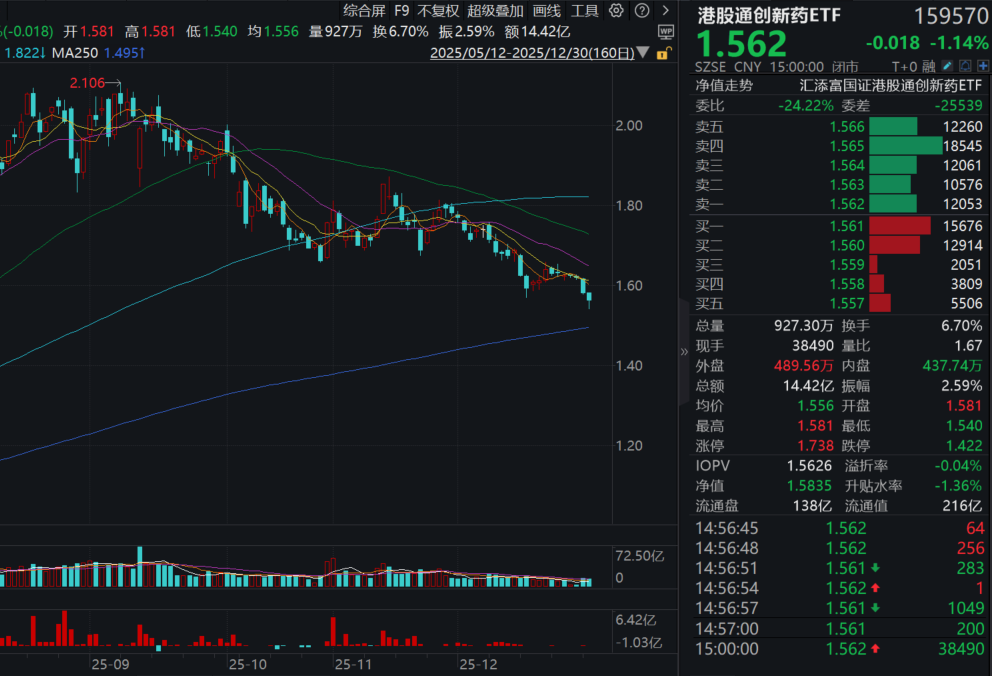
Core Viewpoint - The Hong Kong pharmaceutical market is experiencing a downturn, with the Hong Kong Stock Connect Innovation Drug ETF (159570) declining by 1.14% and over 25% from its previous high, despite a significant trading volume of over 1.44 billion yuan [1][4]. Group 1: Market Performance - The Hong Kong Stock Connect Innovation Drug ETF (159570) has seen a three-day decline, reaching a new low, with a total trading volume exceeding 14.4 billion yuan [1]. - As of December 29, the latest scale of the Hong Kong Stock Connect Innovation Drug ETF (159570) is over 21.9 billion yuan, leading among its peers [1]. - Major stocks within the ETF, such as King’s Bio and Kelun-Bio, have experienced declines, with King’s Bio dropping over 3% [4][5]. Group 2: IPO Activity - On December 30, Insilico Medicine, a generative AI-driven biopharmaceutical company, successfully listed on the Hong Kong Stock Exchange, marking it as the first AI biopharmaceutical company to do so under the main board listing rules [3]. - The IPO raised a total of 2.277 billion Hong Kong dollars, making it the highest fundraising biopharmaceutical IPO in Hong Kong for the year [3]. Group 3: Industry Trends - The upcoming J.P. Morgan Healthcare Conference in January 2026 is expected to attract over 8,000 global participants, featuring more than 500 listed companies and thousands of startups, focusing on "capital + strategy" discussions [6]. - Key trends highlighted for the industry include the continued rise of gene and cell therapies, deep integration of AI in pharmaceuticals, and the emergence of new market forces from China [7]. Group 4: Investment Insights - Multinational corporations (MNCs) are willing to pay higher prices for innovative drugs and technology platforms from China, with average total deals from China reaching 2.756 billion USD compared to 1.289 billion USD from overseas [8]. - The pressure from patent expirations, estimated at around 300 billion USD in sales, is driving MNCs to seek high-potential assets in China, particularly in advanced fields like ADCs and cell therapies [9]. - MNCs are shifting their focus from merely acquiring products to obtaining platforms and technologies that can yield new molecules, indicating a strategic evolution in their investment approach [10]. Group 5: Key Investment Areas - Key investment areas include ADCs, GLP-1 for metabolic diseases, bispecific antibodies, and neuroscience, with a focus on companies that can deliver competitive clinical data and innovative platforms [12][13].
ETF盘中资讯|乐观BD预期退潮?港股通创新药ETF(520880)创5个半月新低!场内延续宽幅溢价,机构:基本面无虞
Jin Rong Jie· 2025-12-30 02:53
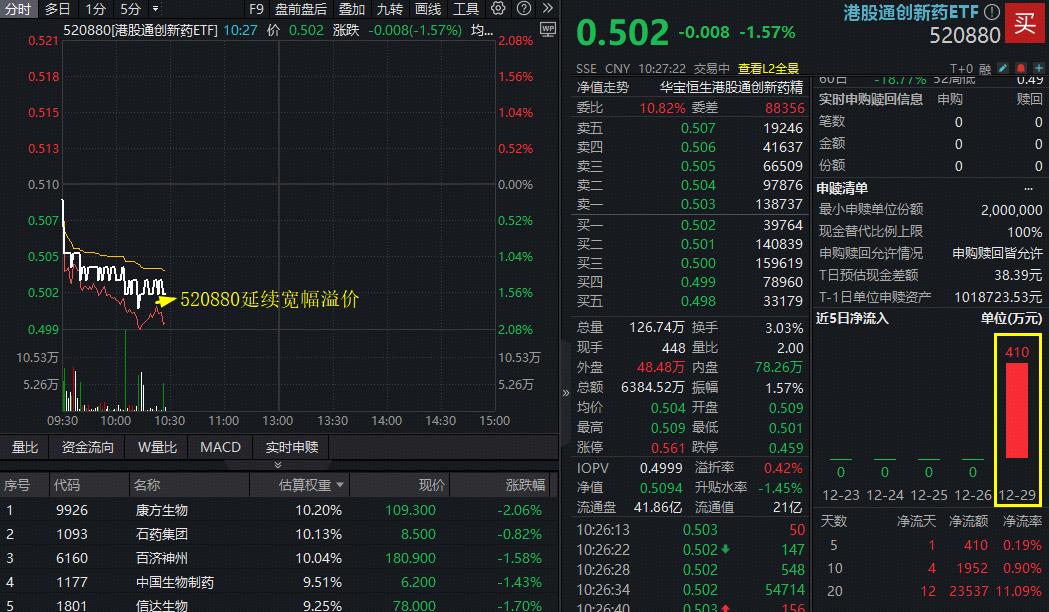
权重龙头股呈普跌态势,康方生物、科伦博泰生物-B跌超2%,百济神州、中国生物制药、信达生物、三生制药等集体跌逾1%。 1、纯粹,全面。不含CXO,纯正创新药!全面覆盖创新药研发类公司。 2、龙头占比大。前十大创新药龙头权重超72%,表征创新药硬核力量。 3、风险更可控。对流动性较差的成份股强制降权,有力管控尾部风险。 | | | 港股通创新药ETF (520880) 标的指数 | | | --- | --- | --- | --- | | | | 前十成份股权重高达72.57%,龙头优势显著 | | | 代码 | 简称 | 权重(%) | 总市值(亿港元) | | 6160.HK | 百济神州 | 11.51 | 3,070 | | 1801.HK | 信达生物 | 10.19 | 1,613 | | 1177.HK | 中国生物制药 | 9.47 | 1,323 | | 9926.HK | 康方生物 | 8.99 | 1,132 | | 1093.HK | 石药集团 | 8.39 | 911 | | 1530.HK | 三生制药 | 8.32 | 760 | | 3692.HK | 翰森制药 | 6.63 ...
乐观BD预期退潮?港股通创新药ETF(520880)创5个半月新低!场内延续宽幅溢价,机构:基本面无虞
Xin Lang Cai Jing· 2025-12-30 02:42
Core Viewpoint - The Hong Kong innovation drug sector continues to adjust, with the Hong Kong Innovation Drug ETF (520880) falling over 1.5%, reaching a new low since July 11, indicating strong buying interest despite the downturn [1][7]. Market Performance - The leading stocks in the sector are experiencing a broad decline, with notable drops including Kangfang Biotech and Kelun-B, both down over 2%, and others like Baijie Shenzhou, China Biopharmaceutical, and Innovent Biologics all falling over 1% [1][8]. - Recent trading data shows that 4.1 million yuan entered the market as investors took advantage of the price drop [1][7]. Sector Analysis - According to Zhongyou Securities, the innovation drug sector is in a continuous correction phase, primarily driven by a retreat from previously optimistic business development (BD) expectations [1][10]. - Despite the downturn, recent clinical data from events like ESMO Asia and ASH conferences have validated the trends for domestic new drugs, aligning with expectations [1][10]. Future Outlook - Looking ahead to 2026, the maturity of clinical data is expected to be a key factor driving the innovation drug market, with BD becoming a necessary outcome of enhanced competitiveness for domestic new drugs [1][10]. - The current adjustment phase, which began in September and has lasted over three months, presents a favorable configuration window for the Hong Kong Innovation Drug sector, with the ETF price nearing its issuance price [1][10]. ETF Characteristics - The Hong Kong Innovation Drug ETF (520880) tracks the Hang Seng Hong Kong Innovation Drug Select Index, which has three unique advantages: it is purely focused on innovative drugs, has a high concentration of leading companies (over 72% in the top ten), and offers better risk control by reducing the weight of less liquid stocks [1][10][11]. - The top ten holdings in the ETF account for 72.57% of the total weight, highlighting the dominance of leading firms in the sector [1][12].
【报告】医药生物行业定期报告:从供需看,中国创新药能从海外分成多少钱?(附下载)
Xin Lang Cai Jing· 2025-12-29 13:40
Group 1: Market Overview - The CITIC Pharmaceutical Index increased by 1.2% during the week of June 3-6, 2025, outperforming the CSI 300 Index by 0.3 percentage points, ranking 16th among CITIC's primary industry classifications [1] - Year-to-date, the CITIC Pharmaceutical and Biotechnology Index has risen by 8.3%, surpassing the CSI 300 Index by 9.9 percentage points, ranking 5th among CITIC's industry classifications [1] - The top five performing stocks for the week included Yiming Pharmaceutical (+33.09%), Wanbangde (+32.59%), Anglikang (+30.28%), Xinnowei (+21.36%), and Haichen Pharmaceutical (+20.93%) [1] Group 2: Patent Cliff and Market Opportunities - By 2037, 27 blockbuster drugs with projected sales exceeding $4 billion in 2024 will face patent expiration, creating a market opportunity of over $240 billion for new entrants [2][12] - China is positioned as a core player in global innovative drug supply, leveraging its technological platforms and research efficiency, with the highest number of clinical pipelines in cell therapy, ADC, and bispecific antibodies [2][21] - The projected revenue from licensing agreements for Chinese projects from 2020 to 2025 is estimated to generate approximately $8.2 billion in net profit, translating to a potential market capitalization increase of $81.7 billion based on a 10x PE ratio [2] Group 3: Investment Recommendations - Focus on authorized blockbuster products with overseas clinical progress, including companies like Kangfang Biotech, Kelun Biotech, and Sanofi [2] - Potentially significant products for licensing out include Innovent Biologics, CSPC Pharmaceutical Group, and Zai Lab [2] - Companies with approved products showing strong commercialization performance include BeiGene, Kingsoft Biotech, and Hutchison China MediTech [2] Group 4: Mid to Long-term Investment Strategy - The investment strategy emphasizes three main lines: innovation, recovery, and policy support [4] - The innovation line focuses on biopharmaceuticals with competitive advantages in international markets and companies with second growth curves in pharmaceuticals [4] - The recovery line anticipates a rebound in medical device tenders and consumer healthcare, while the policy line supports high-dividend companies and encourages mergers and acquisitions [4]



2025年中国医药产业十大谜团
3 6 Ke· 2025-12-29 13:40
Group 1: Industry Overview - The Chinese innovative drug industry is experiencing a significant recovery in 2025, with record high external BD totals and an increase in the number of drug approvals [1][2] - Despite the positive trends, there are concerns about the sustainability of the market, high valuations of some companies, and the potential for structural differentiation in the industry [2][3] Group 2: IPO Market - The IPO market for innovative drug companies has seen a resurgence, with many firms successfully listing on the Hong Kong stock exchange and exceeding fundraising expectations [3][4] - However, the market experienced a downturn in December, with initial public offerings facing challenges such as market sentiment cooling and stricter regulatory scrutiny [4] Group 3: Commercial Insurance and Drug Pricing - The introduction of a commercial insurance directory for innovative drugs aims to address the payment challenges associated with high-priced therapies, with 24 drugs participating in price negotiations [4][5] - The negotiated price reductions for these drugs range from 15% to 50%, but the effectiveness of this new payment model in promoting clinical use remains to be seen [5] Group 4: BD Opportunities and Challenges - The trend of significant BD transactions continues, with companies like 3SBio and Innovent Biologics leading the way, prompting speculation about the next major BD opportunities [6][7] - There is a growing concern about the legal risks associated with BD transactions, as the industry may face an increase in litigation related to these deals [8] Group 5: Future Prospects and Uncertainties - Key questions remain regarding the future of companies like Summit, including potential acquisitions and the performance of their clinical trials [9][10] - The domestic vaccine sector is struggling, with significant declines in stock prices and ongoing challenges related to product differentiation and commercialization [11] - Geopolitical factors continue to pose risks to the innovative drug sector, with ongoing uncertainties regarding regulatory policies and market access [12] Group 6: Unexpected Developments - Some biotech companies have made surprising decisions, such as the acquisition of Lixte Biotechnology by China National Pharmaceutical Group, which deviated from expectations of an independent IPO [13][14] - The sudden dissolution of Run Biotech highlights the high-risk nature of the industry and the challenges of balancing short-term financial returns with long-term innovation [15]

创新药起飞,健康更有保障…… 盘点2025年改写国人健康答案的十大关键词
Mei Ri Jing Ji Xin Wen· 2025-12-29 12:33
Group 1 - The core viewpoint of the article highlights the significant growth and transformation in China's pharmaceutical industry, particularly in the biopharmaceutical sector, with a notable increase in the number of innovative drugs approved for market entry [1][4]. - In 2025, the number of innovative drugs approved in China reached 69, a substantial increase from 48 in the previous year, indicating a surge in innovative research and development [1][4]. - The total amount of external licensing transactions in China's pharmaceutical sector reached $92.03 billion in the first three quarters of 2025, and with additional agreements, it surpassed $100 billion, averaging $270 million per day in international capital investment [4][27]. Group 2 - The government work report in March 2025 emphasized the importance of innovative drugs by introducing the concept of an "innovative drug directory," which supports the development of innovative pharmaceuticals [5][6]. - The rapid approval of two new Alzheimer's drugs in China, namely Donanemab and Lecanemab, reflects the industry's ability to address significant health challenges, with the former being approved just five months after its U.S. approval [8][9]. - The collaboration between 3SBio and Pfizer, amounting to $6.05 billion, marked a significant milestone for Chinese innovative drugs entering international markets [10][11]. Group 3 - The introduction of a 30-day review and approval system for clinical trial applications by the National Medical Products Administration in September 2025 significantly accelerated the drug development process [18][19]. - The clinical data presented by Baillie-Tianheng at the 2025 European Society for Medical Oncology (ESMO) conference showcased impressive efficacy and safety, enhancing China's reputation in the global pharmaceutical arena [20][21]. - The inclusion of the HPV vaccine in the national immunization program signifies a major advancement in public health, particularly for women's health [22][23]. Group 4 - The release of the first version of the commercial health insurance innovative drug directory by the National Healthcare Security Administration aims to enhance the accessibility of innovative drugs through a dual-channel approach of insurance and commercial health coverage [24][25]. - By October 2025, the total amount of external licensing for Chinese innovative drugs exceeded $100 billion, marking a significant shift in the global biopharmaceutical landscape [27][28]. - The article emphasizes the need for Chinese pharmaceutical companies to expand internationally, as the country transitions from being a major raw material supplier to a significant contributor to global innovation [32][33].


医药行业2026年度策略报告:产业趋势明确,创新药产业链是2026年医药板块主线-20251229
HUAXI Securities· 2025-12-29 12:01
Group 1 - The core investment theme for the pharmaceutical sector in 2026 is the innovation drug industry chain, with a clear trend towards international business development and accelerated commercialization of domestic products [2][3]. - The CXO sector is experiencing continuous improvement in performance and orders, supported by favorable financing conditions that benefit the industry's upward trajectory [3]. - The medical device sector is focusing on two main lines: international expansion and innovation [3]. Group 2 - The latest trends in medical insurance show a decline in total expenditure for the first ten months of 2025, amounting to 1,903.6 billion yuan, a year-on-year decrease of 1% [5][7]. - The total income of the medical insurance fund for the same period reached 2,352 billion yuan, with a year-on-year growth of 2%, indicating a slowdown in income growth [7][11]. - The number of medical insurance beneficiaries and hospitalization cases continues to grow, with 6.07 billion total beneficiaries in 2024, a year-on-year increase of 18% [11]. Group 3 - The average medical insurance cost per visit decreased in 2024, with the average cost for employees at 629 yuan (down 10%) and for residents at 351 yuan (down 12%) [15]. - The average hospitalization cost also saw a decline, with employees averaging 11,707 yuan (down 3.8%) and residents at 7,408 yuan (down 3.5%) [15]. Group 4 - The Chinese pharmaceutical industry is witnessing a significant increase in license-out transactions, with over 100 deals completed in 2025, totaling more than 110 billion USD [21][32]. - The number of license-out transactions involving upfront payments exceeding 100 million USD has also risen, indicating a growing interest from global pharmaceutical companies in Chinese innovations [21][32]. - The ADC (Antibody-Drug Conjugate) market is expanding rapidly, with a projected market size exceeding 16 billion USD in 2025, driven by several successful product launches [38]. Group 5 - The Chinese government is actively supporting the innovation drug sector through various policies aimed at enhancing accessibility and encouraging high-quality innovation [16][18]. - The proportion of medical insurance spending on innovative drugs is steadily increasing, with 149 innovative drugs included in the insurance coverage over the past seven years [90][94]. - The average price reduction for innovative drugs during negotiations with the national medical insurance has been around 60%, with some drugs seeing reductions as high as 94% [88][94].


从“借船出海”到“造船远航”:2025药企出海十大关键词
Xi Niu Cai Jing· 2025-12-29 09:34
Core Insights - The article discusses the transformation of Chinese pharmaceutical companies from merely selling products to actively participating in global value chains, with a significant increase in outbound licensing deals reaching over $100 billion by November 2025, a 75% increase year-on-year [3][4]. Group 1: Major Transactions - In 2024, major deals like Hengrui's $5 billion GLP-1 product and a $12.5 billion upfront payment from Pfizer to 3SBio for a dual antibody drug highlight the trend of billion-dollar collaborations becoming standard [4][6]. - Hengrui's partnership with GSK for $12.5 billion includes not only current products but also options for 11 early-stage projects, indicating a shift towards long-term strategic partnerships [4][10]. Group 2: Licensing Strategies - Chinese companies are moving from "one-off sales" to retaining rights in core markets while sharing rights in other regions, allowing them to benefit from both local and global markets [5][6]. - The new strategy involves keeping rights for the Greater China region while sharing development costs and rights for other markets, enhancing long-term revenue potential [6][10]. Group 3: Innovative Drug Categories - Antibody-drug conjugates (ADCs) and dual antibodies are emerging as key areas for Chinese companies, with significant deals reflecting their growing importance in the global market [6][7]. - The shift from traditional cancer drugs to innovative metabolic drugs like GLP-1 is notable, with companies like FOSUN and Hansoh making substantial deals in this area [14][15]. Group 4: Independent Global Expansion - Companies are increasingly opting for "self-driven" global expansion rather than simply licensing out, as seen with Kangfang Biopharma's approach to leading its own global clinical trials [8][9]. - This strategy, while riskier, offers higher potential returns compared to traditional licensing agreements [9]. Group 5: Platform-Based Collaborations - The trend is shifting from selling individual products to offering entire R&D platforms, as demonstrated by Hengrui's collaboration with GSK, which includes options for future projects [10][11]. - This model allows companies to monetize their ongoing research capabilities, enhancing their value proposition to partners [10][11]. Group 6: Regulatory and Pricing Developments - The introduction of a drug pricing registration system by China's National Healthcare Security Administration is expected to alleviate concerns about domestic pricing affecting global pricing strategies [12][13]. - This regulatory change has led to increased foreign investment in Chinese R&D, with a 28% year-on-year growth in 2025 [13]. Group 7: Market Valuation Changes - The market's evaluation criteria for Chinese innovative drug companies have shifted from focusing on generic drug revenues to assessing the value of outbound pipelines and global clinical progress [19][21]. - The average price-to-earnings ratio for innovative drug companies in China has risen significantly, reflecting a revaluation of their market potential [21].


继续推荐创新药械产业链
Haitong Securities International· 2025-12-29 05:01
Investment Rating - The report maintains an "Outperform" rating for several companies in the pharmaceutical sector, including Jiangsu Heng Rui Medicine, Hansoh Pharmaceutical Group, 3SBio, Sichuan Kelun Pharmaceutical, and Jiangsu Nhwa Pharmaceutical [5][6]. Core Insights - The report emphasizes the high prosperity in innovative drugs and continues to recommend companies with promising pipelines and performance growth in the Biopharma/Biotech sector, maintaining an "Outperform" rating for Innovent Biologics, WuXi XDC Cayman, and others [5][23]. - It highlights the performance of the A-Shares pharmaceutical sector, which underperformed the market, with the SW Pharma & Bio index falling by 0.2% while the SHCOMP rose by 1.9% [7][18]. - The report notes that the premium level of the pharmaceutical sector relative to all A-Shares is currently at a normal level of 66.7% as of December 26, 2025 [13][17]. Summary by Sections 1. Continued Recommendation for Innovative Drugs and Industry Chain - The report continues to recommend innovative drugs and the associated industry chain, highlighting the high demand and potential for revaluation in the pharmaceutical sector [5][23]. - Specific companies recommended include Jiangsu Heng Rui Medicine, Hansoh Pharmaceutical Group, 3SBio, Sichuan Kelun Pharmaceutical, and Jiangsu Nhwa Pharmaceutical, all rated as "Outperform" [5][6]. 2. A-Shares Pharmaceutical Sector Performance - In the fourth week of December 2025, the A-Shares pharmaceutical sector underperformed the broader market, with a decline of 0.2% compared to a 1.9% increase in the SHCOMP index [7][18]. - The best-performing sub-sectors included chemical raw materials (+2.0%) and medical equipment (+0.1%), while biological products saw a slight decline of -0.1% [9][18]. 3. Hong Kong and U.S. Market Performance - The Hong Kong pharmaceutical sector also underperformed, with the Hang Seng Healthcare index down by 1.8% and the Hang Seng Biotechnology index down by 2.3% [18]. - In contrast, the U.S. pharmaceutical sector performed similarly to the market, with the S&P Healthcare Select Sector increasing by 1.0% [18].