
华鲁恒升

Search documents
兴证策略:如何看待本轮开门红的结构与延续性?
Xin Lang Cai Jing· 2026-01-11 10:28
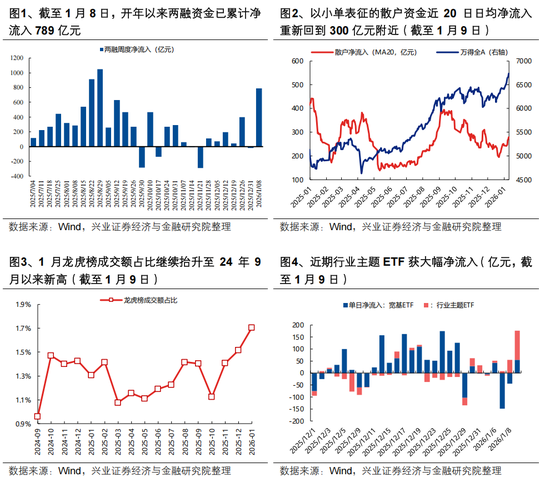
Group 1 - The current market rally, referred to as "开门红," is supported by improving macroeconomic data and ample liquidity, which enhances market risk appetite and attracts new capital inflows [1][9][40] - Various types of trading funds have shown accelerated entry into the market, including a net inflow of 78.9 billion yuan in margin financing since the beginning of the year and an average daily net inflow of retail funds returning to around 30 billion yuan [1][9][40] - The structural consensus among different types of funds is strong, focusing on sectors such as TMT (storage, AI applications), military (commercial aerospace), non-ferrous metals, new energy (controlled nuclear fusion), machinery (robots), and pharmaceuticals (innovative drugs, brain-machine interfaces) [2][35][38] Group 2 - The global stock market is experiencing a strong start in 2026, driven by expectations of loose liquidity, geopolitical changes, and emerging industrial trends, with A-shares reflecting this global narrative [5][38] - Key events such as the International Consumer Electronics Show (CES) and geopolitical developments are catalyzing themes in the market, enhancing the strategic value of resource products and driving structural similarities across global markets [5][38] - The market is currently in a favorable position with limited downside risk and significant potential for upward movement, supported by improved PMI and price data, as well as a high percentage of stocks still below their previous highs [11][44] Group 3 - The recent surge in the commercial aerospace sector has raised concerns about its current crowding and sustainability, with trading volume indicating a potential for further upward movement [16][51] - As the earnings forecast disclosure period approaches, the correlation between stock prices and earnings will increase, necessitating a focus on structural adjustments based on performance [21][57] - Industries with significant upward revisions in profit forecasts since November include technology (consumer electronics, computing), advanced manufacturing (new energy, military), and cyclical sectors (building materials, non-ferrous metals) [26][58]

化工ETF(159870)盘中净申购3.61亿份,12月PPI环比涨幅扩大,连续3个月上涨
Xin Lang Cai Jing· 2026-01-09 06:25
Group 1 - The core viewpoint of the news is that the Producer Price Index (PPI) for industrial products decreased by 1.9% year-on-year in December 2025, with a narrowing decline of 0.3 percentage points compared to the previous month, while showing a month-on-month increase of 0.2%, marking three consecutive months of increase [1] - The PPI's month-on-month growth has expanded, and the year-on-year decline has narrowed, indicating price recovery in industries related to "anti-involution" such as coal, cement, and new energy vehicle manufacturing, with non-ferrous industries continuing to rise due to input factors [1] - As of January 9, 2026, the CSI Sub-Industry Chemical Theme Index (000813) rose by 0.12%, with significant increases in constituent stocks such as Jinfat Technology (600143) up by 9.99% and Xinjubang (300037) up by 4.63% [1] Group 2 - As of December 31, 2025, the top ten weighted stocks in the CSI Sub-Industry Chemical Theme Index (000813) include Wanhua Chemical (600309), Yanhua Co. (000792), and Cangge Mining (000408), with these stocks collectively accounting for 45.31% of the index [2] - The Chemical ETF (159870) closely tracks the CSI Sub-Industry Chemical Theme Index, which consists of seven sub-indices, selecting larger and more liquid listed company securities to reflect the overall performance of the related sub-industries [1][3]
石化ETF(159731)近4个交易日内合计“吸金”超3235万元,资金低位布局特征显著
Sou Hu Cai Jing· 2026-01-09 03:23
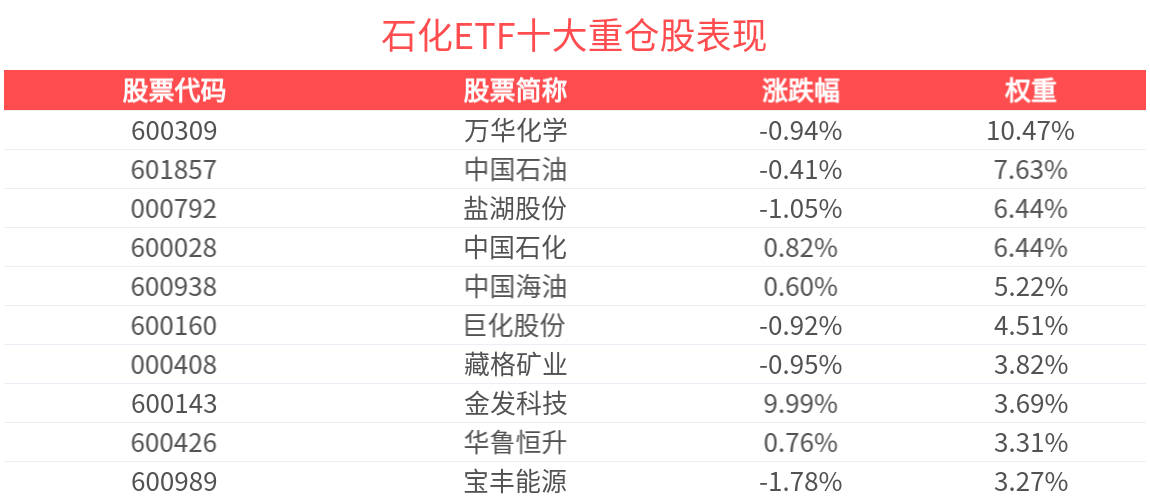
石化ETF(159731),场外联接(华夏中证石化产业ETF发起式联接A:017855;华夏中证石化产业ETF发起式联接C:017856)。 以上内容与数据,与有连云立场无关,不构成投资建议。据此操作,风险自担。 | 股票代码 | 股票简称 | 涨跌幅 | 权重 | | --- | --- | --- | --- | | 600309 | 万华化学 | -0.94% | 10.47% | | 601857 | 中国石油 | -0.41% | 7.63% | | 000792 | 盐湖股份 | -1.05% | 6.44% | | 600028 | 中国石化 | 0.82% | 6.44% | | 600938 | 甲国海海 | 0.60% | 5.22% | | 600160 | 巨化股份 | -0.92% | 4.51% | | 000408 | 藏格矿业 | -0.95% | 3.82% | | 600143 | 金发科技 | 9.99% | 3.69% | | 600426 | 华鲁恒升 | 0.76% | 3.31% | | 600989 | 宝丰能源 | -1.78% | 3.27% | (以上所列 ...






华鲁恒升跌2.02%,成交额1.91亿元,主力资金净流出566.11万元
Xin Lang Zheng Quan· 2026-01-09 02:44
Core Viewpoint - The stock of Hualu Hengsheng has experienced fluctuations, with a recent decline of 2.02%, while the company has shown a year-to-date increase of 3.18% in stock price [1]. Group 1: Stock Performance - As of January 9, Hualu Hengsheng's stock price is 32.43 CNY per share, with a market capitalization of 68.856 billion CNY [1]. - The stock has increased by 3.18% year-to-date, 17.12% over the past 20 days, and 27.42% over the past 60 days [1]. - The trading volume on January 9 was 1.91 billion CNY, with a turnover rate of 0.27% [1]. Group 2: Financial Performance - For the period from January to September 2025, Hualu Hengsheng reported a revenue of 23.552 billion CNY, a year-on-year decrease of 6.46%, and a net profit attributable to shareholders of 2.374 billion CNY, down 22.14% year-on-year [2]. - Cumulative cash dividends since the company's A-share listing amount to 8.965 billion CNY, with 4.775 billion CNY distributed over the past three years [3]. Group 3: Shareholder Information - As of September 30, 2025, the number of shareholders is 44,000, a decrease of 16.59% from the previous period, while the average number of circulating shares per person increased by 19.90% to 48,213 shares [2]. - The top ten circulating shareholders include Hong Kong Central Clearing Limited, which holds 37.98 million shares, a decrease of 38.3747 million shares from the previous period [3].

化工ETF(159870)连续6天净流入,PEEK材料在商业航天/机器人概念催化下领涨
Xin Lang Cai Jing· 2026-01-09 02:40
Group 1 - The core viewpoint of the news highlights the performance of the chemical industry, particularly the active role of PEEK materials in aerospace and lithium battery projects announced by several listed companies in early 2026 [1][2] - The China Securities Subdivision Chemical Industry Theme Index (000813) shows mixed performance among its constituent stocks, with Jinfa Technology (600143) leading with a 9.99% increase, while Luxi Chemical (000830) experienced the largest decline [1] - The chemical ETF (159870) is closely tracking the China Securities Subdivision Chemical Industry Theme Index, which consists of seven sub-indices reflecting the overall performance of listed companies in related sectors [2] Group 2 - PEEK and its carbon fiber reinforced composite materials (CF/PEEK) are crucial in the aerospace sector, replacing metals in aircraft components to significantly reduce weight [1] - Specific applications of PEEK in aerospace include electrical harness clamps in the Airbus A350XWB, turbine engine seals, bearing retainers, and components in fuel systems, showcasing its ability to withstand high temperatures and complex stresses [1] - The top ten weighted stocks in the China Securities Subdivision Chemical Industry Theme Index as of December 31, 2025, include Wanhua Chemical (600309) and Yalv Co. (000792), collectively accounting for 45.31% of the index [2]

化工-关注反内卷低估值龙头及供需边际改善板块
2026-01-08 16:02
Summary of Chemical Industry Conference Call Industry Overview - The chemical industry is currently at the bottom of the economic cycle, influenced by weak global manufacturing PMI and slowing demand growth, leading to weak chemical PPI performance [1][3] - A potential recovery in demand could occur if the Federal Reserve lowers interest rates or if domestic consumption policies are implemented, which would benefit the recovery of chemical PPI [1][4] Key Trends and Changes - The price of oil is lower than that of coal, resulting in a lack of cost support for chemical prices, while domestic real estate and high mortgage rates in the U.S. are suppressing demand [1][5] - If U.S. mortgage rates fall below 4% due to continued rate cuts, overseas real estate may recover, benefiting domestic building materials-related stocks [1][5] - The global chemical industry landscape is changing, with the sales share of European and American countries declining, while China's share has increased significantly, now accounting for nearly half of the global market [1][7] Supply and Demand Dynamics - Domestic fixed asset investment in basic industries like petrochemicals has turned negative year-on-year, indicating a reduction in new investments, which may lead to a recovery in PPI prices when supply becomes insufficient [1][9] - The overall ROE in the chemical industry is low, but many sub-sectors are undervalued. The fourth quarter may see a recovery in PB valuations for leading stocks due to a reversal in the anti-involution trend [1][10] Investment Opportunities - Recommended core assets include Wanhua Chemical and Hualu Hengsheng, both of which have significant market positions and potential for earnings elasticity [3][12] - Specific investment opportunities in sub-sectors include: - **Fertilizers**: Companies like China Heart and International Potash are highlighted due to their growth potential and favorable market conditions [3][15] - **Tires**: Domestic companies are adapting to international trade challenges, with a focus on expanding production for the growing new energy vehicle market [3][16] - **Lubricant Additives**: Ruifeng New Materials is positioned well for growth due to the ongoing reconstruction of international supply chains and domestic substitution trends [3][17] Future Outlook - The overall configuration of the chemical industry is expected to improve, particularly in the petrochemical sector, with a focus on anti-involution strategies as a key investment theme [1][11] - The fourth quarter is anticipated to see an increase in institutional holdings in leading companies, indicating a potential shift in market sentiment [2][10] Conclusion - The chemical industry is at a critical juncture, with potential for recovery driven by macroeconomic factors and strategic investments in undervalued sectors. Continuous monitoring of market dynamics and company performance will be essential for identifying further investment opportunities [1][18]
化工ETF(159870)盘中净申购超3亿份,冲刺连续6日净申购
Xin Lang Cai Jing· 2026-01-08 06:37
Group 1 - The core viewpoint is that recent adjustments in leading chemical companies are considered normal fluctuations, as there were prior expectations of price increases that need time to materialize [1] - The long-term outlook for the chemical industry is positive, with clear supply-demand reversals expected as time progresses, despite short-term disturbances causing volatility [1] - The next two years present good opportunities for investment in cyclical chemical companies during periods of fluctuation or correction [1] Group 2 - As of December 31, 2025, the top ten weighted stocks in the CSI Chemical Industry Theme Index (000813) account for 45.31% of the index, including companies like Wanhua Chemical and Salt Lake Potash [2] - The Chemical ETF (159870) is closely tracking the CSI Chemical Industry Theme Index and has seen significant net subscriptions, indicating strong investor interest [1][2]
化工行业供给侧有望结构性优化,化工ETF嘉实(159129)把握行业新一轮景气周期机遇
Xin Lang Cai Jing· 2026-01-08 02:41
Group 1 - The core viewpoint of the articles indicates a mixed performance in the chemical industry, with the sub-index showing a slight decline while certain stocks experience significant gains [1] - The chemical industry is witnessing a recovery in global manufacturing since Q3 2025, but the PPI for chemical products is weakening year-on-year, indicating a complex demand-side scenario [1] - Domestic real estate is at a cyclical low, while new energy vehicle sales continue to grow, contributing to a stable retail sales growth [1] - China is positioned as a global leader in the chemical industry, with stable production capacity compared to declining utilization rates in the EU [1] - The market is seeing strong performance in sectors like fluorine chemicals and phosphate fertilizers, alongside price increases in niche products driven by accidents [1] - The overall valuation of the basic chemical sector is showing significant recovery [1] Group 2 - The top ten weighted stocks in the chemical sub-index account for 45.31% of the index, with major players including Wanhu Chemical and Salt Lake Shares [2] - The chemical ETF managed by Harvest closely tracks the chemical sub-index, focusing on the new economic cycle under the "anti-involution" policy [2] - Investors can also explore investment opportunities in the chemical sector through the chemical ETF linked fund [3]
2026年度化工策略-新材料大有可为-反内卷-下周期进入右侧
2026-01-08 02:07
Summary of Key Points from the Conference Call Industry Overview - The conference call focuses on the chemical industry, particularly new materials and lithium battery materials, highlighting the potential for growth and cyclical recovery in the sector [1][3][8]. Core Companies and Assets - Key companies mentioned include Wanhua Chemical and Hualu Hengsheng, which are expected to benefit from capacity expansion and favorable pricing trends [1][2][8]. - Wanhua Chemical has a global advantage in MDI and TDI products, while Hualu Hengsheng has cost advantages across multiple products [6][8]. Core Themes and Strategies - The annual strategy is divided into three main lines: 1. **Growth Line**: Focuses on demand-driven sectors such as AI, semiconductor materials, and lithium battery materials [3]. 2. **Cyclical Growth**: Concentrates on midstream core assets with improving supply-demand dynamics [3][8]. 3. **Value Line**: Emphasizes resource products, particularly phosphates and potash [4][10]. Lithium Battery Materials - The lithium battery materials sector is highlighted, with specific attention to lithium hexafluorophosphate, electrolytes, and separators, which are showing upward pricing trends [5][12]. - Phosphate demand from lithium iron phosphate is significant, accounting for approximately 12% of phosphate demand, supporting price increases [5]. Supply-Demand Dynamics - The chemical industry has seen strong performance recently, driven by low profitability, low valuations, and active reallocation of institutional capital [2]. - The "anti-involution" policy is expected to limit new capacity, improving supply-demand relationships, although the fundamental dynamics still depend on actual supply and demand [7][8]. Market Trends and Future Expectations - The organic silicon industry is projected to have limited new capacity in 2026, with a historical compound growth rate of 8-10% over the past 7-8 years, indicating a positive outlook [9][24]. - Key products such as bottles, glyphosate, and PTA are currently in favorable supply-demand conditions, benefiting from the anti-involution policy [10][25]. Investment Recommendations - Recommended investments include leading companies like Wanhua Chemical and Hualu Hengsheng, as well as products benefiting from the new energy boom, such as electronic-grade DMC and oxalic acid [8][27]. - Specific attention is drawn to sectors with high operating rates and favorable supply-demand balances, including spandex, polyester, and organic silicon [19][22][23]. Resource Products - Phosphate and potash companies are highlighted for their growth potential, with phosphate demand expected to outperform potash [11][26]. - Companies involved in phosphate production are projected to see significant volume growth, with valuations around 10-15 times earnings [11]. Conclusion - The chemical industry is positioned for growth, driven by strategic investments in core assets and favorable market dynamics. The focus on midstream assets and resource products presents significant investment opportunities moving forward [1][8][27].
石化化工反内卷稳增长系列之十二:电石、氯碱工业:反内卷加速供给侧出清,龙头竞争力有望提升
EBSCN· 2026-01-07 06:22
Investment Rating - The report maintains an "Overweight" rating for the petrochemical and basic chemical industry [1] Core Insights - The "anti-involution" policy is expected to accelerate the elimination of excess supply in high-energy-consuming industries, enhancing the competitiveness of leading companies in the industry [4] - The Ministry of Industry and Information Technology has introduced a growth plan for the petrochemical and chemical industry, aiming for an average annual growth of over 5% in value-added from 2025 to 2026 [3] - The report highlights that the supply-side reforms in the calcium carbide and chlor-alkali industries are likely to improve industry concentration and overall competitiveness [5][6] Summary by Sections Section 1: Policy Impact - The "anti-involution" policy aims to eliminate outdated production capacity in high-energy-consuming sectors, including calcium carbide and chlor-alkali, which is expected to lead to a healthier industry development [3][4] - The government has set strict controls on new capacity in overproduced sectors, which will facilitate the modernization and large-scale development of production facilities [4] Section 2: Calcium Carbide Industry - The total production capacity of calcium carbide in China is projected to be 41.66 million tons by 2025, a decrease of 7.1% from the peak in 2022 [5] - The apparent consumption of calcium carbide is expected to decline by 6.45% year-on-year in 2025, reaching 24.9 million tons due to weak downstream PVC demand [5] - The introduction of the "anti-involution" policy is anticipated to enhance industry concentration and improve overall market conditions [5] Section 3: Chlor-alkali Industry - The total production capacity of caustic soda is expected to reach 51.66 million tons by the end of 2025, with a year-on-year growth of 2.46% [6] - The industry is currently experiencing a downturn, with a projected single-ton gross profit of 744 yuan, indicating a low level of profitability [6] - The "anti-involution" policy is expected to accelerate the exit of outdated production capacity, leading to improvements in supply-side conditions [6] Section 4: PVC Industry - The apparent consumption of PVC is projected to be approximately 18.66 million tons in 2025, a decrease of 7.1% compared to 2020, primarily due to low demand from the construction and real estate sectors [7] - The total production capacity of PVC is expected to be 30.38 million tons, with a low industry concentration of 26% among the top six companies [7] - Stricter environmental regulations and the "anti-involution" policy are expected to drive structural transformation and upgrade within the industry [7] Section 5: Investment Recommendations - The report suggests focusing on the calcium carbide-chlor-alkali-PVC industry chain, highlighting companies such as Luhua Technology, Chlor-alkali Chemical, and Xinjiang Tianye as potential beneficiaries of the improving supply-demand dynamics [8]