
宝钢股份

Search documents
收盘速递 | 成交额超5亿元,自由现金流ETF(159201)交投活跃,华人健康、亚翔集成涨停
Sou Hu Cai Jing· 2026-01-14 07:35
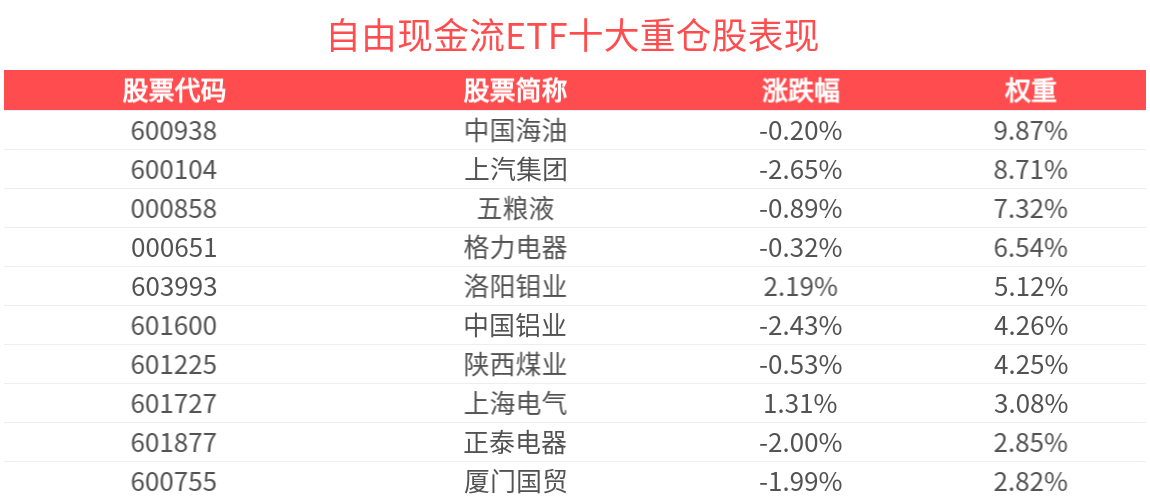
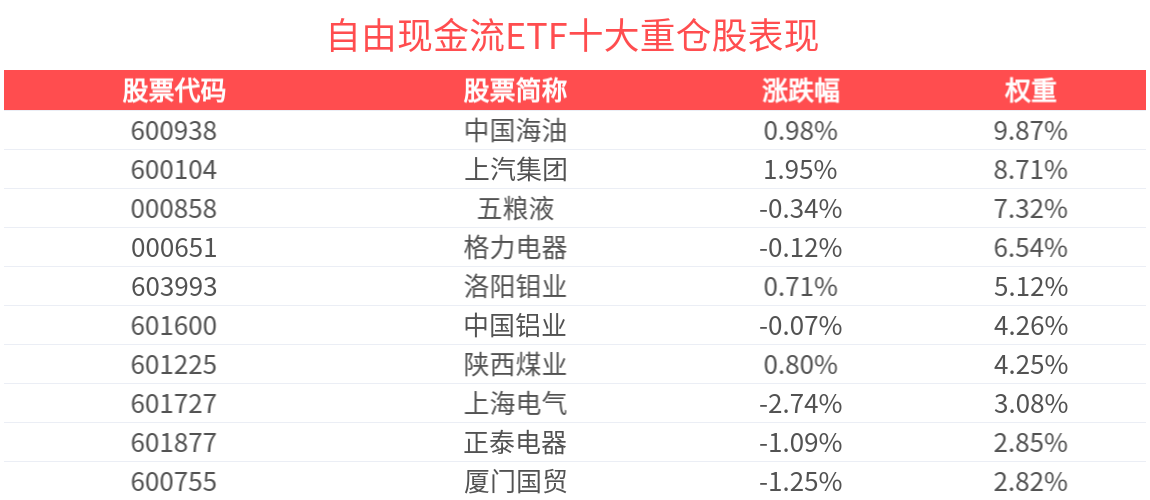
自由现金流ETF紧密跟踪国证自由现金流指数,国证自由现金流指数反映沪深北交易所自由现金流水平较高且稳定性较好的上市公司证券价格变化情况。数 据显示,截至2025年12月31日,国证自由现金流指数前十大权重股分别为中国海油、上汽集团、格力电器、中远海控、中国铝业、宝钢股份、长城汽车、正 泰电器、中国联通、潍柴动力,前十大权重股合计占比51.95%。 | 股票代码 | 股票简称 | 涨跌幅 | 权重 | | --- | --- | --- | --- | | 600938 | 甲国海海 | -0.20% | 9.87% | | 600104 | 上汽集团 | -2.65% | 8.71% | | 000858 | 五粮液 | -0.89% | 7.32% | | 000651 | 格力电器 | -0.32% | 6.54% | | 603993 | 洛阳钼业 | 2.19% | 5.12% | | 601600 | 中国铝业 | -2.43% | 4.26% | | 601225 | 陕西煤业 | -0.53% | 4.25% | | 601727 | 上海电气 | 1.31% | 3.08% | | 60187 ...


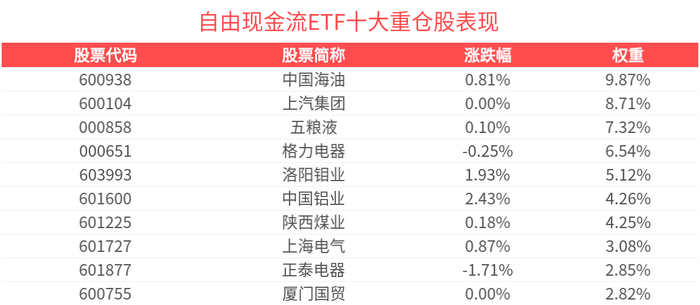
自由现金流ETF(159201)冲击4连涨,最新规模达95.15亿元,创成立以来新高
Xin Lang Cai Jing· 2026-01-14 02:11
Core Viewpoint - The National Index of Free Cash Flow has shown positive performance, with significant increases in both the index and its constituent stocks, indicating strong investor interest and liquidity in the market [1][2]. Group 1: Index Performance - As of January 14, 2026, the National Index of Free Cash Flow rose by 0.39%, with notable increases in constituent stocks such as Huaren Health (+5.40%) and Baijin Nonferrous (+5.34%) [1]. - The Free Cash Flow ETF (159201) has also increased by 0.40%, marking its fourth consecutive rise, with the latest price at 1.26 yuan [1]. - Over the past six months, the net value of the Free Cash Flow ETF has increased by 21.88%, showcasing strong performance [1]. Group 2: Fund Flows and Liquidity - The Free Cash Flow ETF has attracted a total of 1.94 billion yuan in inflows over the last five trading days, indicating robust investor interest [1]. - The latest scale of the Free Cash Flow ETF reached 95.15 billion yuan, a record high since its inception [1]. - The net financing amount for the Free Cash Flow ETF was 4.2543 million yuan, with a total financing balance of 10.2 million yuan [1]. Group 3: Historical Performance Metrics - The Free Cash Flow ETF has recorded a maximum monthly return of 7% since its inception, with the longest consecutive monthly gains reaching six months and a maximum cumulative increase of 22.69% [1]. - The ETF has an 80% monthly profit percentage and a 79.70% probability of monthly profitability, with a 100% historical probability of profitability over a six-month holding period [1]. Group 4: Top Constituent Stocks - As of December 31, 2025, the top ten weighted stocks in the National Index of Free Cash Flow include China National Offshore Oil Corporation, SAIC Motor, and Gree Electric Appliances, collectively accounting for 51.95% of the index [2].
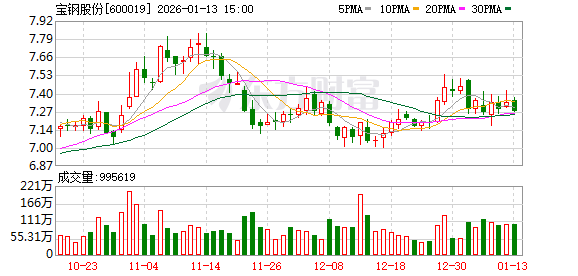
宝钢股份以AI赋能钢铁行业 大模型让高炉更“聪明”
Ren Min Ri Bao· 2026-01-13 22:01
Core Insights - The core focus of the articles is on Baosteel's collaboration with Huawei to implement AI technologies in the steel production process, particularly in blast furnace operations, to enhance efficiency and reduce costs [2][3][4]. Group 1: AI Implementation in Steel Production - Baosteel's blast furnace accounts for approximately 70% of production costs, making its stable operation crucial for profitability [2]. - The introduction of AI technology aims to address challenges such as unclear furnace conditions and slow operational feedback, transforming expert experience into data-driven solutions [2][3]. - The AI model developed has achieved a 90% accuracy rate in predicting key indicators like furnace temperature, leading to reduced fuel consumption and improved iron quality [3]. Group 2: Model Development and Optimization - The AI model is based on Huawei's Pangu model, which integrates general knowledge with specific characteristics of blast furnace operations [3]. - Baosteel has implemented a "pre-trained base + downstream task fine-tuning" approach to shorten the model development cycle for different furnaces [3]. - A closed-loop system has been established for continuous learning and optimization, allowing the model to adapt and improve based on new data [3]. Group 3: Broader AI Applications in Steel Production - China Baowu Steel Group is planning to expand AI capabilities across various steel production processes, including raw material handling and quality analysis [4]. - Baosteel has successfully deployed nearly 300 AI applications by 2025, establishing five benchmark production lines that integrate metallurgical principles with AI technology [5]. - The integration of AI in traditional manufacturing has become a key factor for Baosteel's growth, providing new pathways for cost reduction and efficiency improvement in the steel industry [5].

中国基础材料:2026 年的遗漏与展望-China Basic Materials_ What was missed and what to look forward to in 2026
2026-01-13 11:56
Summary of Key Points from the Conference Call Industry Overview - The focus is on the **Basic Materials** sector in China, with a preference order for 2026 being **copper/gold > aluminum > lithium > coal > steel** [2][4] - The **MSCI China Materials** index is expected to outperform the **MSCI China** index by **3%** in the first week of January 2026, driven by supply disruptions and mergers and acquisitions [2][4] Company-Specific Insights - **Zijin Mining** is highlighted as the top pick for 2026, with a positive profit alert projecting a **2025 net profit** of **RMB 51-52 billion**, representing a **59-62% YoY increase** [4][9] - **Jiangxi Copper (JXC)** has been upgraded to Neutral (N) due to a positive outlook on copper, despite a recent **40%+ share price surge** that has factored in the acquisition of SolGold [2][5] - **Baosteel** and **Angang Steel** have been downgraded to Neutral (N) and Underweight (UW) respectively, due to low steel margins and weaker-than-expected anti-involution efforts [2][5] Market Dynamics - Supply disruptions are expected to continue, with **South32** placing its **Mozal Aluminum smelter** on care and maintenance in March 2026, and a strike at **Capstone Copper's Mantoverde** mine expected to reduce copper supply by **77kt** [4][9] - The **Chinese base metal demand growth** is forecasted to slow to **2.5%** for copper and **1.5%** for aluminum YoY [4][9] Earnings Forecasts - **4Q25 earnings** for steel companies are projected to be the weakest, with **Angang** and **Baosteel** expected to see earnings declines of **86%** and **33%** respectively [4][11] - **Zijin** and **CMOC** are expected to report solid growth, with **CMOC** anticipated to announce a positive profit alert with a **53% YoY increase** [4][11] Stock Recommendations - **Bullish on copper** and **bearish on steel**; **Zijin** remains the top pick for its copper/gold exposure [5][11] - **Hongqiao** and **Chalco** are recommended as buyers on dips due to the positive correlation between aluminum and copper prices [5][11] Regulatory and Policy Impacts - The **Ministry of Commerce** reinstated steel export licensing from January 1, 2026, which may lead to increased near-term exports and keep global prices under pressure [9] - Regulatory uncertainties in lithium mining rights are highlighted, particularly with the cancellation of mining rights affecting **Tianqi** and **Ganfeng** [9] Commodity Price Forecasts - **Copper prices** are forecasted to reach **$12,000/ton** in 1Q26, while **aluminum prices** are expected to stabilize around **$3,000/ton** [12][14] - **Lithium prices** are projected to increase significantly, with battery-grade lithium expected to reach **$17,500/ton** by 2026 [14] Conclusion - The Basic Materials sector in China is poised for a challenging yet opportunistic year in 2026, with significant variations in performance across different commodities and companies. The focus on supply dynamics, regulatory impacts, and strategic acquisitions will be crucial for investors navigating this landscape.


打造世界级标杆!“领航级”工厂如何实现“领跑”中国智造?
Yang Shi Wang· 2026-01-13 08:42
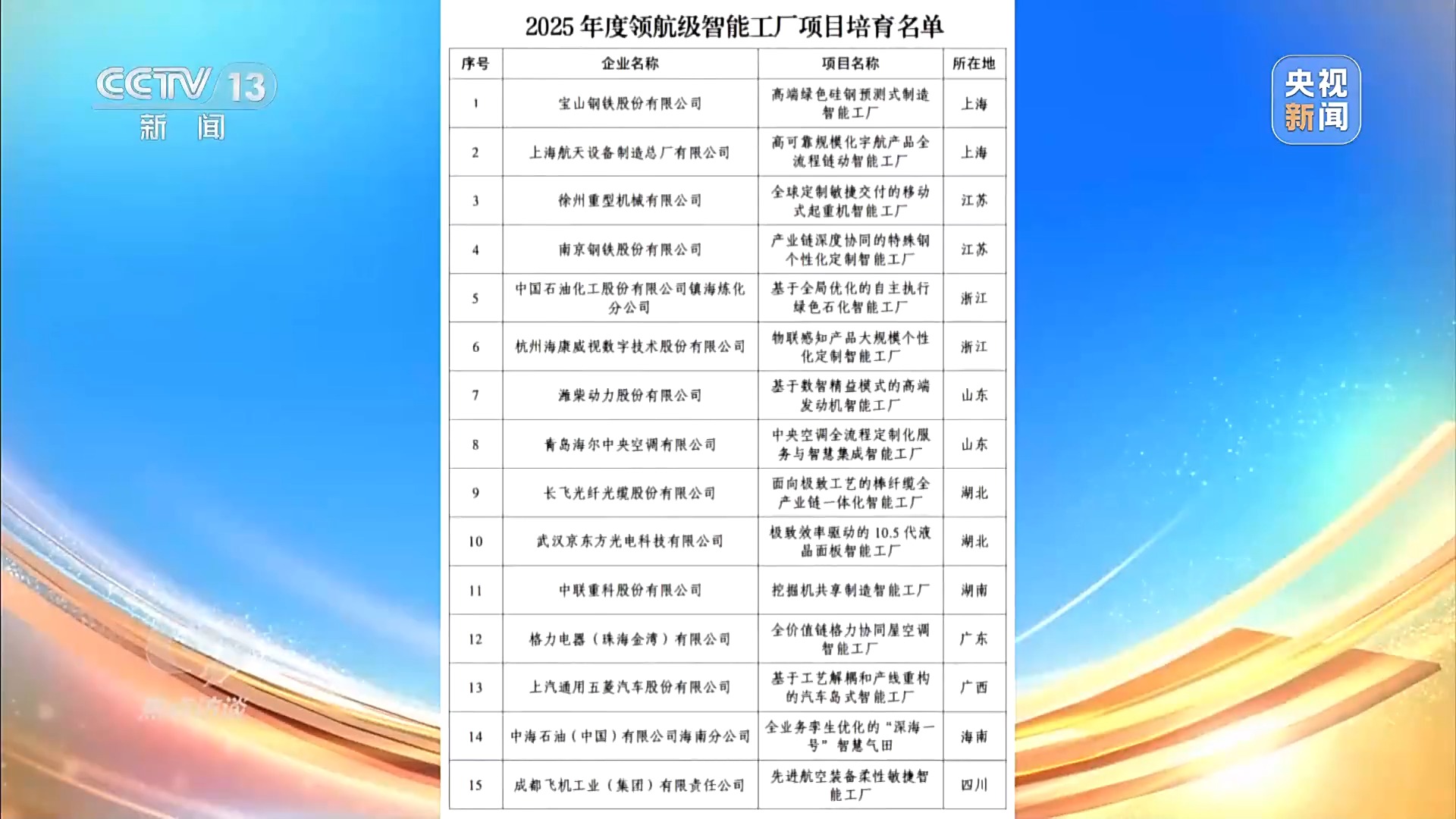
Core Viewpoint - "Smart" manufacturing is the core engine for high-quality development in the manufacturing industry, marking a critical leap from digitalization and networking to intelligence in China's manufacturing sector [1][3]. Group 1: Overview of Leading Smart Factories - The Ministry of Industry and Information Technology and five other departments announced the first batch of 15 leading smart factories, covering key industries such as equipment manufacturing, raw materials, and electronic information [1][2]. - These factories represent the highest level of "intelligent" manufacturing in China and signify a transition towards a more advanced manufacturing model [1][3]. Group 2: Characteristics of Leading Smart Factories - Leading smart factories are characterized by the integration of advanced manufacturing technologies, next-generation information technologies, and lean management concepts, forming the pinnacle of China's manufacturing intelligence pyramid [3][5]. - They aim to be "hexagonal warriors" with six leading identities, focusing on industry, application of AI technology, innovation in smart manufacturing models, performance, replication, and cultivation plans [5]. Group 3: Notable Examples - Changfei Fiber Optic, recognized as a benchmark for intelligent transformation in the electronic information sector, has integrated AI algorithms throughout its production process, achieving a drawing speed of 3,500 meters per minute, the highest globally, without human intervention [7]. - The company has mastered three major mainstream technologies for fiber optic preform preparation, leading to the largest diameter of preforms globally and maintaining the top market share in the fiber optic industry for nine consecutive years [7]. Group 4: Strategic Alignment - The development of leading smart factories aligns with the "14th Five-Year Plan" for intelligent manufacturing and the "15th Five-Year Plan" for building a modern industrial system centered on advanced manufacturing [5][9]. - These factories facilitate collaborative innovation across the industry chain, connecting with national strategic deployments such as "Artificial Intelligence+" and promoting the replication of successful models [9].
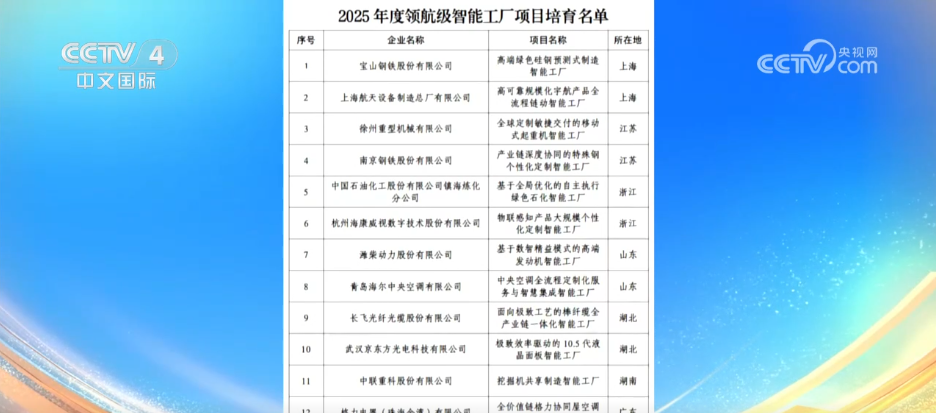
瞄准全球领先、深化AI融合,领航级工厂领跑中国“智造”
Bei Jing Wan Bao· 2026-01-13 06:16
Core Viewpoint - Smart manufacturing is the core engine for high-quality development in the manufacturing industry, marking a critical leap from digitalization and networking to intelligence in China's manufacturing sector [1][5]. Group 1: Overview of Leading Smart Factories - The Ministry of Industry and Information Technology and five other departments announced the first batch of 15 leading smart factories, covering key industries such as equipment manufacturing, raw materials, and electronic information [1][4]. - These leading factories represent the highest level of smart manufacturing in China and showcase the breadth and depth of the country's intelligent manufacturing development [4][5]. Group 2: Classification and Development of Smart Factories - A four-tier system for smart factory cultivation has been established: foundational, advanced, excellent, and leading levels, with 35,000 foundational, over 7,300 advanced, 500 excellent, and 15 leading smart factories built to date [7]. - The leading level aims for global leadership and deep integration of AI, while the excellent level requires at least 20% AI application scenarios [7]. Group 3: Key Elements for Leading Smart Factories - Six key elements define a leading smart factory: industry leadership, AI technology application, innovative smart manufacturing models, performance leadership, replication leadership, and nurturing plans [10][12]. - Longfei Optical Fiber exemplifies these elements by integrating AI throughout its production process, achieving a global record in fiber drawing speed and precision [12][13]. Group 4: Case Studies of Leading Smart Factories - Weichai Power has implemented a digital twin technology that reduces R&D cycles by 20% and enhances production flexibility through AI-driven systems [20][21]. - Baosteel is innovating with AI-driven predictive manufacturing, aiming to establish 1,200 AI scenarios and 25 benchmark production lines by 2027, while also investing in talent development [25][27]. Group 5: Future Manufacturing Models - The exploration of future manufacturing models focuses on high customization, complex product production, and efficient supply chain organization, aiming to enhance China's position in the global supply chain [17][29]. - The emergence of these leading smart factories not only represents individual breakthroughs but also reflects a systemic transformation in China's manufacturing industry, providing replicable and scalable models for industry upgrades [29].
建信期货钢材日评-20260113
Jian Xin Qi Huo· 2026-01-13 02:24
Report Summary 1. Report Industry Investment Rating No information provided. 2. Core Viewpoints - On January 12, the main contracts of rebar and hot-rolled coil futures 2605 oscillated and rebounded, recovering most of the previous day's losses. The steel price is expected to be volatile and bullish in the future, and it is advisable to try to buy for hedging or investment at low prices [5][9]. 3. Summary by Directory 3.1 Market Review - **Futures Market**: On January 12, the main contracts of rebar and hot-rolled coil futures 2605 oscillated and rebounded. The closing prices of RB2605, HC2605, and SS2603 increased by 0.60%, 0.55%, and 1.21% respectively. The trading volume and open interest of each contract also changed to some extent [5]. - **Spot Market**: On January 12, the prices of individual rebar spot markets fluctuated, and the prices of a small number of hot-rolled coil spot markets rebounded. The price of rebar in Hangzhou market rose by 20 yuan/ton, while that in Zhengzhou market fell by 10 yuan/ton. The prices of hot-rolled coils in Shanghai, Hangzhou, and other markets rose by 10 yuan/ton [7]. 3.2 Technical Analysis - The daily KDJ indicator of the rebar 2605 contract changed from a weak dead cross to a weak golden cross, and the daily KDJ indicator of the hot-rolled coil 2605 contract rose. The daily MACD red bars of the rebar and hot-rolled coil 2605 contracts turned slightly larger [7]. 3.3 Market Outlook - **Message**: Geopolitical turmoil has caused the prices of precious metals and some non-ferrous metal commodities to rise significantly and then fall back. Rebar, hot-rolled coil, coke, and coking coal futures in the black series have become hedging chips, but smart funds have begun to lay out medium- and long-term positions [8][9]. - **Fundamentals**: The output of the five major steel products has increased for two consecutive weeks, but the demand has significantly shrunk to the lowest level since mid-October last year and late February last year. Due to the weekly supply exceeding demand, the social inventory has rebounded from the lowest level since late January last year. The cost of steel still has strong support [9]. 3.4 Industry News - Baosteel Zhanjiang Iron and Steel's No. 5 heavy slab continuous caster was fully completed and put into operation on January 9. - Honglu Steel Structure's cumulative new sales contract amount in 2025 was about 29.102 billion yuan, a year-on-year increase of 2.84%, and the steel structure product output was about 5.0207 million tons, a year-on-year increase of 11.30%. - Tangshan Port expects to complete a total cargo throughput of 242 million tons in 2025, a year-on-year increase of 4.1%. - Fushun Special Steel completed the absorption and merger of its wholly-owned subsidiary Xinxing Plate. - Xinji Energy's preliminary estimated operating income in 2025 was 12.343 billion yuan, a year-on-year decrease of 3.02%. - Huayang Co., Ltd. stated that coal prices are affected by multiple factors and are volatile. - Jiangsu Province plans to arrange 670 major provincial projects in 2026, with an annual planned investment of 664.6 billion yuan. - Guangxi's 2026 annual long-term agreement transaction was successfully concluded, with a cumulative transaction electricity volume of 66.534 billion kilowatt-hours. - Mongolia's coal exports in 2025 reached 89.7093 million tons, a year-on-year increase of 7.11%. - Australia's coal export value in November 2025 was 5.644 billion Australian dollars, a month-on-month increase of 2.81%. - JSW Steel's crude steel output in the third quarter of fiscal year 2026 (October - December 2025) reached 7.48 million tons, a year-on-year increase of 6%. - India's coal production in December 2025 was 101 million tons, a year-on-year increase of 3.66% [10][11]. 3.5 Data Overview - The report presents multiple charts, including the social inventory of rebar and hot-rolled coil in major cities, the spot prices of rebar and hot-rolled coil in major markets, the weekly output of the five major steel products, the inventory of steel mills, the blast furnace opening rate, the electric furnace opening rate, the national daily average hot metal output, the apparent consumption of the five major steel products, and the basis between Shanghai rebar and hot-rolled coil spot and May contracts [13][14][32].
自由现金流ETF(159201)近8天获得连续资金净流入,合计“吸金”8.64亿元
Sou Hu Cai Jing· 2026-01-13 02:00
Core Viewpoint - The National Index of Free Cash Flow has shown positive performance, with significant increases in both the index and its constituent stocks, indicating a strong market interest in companies with high and stable free cash flow [1][2]. Group 1: Index Performance - As of January 13, 2026, the National Index of Free Cash Flow increased by 0.09%, with notable gains from constituent stocks such as Yaxiang Integration (+7.06%) and Hailide (+4.49%) [1]. - The Free Cash Flow ETF (159201) has seen a recent price of 1.25 yuan, with a weekly average trading volume of 4.57 billion yuan [1]. - Over the past eight days, the Free Cash Flow ETF has attracted a total net inflow of 864 million yuan, reaching a new high in both share count (7.586 billion shares) and total size (9.484 billion yuan) since its inception [1]. Group 2: Historical Performance - The Free Cash Flow ETF has recorded a net value increase of 21.11% over the past six months, with a maximum monthly return of 7% and a longest consecutive monthly gain of 6 months [2]. - The ETF has an 80% monthly profit percentage and a 79.6% probability of monthly profitability, with a historical 100% profitability rate for holding periods of six months [2]. - The top ten weighted stocks in the National Index of Free Cash Flow, which include China National Offshore Oil Corporation and SAIC Motor, account for 51.95% of the index [2]. Group 3: Component Stocks - The top ten constituent stocks of the index include companies like Gree Electric and China Aluminum, with varying weightings and recent performance metrics [4]. - The management fee for the Free Cash Flow ETF is set at 0.15%, while the custody fee is 0.05%, making it a cost-effective investment option [4].
工信部工业互联网试点示范项目 武汉企业智慧平台“守护”宝武全国42个基地
Chang Jiang Ri Bao· 2026-01-13 01:06
不久前,监控平台发现某厂炼钢转炉水冷氧枪冷却水进水流量低预警,经现场排查系水 冷氧枪堵塞导致进水流量不足。宝武安全生产重大风险监控中心负责人说,"平台能监测、 会预警,帮助各单位发现、排查事故隐患,及时落实处置"。 除监测指标实时预警之外,平台还具有预警回顾、风险点预警及评估排行榜、督办等功 能。中钢安环院技术专家表示,预警超过一定时间还未处置的,上级安全生产监管人员可利 用督办功能下发专项督办,督促基地及时完成事故隐患的整改。风险评估排行榜,可清楚了 解风险值较高的风险点,溯源查看风险各因子的情况,便于有针对性地采取管控措施。 日前,青山区宝武安全生产重大风险监控中心,一条黄色风险预警信息在整面墙大小的 电子屏上闪烁,距武汉千里之外的宝武集团某生产基地,高炉煤气柜活塞上部一氧化碳浓度 超报警值,现场工作人员迅速赶往现场完成处置,屏幕上风险预警提示解除。 "红、橙、黄、蓝不同颜色代表不同预警等级,红色为最高等级,信息直接连通宝武集 团总部。"宝武安全生产重大风险监控中心工作人员介绍,预警信息根据预警等级和持续预 警时长逐级上报,基地根据预警信息进行处置,上报处置结果。 这套智慧安全风险管控平台由中钢武汉安全环 ...
产业期待焦煤期权为经营添底气
Qi Huo Ri Bao· 2026-01-13 00:34
Core Insights - The upcoming launch of coking coal options on January 16 is expected to enhance risk management for enterprises in the coal, coke, and steel industry chain, addressing the need for more sophisticated risk management tools in a volatile market environment [1][4] Group 1: Industry Challenges - Shanxi's coal and coke enterprises are facing intensified price fluctuations and heightened competition, driving the need for financial tools to manage these challenges [2] - Companies like Shanxi Yaxin Energy Group consume nearly 5 million tons of coking coal annually, making procurement price and timing critical to profit margins [2] - The mixed-ownership Shanxi Kaijia Energy Group sells 10 million tons of coking coal annually but relies heavily on external sourcing, making them vulnerable to cost fluctuations and pricing delays [2] Group 2: Adoption of Financial Tools - Shanxi enterprises have proactively integrated futures and other financial tools into their operational strategies, transitioning from mere experimentation to value creation [3] - Shanxi Yaxin Energy Group has established a dedicated subsidiary for futures, using data to guide procurement negotiations and manage inventory risks [3] - Zhongyang Zhixu's designation as a delivery warehouse for coking coal has significantly increased its delivery volume, indicating the importance of futures in stabilizing operations [3] Group 3: Limitations of Futures - As market conditions become more complex, futures alone cannot fully address the nuanced risk management needs of enterprises, particularly in extreme market scenarios [4][5] - The pressure on cash flow during volatile market conditions has highlighted the limitations of futures, necessitating the introduction of options for more flexible risk management [5] Group 4: Strategic Integration of Options - The introduction of coking coal options is seen as a crucial step in enhancing the risk management toolkit for enterprises, allowing for a more comprehensive approach to managing price volatility [5][6] - Companies plan to utilize a combination of futures and options to create a robust risk management framework, with options providing a flexible and cost-effective means to hedge against price fluctuations [6][7] - Shanxi Kaijia Group aims to implement a comprehensive risk management system that integrates procurement, production, and sales with futures and options to enhance operational resilience [7] Group 5: Future Outlook - The launch of coking coal options is expected to contribute to a more resilient and dynamic coal, coke, and steel industry chain, facilitating high-quality development across the sector [7]